

GCSE Geography Study Group: Make It Actually Work
GCSE geography study group advice for choosing members, planning focused sessions, testing recall and stopping your group chat wasting revision time.
A study-group chat can look productive for weeks without producing a single hour of revision. Someone suggests meeting. Three people react with a thumbs-up. Nobody chooses a time. By Friday, the conversation has somehow moved to what everyone is having for dinner.
A GCSE geography study group works only when it has a small membership, a fixed meeting time, a specific agenda and individual accountability. Its purpose is not to make revision more sociable. Its purpose is to help each person recall knowledge, explain geographical processes, analyse unfamiliar information and improve exam answers.
That distinction matters. Friendship may bring the group together, but structure is what makes the meeting useful.
Your study group checklist
Before the first session, agree on these essentials:
- three or four reliable members
- the same exam board and specification
- a regular time and quiet location
- one topic or paper section per meeting
- an agenda shared beforehand
- individual questions completed before discussion
- a short test at the beginning and end
- an error log for weaknesses and next actions
- a firm finish time
If the group cannot agree on those points, it is still a group chat rather than a revision system.
Choose members for reliability, not just friendship
The best person to revise with is not automatically your closest friend. It is the person who arrives prepared, admits when they do not understand something and can disagree without turning the discussion into an argument.
A practical group usually contains three or four students. Two people can work well, but one absence cancels the session. A much larger group creates more opportunities for side conversations and makes it easier for quiet members to disappear.
Look for complementary strengths. One person might remember case-study detail, another may interpret maps confidently, while someone else may structure extended responses clearly. Different strengths are valuable because teaching an idea exposes whether you genuinely understand it.
However, everyone should follow the same GCSE Geography specification. AQA, Edexcel, OCR and Eduqas organise content and assessment differently. Do not assume that a topic title, case study or paper structure transfers perfectly between boards. Check your specification and ask your teacher when uncertain.
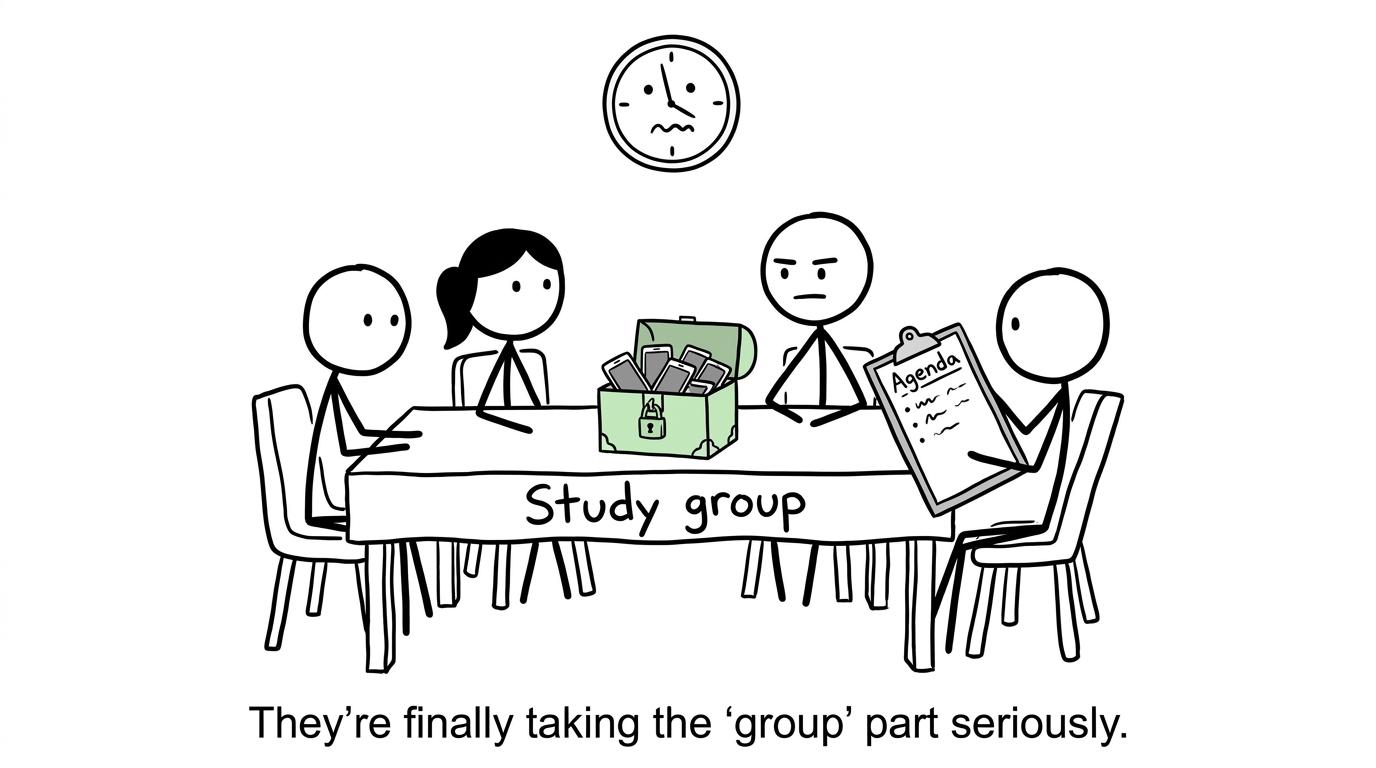 A study group protects its agenda from the group chat
Turn the group chat into a meeting
A useful chat has only a few jobs:
- confirm the next meeting
- share the agenda and resources
- record assigned preparation
- post a brief summary afterwards
It should not be the main place where revision happens. Notifications encourage fragmented attention, and long message threads make it difficult to see what has actually been decided.
Set the next meeting before the current one ends. Use a repeated day, time and location if possible. “Thursday after school in the library” is a plan. “Shall we meet sometime this week?” is a hope.
You may also want a simple cancellation rule. If someone cannot attend, they tell the group early and complete the task independently. That prevents one absence from collapsing everybody else's routine.
Students balancing several subjects can use the principles in the GCSE maths revision timetable to protect realistic revision blocks rather than filling every evening.
Give every meeting a clear output
“Revise rivers” is too vague. A useful target describes what members will produce or be able to do by the end.
Better outcomes include:
- recall the causes, effects and responses for one named hazard
- compare two management strategies using evidence
- annotate a drainage-basin diagram from memory
- evaluate the reliability of a fieldwork method
- complete and mark one timed extended-response question
- interpret an unfamiliar graph, photograph or map
This keeps the session aligned with what GCSE Geography assessments require: knowledge, understanding, application, analysis, evaluation and geographical skills. Official specifications also include quantitative and statistical techniques, so data handling should not be treated as an optional extra.
For students preparing for maths alongside geography, the GCSE Maths Topics by Exam Board and Tier guide helps identify transferable skills such as percentages, averages, ratio, scale, graphs and statistics.
Use a repeatable meeting structure
A predictable format removes the need to negotiate every session. For a meeting lasting about one hour, use this structure:
| Stage | Purpose |
|---|---|
| Opening recall | Answer short questions without notes |
| Main task | Tackle the agreed topic, data set or exam question |
| Peer explanation | Explain reasoning and challenge unclear claims |
| Mark and diagnose | Use the mark scheme or teacher guidance |
| Exit check | Retest key knowledge and choose the next action |
Begin with retrieval, not rereading
Start with closed books. Each member should answer several short questions from the previous meeting or write everything they can recall about the selected topic.
This feels harder than highlighting notes because it reveals gaps. That is precisely why it is useful. Revision should show you what cannot yet be retrieved, not merely make familiar pages feel comfortable.
Keep the atmosphere low stakes. The opening test is diagnostic, not a competition. Record missing knowledge, correct it and return to it in a later session.
Make everyone think before anyone speaks
For an exam question, graph or fieldwork prompt, give everyone quiet thinking time first. If the most confident student answers immediately, other members can mistake recognition for understanding.
After individual thinking, compare responses. Ask:
- What evidence supports that statement?
- Which geographical process explains it?
- Does the answer address the command word?
- Is the judgement balanced and justified?
- What would the mark scheme need to see?
The aim is not to produce four identical answers. It is to identify which features make an answer precise and defensible.
Finish with individual accountability
Every meeting should end with something each student completes alone. This might be a short quiz, a paragraph plan or an explanation recorded without notes.
Then agree on one action before the next meeting. “Revise coasts” is too broad. “Learn the sequence of erosion processes and answer the assigned questions” is observable.
Educational evidence on metacognition emphasises planning, monitoring and evaluating learning. A group can support all three, but only if members identify what they know, inspect their performance and alter the next session accordingly.
Rotate roles without creating unnecessary admin
Roles prevent one student from becoming the permanent teacher while everyone else watches.
Useful roles include:
- chair: keeps the group on the agenda
- timekeeper: protects each activity and the finish time
- question setter: prepares the opening recall quiz
- checker: brings the specification, mark scheme or approved answer guidance
- recorder: notes misconceptions and agreed next actions
Rotate the roles each meeting. Keep the record brief: date, topic, errors and next task. The system should support revision rather than becoming another elaborate project to maintain.
Cover knowledge, case studies and geographical skills
A weak group spends every meeting swapping facts. A stronger one alternates between several types of learning.
Build case-study recall carefully
Create prompts for location, causes, effects, responses, evidence and evaluation. Members should use the case studies taught by their school rather than collecting impressive-looking examples from unrelated specifications.
Challenge vague language. “Lots of damage happened” is not useful. The answer should identify the type of impact, explain its significance and use accurate supporting detail where required.
Practise fieldwork as an enquiry process
GCSE Geography specifications assess understanding of fieldwork, including questions or hypotheses, sampling, data collection, presentation, analysis, conclusions and evaluation. Your group should reconstruct the enquiries actually completed by your class.
Ask why a method was chosen, what could reduce reliability, whether the conclusion follows from the evidence and how the investigation could be improved. Avoid memorising an evaluation point without understanding how it applies to the method.
Keep quantitative skills active
Geography can require students to interpret tables and graphs, work with scale, calculate percentages or averages, and draw conclusions from data. These skills improve through practice rather than observation.
Use the GCSE Maths revision hub when the group uncovers a mathematical weakness. MathsGenie provides free revision lessons and practice questions organised by topic. Short Edexcel GCSE Maths mini tests can also help students check whether a skill remains secure after revision.
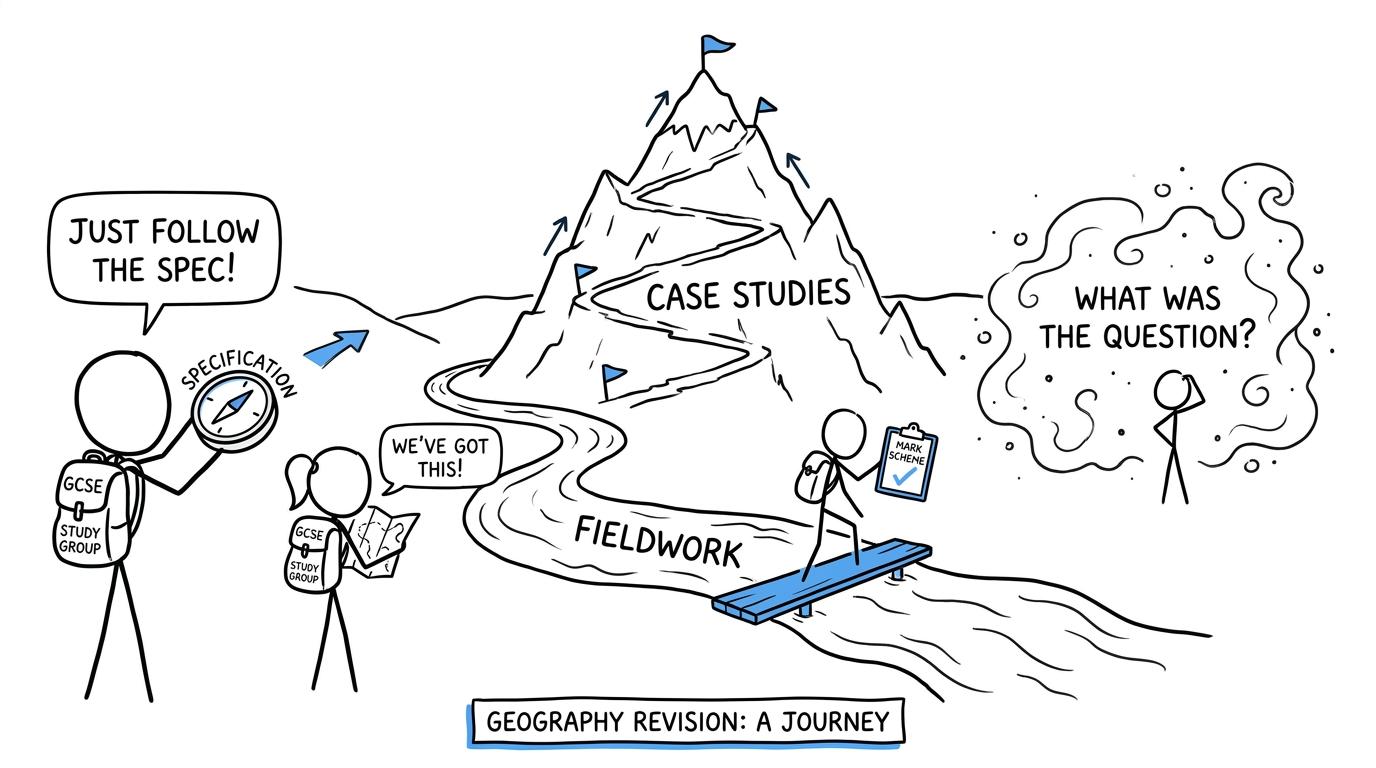 Students navigate the landscape of case studies and fieldwork
Use exam questions without outsourcing the thinking
One person reading a model answer aloud is not group practice. Everyone should attempt the question first. Only then should the group compare approaches and consult the mark scheme.
Mark schemes are best used to discover what earns credit, not to manufacture sentences that everyone memorises. Pay attention to command words, developed explanations, evidence, application and justified conclusions.
The same principle applies in maths. The guide to using GCSE past papers properly explains the useful cycle: attempt, mark, diagnose, repair and retest. Students can apply that cycle to geography while using the correct resources supplied by their school or exam board.
For separate maths preparation, MathsGenie offers board-specific collections for Edexcel GCSE Maths past papers, AQA GCSE Maths past papers and OCR GCSE Maths past papers.
Common mistakes that stop a study group working
Inviting too many people
A large group feels energetic but creates more scheduling problems and less individual participation. Keep the core group small and dependable.
Arriving without preparation
If nobody has attempted the questions or prepared the quiz, the meeting becomes improvised teaching. Assign a small task beforehand and expect everyone to complete it.
Letting one person dominate
The strongest student can accidentally turn the session into a lecture. Use silent thinking time, rotate roles and ask each member to explain part of the reasoning.
Confusing conversation with revision
A lively discussion may still produce no retrievable knowledge. Include written answers, closed-book recall and marked tasks so progress is visible.
Using resources from the wrong exam board
A generic video may teach useful geography, but your specification determines the required content and assessment structure. Confirm your board and use resources that match it.
Never revisiting mistakes
An error log has little value if it is merely written. Begin later meetings with previous weaknesses and check whether they can now be answered independently.
Make the next meeting real
A productive GCSE geography study group does not need matching stationery, a complicated app or hours of free time. It needs a few reliable people, a fixed appointment, a narrow target and a routine that makes everyone retrieve, apply and evaluate knowledge.
Send one message today containing the members, place, time, topic and preparation task. That single decision moves the group from intention to action.
Then keep your maths revision equally deliberate. Use MathsGenie's free revision lessons and practice questions to repair weak topics, mini tests to check recall, and past papers with mark schemes and video solutions to build exam technique. Nearer the exams, add Edexcel GCSE Maths predicted papers as a realistic rehearsal. A good group creates accountability, but improvement still happens one honest attempt at a time.










