

GCSE Geography Grade 9 Meaning: What It Shows
GCSE geography grade 9 meaning explained: learn what the top grade shows, how it compares with old A* grades, and how to revise effectively for it today.
There is a peculiar moment in revision when a target grade stops feeling like a number and starts feeling like a verdict. Grade 999 can seem to mean flawless recall, perfect essays and an encyclopaedic knowledge of every case study. It does not.
The gcse geography grade 9 meaning is simpler and more useful: it is the highest grade available, awarded for an exceptional overall performance across geographical knowledge, understanding, application, evaluation and skills. It does not require perfection in every question. Nor does it correspond exactly to the old A*.
Understanding that distinction matters. A grade is not a personality test. It is a summary of what your examination work demonstrated on a particular specification.
Grade 9 at a glance
A grade 999 in GCSE Geography means that you have:
- achieved the highest grade in the current 999 to 111 system;
- demonstrated detailed and accurate geographical knowledge;
- explained connections between people, places, processes and environments;
- applied knowledge to familiar and unfamiliar sources;
- analysed data, maps, photographs and geographical arguments;
- made supported judgements rather than merely stating opinions;
- used geographical and fieldwork skills accurately;
- earned a total mark at or above that year's grade 999 boundary.
The last point is important. Grade boundaries are set after the examinations have been marked, so there is no fixed percentage that always guarantees a grade 999. MathsGenie's guide to how GCSE grade boundaries work explains why boundaries move when papers differ in difficulty.
What does a grade 9 represent in terms of ability?
A strong geographer knows facts. A grade 999 geographer can do something with them.
Official GCSE Geography assessment objectives distinguish between knowledge, understanding, application and geographical skills. Across regulated specifications in England, the broad weighting is:
- AO1, knowledge: 15%15\%15%;
- AO2, understanding: 25%25\%25%;
- AO3, application, analysis, evaluation and judgement: 35%35\%35%;
- AO4, geographical skills and communication: 25%25\%25%.
The precise arrangement of questions and papers varies between AQA, Edexcel, OCR and Eduqas, so students should always check their own specification. The central lesson, however, is shared: recall alone cannot carry an entire grade 999 performance.
Knowledge that is selective and accurate
At the highest level, knowledge is not a heap of disconnected statistics. It is selected because it helps answer the question.
That might include named locations, processes, fieldwork methods, patterns, causes, consequences and management strategies. Effective answers use precise terminology and relevant evidence, but avoid pouring every remembered fact onto the page.
This is why endless rereading often feels productive while producing little improvement. Recognition is not the same as retrieval. A better test is whether you can choose the right evidence without prompts and connect it to the command word.
Understanding relationships
Geography is built from relationships: physical processes affect people; decisions made at one scale influence another; an intervention creates benefits for one group and costs for another.
Grade 999 work tends to make these links explicit. Instead of listing separate effects, it develops chains of reasoning. Instead of saying that a strategy is successful, it identifies the criteria by which success is being judged, such as cost, sustainability, timescale or impact on different stakeholders.
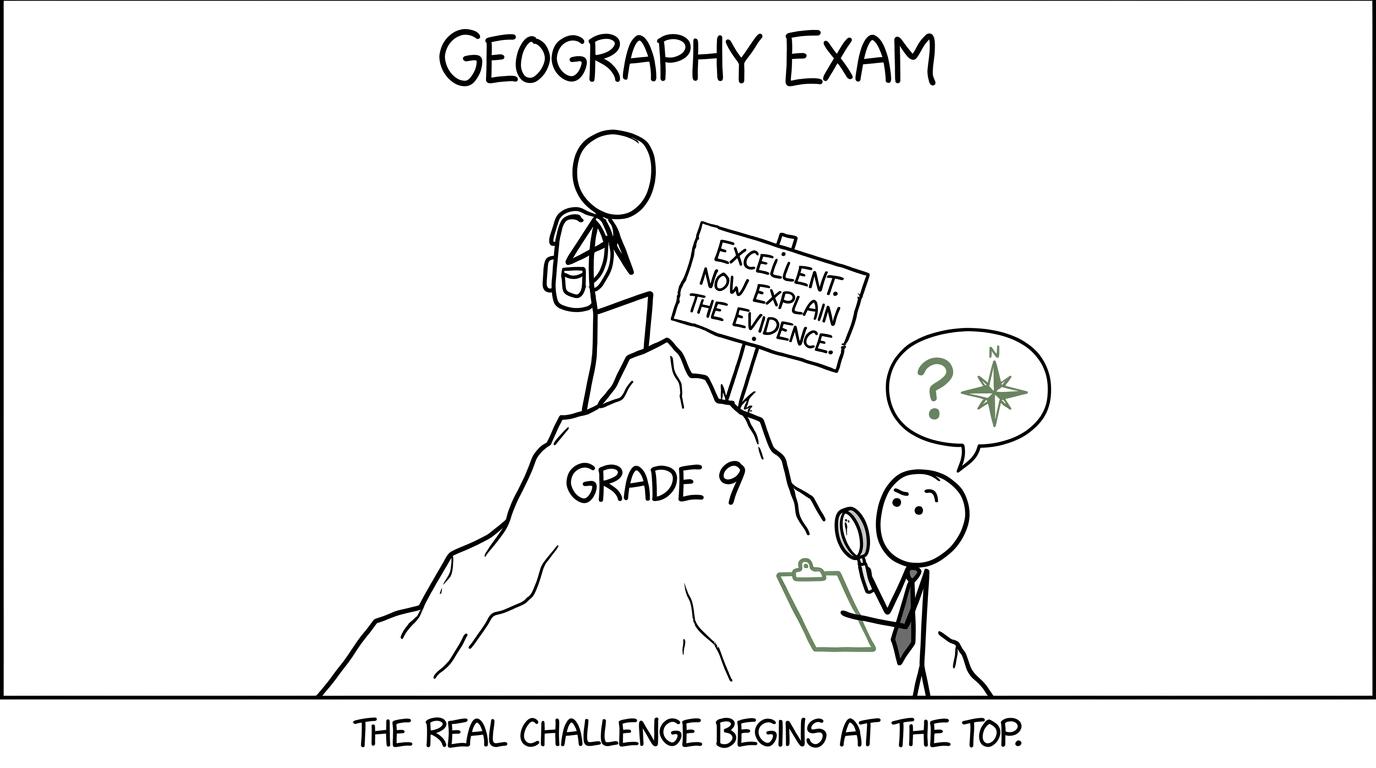 A student reaches the Grade 9 summit and meets an examiner asking for evidence
Application to unfamiliar material
An unfamiliar figure should not feel like an ambush. It is an invitation to use what you know.
Top-level performance includes interpreting resources such as maps, graphs, tables, photographs and extracts, then combining that evidence with geographical understanding. A student may know a topic thoroughly but still lose marks by ignoring the resource supplied in the question.
Application means adapting knowledge to the precise place, scale or issue presented. A memorised paragraph that does not answer the question remains a memorised paragraph.
Analysis, evaluation and judgement
Longer answers often separate good recall from genuinely strong geographical thinking. Evaluation requires more than adding “however” near the end.
A well-supported judgement usually:
- addresses the exact claim in the question;
- considers more than one factor or perspective;
- uses evidence rather than assertion;
- recognises that outcomes may differ by place, group or timescale;
- reaches a conclusion consistent with the preceding argument.
This does not mean making every answer complicated. It means making the reasoning visible.
Is grade 9 equivalent to an A*?
Not exactly.
England's numerical GCSE scale replaced the former A* to G scale. Ofqual identifies three firm comparison points:
- the bottom of grade 777 is comparable with the bottom of the old grade A;
- the bottom of grade 444 is comparable with the bottom of the old grade C;
- the bottom of grade 111 is comparable with the bottom of the old grade G.
Grades 777, 888 and 999 together cover the part of the scale previously represented by A and A*. The new system created more differentiation among high-attaining students.
It is therefore common to describe grade 999 informally as being above an old A* or as a particularly high A*. That can be a useful shorthand, but it is not a precise official conversion. A grade 999 is its own standard within a different qualification and grading structure.
The safest interpretation is this: grade 999 is the highest current GCSE grade, while an A* was the highest grade under the former system. They occupy similar positions at the top, but they are not interchangeable measurements.
A grade 9 is not a fixed percentage
Students sometimes search for one reassuring number: “What percentage do I need?” Unfortunately, the honest answer is that it changes.
Exam boards set boundaries separately for each specification and examination series. They consider statistical evidence and review students' work so that the standard represented by a grade remains comparable over time. If a paper proves more demanding, its boundaries may be lower; if it proves less demanding, they may be higher.
There is also no national quota that prevents additional students from earning a grade. Your result is determined by your total marks and the confirmed boundaries for your qualification.
Unlike GCSE maths, GCSE Geography is not divided into foundation and higher tiers on the major English specifications. Candidates following the same specification take the relevant common papers, and grade 999 is available through strong performance across them.
This changes the revision question. Do not ask, “What was last year's percentage?” Ask, “Can I consistently produce work of the required quality across different papers?”
The maths skills hidden inside top-grade geography
Geography contains more numeracy than its essays initially suggest. Students may need to interpret scales, calculate averages, compare rates, identify trends, use percentages and evaluate the reliability of data.
MathsGenie's AQA Geography statistical skills revision guide covers averages, spread, cumulative frequency, percentage change and scatter graphs in a geographical context. The broader GCSE Statistics revision area can also strengthen data fluency.
The useful formula for percentage change is:
Percentage change=new value−original valueoriginal value×100\text{Percentage change}=\frac{\text{new value}-\text{original value}}{\text{original value}}\times 100Percentage change=original valuenew value−original value×100But calculation is only half the task. In geography, the result must usually be interpreted. What changed? Over what period? Is the comparison meaningful? Could scale, sample size or data collection affect the conclusion?
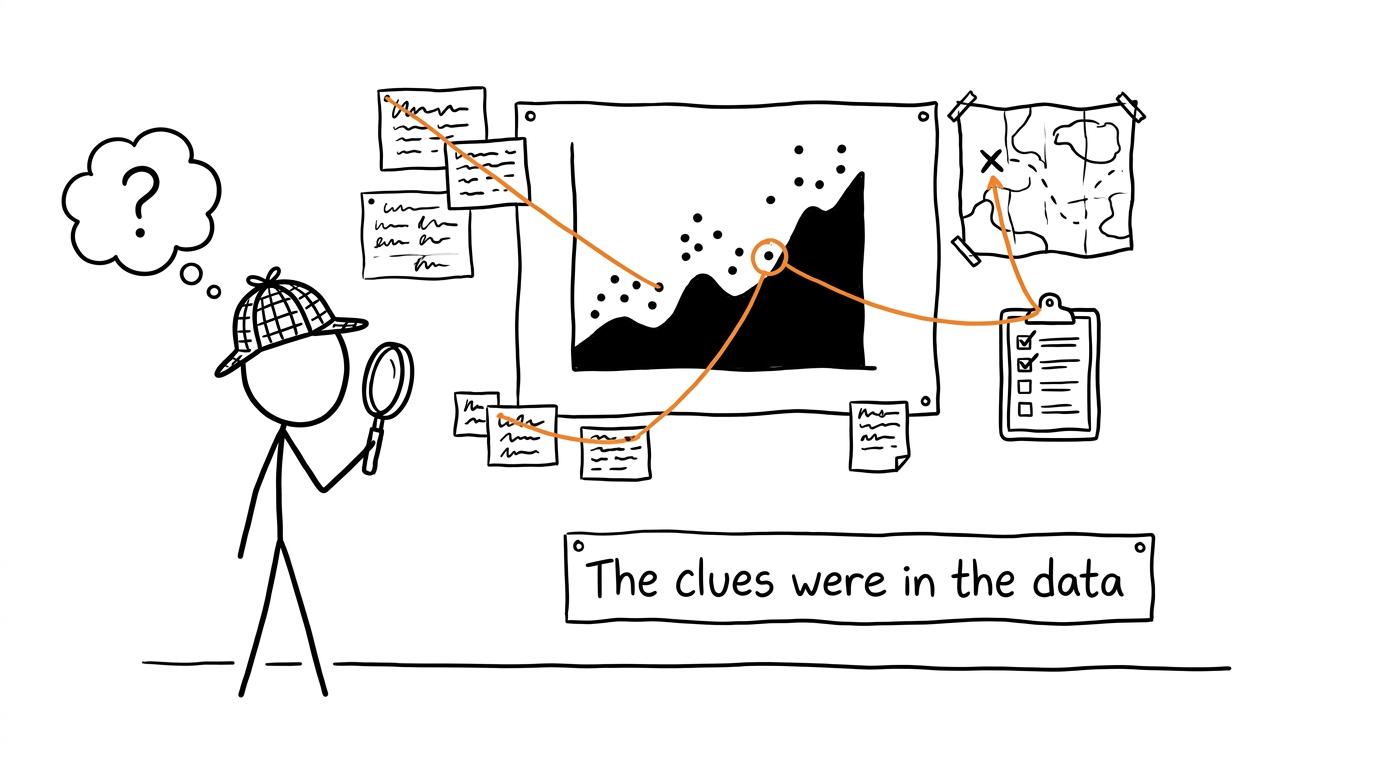 A student detective finds clues in geographical data
For students also preparing for maths exams, these skills reinforce each other. The free AQA GCSE Maths revision hub provides lessons and practice across statistics, percentages, ratio and graphs. Greater numerical confidence leaves more attention available for interpretation and judgement in geography.
How to revise towards grade 9 quality
The goal is not to revise everything with equal intensity. It is to build a feedback loop that reveals what your answers are missing.
Know your specification
Confirm whether you study AQA, Edexcel, OCR or Eduqas. Check the named topics, case-study requirements, fieldwork content, paper structure and command words. Revision material from another board may overlap, but it may also omit something your specification requires.
Retrieve, apply, then evaluate
Use three layers of revision:
- retrieve essential knowledge without notes;
- apply it to maps, data and unfamiliar contexts;
- practise extended responses requiring analysis or judgement.
This progression matters. Flashcards may build recall, but only examination questions reveal whether you can select and use that knowledge.
Mark for causes, not just totals
After completing a question, classify each lost mark. Was the problem missing knowledge, weak application, vague evidence, an incomplete chain of reasoning, inaccurate data handling or failure to answer the command word?
This is the same disciplined process used in effective maths revision. MathsGenie's advice on when to start GCSE past papers shows why papers are most valuable when there is still time to act on the feedback. The guide to redoing past papers effectively also explains why targeted repair should come before repetition.
Build precision before volume
A carefully reviewed answer is worth more than several rushed ones. Practise planning a judgement, selecting two pieces of evidence or writing one clear chain of reasoning. Then compare your response with the mark scheme and examiner guidance supplied by your board or teacher.
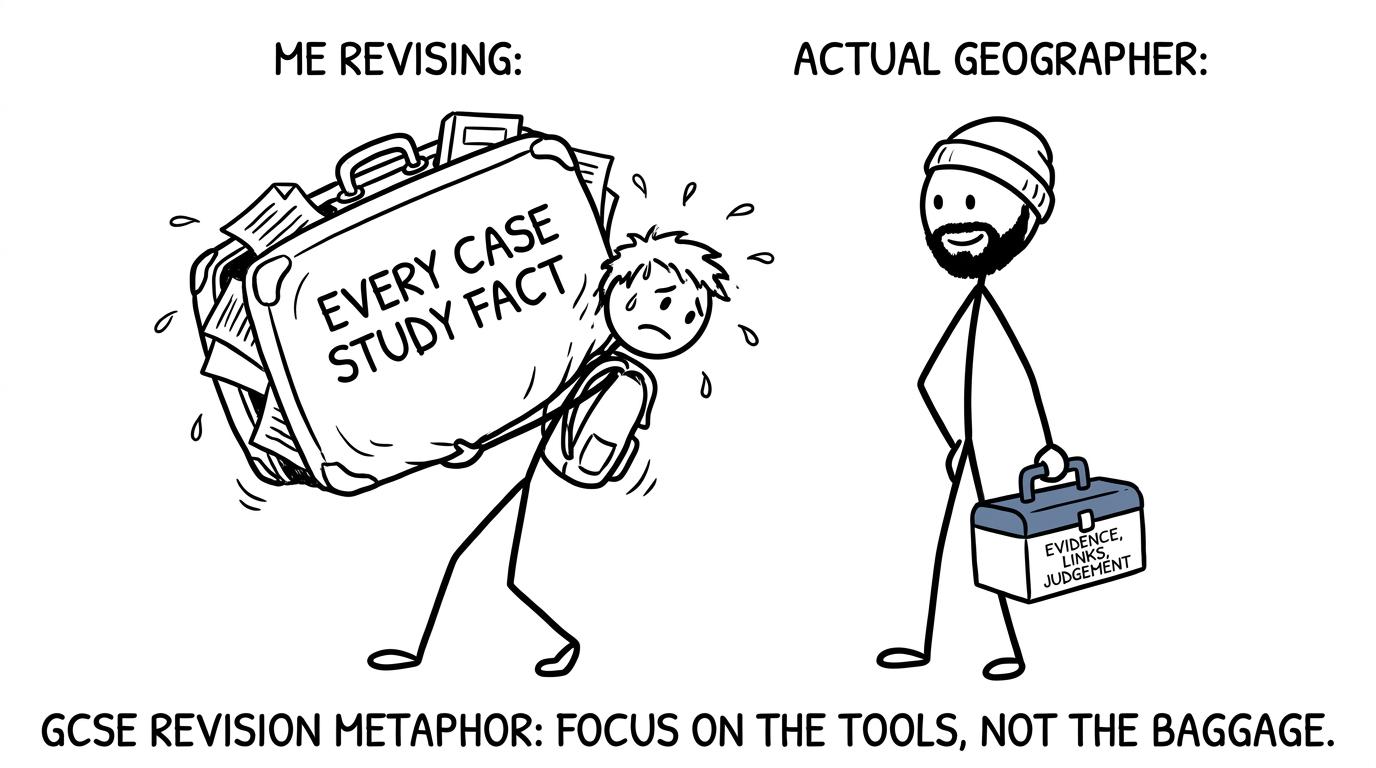 One student carries every fact while another carries a small reasoning toolbox
Common mistakes when aiming for grade 9
Treating grade 9 as perfection
A grade 999 is based on the total mark, not a requirement to answer every question flawlessly. One difficult item does not decide the qualification. Move on when necessary and protect time for the rest of the paper.
Memorising model answers word for word
The examination may alter the location, resource, wording or emphasis. Learn flexible evidence and reasoning structures rather than scripts that only fit one question.
Confusing description with explanation
Description identifies what is happening. Explanation shows why it happens or how one factor leads to another. Check the command word before writing.
Giving evidence without using it
A statistic or place name does not earn its full value merely by appearing. Explain what it demonstrates and how it supports the argument.
Neglecting geographical skills
Maps, graphs, fieldwork methods and numerical questions are not optional extras. Because skills form a substantial part of the assessment, weak data handling can limit an otherwise knowledgeable student.
Revising only comfortable topics
Familiar revision feels smooth because it contains few surprises. Progress often begins where the work becomes diagnostic. Use topic questions, mini tests and timed papers to find the gaps you would not notice through reading alone.
The real meaning of the top grade
A grade 999 does not mean knowing every fact about the planet. It means demonstrating exceptional control of the course you were taught: selecting knowledge, applying it intelligently, handling evidence and reaching defensible judgements under examination conditions.
That is demanding, but it is also learnable. The route is not dramatic. It is a sequence of small corrections made visible through practice.
Use MathsGenie to strengthen the numerical and analytical skills that geography draws upon. Begin with free revision lessons and focused practice questions, check understanding with mini tests, then use past papers, mark schemes and video solutions to diagnose mistakes. As your maths examinations approach, Edexcel GCSE Maths predicted papers can provide an additional timed rehearsal.
A target grade becomes less intimidating when it is translated into actions. Learn accurately. Apply deliberately. Mark honestly. Then return to the difficult parts until they become familiar.










