GCSE Geography Exam Board Differences: Do They Matter?
GCSE geography exam board differences explained: compare AQA, Edexcel, OCR and Eduqas, and discover whether any board is genuinely easier for students.
The unsettling thing about comparing exam papers is that difficulty feels visible. One board uses an unfamiliar resource booklet. Another has longer questions. A third appears to demand more case-study detail. It is easy to conclude that somebody, somewhere, has been given the easier route.
The short answer to GCSE geography exam board differences is reassuring: the specifications and paper structures genuinely differ, but one regulated exam board should not offer an easier path to a particular grade. Grade boundaries are set after the exams to reflect paper demand, while Ofqual oversees standards across boards.
Your exam board still matters, though. It determines the content you learn, the papers you sit and the language you must recognise. Revision must therefore match your exact specification.
The quick answer: what students need to know
Keep this checklist beside your revision plan:
- Your board is not designed to be easier or harder overall. Grade standards are intended to be comparable.
- Specifications are not identical. Topics, optional units, named examples and paper organisation can vary.
- Question style matters in practice. Familiarity with command words, resources and mark schemes can improve performance.
- GCSE Geography is not tiered. Unlike GCSE Maths, there is no foundation or higher geography paper.
- Use materials for your board and specification. A good resource from the wrong course can still teach the wrong detail.
- Do not compare raw grade boundaries without context. A lower boundary may simply indicate a more demanding paper.
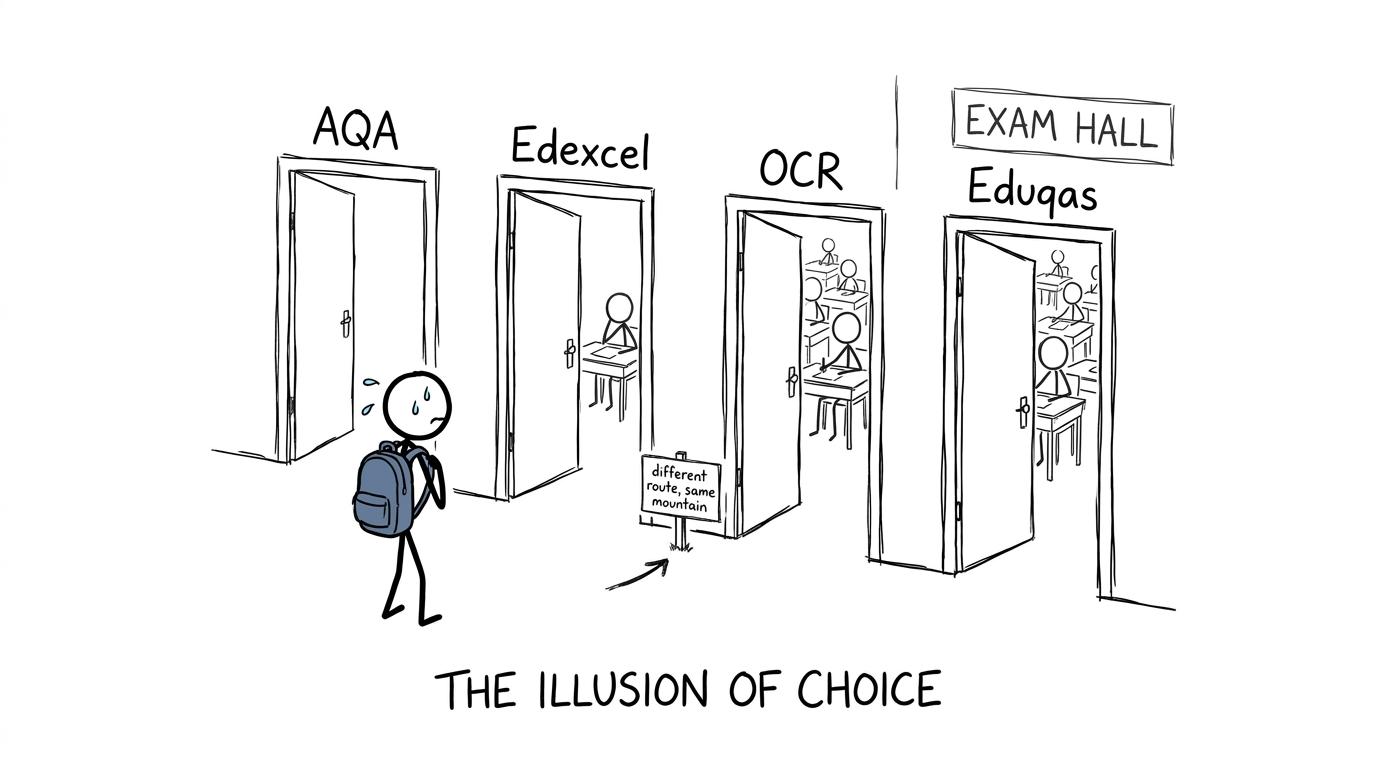 A student discovering that different exam-board doors lead towards the same destination
What all GCSE Geography exam boards have in common
In England, GCSE Geography specifications must work within common subject-content and assessment rules. Exam boards have freedom over the route, but not complete freedom over the destination.
All regulated specifications must develop knowledge of places, physical and human processes, relationships between people and environments, geographical enquiry, fieldwork and geographical skills. Students are assessed through written examinations, including questions connected to fieldwork experience.
The assessment objectives are also shared. Across the qualification, approximately:
- AO1, geographical knowledge, carries 15%15\%15%;
- AO2, geographical understanding, carries 25%25\%25%;
- AO3, application, interpretation, analysis, evaluation and judgement, carries 35%35\%35%;
- AO4, geographical skills and investigation, carries 25%25\%25%.
At least 10%10\%10% of the subject marks must reward appropriate mathematical and statistical techniques. This can include interpreting graphs, calculating change, using scale, analysing data and drawing conclusions from numerical evidence.
That matters for MathsGenie students. Geography is not secretly another maths examination, but confidence with number, ratio, percentages and data removes avoidable friction. The free GCSE Maths revision hub provides lessons and practice questions for strengthening those underlying skills.
Where GCSE Geography exam board differences appear
The broad curriculum is shared, but the packaging changes. That packaging shapes what revision should look like.
| Area | What may differ between boards |
|---|---|
| Specification content | The precise topics, optional themes and depth of coverage |
| Paper structure | The number of components, section order and distribution of marks |
| Case studies | The examples taught and the detail expected by the specification |
| Question presentation | Command words, resource booklets, extended responses and decision-making tasks |
| Fieldwork assessment | How familiar and unfamiliar fieldwork contexts appear in examinations |
| Mark schemes | The wording used to distinguish levels and reward developed explanations |
AQA
AQA organises the qualification around physical environments, human environments and geographical applications. Its applications component includes fieldwork and issue-evaluation skills. Students need to be comfortable moving between learned knowledge and unfamiliar sources rather than relying entirely on memorised case studies.
Pearson Edexcel
Pearson offers different geography specifications, commonly described as Edexcel A and Edexcel B. They are separate courses, not interchangeable versions of the same paper. Their themes, component organisation and enquiry emphasis differ, so students should confirm the full qualification title rather than revising from anything simply labelled “Edexcel Geography”.
OCR
OCR also offers distinct specifications, usually identified as Geography A and Geography B. Each has its own thematic structure and assessment approach. A revision guide for the wrong OCR route may contain excellent geography while still missing material required by your course.
Eduqas
Eduqas structures its specification around changing physical and human landscapes, environmental and development issues, and applied fieldwork or enquiry skills. As with every board, students should use the current specification and board-specific papers rather than assume that a topic shared with another board is assessed identically.
The practical lesson is simple: write your complete exam board and specification at the top of your revision plan. If you are unsure, ask your geography teacher or inspect the front cover of a mock paper.
Is one GCSE Geography exam board actually easier?
Not in the useful sense of “this board gives the same student a free grade”.
Individual papers can certainly feel easier or harder. A student who enjoys rivers may prefer one set of questions; another may be happier evaluating urban change. Paper demand also varies between examination series. This is why grade boundaries are not fixed in advance.
After scripts have been marked, awarding organisations consider evidence including question performance, mark schemes, samples of work and statistical information. Boundaries can move to account for differences in demand. Ofqual also monitors standards across boards, with the intention that the quality of work required for a grade remains comparable.
This produces an important distinction:
- Paper difficulty concerns how demanding a particular set of questions was.
- Grade difficulty concerns the standard of performance needed to receive a grade.
The first can vary. The second is regulated for comparability.
A board with a lower raw boundary is therefore not automatically easier. If more marks were difficult to obtain, the boundary may need to be lower. Comparing boundary percentages while ignoring the paper is like comparing journey times without noticing that one route crossed a mountain.
What matters more than the board
For most students, the exam board has already been selected by the school. Energy spent wishing for another specification rarely earns a mark. These actions can.
Know the exact content
Build revision from your specification and your teacher’s course outline. Separate required case studies, physical processes, human themes, fieldwork and geographical skills. Check that every revision resource belongs to the correct board and route.
Learn how marks are awarded
Extended answers reward more than recalled facts. Depending on the command word, you may need to explain relationships, apply evidence, evaluate alternatives or reach a supported judgement. Read mark schemes alongside your answers so that “I knew it” becomes “I communicated it clearly”.
Practise unfamiliar resources
Maps, photographs, charts, tables and written extracts are not decoration. They are part of the question. Practise identifying trends, anomalies, scale and evidence before forming a conclusion.
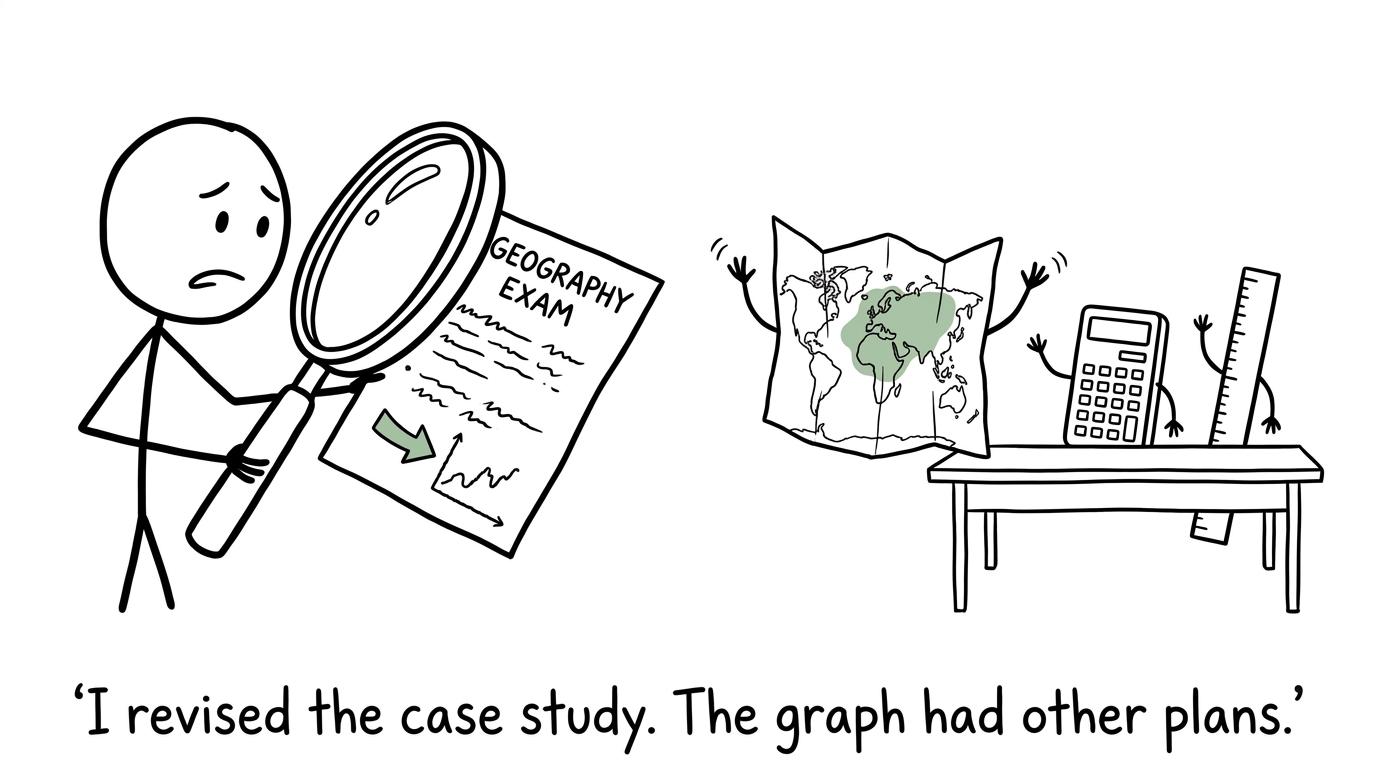 A geography student realising that the graph also needed revision
Strengthen the maths beneath the geography
Geographical data questions can expose small weaknesses in percentages, averages, scale and graph interpretation. MathsGenie’s free resources are designed for GCSE Maths, but those skills transfer directly.
Begin with the MathsGenie home page or the board-specific GCSE hub, then use revision lessons and practice questions for the numerical topics that slow you down. If percentages or proportional reasoning feel uncertain, fix the underlying method rather than hoping it will not appear in geography.
Turn papers into feedback
A paper is most valuable after it has been marked. Categorise each lost mark:
- missing geographical knowledge;
- weak use of evidence;
- misunderstanding the command word;
- incomplete evaluation;
- mathematical or graphical error;
- poor time management.
The same feedback loop works across subjects. MathsGenie explains when to start GCSE past papers and how to convert mistakes into targeted revision. Students taking Edexcel Maths can also use the more detailed guide to using Edexcel GCSE Maths past papers properly.
How maths students can organise geography revision
Students preparing for several GCSEs do not need a completely different system for every subject. The content changes; the learning cycle does not.
Use this sequence:
- learn one clearly defined section;
- retrieve it without notes;
- answer board-specific examination questions;
- mark the response carefully;
- record one precise correction;
- revisit the weakness later.
MathsGenie’s one-week GCSE revision plan shows how short diagnostic sessions, focused repair and timed papers can fit together. Adapt the structure for Geography while keeping your source material board-specific.
Near the examination, resist the temptation to consume endless notes. Use your specification checklist, fieldwork records, case-study summaries and recent papers. For Maths, combine that approach with MathsGenie’s revision lessons, mini tests, mark schemes, video solutions and predicted papers. The GCSE Maths night-before plan offers a calm model for final preparation without panic-driven cramming.
Common mistakes when comparing geography boards
Assuming lower boundaries mean easier exams
Boundaries respond to paper demand and candidate performance. Compare neither boards nor years using percentages alone.
Revising from the wrong specification
“AQA”, “OCR” or “Edexcel” may not be enough information. Check the qualification title and, where relevant, whether you take specification A or B.
Memorising case studies without learning to apply them
Knowledge earns marks only when it answers the question. Practise selecting relevant evidence and connecting it to a clear argument.
Ignoring fieldwork
Fieldwork is assessed through the written examinations. Revise the enquiry process, methods, data presentation, limitations, conclusions and possible improvements, not merely the location visited.
Treating numerical skills as an afterthought
Graphs, scale and statistics are part of geographical reasoning. Use MathsGenie’s GCSE Maths resources to repair weak foundations before they cost marks in two subjects.
Collecting papers without reviewing them
Completion is not improvement. Mark each paper, identify recurring weaknesses and retest them. The guide to revising Edexcel GCSE Maths efficiently demonstrates the same learn, practise, mark, fix and retest cycle.
The board matters less than your response to it
GCSE Geography exam boards take different routes through a regulated subject. The topics, paper structures and question styles matter because they determine what you must prepare. But those differences do not mean that AQA, Edexcel, OCR or Eduqas offers a reliably easier grade.
So confirm your specification. Use its past papers. Learn its command words. Revise your own fieldwork and practise applying knowledge to unfamiliar information.
Then carry that discipline into Maths. Open the MathsGenie GCSE Maths revision hub, choose your board and use the free revision lessons, practice questions, mini tests, past papers, predicted papers, mark schemes and video solutions. You cannot choose every paper you face. You can choose how precisely you prepare for it.