GCSE Geography Coursework Deadlines: A Calm Plan
GCSE geography coursework deadlines explained: use a practical pacing plan to finish fieldwork notes, data and evaluation calmly, on time and before exams.
The deadline rarely creates the panic by itself. The panic comes from discovering, too late, that one task labelled “geography coursework” is really six smaller tasks wearing a long coat.
If you are searching for GCSE geography coursework deadlines, the first thing to know is that there is no single national hand-in date for students. Under the current GCSE Geography arrangements in England, fieldwork is assessed through written examinations rather than a separately marked coursework component. However, schools commonly set their own deadlines for fieldwork notes, data presentation, conclusions, evaluations and revision materials.
Your teacher’s date is therefore the one that matters. Confirm it, break the assignment into stages and aim to finish a complete draft several days early. That protects your geography work without allowing it to consume the time you need for GCSE maths and your other subjects.
Your deadline checklist
Before making an elaborate timetable, answer these questions:
- What exactly must be submitted?
- What is the final date and time?
- Is there an earlier draft or teacher-feedback deadline?
- Does the task require graphs, maps, calculations or referenced secondary data?
- Which parts depend on information held by your teacher or classmates?
- When will you complete a full draft?
- When will you check, improve and submit it?
- Which maths revision sessions must remain protected?
Write the answers in one place. A deadline becomes less frightening when it stops being vague.
Does GCSE Geography still have coursework?
The word “coursework” is often used informally for a fieldwork booklet, investigation or extended write-up. That does not necessarily mean it is a separately assessed coursework unit.
For GCSE Geography qualifications regulated in England, official subject requirements state that fieldwork is assessed by examination. Students must be given opportunities to undertake fieldwork outside the classroom on at least two occasions in contrasting environments. Schools also provide the relevant exam board with a fieldwork statement.
Exam boards including AQA, Pearson Edexcel and OCR assess knowledge of fieldwork through written papers. Questions may cover your own fieldwork experience as well as an unfamiliar investigation. The assessed skills include choosing enquiry questions, collecting and presenting data, analysing results, reaching conclusions and evaluating methods.
Eduqas specifications also include fieldwork requirements, but arrangements can depend on the precise qualification and where it is taught. Always check your specification and ask your teacher whether a piece of work is a classroom deadline, an exam preparation task or part of another formal requirement.
The practical lesson is simple: do not ignore a school deadline because somebody online says that geography has “no coursework”. The submitted work may provide vital feedback and become the foundation of your fieldwork revision.
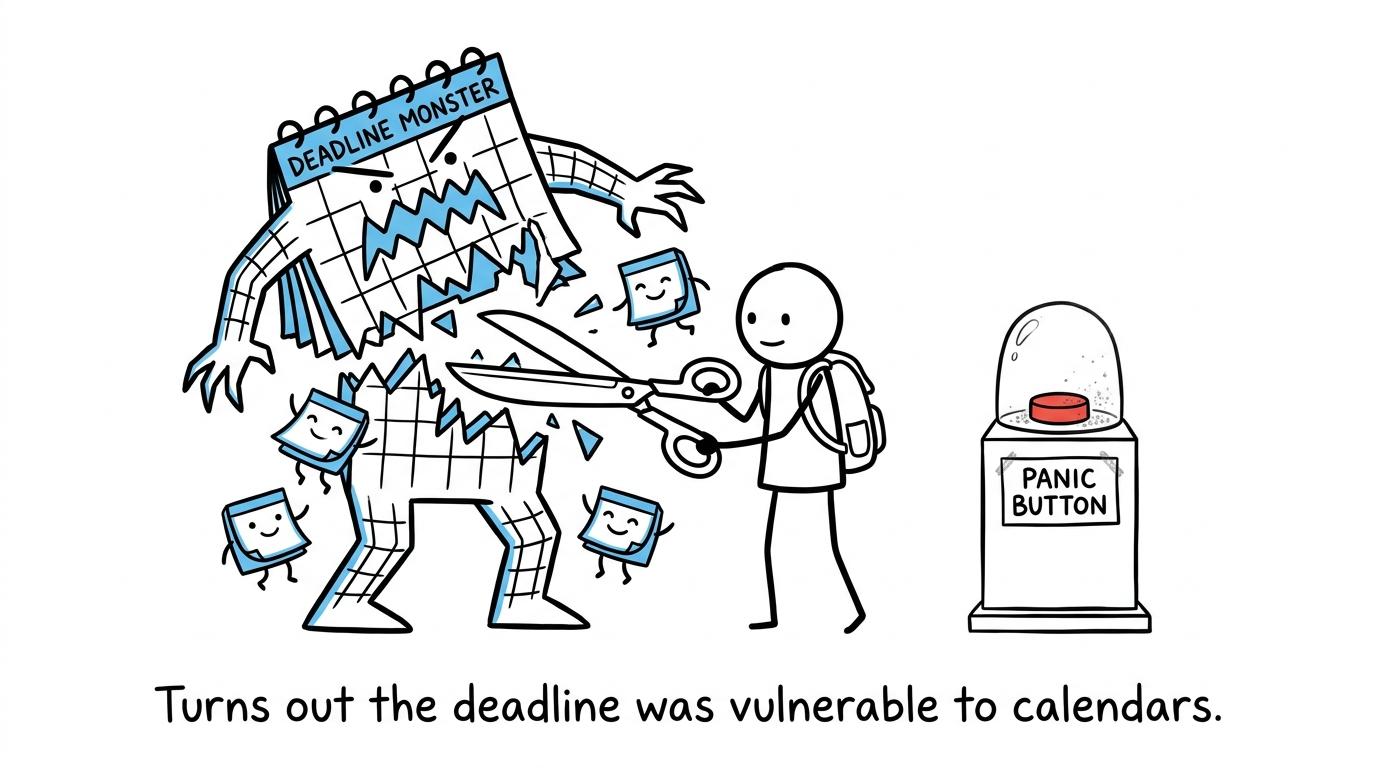 A student defeats a calendar monster by turning it into small tasks
Build backwards from the real deadline
Most students plan forwards. They begin today, do whatever feels urgent and hope the remaining work fits into the remaining time. Backward planning is calmer because it starts with the result you need.
Put these milestones into your calendar in reverse order:
- Submission: upload or hand in the correct final file.
- Final check: inspect the instructions, labels, spelling and references.
- Improvement: strengthen analysis, conclusions and evaluation.
- Complete draft: every required section exists, even if it is imperfect.
- Analysis: explain patterns, relationships and anomalies in the data.
- Presentation: complete graphs, tables, maps and calculations.
- Organisation: gather field notes, photographs and secondary evidence.
- Set-up: confirm the title, enquiry question and required structure.
Make your personal finishing date earlier than the official one. A buffer of several days leaves room for illness, technology problems, missing data and competing homework. It also separates the demanding work of creating a draft from the more precise work of checking it.
If you need a wider plan for balancing subjects, adapt the structure in the GCSE maths revision timetable guide. Give geography temporary priority near its deadline, but keep at least a few short maths sessions alive so previously learned methods do not fade.
Pace the work without losing whole evenings
A fieldwork assignment expands to fill whatever time you give it. The solution is not one heroic weekend. It is a sequence of sessions with visible outcomes.
Use tasks you can finish in one sitting
“Do geography” is not a useful instruction. It gives you no starting point and no clear moment of completion. Replace it with actions such as:
- enter the fieldwork results into a table;
- choose the appropriate graph for each data set;
- label axes, units and locations;
- identify the main pattern and any anomaly;
- connect the evidence to the enquiry question;
- write one limitation and a realistic improvement;
- check the work against the teacher’s instructions.
Each session should produce something you can see. Visible progress reduces the temptation to restart, redesign or spend an hour choosing a title font.
Separate drafting from improving
Trying to write a perfect paragraph immediately makes every sentence feel expensive. Draft the full answer first. Improve it later.
During the drafting stage, focus on whether the required ideas are present. During the improvement stage, ask whether claims are supported by evidence, whether geographical terminology is precise and whether the evaluation explains how a limitation affects confidence in the conclusion.
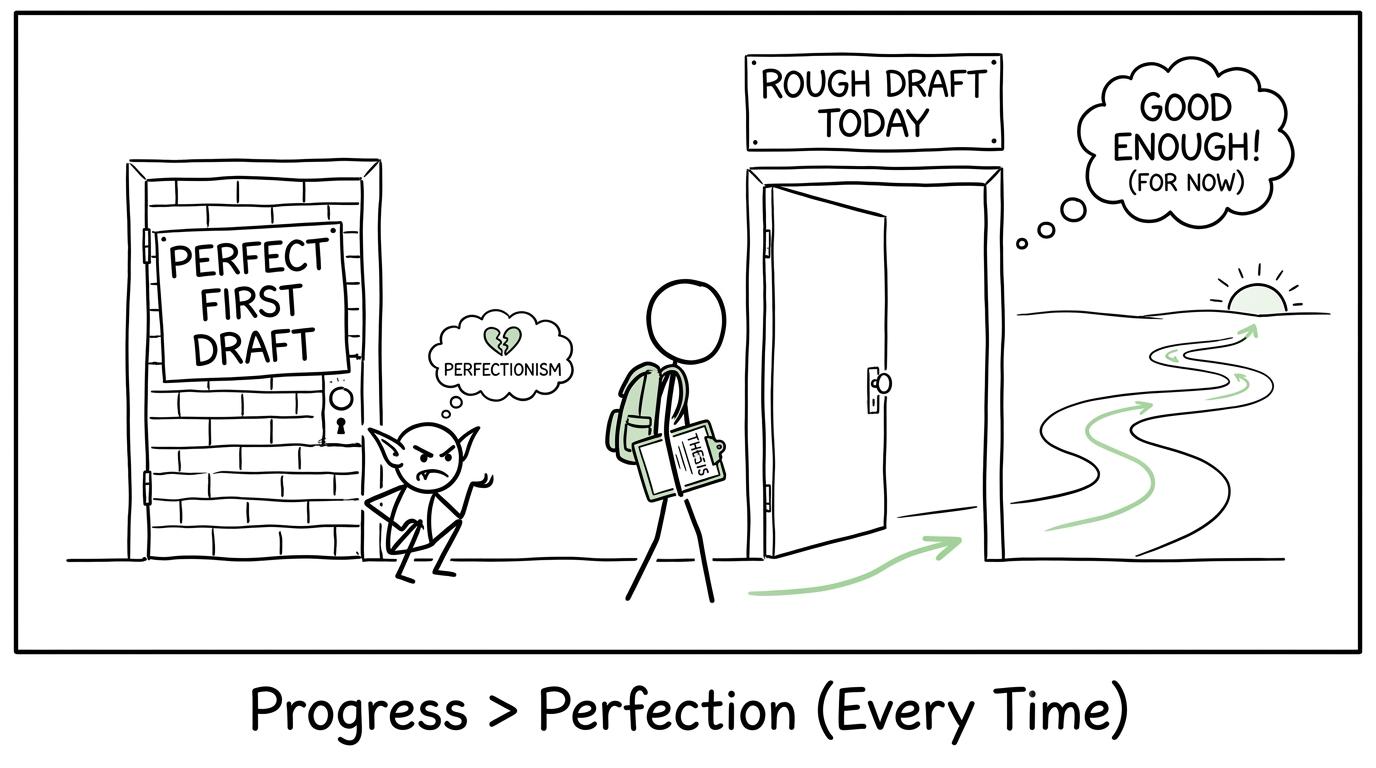 A student chooses the open rough-draft door while perfectionism looks disappointed
Keep a short daily restart note
At the end of each session, write down:
- what you completed;
- the exact next action;
- anything you need to ask your teacher.
This takes less than a minute, but it removes the friction of reopening the task tomorrow and wondering where to begin.
Use maths carefully in geography fieldwork
Geography fieldwork can involve averages, percentages, graphs, sampling and relationships between variables. These are not decorative extras. They help you turn observations into evidence.
For a percentage, the underlying calculation is:
percentage=partwhole×100\text{percentage}=\frac{\text{part}}{\text{whole}}\times 100percentage=wholepart×100For an arithmetic mean:
mean=sum of the valuesnumber of values\text{mean}=\frac{\text{sum of the values}}{\text{number of values}}mean=number of valuessum of the valuesFor the range:
range=highest value−lowest value\text{range}=\text{highest value}-\text{lowest value}range=highest value−lowest valueChoose the technique because it answers the enquiry question, not because it looks sophisticated. A bar chart can compare separate categories, while a scatter graph can help investigate a possible relationship between two numerical variables. Every graph needs an appropriate scale, labelled axes and units where required.
You can strengthen these transferable skills through the MathsGenie GCSE maths revision hub, the dedicated GCSE Statistics revision resources and the averages lesson and exam questions. If your presentation needs a categorical graph, revisit the bar charts revision guide.
Check calculations independently before building conclusions around them. Also retain sensible precision: excessive decimal places can suggest certainty that the original field measurements do not support.
Protect your GCSE maths revision
A geography deadline can feel more urgent than maths because it has a visible hand-in date. Maths revision is easier to postpone, but the cost appears later in slower recall and avoidable lost marks.
During a busy coursework week, reduce the size of maths sessions rather than deleting them. A sustainable minimum might include:
- one short revision lesson;
- a focused set of practice questions;
- immediate marking;
- one written note explaining the main mistake;
- a brief retest on another day.
The GCSE past-paper timing guide explains how to progress from topic practice to timed papers. Near the exams, use MathsGenie GCSE revision resources to select material for your board, whether you take Edexcel, AQA, OCR or Eduqas.
Do not attempt a full paper on an evening already crowded by a geography milestone. Use a mini test or targeted question set instead. The purpose is continuity. Once the submission is complete, return the protected time to longer maths sessions, past papers and predicted papers.
What to do when the deadline is close
If very little time remains, stop planning the ideal project and protect the essential submission.
First, read the instructions and list every compulsory component. Then prioritise missing sections over cosmetic improvements. A complete, clearly structured draft is more useful than one polished page followed by several blank sections.
Work in this order:
- complete missing content;
- check that evidence supports the conclusion;
- label graphs, tables and maps;
- evaluate methods and data quality;
- check calculations;
- proofread and confirm the file format;
- submit before the technical deadline.
Ask your teacher promptly if illness, missing fieldwork or another serious issue affects your work. Do not assume that an extension exists, and do not wait until the submission portal closes before explaining a genuine problem.
For a sensible approach to the final evening, the principles in the GCSE night-before plan transfer well: choose the highest-value tasks, remove distractions, prepare what you need and set a stopping time. Exhaustion usually makes checking less reliable, not more thorough.
Common mistakes with geography coursework deadlines
Confusing an exam-board requirement with your hand-in date
The exam board may set administrative requirements for centres, while your school sets student deadlines. Record the date given directly by your teacher and clarify anything ambiguous.
Treating the work as one enormous task
A vague task encourages avoidance. Divide it into data organisation, presentation, analysis, conclusion, evaluation and checking.
Spending too long on presentation
A visually tidy document matters, but attractive colours cannot replace accurate evidence or geographical reasoning. Complete the intellectual work before refining the appearance.
Describing data without analysing it
Analysis goes beyond stating what a graph shows. It considers patterns, relationships, anomalies and possible explanations, then links them to the enquiry question.
Writing generic evaluation points
“Collect more data” is weak unless you explain what data, where it should be collected and how that change would improve reliability or validity.
Sacrificing every other subject
One deadline should not erase a week of maths revision. Keep short sessions in your planner, then restore your normal routine after submission.
Leaving submission until the final minute
Files can corrupt, internet connections can fail and the wrong version can be uploaded. Submit early enough to check that the correct document has arrived.
Finish early enough to think clearly
Deadlines feel personal, but they are mostly logistical. The work has stages, the stages need time and uncertainty needs a buffer. Once those facts are visible, panic has less room to grow.
Confirm your teacher’s deadline today. Create the milestones backwards, complete a rough draft before trying to perfect it and preserve a small amount of maths practice throughout the week.
Then return to MathsGenie as your free revision base. Use the revision planner to organise your next steps, learn through revision lessons, practise with topic questions and mini tests, and build exam readiness with past papers, predicted papers, mark schemes and video solutions. Start at the MathsGenie GCSE revision hub and turn the next deadline into a plan rather than a surprise.