

GCSE Geography 5 to 7: A Practical Grade Guide
GCSE geography 5 to 7 advice: improve explanations, case-study evidence, data skills, fieldwork evaluation and extended answers with a clear plan.
Moving from a grade 5 to a grade 7 in GCSE Geography is rarely about learning twice as many facts. The more important change is how you use what you know. A grade 5 answer is generally accurate and supported; a grade 7 student applies knowledge more precisely, explains complex links, analyses unfamiliar resources and reaches substantiated judgements.
That is the heart of a successful GCSE geography 5 to 7 plan: turn knowledge into evidence-led geographical reasoning. You still need case studies and processes, but they must become tools rather than facts stored for their own sake.
This guide explains the specific changes to make, including how stronger maths and data skills can help you collect marks that are often overlooked.
Your grade 5 to grade 7 checklist
Focus your revision on these changes:
- replace general case-study points with selected, place-specific evidence;
- explain chains of cause, effect and response rather than listing ideas;
- apply knowledge directly to maps, photographs, graphs and unfamiliar places;
- make a clear judgement in extended answers and support it throughout;
- interpret calculations rather than stopping after finding an answer;
- evaluate fieldwork methods using realistic, specific improvements;
- use mark schemes to diagnose the reason each mark was lost;
- practise under time pressure once your knowledge is secure.
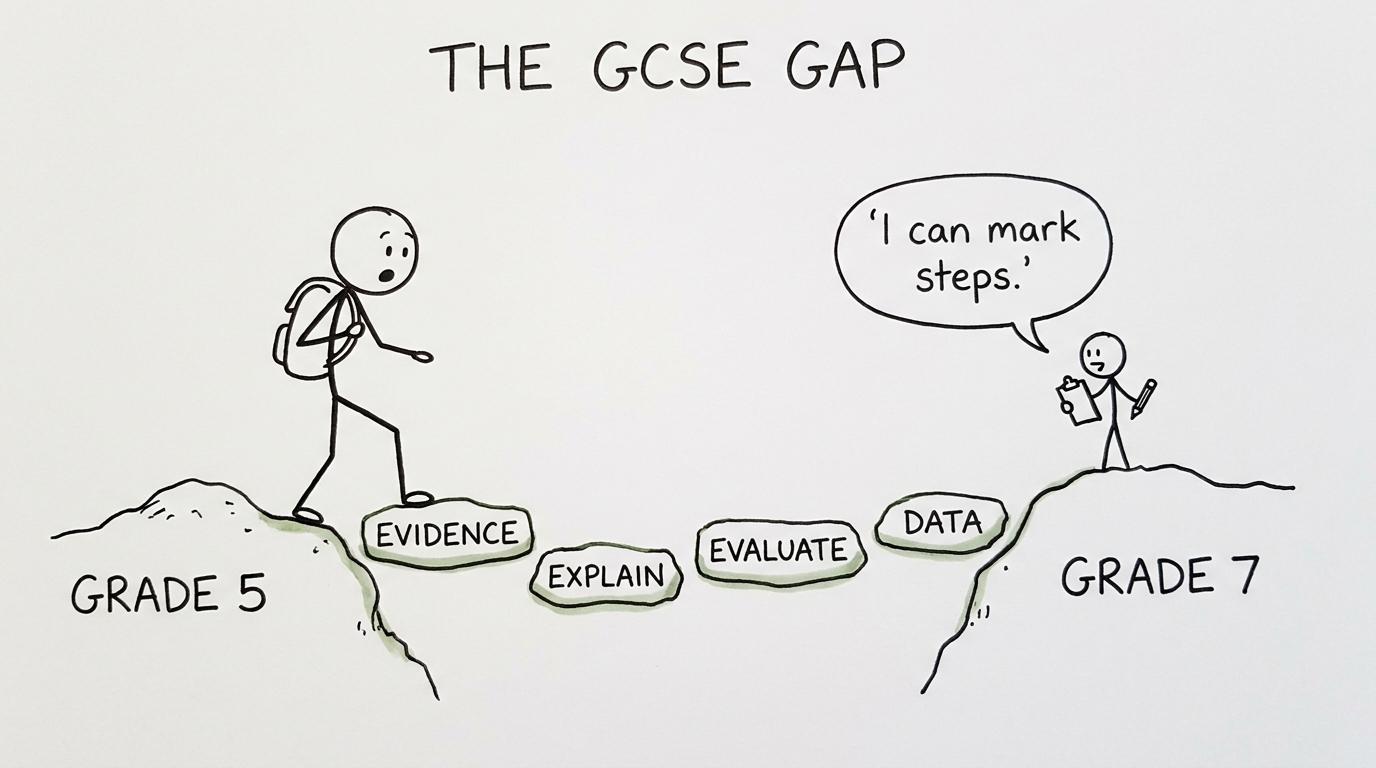 A student discovers that the route from grade 5 to grade 7 is made of markable steps
What separates a grade 5 from a grade 7?
Official GCSE Geography grade descriptors are intended to indicate typical performance across the qualification. They do not provide a fixed recipe for every individual answer.
At grade 5, students are expected to show mostly accurate and appropriate knowledge, clear understanding of geographical relationships, coherent arguments supported by evidence and accurate use of a range of skills.
The official descriptors describe grade 7 as securely meeting the grade 6 standard, with stronger performance in most or all grade 6 features, without yet meeting most of the grade 8 standard. Grade 6 includes broad and relevant knowledge, some strong understanding of complex interactions, convincing arguments, reasoned judgements and effective skills with some evaluation.
In practical terms, the shift looks like this:
- Knowledge becomes selection: you choose the facts that answer this question rather than writing everything remembered.
- Explanation becomes connected: you show how one factor causes another and recognise interactions.
- Evidence becomes purposeful: data and case-study details support a line of reasoning.
- Conclusions become judgements: you decide which factor, strategy or viewpoint is most significant and explain why.
- Skills become interpretation: you calculate accurately, identify patterns and explain what they mean geographically.
A grade is based on performance across the whole set of papers. There is no universal mark that always produces a grade 7 because grade boundaries are set for each exam series.
Understand what GCSE Geography actually assesses
Edexcel, AQA, OCR and Eduqas organise their specifications and papers differently, so use the materials for your own board. However, the Ofqual assessment objectives are common across GCSE Geography qualifications.
They require:
- AO1: knowledge of places, processes, environments and scales: 15%15\%15%;
- AO2: geographical understanding and interrelationships: 25%25\%25%;
- AO3: application, interpretation, analysis, evaluation and judgement: 35%35\%35%;
- AO4: geographical skills and communication: 25%25\%25%.
The useful lesson is that recall alone represents a relatively small part of the qualification. AO3 has the greatest weighting. If your revision consists almost entirely of rereading notes and memorising flashcards, it does not closely resemble what much of the exam asks you to do.
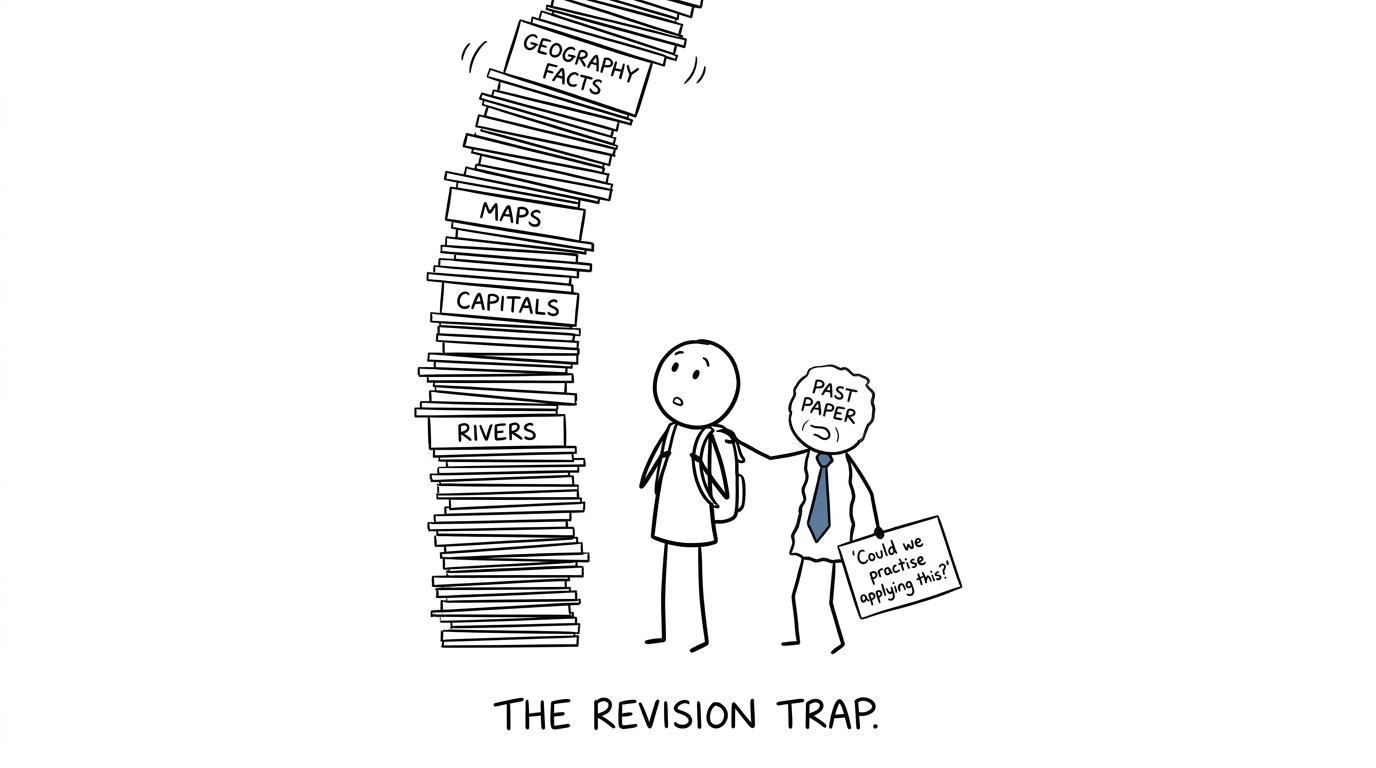 A tower of flashcards is reminded that application matters too
Make case studies precise but manageable
Students sometimes respond to a disappointing mock by trying to memorise every statistic in the textbook. This creates a larger memory problem without necessarily creating a better answer.
Build a compact case-study sheet for each required place or event. Include:
- location and geographical context;
- causes or processes;
- social, economic and environmental effects;
- immediate and long-term responses where relevant;
- named strategies or projects;
- a small set of accurate, distinctive evidence;
- limitations, conflicts or contrasting viewpoints.
Then practise selecting from the sheet. A question about the effectiveness of management does not need every remembered effect. It needs evidence that lets you compare success against limitations.
Never invent a statistic because it sounds specific. A correct named detail is more useful than a doubtful number. Check your school materials and current exam-board specification to confirm which examples and case studies you are expected to know.
Build explanations as connected chains
Grade 5 answers often identify a valid cause and effect. Stronger answers extend the chain and explain the mechanism connecting each stage.
A useful structure is:
claim →\rightarrow→ geographical process →\rightarrow→ immediate consequence →\rightarrow→ wider implication
For physical geography, this might mean connecting conditions to a process, then to a landform or hazard. In human geography, it could connect economic change to migration, pressure on services and uneven consequences for different groups.
Ask yourself four questions after each paragraph:
- Why does this happen?
- What does it lead to?
- Who or what is affected?
- Does the effect change according to place, time or scale?
This avoids the vague phrase “this causes lots of problems”. It also shows the interrelationships highlighted in higher grade descriptors.
Turn extended responses into arguments
Long answers are not marked simply by length. Examiners reward relevant knowledge, application, analysis and a justified conclusion according to the question and its levels-based mark scheme.
Before writing, identify the command word. “Explain” requires reasons and processes. “Assess” requires consideration of importance or impact. “Evaluate” requires you to measure success, value or effectiveness before reaching a substantiated judgement. Exact command-word guidance varies by board, so learn the definitions used in your specification.
For an evaluative response:
- establish a clear line of argument;
- develop two or three distinct analytical points;
- use evidence from the question’s resources where supplied;
- consider a limitation, alternative or contrasting stakeholder;
- reach a judgement based on stated criteria.
Useful criteria might include cost, sustainability, number of people affected, environmental impact, timescale or effectiveness at different spatial scales.
Do not save your opinion for an isolated final sentence. Each paragraph should contribute to the eventual decision.
Strengthen geographical maths and data skills
Maps, graphs, tables and statistics are not decorative extras. Ofqual requires quantitative, qualitative and fieldwork skills, while exam-board specifications can assess geographical skills throughout their papers.
You may need to work with percentages, percentage change, ratios, averages, range, scale, coordinates, graphical information and statistical techniques named by your specification. The essential percentage-change relationship is:
percentage change=new value−original valueoriginal value×100\text{percentage change}=\frac{\text{new value}-\text{original value}}{\text{original value}}\times 100percentage change=original valuenew value−original value×100The calculation is only the first step. A geographical response should normally state what the result reveals about a place, process, trend or comparison.
Use MathsGenie’s free GCSE maths revision hub to repair weak numerical foundations. The percentages revision resources are particularly useful when you need to compare changing populations, land use, rainfall or economic data.
When reading a resource, follow this sequence:
- identify the variable, units, location and timescale;
- describe the overall pattern;
- support it with accurate data;
- identify contrasts or anomalies;
- explain the pattern using geographical understanding;
- consider whether the evidence has limitations.
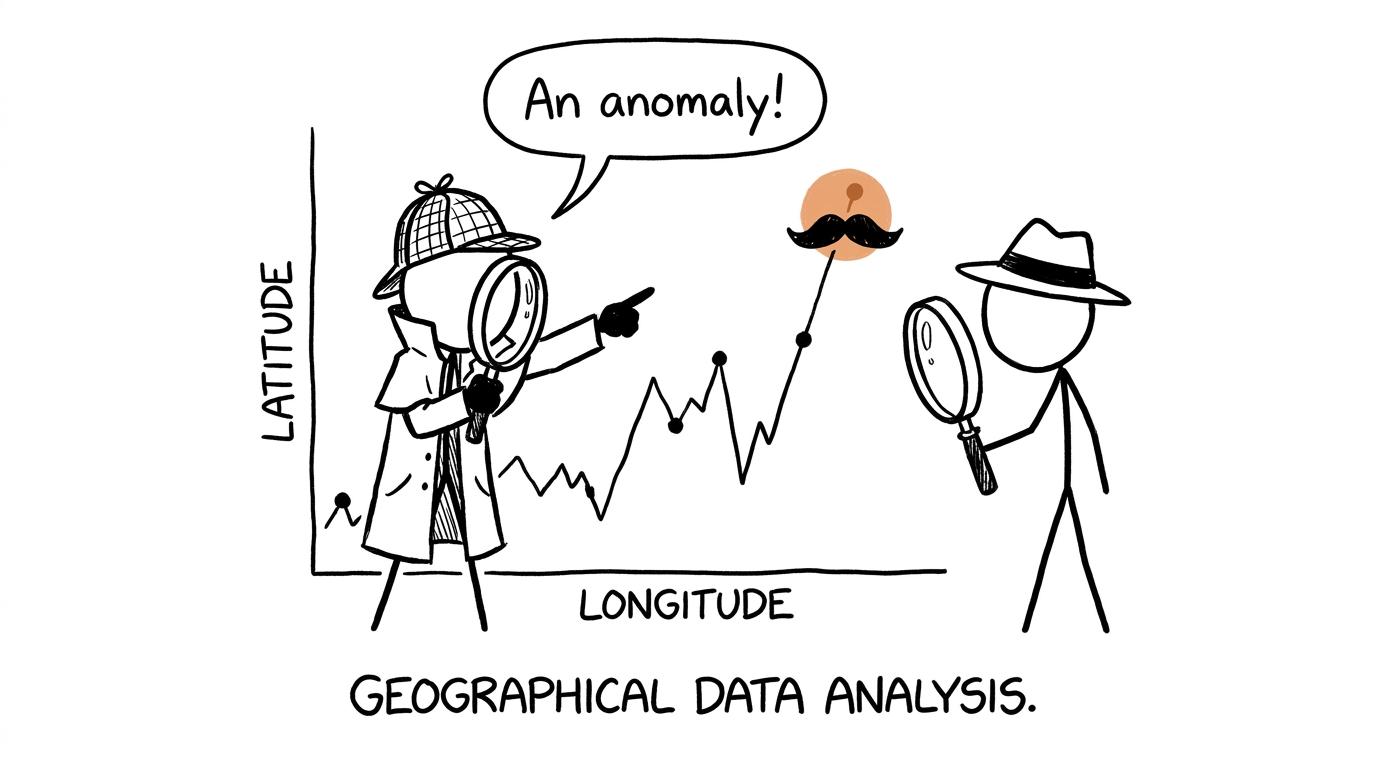 Geographical data detectives discover an anomaly wearing a disguise
Improve fieldwork answers through specificity
Fieldwork questions test more than your memory of where you went. You need to understand the enquiry process: the question or hypothesis, sampling, data collection, presentation, analysis, conclusions and evaluation.
Weak evaluation says, “collect more data” or “use more people”. Strong evaluation identifies a particular limitation, explains how it could affect the results and proposes a feasible improvement.
Know for each enquiry:
- why the location and method were suitable;
- whether sampling was systematic, random or stratified;
- possible sources of bias or measurement error;
- why a graph, map or statistical technique was appropriate;
- whether the evidence supported the conclusion;
- how reliability, accuracy or representativeness could improve.
Be careful with the word “reliable”. Repeating a method may test consistency, but repetition does not automatically remove bias. A larger sample is useful only if it improves the evidence relevant to the enquiry.
Use practice as a feedback system
A completed paper gives you a score. A carefully reviewed paper gives you a plan.
Use the same feedback cycle recommended in MathsGenie’s guide to using GCSE past papers properly: attempt, mark, diagnose, repair and retest. Although the available papers on MathsGenie are for maths, the revision principle transfers directly to geography.
Classify lost geography marks as:
- missing knowledge;
- weak application to the resource;
- incomplete explanation;
- unsupported judgement;
- inaccurate skill or calculation;
- poor timing or misread command word.
Then fix the category rather than merely rereading the topic. If calculations are slowing you down, combine the best order for rebuilding GCSE maths skills with short geography data questions. Use MathsGenie predicted maths papers and mini tests for your maths preparation, while keeping official geography past papers and mark schemes matched to your own board.
Common mistakes that keep answers at grade 5
Writing everything you know
An information dump may contain correct geography but still lack focus. Keep returning to the exact issue, place and command word.
Describing when the question requires explanation
Description states what happens. Explanation shows why. Add processes and links rather than repeating the pattern in different words.
Adding case-study facts without using them
Evidence should prove or qualify a point. After including it, explain what it demonstrates.
Ignoring the supplied resource
If the question provides a map, graph, photograph or table, refer to it accurately. Avoid vague statements such as “the graph goes up” when values, dates or spatial contrasts are available.
Giving a conclusion with no basis
A judgement needs criteria. State why one factor matters more, for whom, over what timescale and at which scale.
Practising without reviewing
Repeated papers can rehearse the same weaknesses. The MathsGenie guide to redoing past papers explains why repair should come before another attempt.
Your next step towards grade 7
The distance between grade 5 and grade 7 is not crossed by one heroic weekend. It is built through small, visible upgrades: more selective evidence, longer chains of reasoning, better resource use, accurate skills and judgements that have earned their conclusion.
Choose one recent geography response today. Identify one paragraph that describes rather than analyses, then rewrite it with a process, evidence and implication. Next, complete a short data question and explain what your result means geographically.
For the numerical side of your revision, make MathsGenie your free base. Use revision lessons to rebuild a weak skill, practice questions to make it secure, mark schemes and video solutions to correct mistakes, then mini tests, past papers and predicted papers to check whether it holds under pressure. Better grades usually arrive after the work becomes more precise, and precision can be practised.











