GCSE Further Maths vs A-level Early Entry
GCSE Further Maths vs A-level Maths early entry: discover what sixth forms value, compare the risks and choose the route that best supports your grades.
The difficult part is not choosing the qualification with the most impressive name. It is working out which choice will leave the clearest evidence that you are ready for sixth-form maths.
For students comparing GCSE Further Maths vs A-level Maths early entry for sixth form, the short answer is this: sixth forms do not universally favour either route. Their published entry requirements usually focus first on your GCSE Mathematics grade, your wider GCSE results and whether you meet the conditions for your chosen subjects. An additional Further Maths qualification can strengthen your preparation, while an early AS or A-level result may demonstrate advanced attainment, but neither automatically overrides the admissions policy.
In most situations, Further Maths at Level 222 is the safer extension of GCSE study. Early Level 333 Mathematics can be valuable for an unusually advanced student, but only when it is properly taught, supported and accepted by the sixth form as part of a sensible progression plan.
The decision at a glance
Before choosing, check the following:
- the exact title and level of the qualification offered by your school
- the published admissions policy of every sixth form you may apply to
- the required GCSE Mathematics grade for A-level Mathematics or Further Mathematics
- whether an early AS or A-level changes course placement after enrolment
- whether the extra course could reduce your performance in GCSE Mathematics or other subjects
- which option provides sustained teaching rather than accelerated examination entry
- what your maths teacher recommends based on your current algebra and problem-solving fluency
The strongest application is rarely the one with the largest collection of certificates. It is the one that shows high attainment, readiness and sound choices.
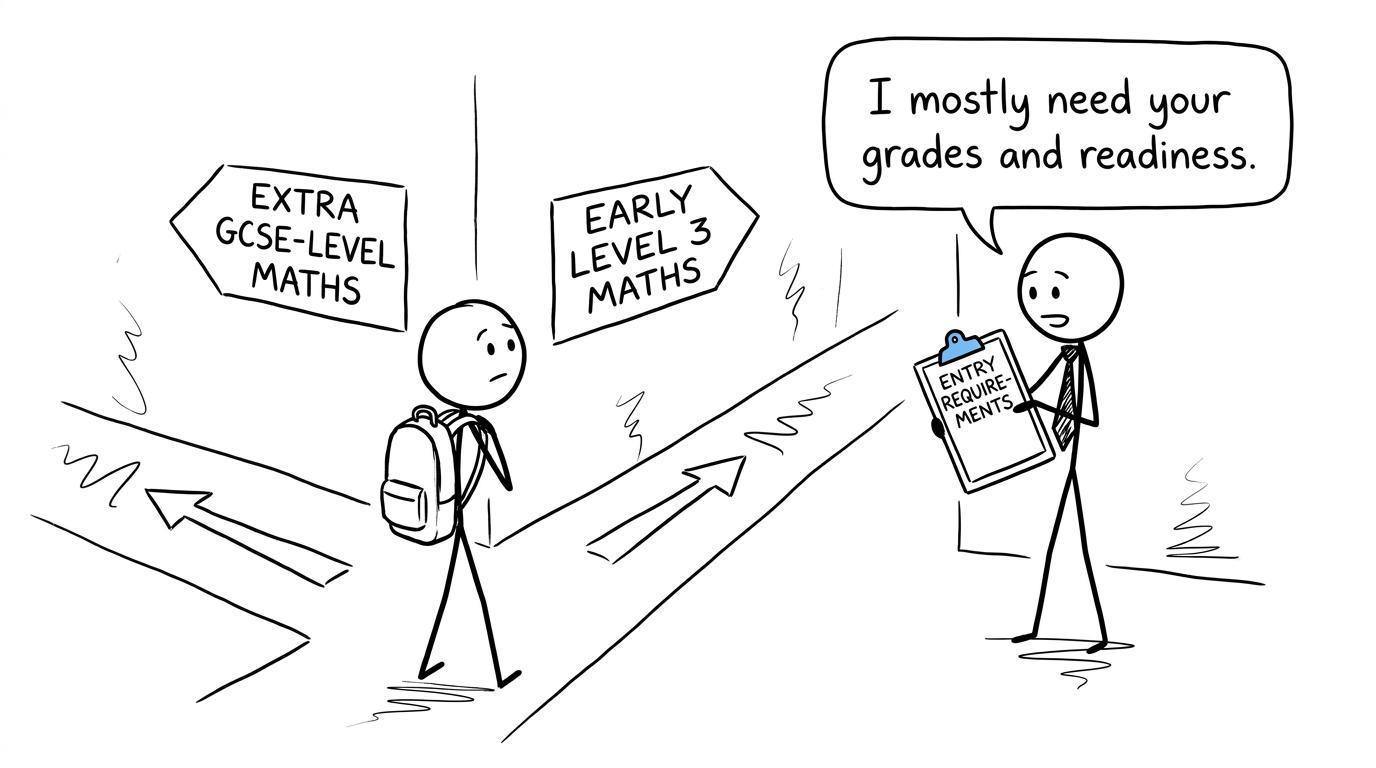 A student choosing between extra GCSE-level maths and early Level 3 maths while an admissions tutor checks entry requirements
What does GCSE Further Maths actually mean?
“GCSE Further Maths” is often used informally. You must check the qualification printed in your school’s options information because different courses can sit at different levels and follow different specifications.
One common route is the AQA Level 2 Certificate in Further Mathematics. AQA describes it as an additional qualification for students expected to achieve grades 777, 888 or 999 in GCSE Mathematics and who are likely to continue to A-level Mathematics, possibly alongside Further Mathematics. It is not intended to replace GCSE Mathematics.
The current AQA specification extends algebra, coordinate geometry and geometry while introducing ideas including calculus and matrices. It is an untiered Level 222 qualification assessed through two papers. This makes it a bridge beyond higher-tier GCSE content rather than an early completion of the full A-level course.
That distinction matters. A sixth form may see the qualification as useful evidence of mathematical interest and preparation, but its admissions policy may still state that entry depends on a particular GCSE Mathematics grade.
If your first priority is protecting that core result, use the GCSE Maths revision hub to choose your exam board and strengthen the higher-tier topics that underpin later study.
What counts as A-level Maths early entry?
Early entry means taking a qualification before the stage at which students normally complete it. In this context, it could mean sitting a standalone AS Mathematics qualification or completing the full A-level Mathematics qualification while still in Key Stage 444.
Those are not the same achievement. AS and A-level specifications are Level 333 qualifications, but a standalone AS is separate from the full A level. Ask your school for the exact qualification, exam board, examination series and certification plan rather than relying on the phrase “doing A-level maths early”.
A-level Mathematics also represents more than exposure to a few advanced topics. It requires connected knowledge, fluent algebra, mathematical reasoning and performance across a complete specification. Moving quickly is not the same as developing depth.
Students considering acceleration can inspect MathsGenie’s A-level revision guides and the Edexcel A-level Mathematics revision resources to understand the scale of Level 333 work. These pages should inform the decision, not become a reason to rush it.
Which qualification looks better to sixth forms?
Published requirements matter more than assumptions
Current sixth-form policies vary considerably. Recent admissions information from several English schools and colleges shows requirements ranging from grade 666 to grade 777 in GCSE Mathematics for A-level Mathematics, with grade 777 or grade 888 often requested for A-level Further Mathematics. Some providers also use an overall GCSE profile, an admissions test or higher grades when courses are oversubscribed.
These examples reveal the important pattern: there is no national admissions rule saying that early A-level Mathematics is preferred to Level 2 Further Mathematics, or vice versa.
A sixth form must apply its own published policy. If that policy requests grade 777 in GCSE Mathematics, an additional qualification may support your application but should not be assumed to replace the stated grade. Requirements can also change between admission years, so read the policy for your intended year of entry.
Further Maths often provides the cleaner story
For many strong GCSE students, a Level 222 Further Maths qualification tells a coherent story: you mastered higher-tier GCSE Mathematics, accepted additional challenge and began developing the algebra needed for Level 333 study.
That route can be attractive because it stretches understanding without pretending that the normal sixth-form sequence has already been completed. It may also fit more comfortably alongside the rest of a GCSE timetable.
This does not mean every sixth form awards it special status. Some may consider it as part of your overall academic profile; others may rely almost entirely on your GCSE Mathematics grade and standard admissions score. Its practical value is preparation first, application signal second.
Early A-level Mathematics can be impressive, but complicated
A strong early A-level result is clear evidence of advanced attainment. Yet “more advanced” does not automatically mean “better for admission”. It can create questions that Further Maths does not:
- Will the sixth form allow you to repeat A-level Mathematics?
- Would you move directly to A-level Further Mathematics?
- Does the provider offer a suitable class or progression route?
- Will universities later expect recent evidence of mathematical study?
- Has acceleration displaced breadth or weakened other GCSE grades?
The answers are provider-specific. Never assume that an early qualification guarantees a place, changes an offer or allows you to skip part of a sixth-form programme.
The most useful approach is to contact the head of mathematics or admissions team before entry. Give the exact qualification and ask for a written explanation of how it would be treated.
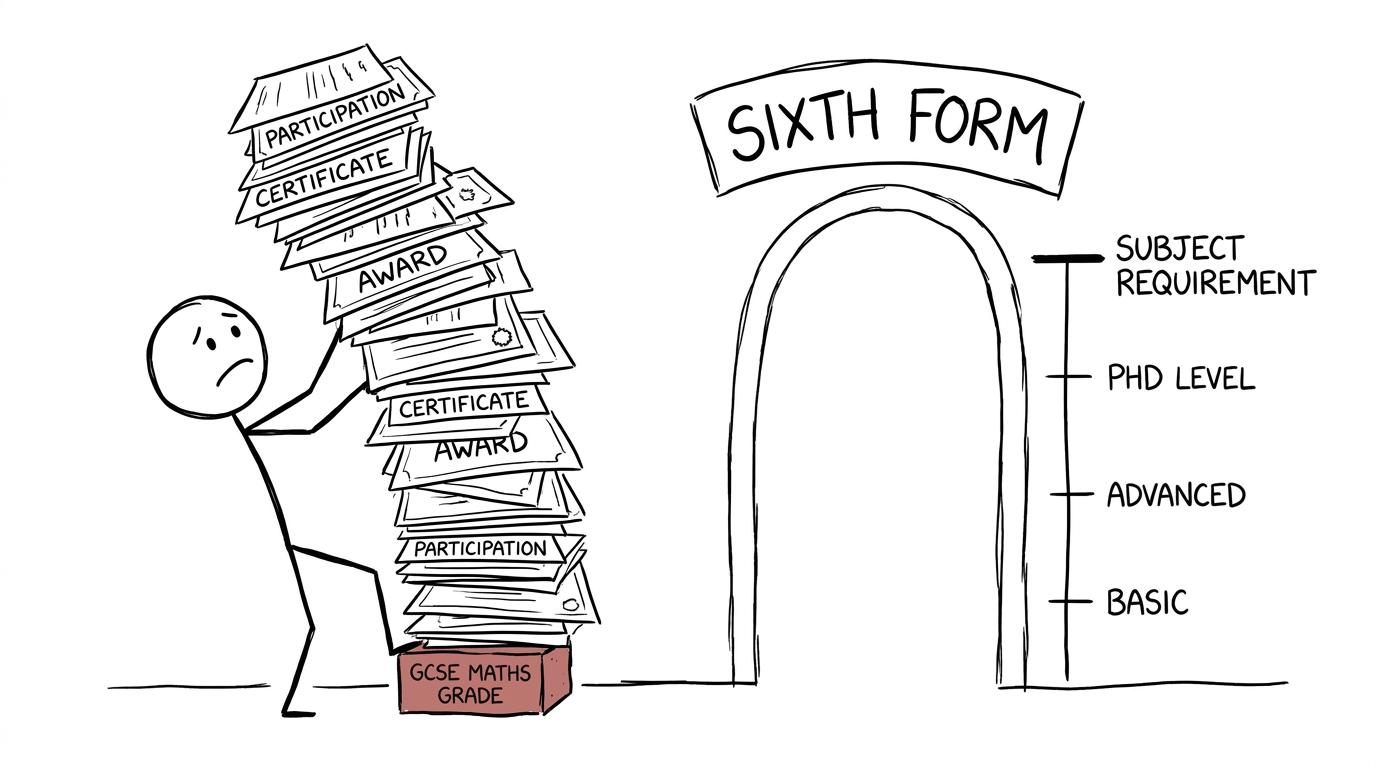 A tall tower of certificates balanced on the important GCSE Mathematics grade
Admission and mathematical preparation are different questions
Students often combine two questions:
- Which option helps me get an offer?
- Which option prepares me to succeed after I arrive?
The answers may differ.
For admission, the decisive evidence is likely to be the set of results named in the sixth form’s policy. For preparation, Further Maths can introduce unfamiliar ideas while reinforcing algebra, graphs, trigonometry and proof. A well-run early A-level course can go further, but it also demands more curriculum time and maturity.
The transition to Level 333 study is explained in MathsGenie’s GCSE to A-level curriculum guide. It is worth reading because sixth-form success depends on retaining and connecting methods, not simply reaching them early.
A qualification completed too quickly can produce a curious result: an impressive certificate accompanied by fragile knowledge. Months later, rearranging an expression or interpreting a graph may feel less secure than it should. Depth compounds. Gaps do too.
How to make the right choice for your application
Begin with the non-negotiable grade
Find the GCSE Mathematics requirement for each possible sixth form. If one asks for grade 777 and another asks for grade 888 for your preferred programme, plan around the higher threshold.
Your first objective is then simple: make that GCSE grade as secure as possible. Use the best order for learning GCSE Maths topics to repair prerequisite gaps before adding advanced content.
Ask sixth forms precise questions
Avoid asking, “Do you like early A levels?” Instead, ask:
- Does this qualification count towards the general entry profile?
- Does it alter the GCSE Mathematics requirement?
- If I already hold AS or A-level Mathematics, which maths course could I join?
- Would I still be eligible for A-level Mathematics and Further Mathematics?
- Are there tests or teacher assessments before course placement?
Specific questions produce useful answers. General questions often produce encouraging but non-binding replies.
Protect your whole GCSE profile
Admissions policies may consider several GCSE results, not one mathematical achievement in isolation. An accelerated course that consumes time needed for English, science or other options may weaken the application it was intended to strengthen.
Use the free MathsGenie revision planner to see whether the additional workload fits beside your existing revision. A plan should include recovery time, topic repair and paper practice rather than assuming every available hour can become another lesson.
Choose depth unless acceleration has a clear purpose
Early A-level entry makes most sense when you have already mastered GCSE Mathematics, have qualified teaching, can maintain your other subjects and know how the sixth form will continue your progression.
If any of those conditions is missing, Level 222 Further Maths is usually the more proportionate choice. It offers stretch while keeping the essential GCSE result at the centre.
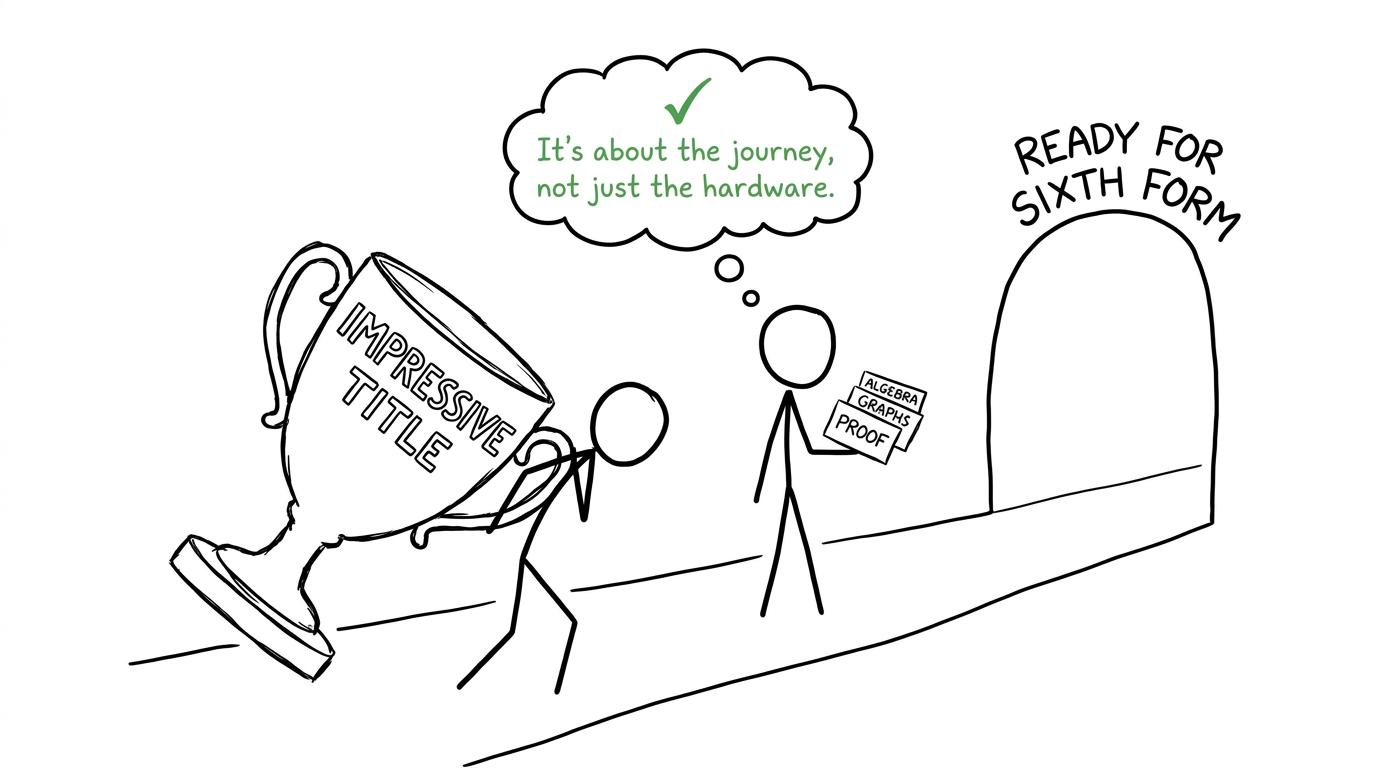 One student carries an impressive title while another builds algebra, graph and proof skills for sixth form
Common mistakes when comparing the two routes
Treating GCSE Further Maths as a full GCSE everywhere
The informal name can hide the qualification’s official title and level. Check the awarding body, specification and certificate before describing it on an application.
Assuming the harder-sounding option wins
Admissions decisions are governed by published criteria, available places and subject requirements. A Level 333 title does not automatically cancel a missing GCSE condition.
Entering early before GCSE knowledge is secure
Advanced topics depend on fluent algebra and mathematical reasoning. If acceleration lowers your GCSE Mathematics grade, the trade-off may be particularly unhelpful because that grade is commonly named in entry requirements.
Ignoring what happens after admission
An early result may affect course choice, timetabling or whether repeating content is permitted. Ask about progression before committing to the examination.
Collecting papers without learning from them
Past papers become valuable when you mark them, identify the reason for each lost mark and revisit the topic. Follow MathsGenie’s guide to using past papers properly rather than treating a completed paper as proof that revision happened.
Build the application on evidence, not labels
There is no universal winner in the GCSE Further Maths vs A-level Maths early entry sixth-form comparison. Most applicants should prioritise an excellent GCSE Mathematics result, a strong overall GCSE profile and genuine readiness for Level 333 work. Level 222 Further Maths is often the safer and more coherent extension. Early A-level Mathematics can be appropriate, but only with exceptional readiness and a confirmed progression route.
Start by reading each sixth form’s current admissions policy. Then ask your teacher and the receiving maths department how the exact qualification will be treated.
Finally, turn the decision back into daily progress. Use MathsGenie’s free revision lessons and practice questions to secure weak topics, mini tests to check retention, and past papers or predicted papers to test your methods under pressure. Mark with the mark schemes, use video solutions when a method remains unclear, and let the revision planner keep the workload realistic. The certificate may open a conversation. Your mathematical fluency is what will carry you through sixth form.