

GCSE Further Maths Revision Burnout: Avoid It
GCSE further maths revision burnout can be avoided. Spot early warning signs, build a sustainable plan and stay sharp for the exam season in May.
There is a dangerous kind of revision session that looks productive from the outside. The books are open. The desk is covered in paper. Three hours pass. Yet almost nothing sticks.
That is often how GCSE further maths revision burnout begins, not with a dramatic collapse, but with tiredness, fading concentration and the belief that the answer must be even more revision.
The better response is to reduce the strain and improve the quality. Use short, focused sessions, protect your sleep, practise questions actively and let mistakes decide what comes next. The aim is not to work at maximum intensity until May. It is to arrive at the examination able to think clearly.
Your burnout-prevention checklist
Keep this list visible as the exam season approaches:
- Choose one precise topic for each session.
- Stop when concentration has clearly fallen.
- Build breaks, meals, movement and sleep into the plan.
- Mark questions promptly and record specific errors.
- Alternate difficult work with lighter review.
- Increase timed practice gradually rather than sitting full papers every day.
- Keep at least one low-intensity evening each week.
- Tell a trusted adult if stress is affecting everyday life.
The free MathsGenie revision planner can help turn those principles into a visible weekly routine.
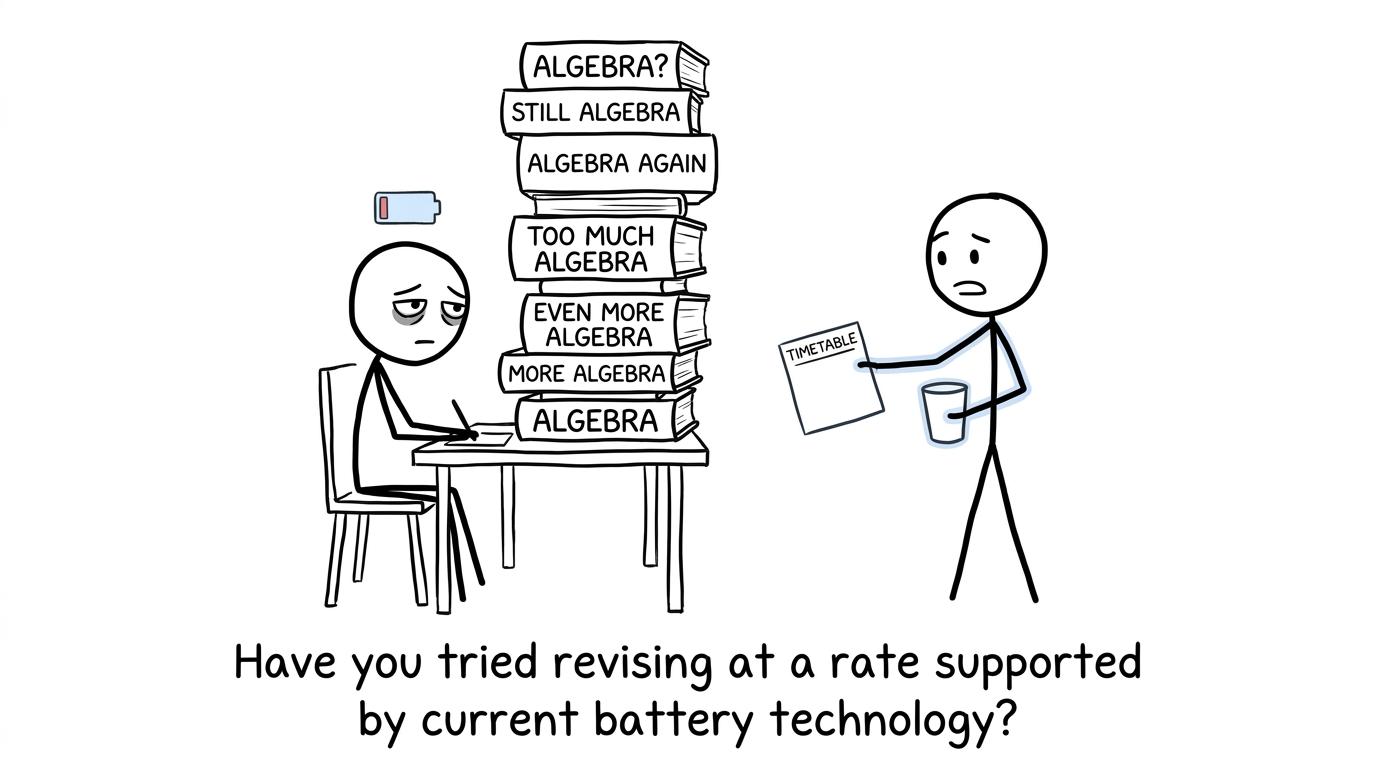 A tired student receives a timetable suited to their remaining battery
Why Further Maths can feel unusually heavy
Further Maths is often taken alongside GCSE Mathematics and a full set of other subjects. That creates a particular pressure: you may be learning unfamiliar material while also maintaining everything needed for your main GCSE papers.
The exact qualification matters. For example, AQA Level 222 Certificate in Further Mathematics is an untiered qualification intended as an additional mathematical challenge. Its content extends GCSE knowledge through areas including algebra, coordinate geometry, calculus, matrix transformations and geometry. OCR's FSMQ Additional Mathematics is a different Level 333 qualification with its own content and assessment structure.
So before planning revision, confirm the exam board, specification and paper format with your teacher. Do not assume that a friend's Further Maths timetable matches yours. If you take AQA, begin with the AQA GCSE Further Maths revision hub, where the relevant lessons, questions and papers are gathered together.
The difficulty is not simply that the material is advanced. Further Maths questions often connect several ideas. When you are tired, the first thing to disappear may be your ability to recognise that connection. More hours cannot always repair that. Better recovery sometimes can.
Early signs of GCSE further maths revision burnout
Burnout is easier to address when you notice the pattern early. One difficult evening is not proof that you are burning out. Look instead for changes that persist or repeatedly return.
Your concentration is becoming fragile
You read the same line several times, copy methods without processing them or make errors in skills you normally understand. You may spend longer at the desk while completing fewer useful questions.
Treat this as information, not a character judgement. End the session, take a proper break and return later with a smaller target.
Revision is becoming avoidance
Avoidance does not always look like doing nothing. It can look like reorganising folders, rewriting a timetable or watching several explanations without attempting a question.
A more useful starting instruction is deliberately small: open one topic, attempt one question without notes and mark it. MathsGenie's GCSE mini tests are useful when a complete paper feels too large.
Your mood and sleep are changing
Irritability, persistent worry, low mood, headaches, stomach discomfort and poor sleep can all accompany exam stress. NHS guidance says most teenagers need around 888 to 101010 hours of sleep and warns that all-night cramming is generally less useful than sleeping.
Revision is not separate from physical wellbeing. Sleep supports concentration; movement can clear your head; regular food and water make a long school day more manageable. These are not rewards you earn after finishing. They are part of preparation.
Nothing feels good enough
Further Maths attracts many students who are used to being successful at maths. A difficult calculus or algebra question can therefore feel like evidence that something has gone wrong.
It has not. The qualification is supposed to stretch you. Replace vague standards such as “master calculus tonight” with observable targets: complete a short question set, identify one recurring error and retry that skill after a gap.
How to pace revision without hitting a wall in May
A sustainable plan should have different gears. Not every session needs to be a timed paper, and not every day should carry the same load.
Set a repeatable weekly ceiling
Students often set a minimum amount of revision but never set a maximum. That makes the timetable expand whenever anxiety rises.
Decide in advance when your school-night revision ends. The correct ceiling depends on your workload, health and teacher guidance, but it should leave enough time to wind down and sleep. A plan you can repeat for several weeks is more valuable than one heroic weekend followed by three exhausted days.
The GCSE maths revision timetable guide explains how to balance topic work, exam questions and timed practice while leaving room for rest and catch-up.
Give each session one job
A focused session might follow this structure:
- Recall: retrieve key facts or methods without notes.
- Learn: use one short revision lesson if the method is unclear.
- Practise: attempt a manageable set of questions.
- Mark: use the mark scheme or video solution.
- Repair: write one precise correction and schedule a retry.
This is more efficient than moving randomly between matrices, differentiation, trigonometry and factorisation. A session should finish with evidence of what changed.
Use difficulty waves
Do not place your three hardest topics back-to-back. Follow a demanding session with a shorter review of something more secure. Across a week, alternate new learning, retrieval, topic practice and timed sections.
This is not lowering your ambition. It is managing cognitive load so that hard work remains genuinely hard rather than merely long.
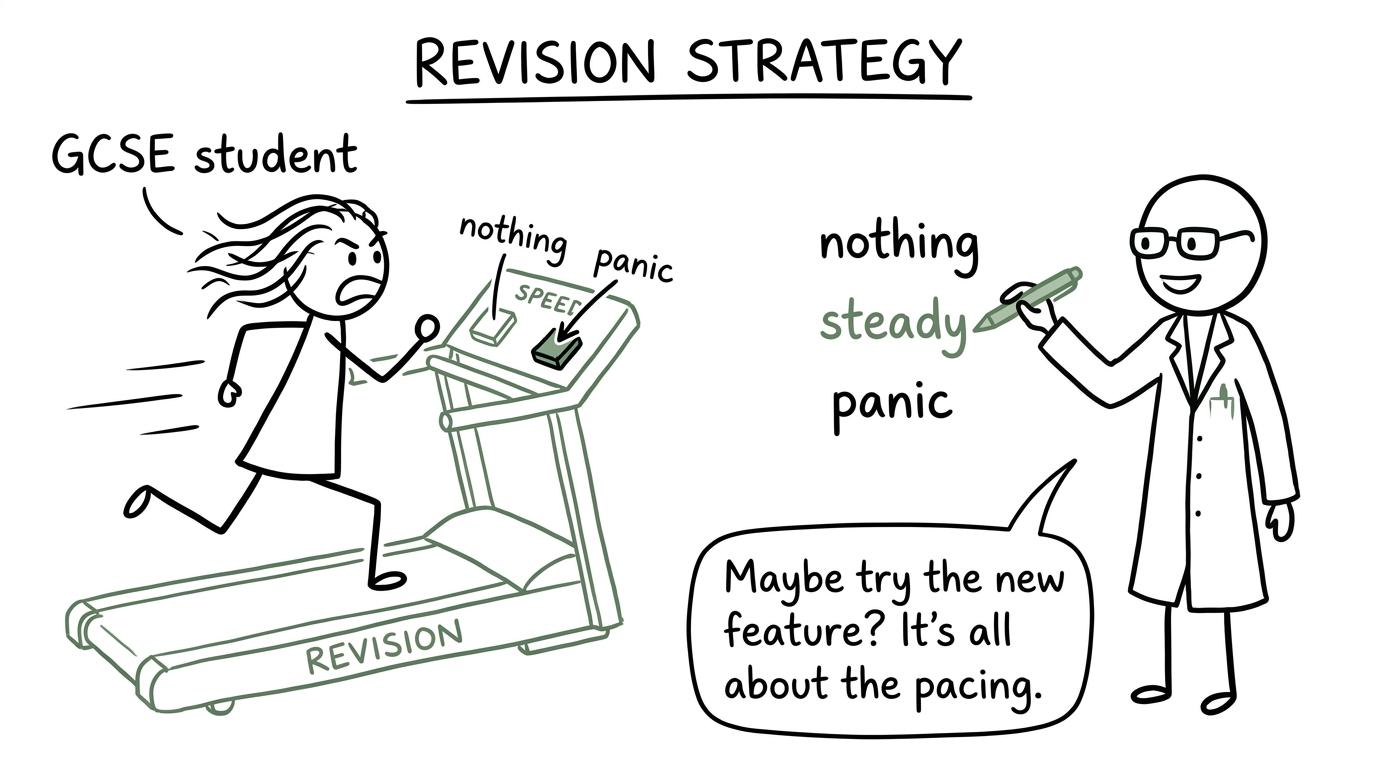 A revision treadmill gains a sensible steady setting between nothing and panic
Let evidence choose the topic
Anxiety says everything needs attention immediately. A marked paper gives a narrower answer.
Use the approach in MathsGenie's guide to finding your weakest GCSE topics: classify lost marks by topic and cause. Distinguish between:
- a missing method;
- failure to recognise which method was needed;
- an accuracy error;
- incomplete working;
- poor use of time.
Then revise the two or three patterns responsible for repeated losses. This makes the workload finite.
Build towards papers instead of living inside them
Full papers matter because they develop timing, stamina and decision-making. But doing them too frequently can produce a pile of marks without enough repair.
Begin with topic questions and short timed sections. Move towards full AQA Further Maths past papers as your knowledge becomes more secure. After each paper, spend enough time reviewing it: check the mark scheme, use video solutions where available and reattempt selected questions after a gap.
A paper is not only a score. It is a diagnostic instrument. If you immediately start another without addressing the errors, you are measuring the same weaknesses twice.
As May approaches, the balance can shift towards mixed and timed work. The one-month GCSE maths revision plan offers a useful structure that can be adapted around your Further Maths specification and your other subjects.
What to do when you already feel burnt out
First, stop trying to repay an imaginary revision debt in one night. A missed session is not fixed by sacrificing sleep.
Reduce the next task until it feels startable. That might mean marking work already completed, watching one short revision lesson or attempting a few questions from a familiar topic. Then rebuild gradually.
Also speak to someone. A parent, carer, teacher, head of year, school counsellor or GP can help if stress is persistent, severe or interfering with sleep, eating, school or normal daily life. If you feel unsafe or think you may hurt yourself, tell a trusted adult immediately and seek urgent support through emergency or crisis services.
This article offers revision guidance, not medical advice. Asking for help is not abandoning your exam goal. It is protecting the person who has to sit the exam.
Common mistakes that make burnout worse
Measuring revision only in hours
Time at a desk is not the same as useful practice. Track completed questions, corrected misconceptions and successful retries instead.
Revising only the topics you enjoy
Comfortable algebra can create the feeling of progress while matrices or calculus remain untouched. Use marked work to divide time fairly.
Treating every mistake as a crisis
Mistakes made during practice are useful because they arrive before the examination. Record the cause, correct it and return to it later.
Completing papers without reviewing them
The learning often happens after the timer stops. Mark schemes and video solutions show where methods earned marks and where working became unclear.
Removing every enjoyable activity
Dropping exercise, hobbies and time with friends may create more hours but less concentration. Recovery should appear on the timetable, not depend on spare time magically appearing.
Continuing late because stopping feels guilty
Set a finishing time before the session begins. Tomorrow's concentration is part of today's revision decision.
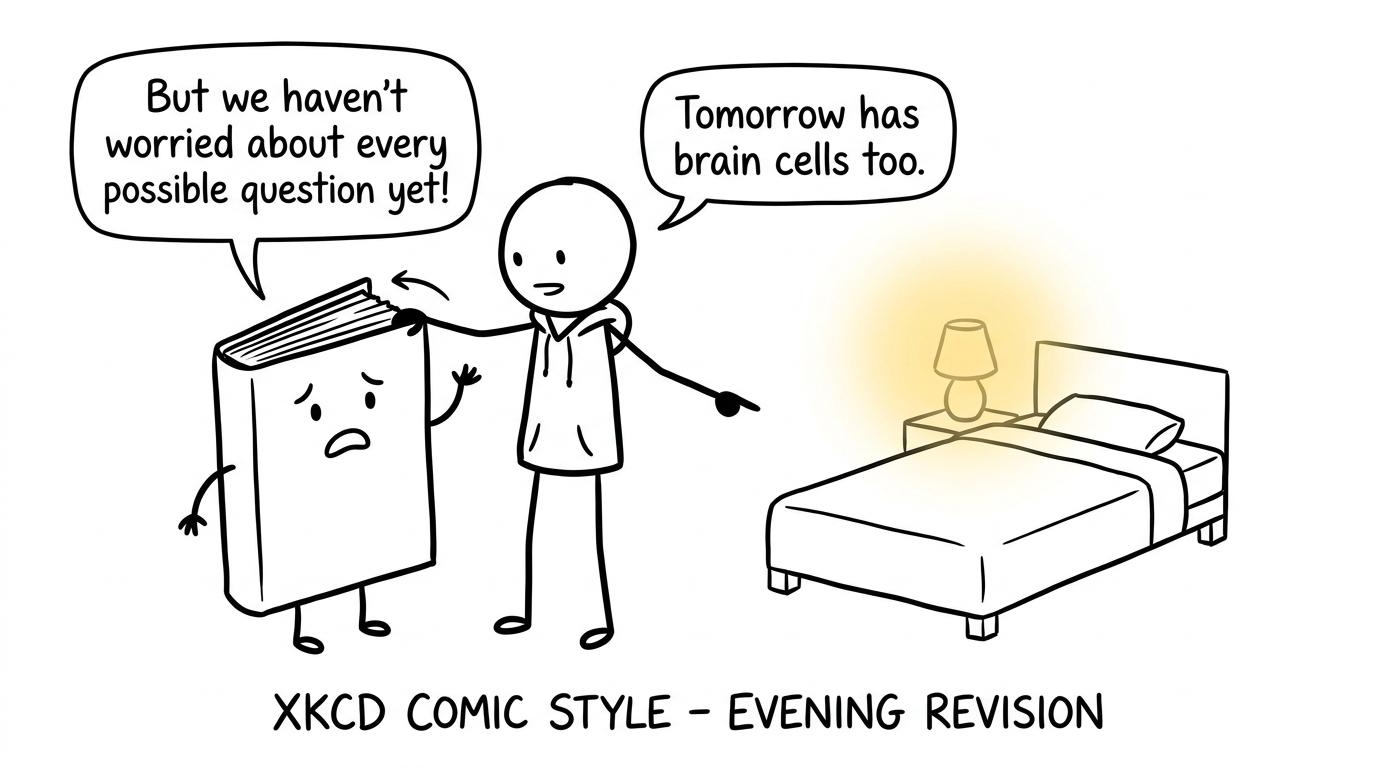 A student reminds an anxious revision book that tomorrow also has brain cells
Arrive with something left
Further Maths rewards careful algebra, connected thinking and persistence. Those qualities are difficult to access when every reserve has already been spent.
The goal is not to reach May having completed the greatest possible volume of revision. It is to reach the examination knowing your methods, understanding your common errors and having enough energy to respond to an unfamiliar problem.
Start with the free MathsGenie AQA Further Maths resources. Choose one revision lesson, complete focused practice questions and check the mark scheme or video solution. As confidence grows, add mini tests, past papers and predicted papers where available. Put the sessions into the revision planner, and put the stopping times there too.
Steady revision rarely feels dramatic. That is its strength. It keeps working long after panic has run out of energy.










