GCSE Further Maths Mock Results: Use Them Properly
GCSE further maths mock results become a focused revision plan. Learn to analyse lost marks, rank weak topics and retest progress with confidence.
A mock result can change the atmosphere of an entire afternoon. A pleasing grade brings relief; a disappointing one can make months of effort feel invisible. Yet neither reaction tells you what to do next.
The real value of GCSE further maths mock results is not the grade on the front. It is the evidence inside: which topics cost marks, why those marks disappeared and which changes could recover them. Read properly, your marked paper becomes a personalised revision plan.
The short answer is simple: ignore the urge to judge yourself, analyse every lost mark, group the losses by cause, prioritise the most recoverable areas and retest them with fresh questions.
Your mock-results checklist
Before beginning more revision, complete these steps:
- Confirm the qualification, specification and papers used in your mock.
- Record your raw mark for each paper, not only the estimated grade.
- Mark every lost mark by topic and reason.
- Separate knowledge gaps from execution and exam-technique errors.
- Choose no more than three immediate revision priorities.
- Use targeted questions before attempting another full paper.
- Retest the same skills without notes.
- Compare like with like when measuring progress.
That sequence turns a result from a verdict into a feedback loop.
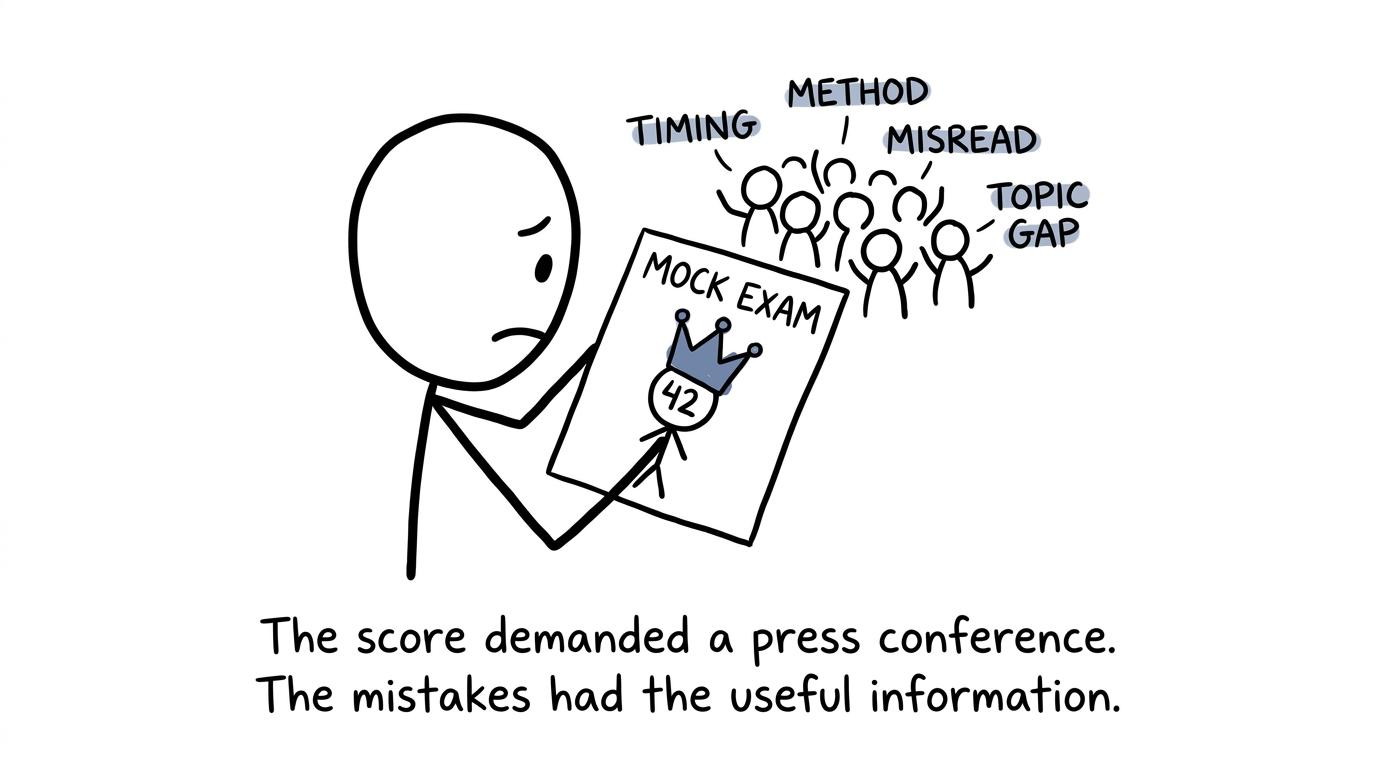 A mock score attracting attention while useful clues wait behind it
First, know which qualification you are taking
Students and schools often use “GCSE Further Maths” as a convenient description, but the formal qualification can vary. Confirm the awarding organisation and specification with your teacher before comparing marks, paper formats or grades.
For example, the current AQA Level 2 Certificate in Further Mathematics, specification 836583658365, is graded from 555 to 999. It has two equally weighted papers: Paper 111 is non-calculator and Paper 222 is calculator. Each lasts 111 hour 454545 minutes and carries 808080 marks. Content from across the specification can appear on either paper.
Other Level 2 qualifications may use different assessment structures and grading systems. Pearson Edexcel's Extended Mathematics Certificate, for instance, is not graded on the same 999 111 scale. This is why an isolated statement such as “I got 62%62\%62% in Further Maths” is not enough to make a reliable comparison.
Your school may also create a mock from several papers, shorten the official time or use its own provisional grade boundaries. A mock grade is therefore an informed school judgement, not an official summer result.
Start by writing down:
- the exact qualification and specification;
- whether the paper was calculator or non-calculator;
- the paper's total marks and time limit;
- whether it was a complete official-style paper;
- how your school produced the reported grade.
If you take AQA, the AQA GCSE Further Maths past papers collection provides papers, mark schemes and worked solutions where available.
Read the raw marks before reading the grade
A grade compresses a large amount of information into one symbol. That is useful for summarising performance, but poor for planning tomorrow's revision.
Official grade boundaries can vary between exam series because awarding bodies consider the demand of the papers. Your mock boundary may be based on a previous series or a boundary chosen by your school. Treat it as an estimate rather than a permanent conversion between a percentage and a grade.
Record your paper percentage using:
Paper percentage=marks achievedmarks available×100\text{Paper percentage}=\frac{\text{marks achieved}}{\text{marks available}}\times 100Paper percentage=marks availablemarks achieved×100Then keep the calculator and non-calculator results separate. A similar total can conceal very different needs. Weak algebraic fluency may become more visible without a calculator, while poor checking or inefficient calculator use can damage the calculator paper.
Also record where you stopped working comfortably. If the final section was mostly blank, the issue may involve timing or confidence with higher-demand questions rather than complete ignorance of every topic involved.
Turn every lost mark into a useful category
Looking at the correct answer and thinking “that makes sense” is not analysis. You need to explain why your answer did not earn the mark.
Use four categories.
Knowledge gap
You did not know the required fact, definition, notation or method. Perhaps you could not begin a matrix transformation, differentiation question or algebraic proof.
This requires relearning followed by focused practice. Watching a solution alone is insufficient because recognition is easier than independent recall.
Method-selection error
You understood the topic but chose an unsuitable route. You may have used a familiar GCSE method where the question required a more advanced Further Maths technique.
The repair is to practise identifying clues in question wording. Ask: what information was supplied, what result was requested and which method connects them efficiently?
Execution error
You selected a valid method but made an algebraic, arithmetic, notation or calculator mistake. These errors can look “silly”, but repeated slips are patterns, not bad luck.
Write the exact pattern: dropped negative sign, incomplete factorisation, incorrect matrix order, premature rounding or substitution into the wrong expression.
Exam-technique error
You misread the command, omitted working, gave insufficient justification, ran out of time or left a result in the wrong form. Mark schemes reward mathematical evidence, not an answer you nearly produced mentally.
Use the mark scheme to see where credit was available. Then compare it with your written working rather than merely checking the final answer.
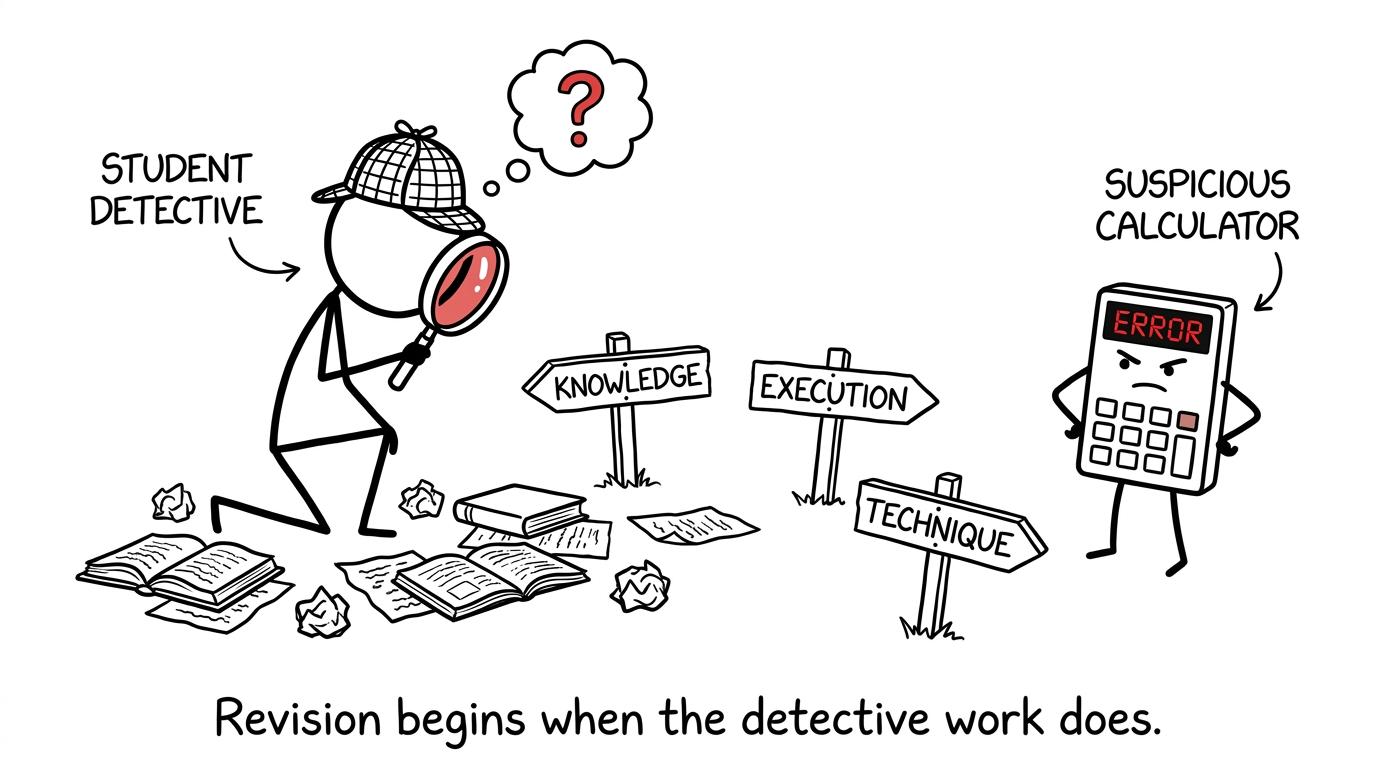 A student detective investigating knowledge, execution and technique errors
Build a marks-leak list
Now group errors by topic. Avoid labels that are too broad. “Algebra” is difficult to act upon; “factorising cubic expressions using the factor theorem” is specific enough to revise.
For each topic, record:
- marks available;
- marks lost;
- dominant error category;
- whether the problem appeared more than once;
- the next revision action;
- the date you will retest it.
A simple priority measure is:
Recovery priority=marks lost×frequency×recoverability\text{Recovery priority}=\text{marks lost}\times\text{frequency}\times\text{recoverability}Recovery priority=marks lost×frequency×recoverabilityYou do not need a sophisticated numerical scale. The principle matters: repeated, fixable losses deserve attention before one extremely difficult final question worth few marks.
For broader diagnostic advice, read how to find your weakest GCSE maths topics. Although Further Maths extends beyond standard GCSE content, the same evidence-led process applies.
Choose what to revise next
Select three priorities:
- one significant knowledge gap;
- one repeated execution pattern;
- one exam-technique problem.
This balance matters. Revising only unfamiliar content ignores marks lost through unreliable working. Revising only easy mistakes may leave a major topic untouched.
Some Further Maths errors also reveal a weakness in underlying GCSE Higher Maths. If polynomial manipulation breaks down because factorising is insecure, repair the foundation first through the GCSE maths revision hub. You can then return to the Further Maths application without carrying the same weakness forward.
A focused session should follow this cycle:
- recall the method without notes;
- use a revision lesson or video if recall fails;
- complete targeted practice questions;
- mark them immediately;
- write one precise correction rule;
- attempt a fresh question later without support.
The GCSE twenty-minute revision routine can help when schoolwork makes longer sessions unrealistic.
Retest instead of assuming the problem is fixed
A corrected question does not prove that you have learnt the skill. You have just seen its route and answer, so immediate success may partly reflect short-term memory.
Retest with a different question after a gap. Begin with targeted practice, then move to a timed section and finally a complete paper. MathsGenie's guide to starting GCSE past papers explains how diagnostic work and full-paper practice can fit together.
Measure progress using more than the total mark:
- Did the targeted topic improve?
- Did the same error category return elsewhere?
- Did you complete more of the paper?
- Was your working clearer?
- Did performance hold under timed conditions?
When using standard GCSE papers to strengthen prerequisite skills, choose your own board and tier. The AQA GCSE Maths past papers, for example, are useful for testing Higher Maths foundations, but they do not replace qualification-specific Further Maths papers.
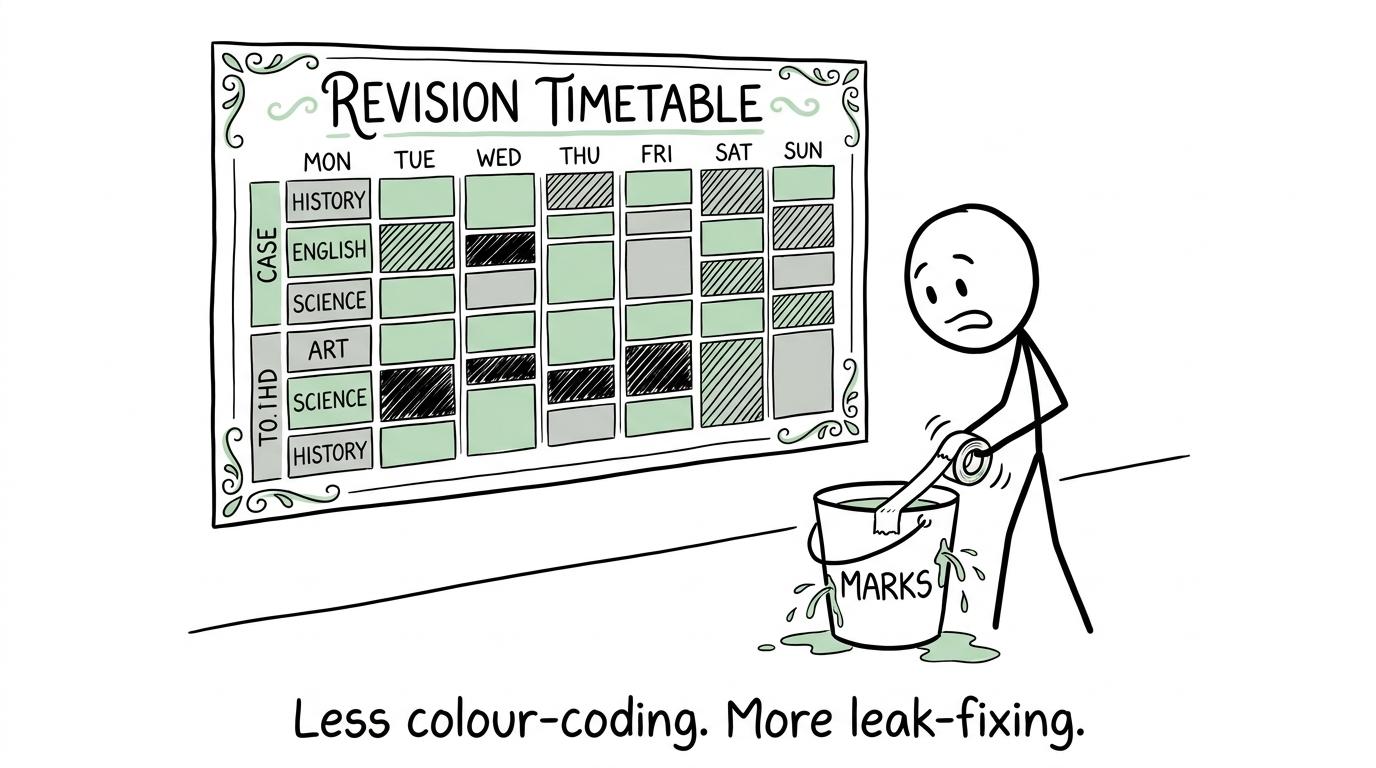 A student fixing leaks in a marks bucket instead of decorating a timetable
Common mistakes when using mock results
Fixating on the estimated grade
A grade describes the whole performance but does not identify the next task. Keep it in perspective and work from question-level evidence.
Revising every weak topic at once
A long list creates motion without priority. Start with three areas where improvement is both valuable and realistic.
Copying corrections passively
Neat copied solutions can create familiarity without recall. Close the solution, reproduce the method and then answer a different question.
Treating all lost marks as knowledge gaps
Some marks disappear because of timing, notation, incomplete reasoning or inaccurate execution. Each cause needs a different repair.
Comparing incompatible scores
Do not compare a shortened school paper with a complete official paper as though the percentages mean exactly the same thing. Match the qualification, calculator conditions, time and paper demand where possible.
Repeating full papers without targeted repair
Another paper may confirm the same weakness without fixing it. Use topic practice between papers, then return to timed assessment.
From mock result to better evidence
A mock result is a photograph, not a forecast. It records what happened on one paper, under one set of conditions, on one day. Its usefulness depends on what you do after receiving it.
Open the script. Classify the lost marks. Choose three repairs. Practise them, mark them and retest them with unfamiliar questions. When the weaknesses become more stable, return to the AQA GCSE Further Maths past papers and test the whole process under realistic conditions.
MathsGenie gives you a free route from diagnosis to improvement: revision lessons for methods, practice questions for accuracy, mark schemes and video solutions for correction, and past papers, predicted papers and mini tests for checking progress. If Further Maths is also preparing you for your next qualification, the A Level maths revision hub is ready when you are.
Do not ask only, “What grade did I get?” Ask the more useful question: “What does this paper tell me to change next?” Then let MathsGenie help you make that change.