GCSE Further Maths Grade Boundaries Explained
GCSE further maths grade boundaries explained: learn why raw marks change each year, how boundaries are set, and how to use past papers wisely in revision.
You finish a Further Maths paper, add up your marks and turn the result into a percentage. It feels as though the grade should now be obvious. Yet the same raw mark can produce a different grade from one year to the next.
The short answer is that grades are not assigned using permanent percentage thresholds. GCSE further maths grade boundaries explained properly means understanding that exam boards set minimum raw marks after the papers have been taken and marked. They consider the demand of that year's assessment, statistical evidence and the standard of students' work. Your percentage describes your score; the confirmed boundary determines your grade.
Before looking at individual figures, keep this checklist in mind:
- Check the exact qualification and specification, not just the words “Further Maths”.
- Use the boundaries from the correct exam board, year and exam series.
- Add the marks from every required paper before judging the final grade.
- Treat previous boundaries as useful context, not future promises.
- Build a revision target with some protection above an old boundary.
What a Further Maths grade boundary actually means
A grade boundary is the minimum total raw mark required for a grade in a particular examination series. A raw mark is simply the number of marks awarded by examiners before it is translated into a qualification grade.
For a qualification with two papers, the subject mark is generally formed by combining them:
subject raw mark=Paper 1 raw mark+Paper 2 raw mark\text{subject raw mark}=\text{Paper 1 raw mark}+\text{Paper 2 raw mark}subject raw mark=Paper 1 raw mark+Paper 2 raw markA percentage can still be calculated:
percentage=raw markmaximum mark×100\text{percentage}=\frac{\text{raw mark}}{\text{maximum mark}}\times 100percentage=maximum markraw mark×100But that percentage has no universal grade attached to it. There is no permanent rule saying that a particular percentage must always equal a particular grade. The relevant exam board's confirmed subject-level boundaries provide the conversion.
This is also why you should read the table carefully. The exact boundary mark earns that grade; a mark immediately below it belongs to the next available grade down.
MathsGenie's broader guide to how GCSE grade boundaries work explains the same principle for standard GCSE subjects.
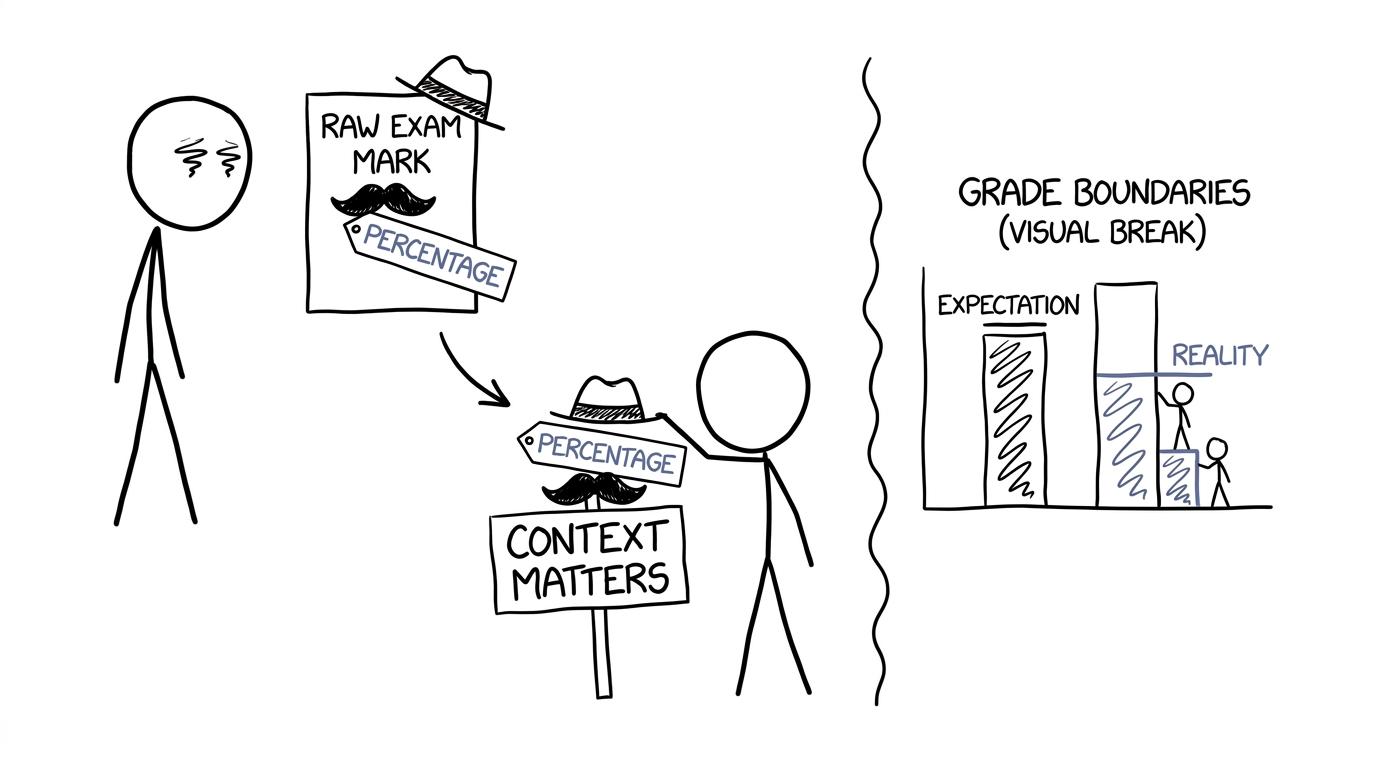 A raw exam mark tries to disguise itself as a percentage while an examiner reveals that context matters
“GCSE Further Maths” can mean different qualifications
There is an important detail hidden inside the name. Students and schools often say “GCSE Further Maths” informally, but the official qualification may have a different title.
For example, AQA's qualification is the Level 2 Certificate in Further Mathematics, specification 836583658365. Other awarding organisations offer their own Level 2 or additional mathematics qualifications, with different structures, content and grading arrangements. OCR's Free Standing Mathematics Qualification in Additional Mathematics is not interchangeable with AQA's certificate, while Pearson qualifications must also be checked by their exact specification title.
That means an AQA table cannot be used to interpret a result from another awarding organisation. It is not enough to search for “Further Maths boundaries” and take the first figure you see.
Confirm all of the following:
- the awarding organisation;
- the qualification title;
- the specification code;
- the examination series;
- the total maximum mark;
- the grading scale used by that qualification.
This matters because ordinary GCSE Mathematics has its own foundation and higher tiers, whereas the structure of a Level 2 Further Mathematics qualification is different. If you want to compare the systems, use the dedicated AQA GCSE Maths grade boundary tables rather than assuming the same rules apply.
The latest AQA Further Maths boundaries in context
At the time of writing, the latest published summer boundaries are for June 202520252025. AQA's Level 2 Certificate in Further Mathematics had a maximum subject mark of 160160160, formed from two papers worth 808080 marks each.
The confirmed overall boundaries were:
| Grade | Minimum subject raw mark |
|---|---|
| 999 | 141141141 |
| 888 | 127127127 |
| 777 | 113113113 |
| 666 | 959595 |
| 555 | 787878 |
| 444 | 696969 |
These are subject-level boundaries. AQA also publishes notional component boundaries for individual papers, but those are illustrative rather than separate grades that students must achieve. The overall subject mark is what determines the qualification grade.
The table should therefore be read as a historical record of June 202520252025, not as a forecast for the next examination series. MathsGenie's AQA Further Maths past papers let you practise the complete assessment and compare your combined mark with the boundary from the year in which that paper was sat.
Why the same mark can produce a different grade
Exam papers are designed to be comparable, but no two sets of questions can be perfectly identical in demand. One series may contain an unfamiliar algebraic arrangement that many strong candidates find awkward. Another may present the same underlying skill more directly.
If the boundary never moved, students taking the more demanding paper could be unfairly disadvantaged. Grade boundaries allow the awarding process to preserve the standard represented by each grade rather than preserving an arbitrary percentage.
Official guidance from AQA and the qualifications regulator explains that boundaries are set after the assessments have been marked. Senior examiners and assessment experts consider several forms of evidence, including:
- how demanding the papers proved to be;
- statistical information about the cohort;
- samples of current students' work around possible boundaries;
- evidence from previous examination series;
- the standard of performance expected for each grade.
This process is sometimes described through the principle of comparable outcomes. Broadly, a student demonstrating the same standard should receive the same grade regardless of whether the paper was slightly harder or easier than the previous year's paper.
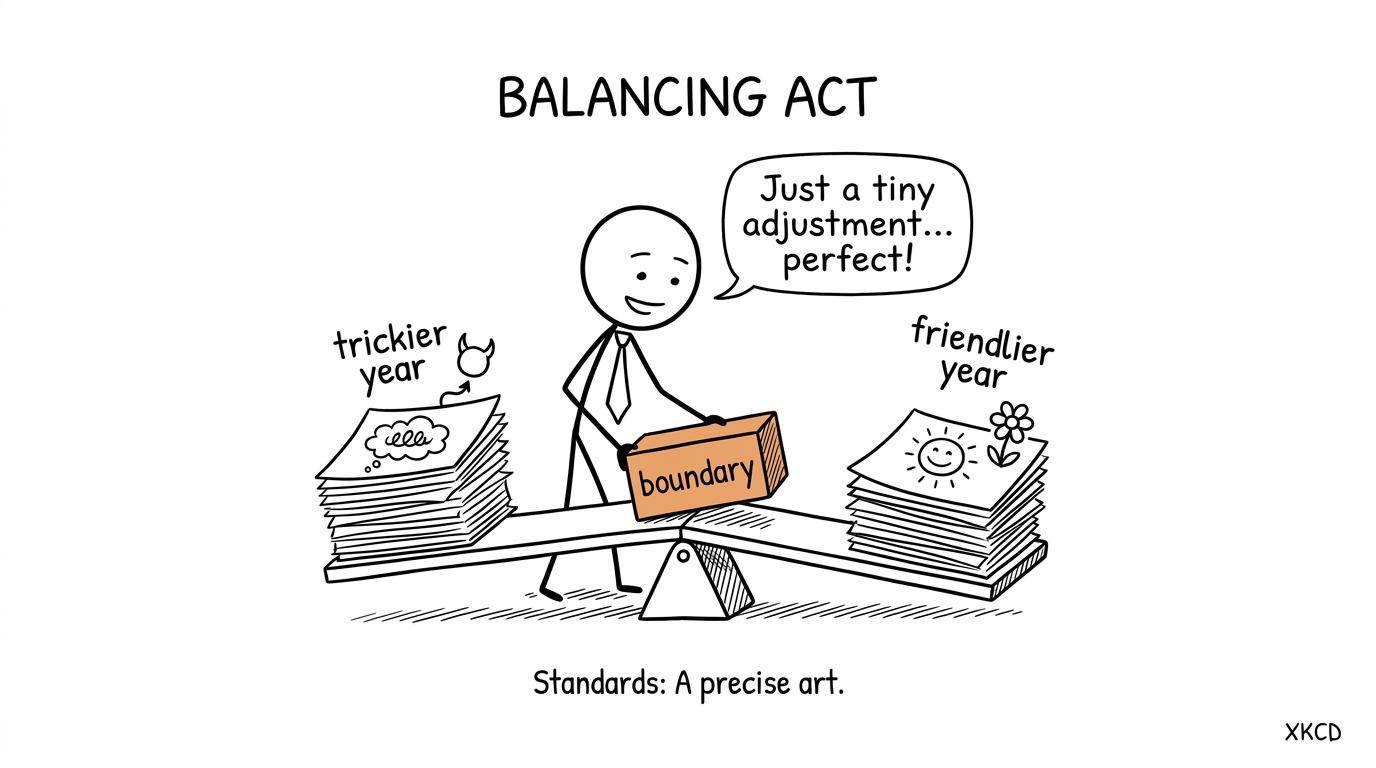 An examiner balances a trickier paper and a friendlier paper by adjusting the grade boundary
Grade boundaries are not a simple ranking system
It is tempting to imagine that exam boards decide in advance that only a fixed percentage of candidates may receive each grade. That is not an accurate description of the awarding process.
Statistical evidence helps examiners judge where potential boundaries may lie, but expert judgement and scrutiny of actual student work also matter. If a cohort is stronger, the system does not require examiners to remove high grades merely to preserve an inflexible quota.
Nor is a boundary chosen by looking only at the average mark. An average says something about the whole distribution; a grade boundary identifies the minimum performance associated with a particular standard. Those are different questions.
The crucial distinction is simple:
- a raw mark records how many marks you earned;
- a percentage expresses that mark as a fraction of the available total;
- a grade boundary translates the total into a grade for that specification and series.
Why boundaries cannot be known before the exam
The exact boundaries cannot be confirmed before students sit the papers because examiners do not yet have the evidence showing how demanding those papers were in practice.
Predictions may estimate a likely range using previous years, but no teacher, revision website or social media account can know the final figures in advance. Confirmed boundaries are published on results day after marking and awarding have taken place.
This is why spending revision time guessing whether a boundary will rise or fall rarely helps. The questions under your control are more useful: Which topics still cost you marks? Are errors caused by knowledge, algebra, notation or time pressure? Can you reproduce your method without looking at a solution?
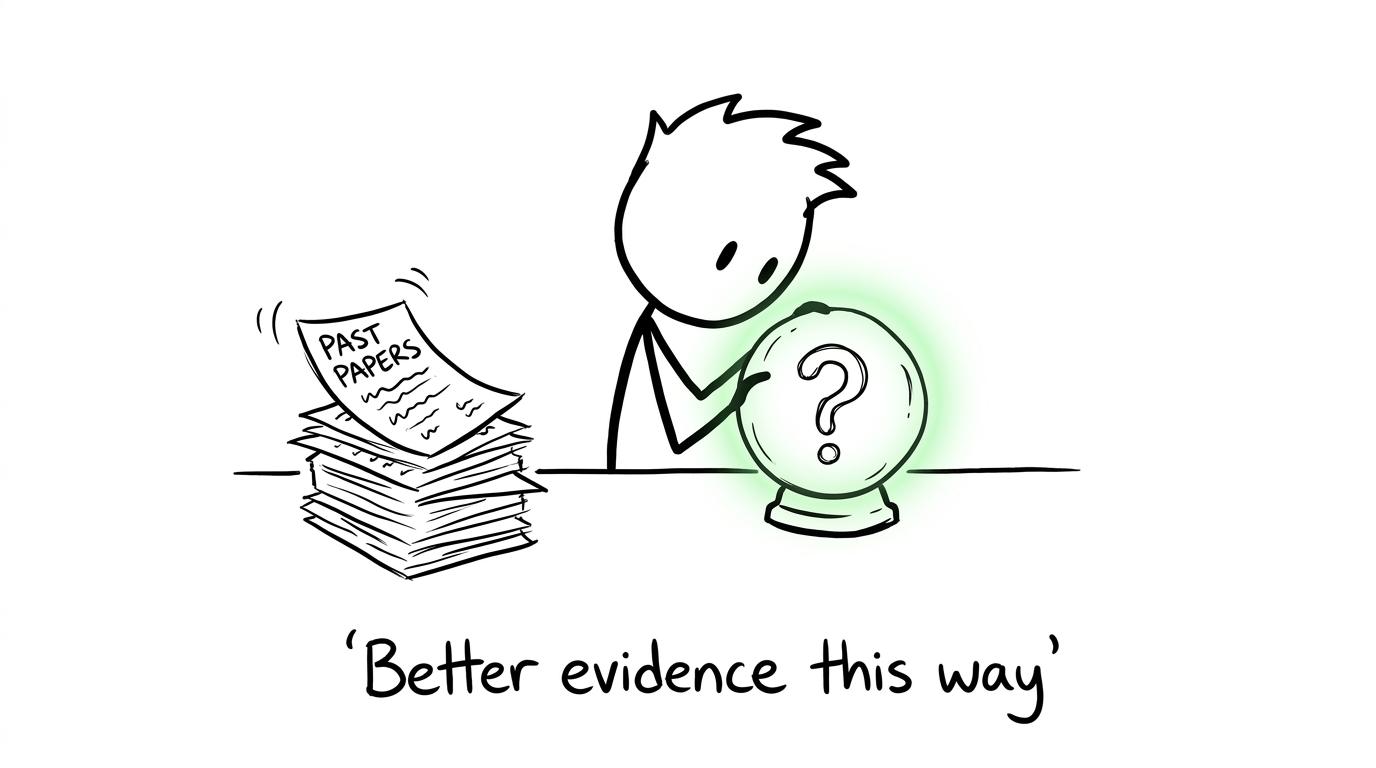 A student abandons a grade-boundary crystal ball and turns towards a useful pile of past papers
How to use old boundaries without misleading yourself
Past boundaries are valuable when paired with the matching paper. Complete an assessment under timed conditions, mark it carefully and compare your total with the official boundary for that same series.
A reliable review cycle looks like this:
- Complete both papers under realistic conditions.
- Use the mark scheme rather than awarding marks for an answer that merely “looks close”.
- Combine the paper marks into the full subject total.
- Compare the total with that paper set's confirmed boundaries.
- Record weak topics and return to targeted revision.
- Reattempt missed questions after enough time has passed.
Do not build your plan around scraping over an old threshold. Boundaries move, marking mistakes happen and performance varies between papers. A sensible working target includes a cushion above the historical boundary while keeping the main focus on mathematical understanding.
You can also consult MathsGenie's guide to GCSE maths marks per grade for a clear explanation of why previous thresholds are evidence rather than guarantees. The AQA GCSE grade boundaries hub is useful when checking that you have selected the correct subject and series.
Common mistakes when reading Further Maths boundaries
Treating a familiar percentage as a guaranteed grade
School assessments sometimes use fixed percentage bands for convenience. Official qualification grades are based on the boundary table for the relevant examination series, not a universal classroom scale.
Looking at one paper in isolation
Notional paper boundaries can help describe performance, but the final grade is based on the combined subject mark. A difficult first paper can be offset by a stronger second paper.
Using standard GCSE Maths boundaries
GCSE Mathematics and Level 2 Further Mathematics are separate qualifications. They have different papers, maximum marks and candidate groups. Even comparisons between AQA and Eduqas GCSE Maths boundaries show why figures from different specifications cannot safely be mixed.
Using the wrong year
A boundary belongs to one examination series. Comparing a June paper with a table from another year creates a false grade estimate.
Assuming a high boundary means unfair marking
A higher boundary usually indicates that candidates found the assessment more accessible relative to the expected standard. A lower boundary commonly reflects a more demanding paper. Neither automatically means that marking was harsher or more generous.
Predicting boundaries from online reactions
Comments after an exam come from a self-selecting group and cannot replace marked scripts, national data and examiner judgement. They may describe how some students felt, but they do not establish a boundary.
Revise for marks, not rumours
Grade boundaries matter on results day, but they should not dominate the weeks before it. You cannot control where the final line is drawn. You can control how often you practise algebra, how accurately you show reasoning and how honestly you mark a paper.
Start with AQA Further Maths past papers, then use MathsGenie's free revision lessons, practice questions, mini tests, mark schemes and video solutions to repair the topics costing you marks. Add predicted papers when available, and use the revision planner to turn broad intentions into specific sessions.
A percentage is only a snapshot. Consistent, well-reviewed practice is what makes the next snapshot better.