GCSE Maths Results Day: AQA vs Eduqas Boundaries
GCSE maths AQA vs Eduqas grade boundaries compared for 2025, with tier tables, results-day guidance and practical revision targets for students and teachers.
Results day has a strange way of turning one mark into the only mark that matters. A student may remember hundreds of calculations from the course, yet their attention narrows to a single question: was the total enough?
For anyone comparing GCSE maths AQA vs Eduqas grade boundaries, the short answer is that the raw boundaries can look dramatically different. In summer 202520252025, for example, a higher-tier grade 777 required 164164164 marks with AQA but 115115115 with Eduqas, both out of 240240240. That does not mean Eduqas was easier. Boundaries adjust for the demand of each board's papers and must be read within the relevant exam series.
This guide compares the latest completed summer series, explains what the figures mean and shows how to use them sensibly before GCSE maths results day.
The comparison at a glance
Before looking at the tables, keep four points in mind:
- The figures below are official overall subject boundaries from summer 202520252025.
- Both qualifications had a maximum total of 240240240 marks.
- Foundation tier awards grades 111 to 555; higher tier awards grades 444 to 999, with grade 333 available for candidates narrowly below grade 444.
- Boundaries for a future exam series cannot be known in advance.
You can also check the complete AQA GCSE maths grade boundaries and Eduqas GCSE maths grade boundaries on MathsGenie.
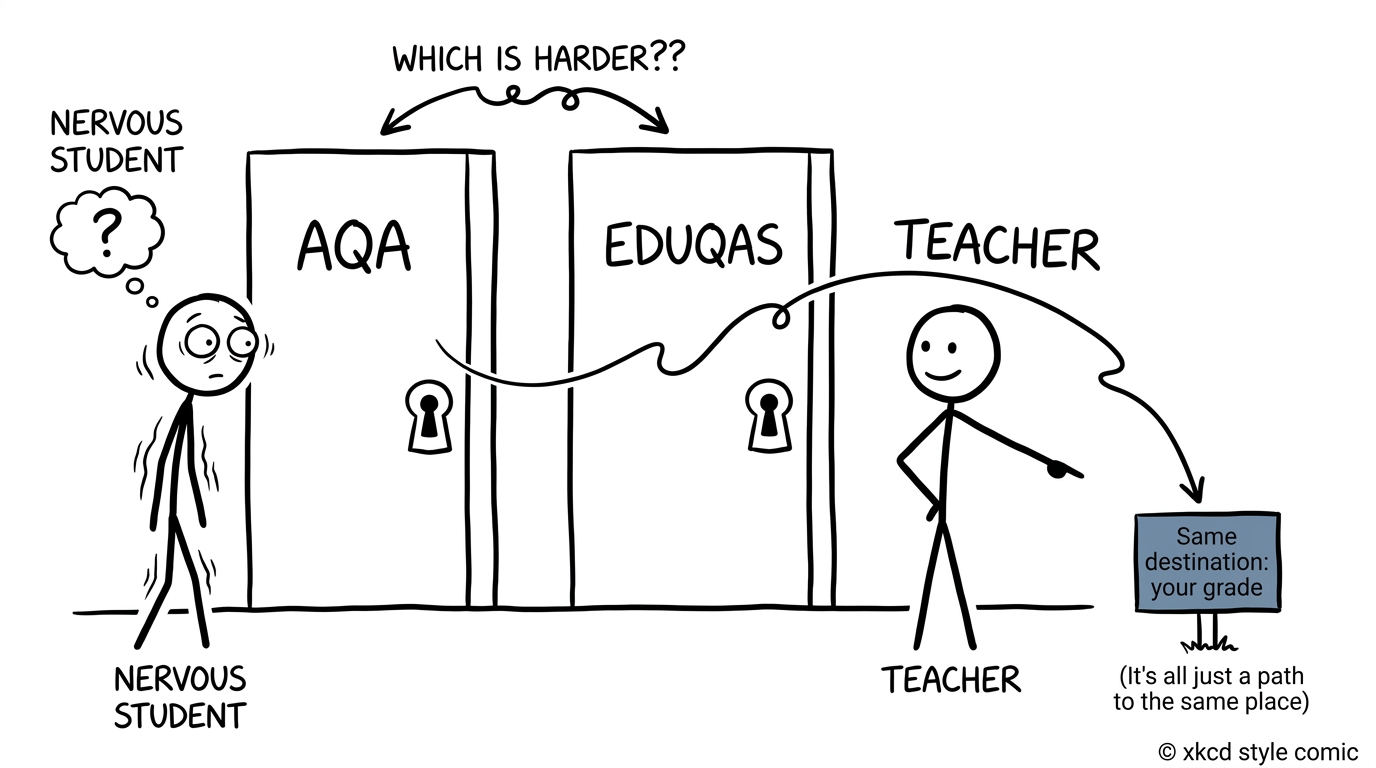 A GCSE student comparing AQA and Eduqas doors leading towards the same grade
AQA vs Eduqas higher-tier grade boundaries
The summer 202520252025 higher-tier boundaries were:
| Grade | AQA marks out of 240240240 | Eduqas marks out of 240240240 |
|---|---|---|
| 999 | 219219219 | 196196196 |
| 888 | 191191191 | 155155155 |
| 777 | 164164164 | 115115115 |
| 666 | 130130130 | 858585 |
| 555 | 969696 | 565656 |
| 444 | 636363 | 272727 |
| 333 | 464646 | 121212 |
The gap is substantial at several grades, but raw marks are not a universal currency. An AQA mark and an Eduqas mark come from different questions, mark schemes and paper structures. Comparing them without that context is like comparing finishing times from two different courses.
AQA assesses GCSE Mathematics through three 808080-mark papers: one non-calculator paper and two calculator papers. Eduqas uses two 120120120-mark components: one non-calculator and one calculator-allowed paper. Both total 240240240 marks and have 444 hours 303030 minutes of assessment, but the experience of earning those marks is different.
Students should therefore use the boundary for the board, tier and exam series printed on their entry. The AQA predicted grade calculator and Eduqas predicted grade calculator make that distinction clear.
AQA vs Eduqas foundation-tier boundaries
The summer 202520252025 foundation-tier comparison tells the same broad story:
| Grade | AQA marks out of 240240240 | Eduqas marks out of 240240240 |
|---|---|---|
| 555 | 188188188 | 141141141 |
| 444 | 160160160 | 111111111 |
| 333 | 119119119 | 818181 |
| 222 | 797979 | 515151 |
| 111 | 393939 | 212121 |
A grade 555 is the highest available grade on foundation tier for both boards. Higher tier covers grades 444 to 999, although the safety grade 333 may be awarded when a candidate falls just below the grade 444 boundary.
For revision matched to the correct specification, use the AQA GCSE maths revision hub or the Eduqas GCSE maths revision hub. Board-specific practice matters because timing, paper length and question presentation affect exam technique even when much of the mathematical content overlaps.
Why are Eduqas grade boundaries lower?
Grade boundaries are set after papers have been marked. Exam boards consider statistical evidence, how students performed and samples of work around proposed boundaries. Senior examiners use this evidence to maintain comparable standards over time.
Consequently, a lower boundary does not automatically indicate a more generous board. It usually reflects how demanding that particular assessment proved for the cohort. Ofqual's published guidance is clear that standards should be comparable between boards and from one year to the next.
There is no fixed quota requiring a particular number of students to pass or fail. Nor does a higher boundary mean that achieving the grade became harder. If a paper proves more accessible, more marks may be required to demonstrate the same grade standard.
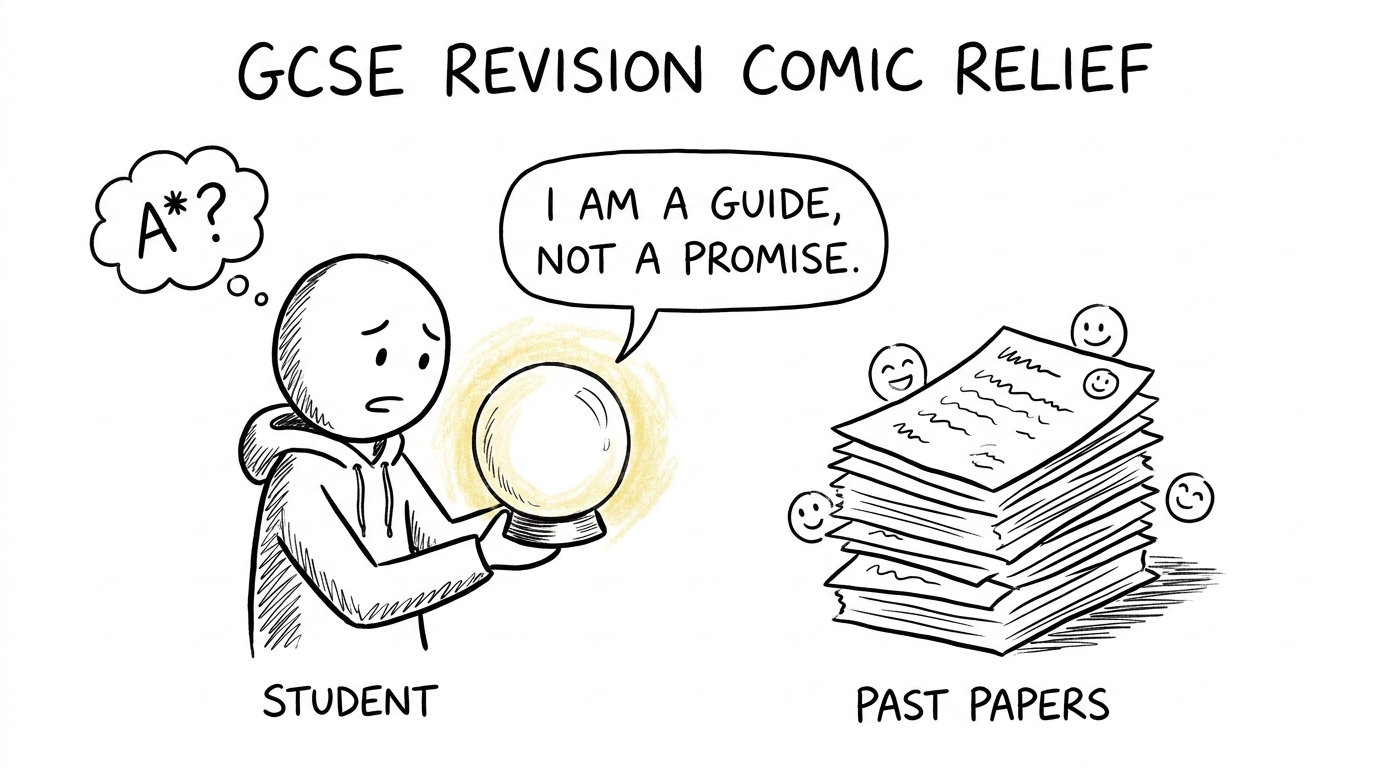 A student asking last year's boundary to predict the future while past papers look on
What happens on GCSE maths results day?
GCSE results day in England is Thursday 202020 August 202620262026. Schools and colleges decide how students collect their results, so check the arrangements provided by your centre.
Your result reports an overall qualification grade, not a separate official grade for each maths paper. Exam boards may publish notional component boundaries, but these are illustrative. Your qualification grade comes from the total mark across all required components.
If a result is unexpected, speak to your exams officer or maths teacher. They can explain your marks and the available post-results services. A review is not a free second attempt at the paper, and marks can stay the same, rise or fall.
How to use old boundaries before the exam
Past boundaries are best treated as context, not predictions. When marking a practice paper:
- use the boundary from the same board, tier and series as the paper;
- record the raw mark as well as the estimated grade;
- build a sensible margin above the historical threshold;
- identify lost marks by topic and question type;
- revisit the weakness through targeted questions before trying another paper.
The GCSE maths revision hub brings together board-specific past papers, practice questions and mark schemes. Nearer the exams, GCSE predicted papers can provide additional timed practice, but they cannot predict official grade boundaries.
Common mistakes when comparing boundaries
Assuming lower boundaries mean an easier board
The opposite may be true: lower boundaries can reflect a paper that students found more demanding. Compare standards, not raw marks in isolation.
Mixing foundation and higher figures
A foundation grade 555 boundary cannot be compared directly with a higher grade 555 boundary. The papers assess overlapping content at different levels of demand.
Using the wrong exam series
Summer and November boundaries can differ. Always match the boundary to the exact paper and series being marked.
Treating component boundaries as official grades
Your overall result depends on the combined subject total. Notional paper boundaries are guides rather than independently awarded grades.
Predicting this year's boundary from last year's figure
Previous boundaries provide a useful range, not a promise. Your safest revision target is to maximise marks rather than aim for the lowest historical threshold.
The takeaway
The summer 202520252025 AQA grade boundaries were higher than the corresponding Eduqas grade boundaries at every reported GCSE maths grade. Yet that difference does not show that one board offers an easier route. Different papers produce different raw-mark scales, while the grading process is designed to preserve comparable standards.
Use boundaries to understand past performance, then return your attention to what you can control. Choose your board and tier on MathsGenie, learn through free revision lessons, practise with topic questions and mini tests, and test your progress using past papers, predicted papers, mark schemes and video solutions. A boundary is decided after the exam. The marks that place you above it are built now.