GCSE Further Maths Flashcards Quizlet Guide
GCSE Further Maths flashcards Quizlet guide: find accurate, specification-matched decks, build your own quickly and turn active recall into exam marks.
A flashcard can make revision feel reassuringly tidy. Question on one side, answer on the other. Yet Further Maths papers are rarely that neat.
If you are searching for GCSE Further Maths flashcards Quizlet sets, the best choice is not necessarily the largest or most popular deck. It is a concise, accurate set matched to your qualification, covering key facts and method choices without pretending that flashcards can replace mathematical practice.
Use existing decks to save time. Check every card against your specification or a trusted lesson. Then build a smaller personal deck from the facts you forget and the mistakes you actually make.
The quick checklist for choosing a deck
A worthwhile Further Maths flashcard or Quizlet set should:
- name the exact qualification and exam board;
- follow the current specification rather than a generic topic list;
- use correct notation and complete definitions;
- separate recall prompts from longer procedures;
- include conditions, such as when a rule can be applied;
- be short enough to revisit regularly;
- support exam questions rather than replace them.
Be careful with the name of your course. What schools casually call “GCSE Further Maths” may be a separate Level 222 qualification. For example, AQA offers the Level 222 Certificate in Further Mathematics, whose content includes number, algebra, coordinate geometry, calculus, matrix transformations and geometry. Other schools may teach a different qualification, such as Additional Mathematics. Always check the title and specification supplied by your school.
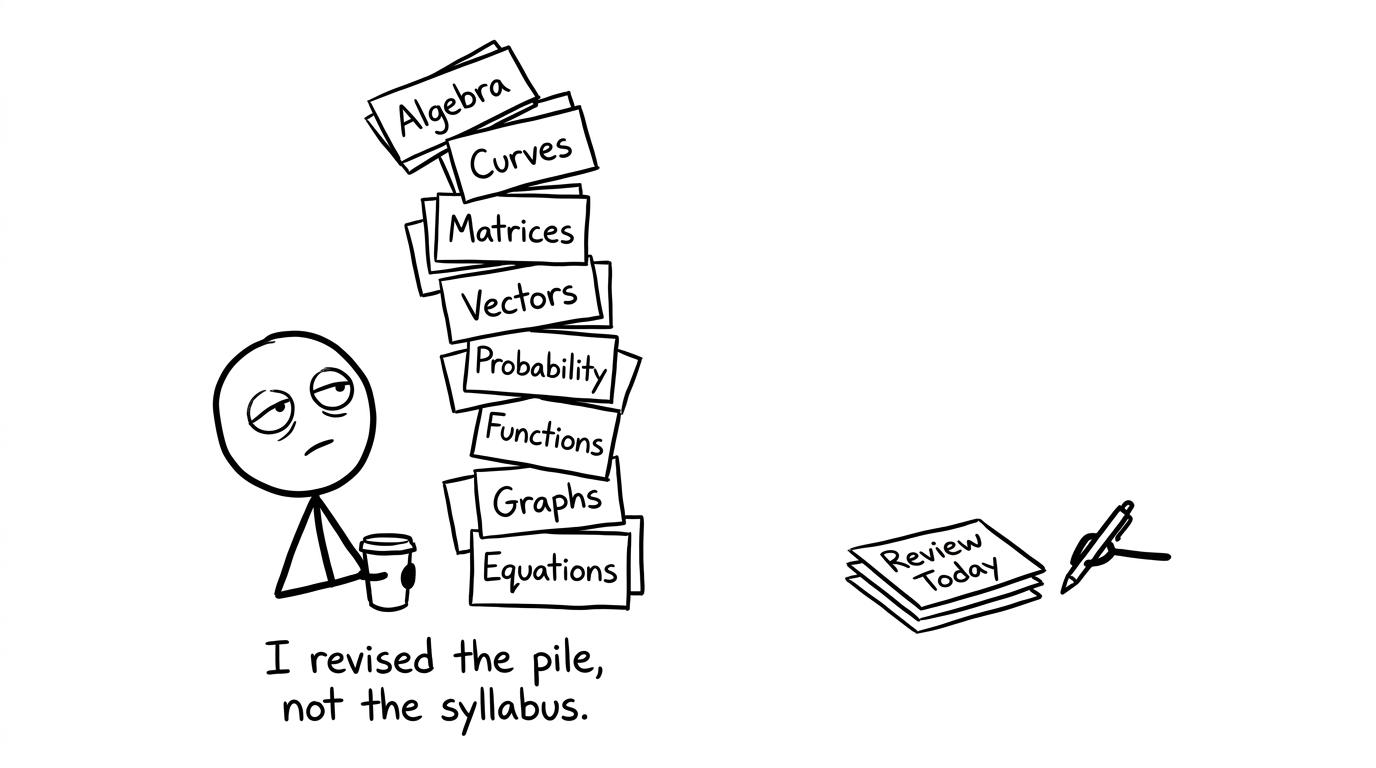 A student choosing a sensible review pile instead of an enormous flashcard tower
Which GCSE Further Maths flashcards and Quizlet decks are worth using?
Public Quizlet sets are created by students, teachers and other users. That makes the library useful, but not automatically reliable. A confident-looking card can still contain an outdated topic, a missing condition or a small sign error.
Rather than trusting a deck because it has many cards or users, look for the following types.
Specification-matched overview decks
An overview deck is useful for checking whether the course feels familiar. Search using the complete qualification name, exam board and specification code where possible, rather than using “Further Maths” alone.
For AQA, a sound overview should reflect the six published content areas:
- number;
- algebra;
- coordinate geometry;
- calculus;
- matrix transformations;
- geometry.
Treat an overview deck as a map, not the whole journey. A deck containing hundreds of disconnected cards often creates the illusion of coverage while giving too little attention to your weak areas.
Focused topic decks
Smaller decks tend to be more useful because their purpose is clearer. A functions deck might test notation, domain, range and inverse functions. A coordinate geometry deck might focus on gradient relationships, equations of lines and circle facts.
These narrow sets are easier to verify. You can compare a surds deck with the MathsGenie surds revision resources, or check function prompts against the inverse and composite functions guide. These GCSE pages support important prerequisite knowledge, although you should still follow the specification for your separate Further Maths qualification.
Formula and notation decks
Flashcards work especially well for precise information that must be available quickly. Suitable prompts include:
- the meaning of f−1(x)f^{-1}(x)f−1(x);
- the relationship between perpendicular gradients;
- the discriminant b2−4acb^2-4acb2−4ac;
- the derivative of axnax^naxn;
- the identity matrix;
- exact trigonometric values;
- the conditions required for a geometrical result.
The answer must include enough detail to prevent misconceptions. For instance, a card about perpendicular gradients should not merely say “negative reciprocal”. It should state the applicable relationship:
m1m2=−1 m_1m_2=-1 m1m2=−1for non-vertical perpendicular lines.
Teacher-checked class decks
If your teacher has created or approved a deck for your class, it deserves priority. It is more likely to match the order, notation and qualification being taught. Ask whether the set covers the entire specification or only the current unit.
A teacher-approved deck can still be personalised. Add cards for your own errors rather than copying the same generic material indefinitely.
Your own mistake deck
This is usually the highest-value set because it follows evidence from your work. After completing AQA GCSE Further Maths past papers, turn recurring gaps into prompts.
A missed mark involving matrix order, for example, should become a card about the decision you failed to make. Do not copy the entire examination question. Capture the transferable idea: dimensions, order, notation or interpretation.
How to check a Quizlet set before trusting it
Give a prospective deck a short audit before revising from it.
Confirm its identity
The title should specify the exam board and qualification. “GCSE algebra” is not precise enough. AQA Level 222 Further Mathematics and an ordinary GCSE higher-tier course overlap, but they are not identical.
Compare its coverage with the specification
Scan the topic headings and note what is missing. A set devoted almost entirely to calculus may be useful for calculus, but it is not a complete Further Maths deck if the course also assesses matrices, algebra and geometry.
Check a sample of difficult cards
Inspect cards involving signs, inverse notation, domains, matrix multiplication, gradients and formula conditions. These are places where a short answer can become misleading.
Use MathsGenie lessons as a checking point. For example, revise core algebra through the solving quadratics guide and quadratic formula resources before accepting another deck’s wording.
Edit rather than tolerate errors
If a set is mostly useful but contains weak cards, duplicate or rebuild the relevant content in your own private set. One incorrect card repeatedly retrieved can strengthen the very misconception you need to remove.
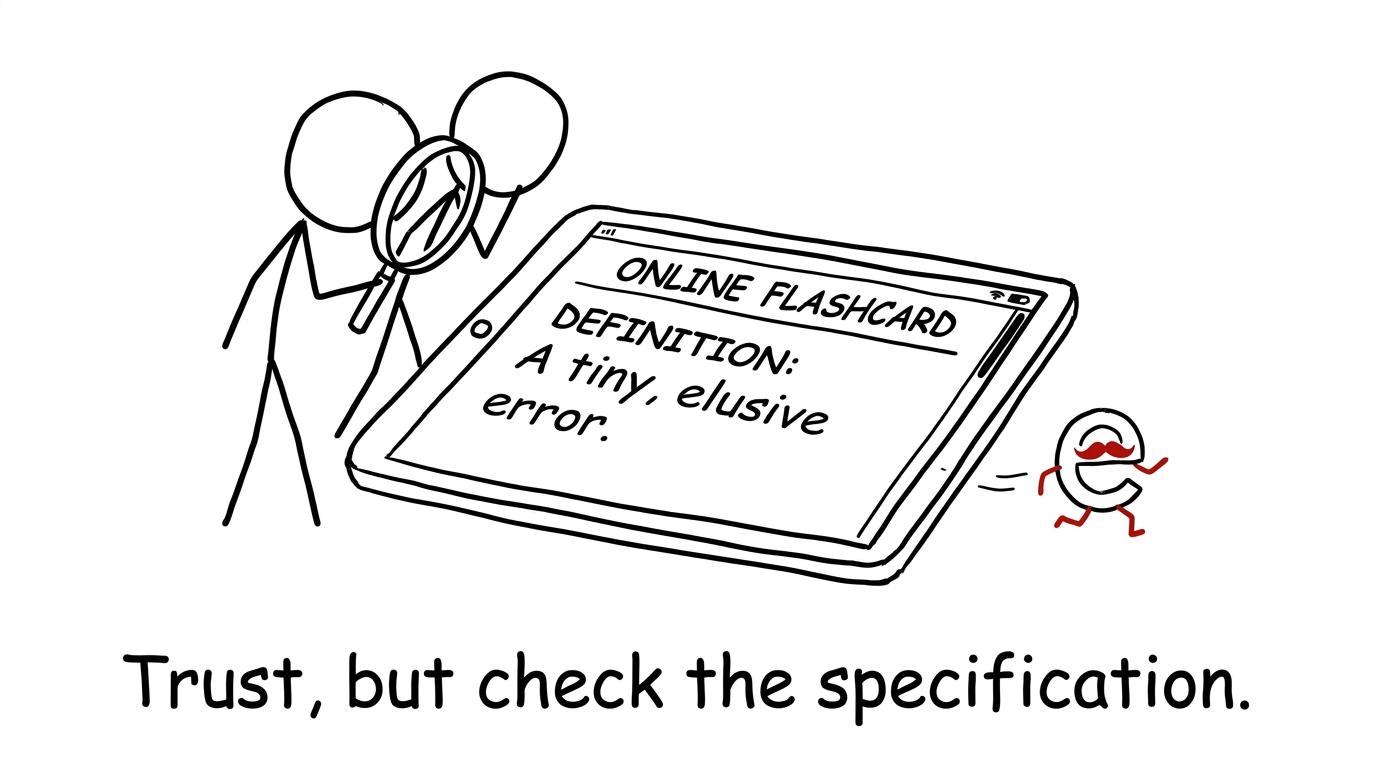 Students using a magnifying glass to catch a disguised flashcard typo
How to build your own deck quickly
Creating flashcards can quietly turn into a stationery project. The goal is not to produce beautiful cards. It is to create useful retrieval prompts with minimal delay.
Start with a specification checklist
Create one heading for each specification area. Under each heading, identify:
- definitions you must state precisely;
- formulae or identities you must recall;
- notation you sometimes confuse;
- method choices you struggle to recognise;
- conditions you forget;
- errors found in marked questions.
This prevents an easy topic from filling half the deck simply because it was the first chapter in your notes.
Write one idea per card
A card should ask one clear question. If its answer needs a page, it is probably a lesson or practice question rather than a flashcard.
Good cards might ask what the discriminant reveals, what an inverse function does, or which gradient relationship identifies perpendicular lines. Less useful cards say “Explain differentiation” or “Everything about matrices”.
Make the prompt force retrieval
Reading the front and immediately revealing the back is recognition, not genuine recall. Say or write the answer before turning the card.
Educational evidence supports retrieval practice and revisiting knowledge after a delay. It also stresses the importance of feedback because repeatedly retrieving an incorrect answer can embed it. This is why your cards need checked answers and why difficult cards should return later rather than disappearing after one successful guess.
Include decision cards
Further Maths rewards knowing what to do next. Add prompts such as:
- What feature suggests completing the square?
- What must be checked before multiplying two matrices?
- What does a repeated quadratic root imply about a line and curve?
- When does a stationary point occur?
These cards connect knowledge to method selection. They are more useful than cards that merely display a formula without context.
For a wider card-making routine, use the MathsGenie active recall guide.
How to use flashcards without neglecting questions
Flashcards can make knowledge available. Exam questions test whether you can select, combine and communicate that knowledge.
A sensible revision session has three stages:
- Recall: test a small mixed batch without notes.
- Apply: complete related questions and show full working.
- Correct: use solutions or a mark scheme, then add only the important errors to your deck.
The limitation matters. Research evidence for retrieval is strong, but complex mathematical performance also requires application and transfer. Remembering
ddx(axn)=anxn−1 \frac{d}{dx}(ax^n)=anx^{n-1} dxd(axn)=anxn−1is useful; recognising when differentiation belongs inside a multi-step problem is a different skill.
 A student hiding behind a flashcard while an exam paper asks them to apply it
Once recall feels secure, move towards timed work. Use Further Maths papers where they match your qualification. You can also use Edexcel GCSE Maths past papers to strengthen overlapping higher-tier algebra and geometry, but do not mistake them for complete Further Maths preparation.
Near the main GCSE exams, MathsGenie predicted papers can sharpen your core GCSE technique. Check the label carefully, however: a GCSE Maths predicted paper is not automatically a predicted paper for a separate Further Maths qualification.
Common mistakes with Further Maths flashcards
Choosing popularity over accuracy
A widely shared deck may still be incomplete or wrong. Specification match and mathematical accuracy matter more than usage figures.
Copying cards without thinking
Importing a large set is quick, but the result may contain unfamiliar wording and irrelevant material. Keep only cards you understand and can verify.
Putting too much on one card
Long answers encourage vague self-marking. Break a broad topic into definitions, conditions, formulae and decision prompts.
Revising only comfortable cards
Easy cards feel productive because the answers arrive quickly. Spend more time on cards linked to lost marks, while still revisiting secure knowledge occasionally.
Treating formulas as methods
Knowing the quadratic formula
x=−b±b2−4ac2a x=\frac{-b\pm\sqrt{b^2-4ac}}{2a} x=2a−b±b2−4acdoes not guarantee accurate substitution, algebra or interpretation. Follow formula recall with written questions.
Never checking answers against mark schemes
A correct final value does not reveal whether your working would earn the available marks. Use official-style papers, mark schemes and video solutions to learn how methods must be communicated.
Turn a small deck into stronger exam performance
The best deck is rarely the one containing the most information. It is the one that stays aligned with your specification, exposes weak recall and sends you back to mathematical questions.
Begin with a checked topic deck or teacher-approved Quizlet set. Build a personal mistake deck beside it. Test yourself without looking, revisit cards after a delay, and use every weakness as a reason to practise.
MathsGenie gives that routine somewhere to go. Start from the free GCSE and A Level maths revision hub, use revision lessons and practice questions to repair gaps, then test the result with past papers, mark schemes, video solutions, mini tests and relevant predicted papers. Flashcards help you remember the tools. Careful practice teaches you when and how to use them.