Solving Quadratics
x

Revision notes for Edexcel GCSE Maths Solving Quadratics. Open the guide for explanations and worked examples. Written against the Edexcel GCSE Maths (1MA1) specification, so the content matches what's examinable rather than general Maths background.

Solving Quadratics

What you'll learn

  • How to recognise a quadratic expression.
  • How to factorise quadratics like x2+bx+cx^2+bx+cx2+bx+c into two brackets.
  • How to solve a quadratic equation once it is factorised.
  • How to choose the correct signs in the brackets.

1. What is a quadratic?

A quadratic is an expression or equation where the highest power of the variable is squared, such as x2x^2x2 or a2a^2a2.

Definition

Quadratic

A quadratic expression has a squared term as its highest power, for example x2+5x+6x^2+5x+6x2+5x+6. A quadratic equation sets a quadratic expression equal to something, often zero, for example x2+5x+6=0x^2+5x+6=0x2+5x+6=0.

A quadratic can be recognised by its highest power being 2.

In this topic, you will mostly see quadratics where the squared term is just x2x^2x2, a2a^2a2, y2y^2y2, and so on, with no number in front.

Example

Spotting the parts of a quadratic

  1. Look at the expression t2+8t+15t^2+8t+15t2+8t+15.

The three parts of a quadratic are the squared term, the variable term and the constant term.

  1. The squared term is t2t^2t2, so it is a quadratic.

  2. The ttt-term is 8t8t8t. The coefficient of ttt is 8.

  3. The constant term is 15, because it has no variable attached to it.

2. Factorising reverses expanding

Before solving, you need to be confident with factorising.

Definition

Factorise

To factorise means to rewrite an expression as a product of brackets. For example, x2+7x+12x^2+7x+12x2+7x+12 can be written as (x+3)(x+4)(x+3)(x+4)(x+3)(x+4).

Factorising rewrites a quadratic as a product of two brackets.

Expanding goes from brackets to a quadratic. Factorising goes the other way.

Example

Checking by expanding brackets

  1. Start with the brackets (x+2)(x+5)(x+2)(x+5)(x+2)(x+5).

The four products in expanding brackets combine to make the quadratic.

  1. Multiply each part carefully: first terms, outside terms, inside terms, then last terms.

  2. Write the expansion:

    (x+2)(x+5)=x2+5x+2x+10(x+2)(x+5)=x^2+5x+2x+10(x+2)(x+5)=x2+5x+2x+10
  3. Collect the like terms:

    x2+5x+2x+10=x2+7x+10x^2+5x+2x+10=x^2+7x+10x2+5x+2x+10=x2+7x+10
Key Idea

The reverse pattern

If (x+2)(x+5)=x2+7x+10(x+2)(x+5)=x^2+7x+10(x+2)(x+5)=x2+7x+10, then x2+7x+10x^2+7x+10x2+7x+10 factorises to (x+2)(x+5)(x+2)(x+5)(x+2)(x+5).

3. Factorising x2+bx+cx^2+bx+cx2+bx+c

For quadratics like x2+bx+cx^2+bx+cx2+bx+c, you are looking for two numbers that:

  • multiply to make the constant term, ccc
  • add to make the coefficient of the xxx-term, bbb
Example

Factorising with two positive signs

  1. Factorise x2+6x+8x^2+6x+8x2+6x+8.

For x^2+6x+8, the pair 2 and 4 works because it multiplies to 8 and adds to 6.

  1. Find two numbers that multiply to 8 and add to 6. The pair is 2 and 4.

  2. Put those numbers into brackets with xxx:

    x2+6x+8=(x+2)(x+4)x^2+6x+8=(x+2)(x+4)x2+6x+8=(x+2)(x+4)
  3. Check the middle term: 2x+4x=6x2x+4x=6x2x+4x=6x, so the factorisation works.

Common Mistake

Only checking the multiply part

For x2+6x+8x^2+6x+8x2+6x+8, the numbers must multiply to 8 and add to 6. The pair 1 and 8 multiplies to 8, but adds to 9, so it is not correct.

4. Choosing the signs

The signs in the brackets matter.

The sign of the constant and the sign of the middle term decide the signs in the brackets.

If the constant term is positive, the signs are the same:

  • positive middle term means both signs are positive
  • negative middle term means both signs are negative

If the constant term is negative, the signs are different.

Example

Factorising when both signs are negative

  1. Factorise a2−9a+18a^2-9a+18a2−9a+18.

  2. The constant term is positive 18, so the bracket signs are the same.

  3. The middle term is negative, so both signs must be negative.

  4. Find two numbers that multiply to 18 and add to 9. The pair is 3 and 6.

  5. Write the brackets:

    a2−9a+18=(a−3)(a−6)a^2-9a+18=(a-3)(a-6)a2−9a+18=(a−3)(a−6)
Example

Factorising when the signs are different

  1. Factorise y2+y−30y^2+y-30y2+y−30.

The factors 6 and 5 have different signs, and the larger positive number gives the positive middle term.

  1. The constant term is negative, so the bracket signs are different.

  2. Find two numbers that multiply to 30 and have a difference of 1. The pair is 6 and 5.

  3. The middle term is positive, so the larger number must be positive:

    y2+y−30=(y+6)(y−5)y^2+y-30=(y+6)(y-5)y2+y−30=(y+6)(y−5)
Tip

Quick sign check

After writing the brackets, mentally expand the outside and inside terms. They should combine to give the middle term.

5. Solving using the zero product rule

Once the quadratic is factorised, solving is quite quick.

Definition

Zero product rule

If two things multiply to make zero, at least one of them must be zero. So if (x+4)(x−3)=0(x+4)(x-3)=0(x+4)(x−3)=0, then x+4=0x+4=0x+4=0 or x−3=0x-3=0x−3=0.

The zero product rule splits one factorised quadratic equation into two linear equations.

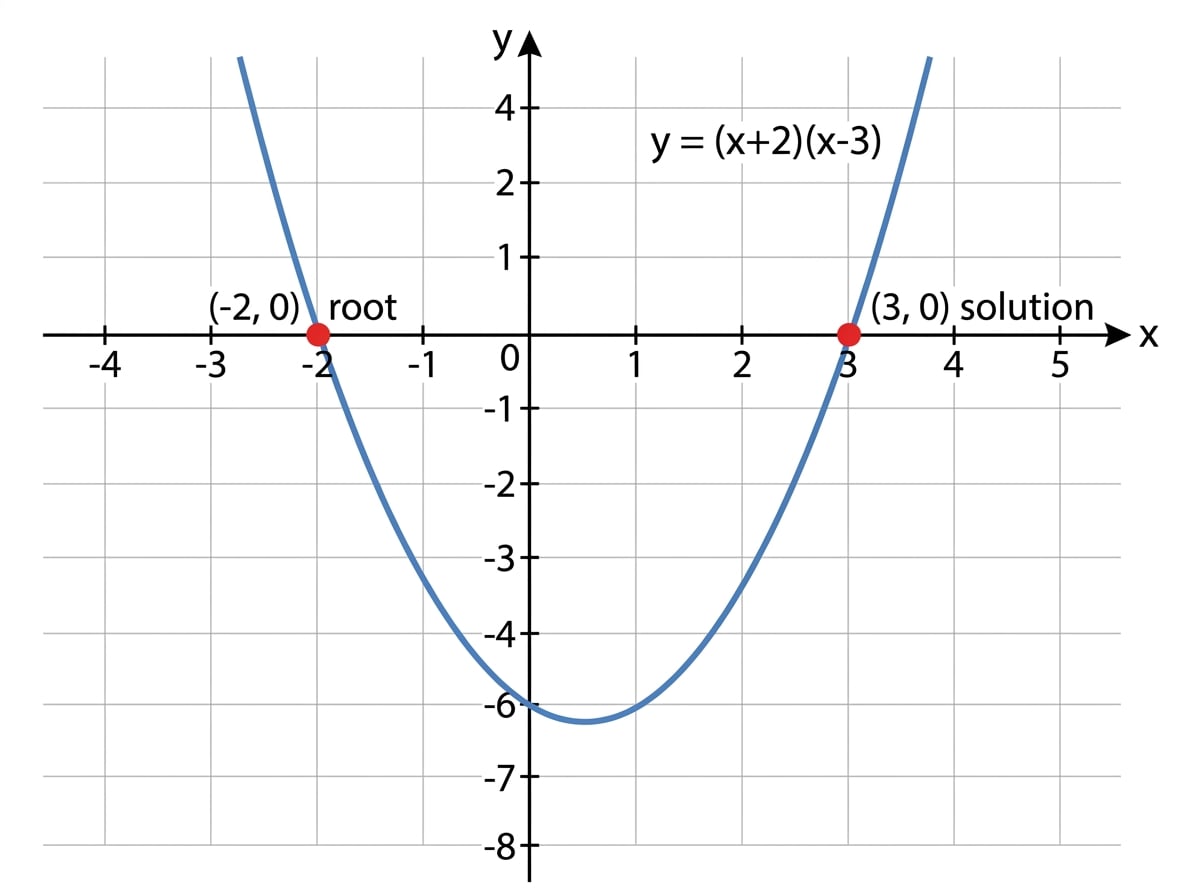
The answers to a quadratic equation are called its solutions or roots.

Example

Solving a factorised quadratic

  1. Solve n2+n−42=0n^2+n-42=0n2+n−42=0.

  2. Factorise the left-hand side:

    n2+n−42=(n+7)(n−6)n^2+n-42=(n+7)(n-6)n2+n−42=(n+7)(n−6)
  3. Rewrite the equation:

    (n+7)(n−6)=0(n+7)(n-6)=0(n+7)(n−6)=0
  4. Set each bracket equal to zero:

    n+7=0orn−6=0n+7=0 \quad \text{or} \quad n-6=0n+7=0orn−6=0
  5. Solve each small equation:

    n=−7orn=6n=-7 \quad \text{or} \quad n=6n=−7orn=6
Common Mistake

Giving only one answer

Most factorising quadratics have two solutions. Do not stop after the first bracket; set both brackets equal to zero.

6. Factorise first, then solve

Some questions ask you to factorise in part (a), then solve in part (b). The solving part uses the factorisation you have already found.

Example

Factorise, then solve

  1. Factorise r2−5r−14r^2-5r-14r2−5r−14.

  2. Find two numbers that multiply to negative 14 and add to negative 5. The numbers are negative 7 and positive 2.

  3. Write the factorisation:

    r2−5r−14=(r−7)(r+2)r^2-5r-14=(r-7)(r+2)r2−5r−14=(r−7)(r+2)
  4. Now solve r2−5r−14=0r^2-5r-14=0r2−5r−14=0 by using the brackets:

    (r−7)(r+2)=0(r-7)(r+2)=0(r−7)(r+2)=0
  5. Set each bracket equal to zero:

    r−7=0orr+2=0r-7=0 \quad \text{or} \quad r+2=0r−7=0orr+2=0
  6. Give both solutions:

    r=7orr=−2r=7 \quad \text{or} \quad r=-2r=7orr=−2
Exam technique

In the exam

  1. Make sure the equation is in the form x2+bx+c=0x^2+bx+c=0x2+bx+c=0 before solving.

  2. Find two numbers that multiply to the constant term and add to the xxx coefficient.

  3. Write two brackets, set each bracket equal to zero, and give both solutions.

  4. Check your signs by quickly expanding the brackets in your head.

Self review

Check yourself

  • Can you factorise x2+9x+20x^2+9x+20x2+9x+20 into two brackets?

  • If (x−4)(x+6)=0(x-4)(x+6)=0(x−4)(x+6)=0, why are there two possible solutions?

  • For m2−m−30=0m^2-m-30=0m2−m−30=0, how do you know the bracket signs must be different?

Recap questions

Test yourself with 5 quick questions on this guide. Answer them all correctly to complete it.

You've reached the end

Test yourself on this topic, or move on to the next guide.

Practice questionsTake a quick quiz on this topicFlashcardsSelf-test with active recall
Drawing Quadratic GraphsUp next

How was this guide?

Solving Quadratics Revision Guide

  1. GCSE
  2. /Maths
  3. /Solving Quadratics