GCSE Further Maths Extra Reading: How Much?
GCSE further maths extra reading should be brief and focused. Learn how to balance notes, questions, mark schemes and past papers wisely.
There is a particular kind of revision guilt that comes from seeing an untouched maths textbook on your desk. It looks important. It is full of knowledge. Surely serious students read it from beginning to end.
But GCSE further maths extra reading does not need to consume your evenings. For most students, a short period of focused reading followed by substantially more question practice is the better use of time. Read to understand a definition, notation or method. Then close the notes and use it.
A sensible starting point is to spend roughly 15%15\%15% to 25%25\%25% of an independent revision session reading or reviewing explanations, with the remaining 75%75\%75% to 85%85\%85% spent attempting questions, marking them and correcting mistakes. That is a practical guideline, not an exam-board requirement. Your exact balance should depend on what your work reveals.
The short answer
Most students do not need hours of traditional reading outside class. You need enough to:
- check what is included in your exact specification;
- understand unfamiliar vocabulary and notation;
- revisit a method that was unclear in class;
- read mark schemes and model solutions carefully;
- identify the reason for a mistake before trying again.
Your time is usually better spent on active mathematical work:
- practising algebraic techniques;
- answering unfamiliar problems;
- recalling methods without notes;
- completing timed sections;
- marking work honestly;
- redoing questions that exposed a weakness.
Start with the AQA GCSE Further Maths past papers if that is your qualification. One short attempt will tell you more about what you need to read than an hour spent browsing a textbook without a clear purpose.
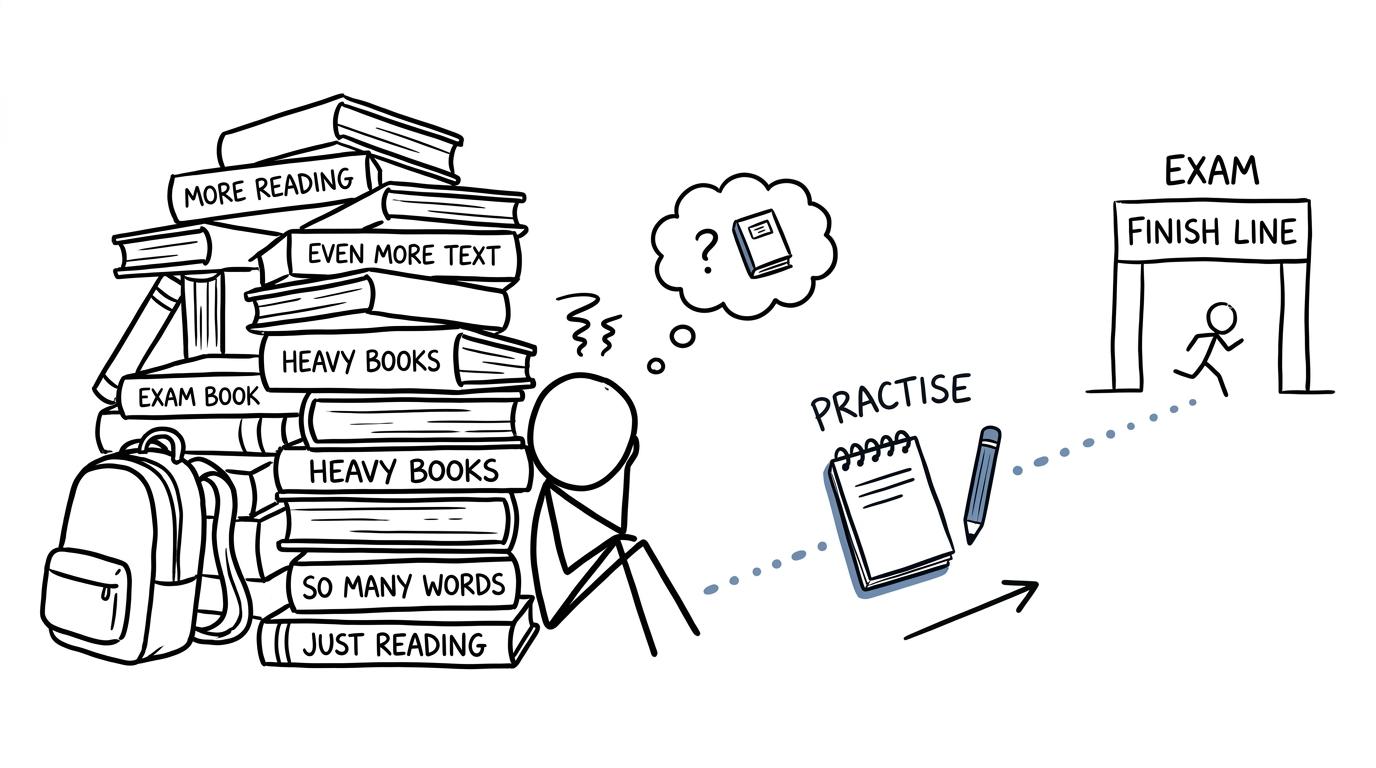 A student choosing practice over a towering pile of revision books
Check which further maths qualification you take
“GCSE Further Maths” is often used as a convenient classroom label, but schools do not all offer the same qualification. Before planning any extra reading, find its exact title and exam board.
A common route is the AQA Level 222 Certificate in Further Mathematics. It is an untiered qualification intended to extend GCSE Mathematics, particularly for students likely to achieve grades 777 to 999. Its current content includes number, algebra, coordinate geometry, calculus, matrix transformations and geometry. It is assessed through two papers, one non-calculator and one calculator.
Other schools may offer Pearson Edexcel Level 222 Extended Mathematics, OCR Level 333 FSMQ Additional Mathematics or another additional maths qualification. Their content and assessment structures are not interchangeable. OCR FSMQ, for example, is a Level 333 qualification rather than a GCSE or Level 222 certificate.
This distinction matters. Reading a chapter on matrices is useful if matrices are on your specification. It is a distraction if your course instead requires a different topic. Ask your teacher for:
- the full qualification title and code;
- the current specification or topic list;
- the paper structure;
- any formulae provided in the examination;
- the topics that have and have not yet been taught.
Ordinary GCSE Mathematics has foundation and higher tiers. The AQA Level 222 Further Mathematics certificate itself is untiered, so do not assume that “further maths” simply means another higher-tier GCSE paper.
What useful extra reading looks like
The word “reading” can be misleading. Passive reading means moving through pages while each line feels familiar. Useful reading ends with a decision: what will you now recall, explain or practise?
Read the specification once
The specification is a boundary map. It tells you what may be assessed and prevents revision from expanding into every interesting A Level topic you encounter online.
You do not need to memorise it. Convert it into a checklist and label each topic:
- secure;
- partly secure;
- not yet secure;
- not yet taught.
Review that checklist occasionally rather than rereading the whole document every week.
Read explanations when you have a precise question
Reading is valuable when you can name the gap. Perhaps you do not understand what a matrix transformation represents, why a function has a restricted domain or what differentiation is finding.
Use a revision lesson to answer that question, then attempt related problems immediately. If the explanation concerns material that overlaps with later study, the MathsGenie A Level Maths revision hub can provide useful context. However, treat A Level pages as optional extension material, not as a substitute for your own specification.
Read mark schemes as mathematical documents
A mark scheme is not merely an answer list. It shows where method marks are earned, what working must be visible and which forms of an answer are accepted.
After a question, compare your reasoning line by line. Ask:
- Did I choose an appropriate method?
- Was my notation unambiguous?
- Did I show enough working?
- Did an early error affect everything that followed?
- Could I reproduce the method without looking?
This is reading with evidence attached. It is far more useful than highlighting a page because the question has already shown you what needs attention.
Where most of your time is better spent
Further maths is assessed through doing mathematics. Technical fluency matters, but so do reasoning and problem solving. Those skills cannot be built by recognition alone.
A reliable revision loop is:
- choose one topic;
- review the idea briefly;
- attempt questions without notes;
- mark them using the official scheme;
- classify each lost mark;
- correct the work;
- try a fresh question later.
MathsGenie's guide to finding your weakest GCSE topics can help you turn marks lost into a focused revision list rather than a vague feeling that everything needs attention.
Build algebraic fluency
Further maths often makes familiar algebra less forgiving. Manipulating expressions, factorising, solving equations, using graphs and handling exact values must become dependable enough to support newer ideas.
If basic algebra is causing errors in further maths questions, repair that foundation first. This is not stepping backwards. It is removing the obstacle that makes every later topic take longer.
Use mixed and unfamiliar questions
Topic questions are useful while a method is new. Eventually, however, the question must stop announcing which technique to use. Mixed practice develops the ability to recognise structure and select a method independently.
This matters because exam questions may connect several areas. Knowing each technique separately is not the same as knowing which one belongs in an unfamiliar problem.
Practise under timed conditions
Once most of the course has been covered, introduce timed sections and then complete papers. The guide to starting GCSE past papers explains how to move from diagnostic questions towards full exam conditions.
Past papers should not replace topic learning too early. Nor should they be saved until every topic feels perfect. Use them to discover where knowledge breaks down under pressure, then return to focused practice.
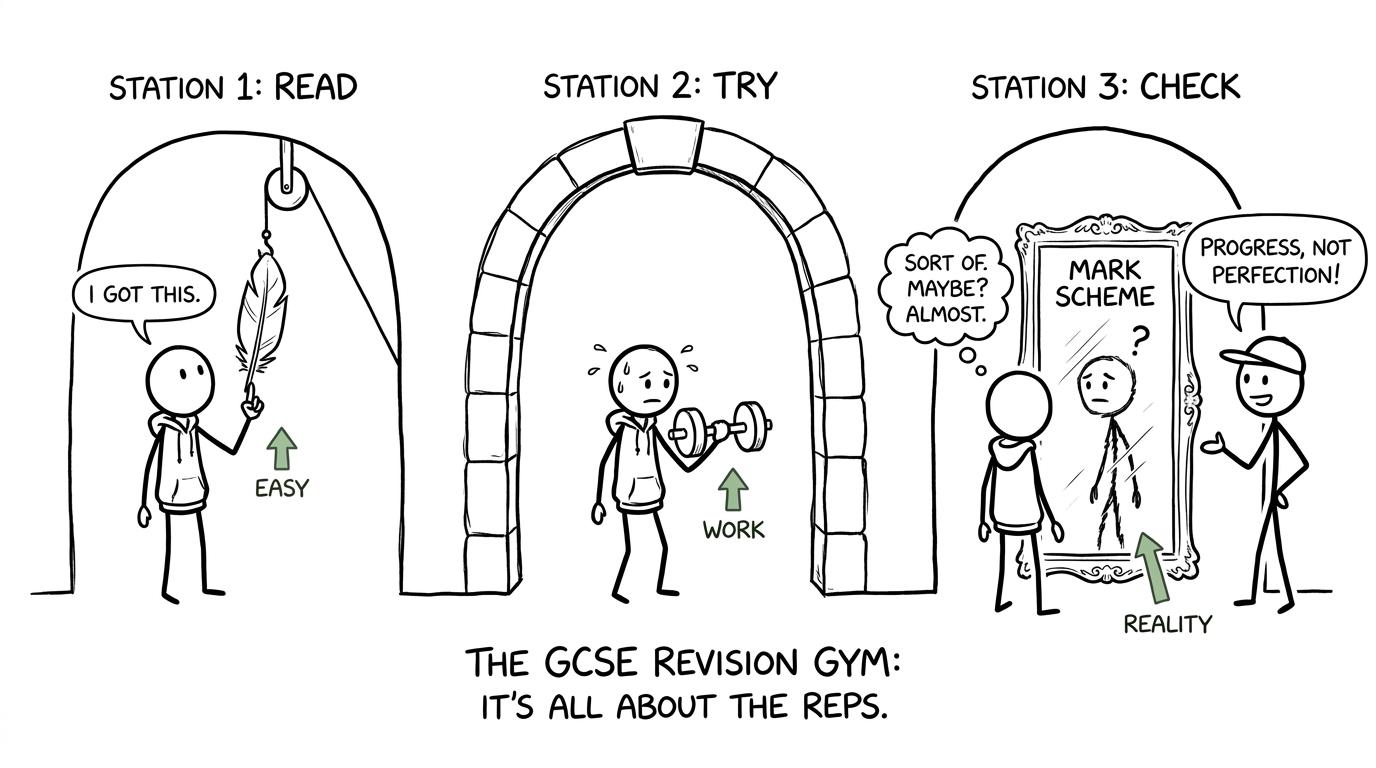 A three-part revision gym showing read, try and check
A realistic weekly approach
There is no universal number of hours because teaching time, homework and prior GCSE fluency vary. A student who understands the lessons but needs greater speed has a different task from one who has missed a substantial part of the course.
For each independent session, try this structure:
- spend about 555 to 101010 minutes recalling key facts and reviewing one precise explanation;
- spend about 252525 to 404040 minutes on questions;
- spend about 101010 to 151515 minutes marking, correcting and recording the next action.
If you cannot start a question because the underlying idea is unfamiliar, increase the reading and lesson time temporarily. If you understand every solution but cannot produce one independently, reduce the reading and practise more.
A weekly plan might include two focused topic sessions and one mixed or timed session. During a busy GCSE week, even a short, completed cycle is better than a grand plan that never begins. The MathsGenie GCSE revision timetable guide can help you fit further maths around your main GCSE subjects without allowing it to take over the timetable.
When extra reading is worth more time
Sometimes reading genuinely is the right priority.
Give it more time when:
- your school has introduced a topic quickly;
- the notation is new and prevents you understanding questions;
- you can carry out a procedure but cannot explain why it works;
- a mark scheme uses language you do not recognise;
- you are deciding whether to take A Level Mathematics;
- your teacher has assigned specific preparatory material.
Reading can also deepen understanding when a topic interests you. That curiosity is valuable. Just separate enrichment from examination preparation. Exploration may make you a broader mathematician, but it should not displace urgent practice on specification content where marks are currently being lost.
Common mistakes with GCSE further maths extra reading
Reading from the first page to the last
A textbook is organised for teaching, not necessarily for your personal revision needs. Diagnose first, then read the relevant section.
Copying notes instead of retrieving ideas
Neat notes can create a sense of progress without testing memory. After reading, close the source and write the key definition, method or conditions from memory. Then check.
Moving into A Level material too soon
Calculus and advanced algebra can make further maths feel like a doorway to A Level, but the courses are not identical. Secure the assessed Level 222 content before following interesting extensions.
Collecting too many resources
Switching between books, videos and websites makes it difficult to finish a full learn-practise-check cycle. Choose one clear explanation, one question set and one mark scheme.
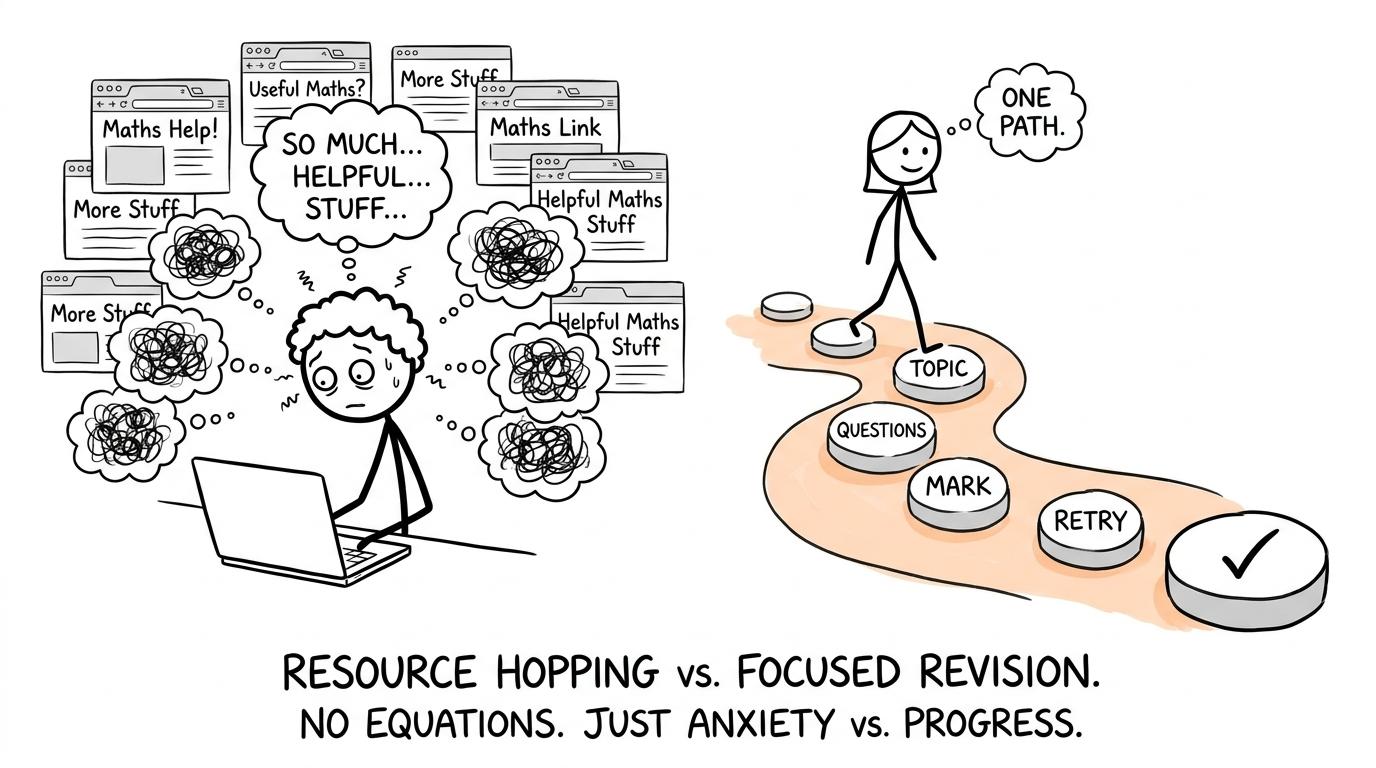 One student overwhelmed by browser tabs while another follows a simple revision path
Marking generously
An answer that is “basically right” may still omit required reasoning or contain invalid notation. Use the published mark scheme, record lost marks and redo the question without support.
Neglecting the main GCSE course
Further maths builds on secure higher-tier GCSE skills. If weaknesses in surds, quadratics, graphs, trigonometry or algebraic manipulation are repeatedly costing marks, allocate time to the underlying GCSE topic. The GCSE one-month maths revision plan offers a practical structure for balancing topic repair with paper practice.
Read less, but read with a reason
The amount of extra reading is not the real measure of preparation. The better question is whether each session changes what you can do unaided.
Use reading to locate an idea, clarify notation or understand an error. Then move towards questions. Mark carefully. Return to the weak point. Try again. That simple cycle turns information into examination skill.
Make MathsGenie your free revision base: begin with clear revision lessons and practice questions, use the AQA Further Maths paper collection for authentic assessment practice, and support your wider GCSE preparation with GCSE predicted papers, mark schemes, mini tests and video solutions. Your aim is not to finish the biggest pile of reading. It is to arrive at the examination able to think clearly on the page in front of you.