GCSE Further Maths 5 to 7: How to Improve
GCSE further maths 5 to 7: discover what separates the grades, which topics to prioritise and how focused revision can turn mistakes into marks.
A grade 555 can feel frustrating because it proves you understand much of the course, yet the grade 777 questions still seem to unravel halfway through. Usually, the gap is not intelligence or a missing secret. It is the accumulation of smaller differences: stronger algebra, broader topic coverage, clearer working and fewer repeated errors.
For a successful gcse further maths 5 to 7 journey, your revision must become more diagnostic. Attempt questions without help, mark them precisely, identify why each mark was lost and revisit the same skill later. That feedback loop matters more than simply doing longer hours.
This article focuses mainly on the current AQA Level 222 Certificate in Further Mathematics, commonly called GCSE Further Maths. If you take OCR Additional Mathematics, Pearson Edexcel Further Pure Mathematics or another additional qualification, check your own specification because the content, grading and assessment structure differ.
Your grade 555 to grade 777 checklist
Use this as the short version of the plan:
- Confirm your exact qualification and specification.
- Diagnose weaknesses using a timed paper, not your feelings.
- Make algebraic manipulation dependable.
- Secure every topic rather than relying on favourites.
- Practise unfamiliar, multi-step problems.
- Show enough working to make method marks visible.
- Keep an error log organised by cause.
- Reattempt weak questions without looking at the solution.
- Alternate targeted practice with timed papers.
- Track marks over several papers rather than chasing one boundary.
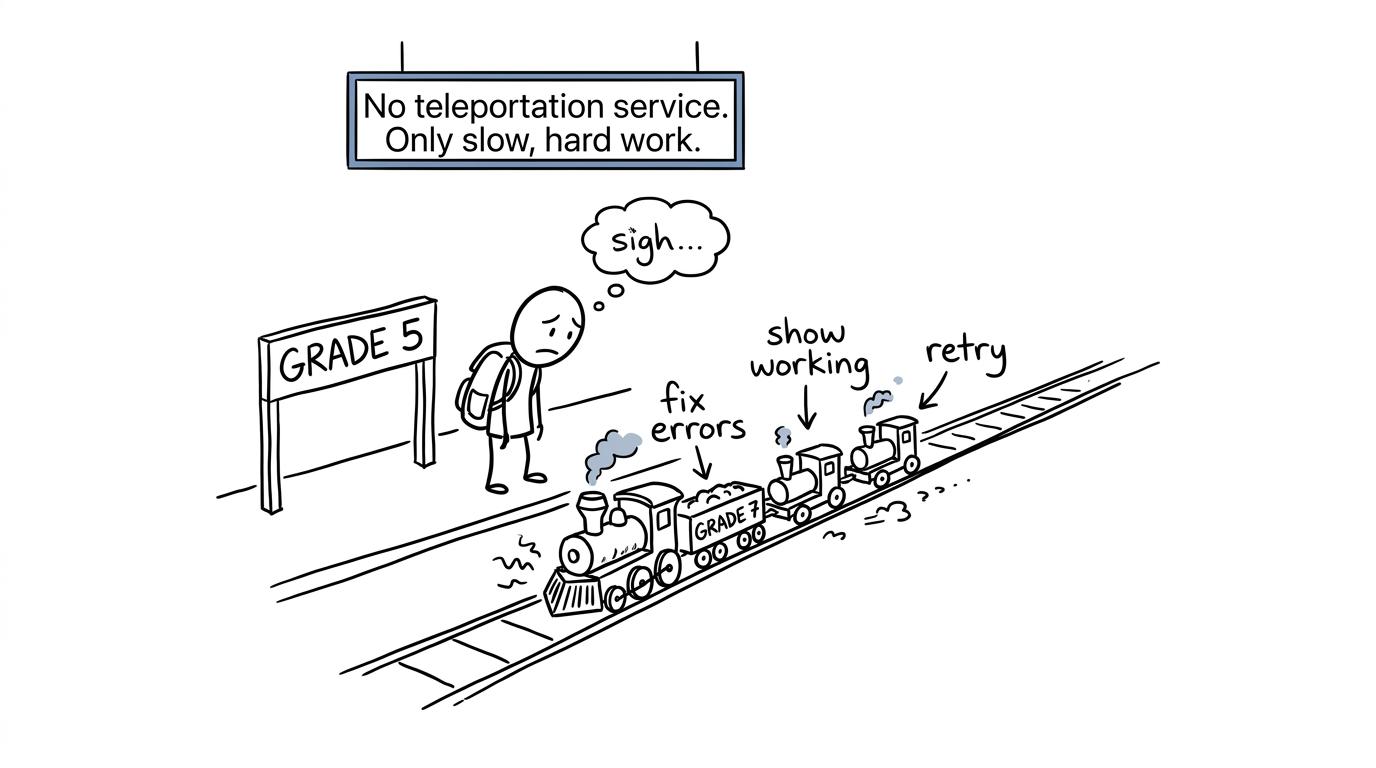 A student waiting for the grade 7 train powered by fixing errors, showing working and retrying
Understand the qualification before planning revision
AQA Further Mathematics specification 836583658365 is an untiered Level 222 qualification. Unlike standard GCSE Maths, there is no foundation or higher tier: everyone sits the same papers.
The current assessment has two equally weighted papers. Paper 111 is non-calculator and Paper 222 permits a calculator. Each lasts 111 hour 454545 minutes and carries 808080 marks, giving 160160160 marks overall. Content from any part of the specification can appear on either paper.
The six broad areas are number, algebra, coordinate geometry, calculus, matrix transformations and geometry. The qualification extends GCSE Higher content and introduces ideas such as differentiation and matrices. It is intended to stretch students who are already working towards high grades in standard GCSE Maths.
Grades 555 to 999 are awarded, with an allowed grade 444 below the grade 555 boundary. This matters because a grade 555 is not the middle of an ordinary foundation paper. It represents performance on an untiered qualification designed around demanding algebraic reasoning and problem solving.
In the June 202520252025 AQA series, the overall boundaries were 787878 marks for grade 555 and 113113113 for grade 777, out of 160160160. That historical difference was 353535 marks. Boundaries change after each series, so do not turn 113113113 into a permanent target. Use past boundaries only to understand the approximate scale of improvement required.
Start your diagnosis with the AQA GCSE Further Maths past papers, using the correct calculator rules and time limit.
What separates a grade 555 from a grade 777?
A grade 555 student can often reproduce a familiar method. A grade 777 student is more likely to recognise that method when it is disguised, combine it with another topic and carry the argument through accurately.
That difference appears in five areas.
Reliable algebra rather than occasional success
Further Maths uses algebra as its working language. Expanding, factorising, rearranging and substituting are not isolated topics. They sit inside calculus, coordinate geometry, functions, trigonometry and proof.
Grade 777 performance usually depends on handling expressions such as
ax2+bx+c, ax^2+bx+c, ax2+bx+c,algebraic fractions, inequalities, function notation and simultaneous equations without the underlying manipulation becoming the main obstacle.
This does not mean never making a slip. It means recognising one quickly and having enough fluency to continue. Strengthen the overlap with GCSE Higher through MathsGenie's algebraic fractions revision and quadratic simultaneous equations resources.
Flexible recognition
At grade 555, a student may succeed when the question announces the method. At grade 777, questions are more likely to require a decision: should you factorise, form an equation, use a graph, differentiate or introduce a geometric relationship?
Train that decision-making by mixing topics. After focused practice, create a short set containing several methods and hide the topic labels. Before calculating, write one sentence explaining what the question is testing. This forces you to recognise structure rather than follow a heading.
Complete multi-step reasoning
A demanding question often consists of manageable steps joined together. The challenge is holding the chain intact.
For instance, a coordinate geometry problem might involve a gradient, a perpendicular relationship and an equation of a line. A functions question might require careful interpretation of f−1(x)f^{-1}(x)f−1(x) or a composite such as f(g(x))f(g(x))f(g(x)). Revise the notation through inverse and composite functions.
The useful habit is to pause between stages. Ask:
- What have I established?
- What does the question still require?
- Which fact connects the two?
That short pause prevents correct intermediate work from drifting into an irrelevant calculation.
Breadth across the specification
A grade 555 can sometimes be built around strong favourite topics and partial marks elsewhere. A grade 777 normally requires fewer abandoned areas because either AQA paper can assess any part of the course.
Build a specification checklist and label each skill:
- Secure: correct without prompts under time pressure.
- Developing: method known, but errors remain.
- Unlearned: unable to begin independently.
Do not mark a topic secure because a video made sense. Evidence means answering unseen questions. The GCSE Maths topics by board and tier can help you audit the Higher-tier foundations beneath Further Maths, although your Further Maths specification remains the definitive checklist.
Mathematical communication
Examiners can only credit what is on the page. A correct idea hidden in mental arithmetic is fragile; a structured solution can preserve method marks even when a later answer is wrong.
Write transformations on separate lines, keep equality statements valid and state reasons in proof or geometry. When solving an equation, show the equation before the numerical answer. When differentiating a function such as
y=axn, y=ax^n, y=axn,make the resulting gradient function explicit. On calculator questions, write the mathematical setup before entering it.
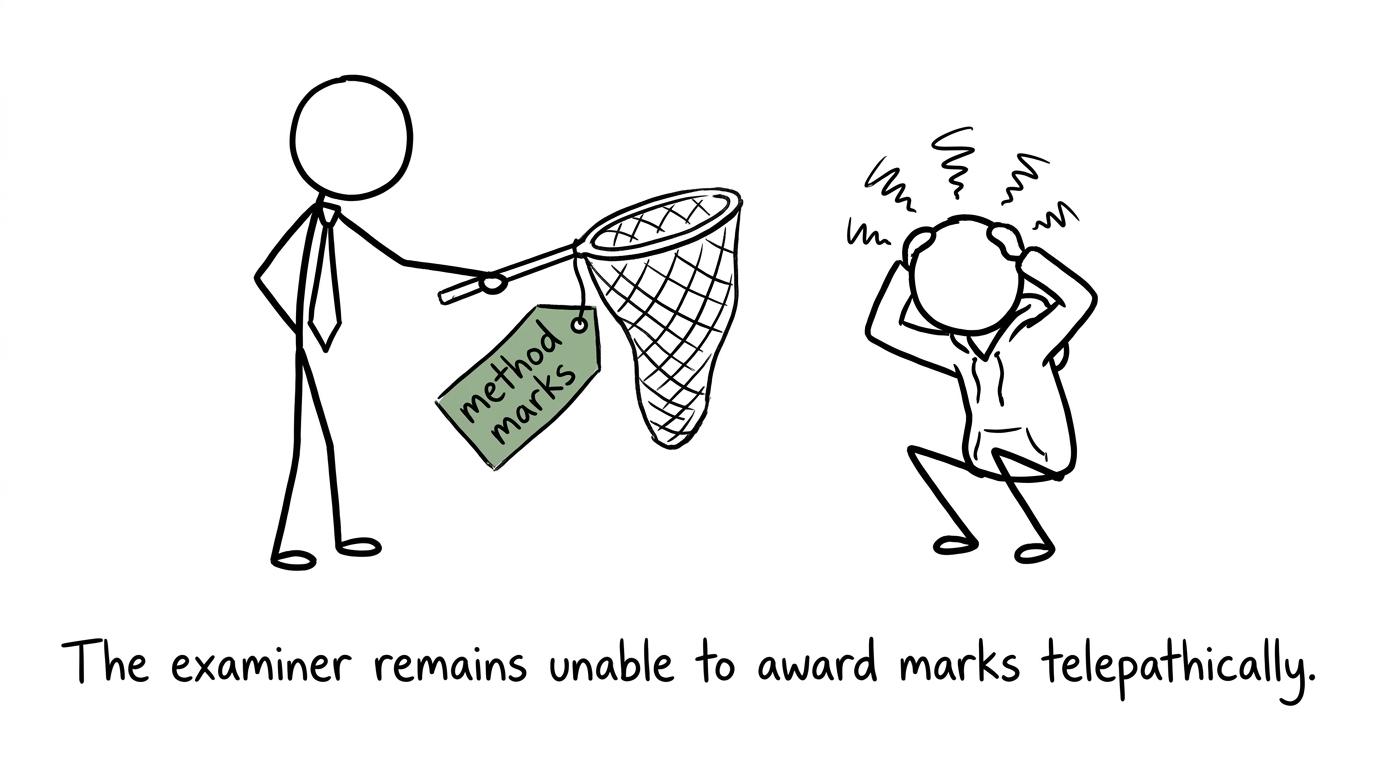 An examiner waiting unsuccessfully for telepathic working while holding a method marks net
Prioritise topics that unlock other topics
Not every weakness has the same effect. A gap in algebra can damage several sections, while a narrow factual gap may affect only one question type.
Begin with these high-leverage foundations:
- expanding and factorising expressions;
- solving linear, quadratic and simultaneous equations;
- rearranging formulae;
- indices and exact values;
- surds and rationalising denominators;
- gradients and equations of lines;
- interpreting functions and graphs;
- trigonometric identities, graphs and equations.
Use the surds revision and practice resources to improve exact manipulation and the trigonometric and exponential graphs topic to strengthen graph recognition.
Then give dedicated attention to genuinely additional material, particularly calculus and matrix transformations. These topics should not be left until the end simply because they feel unfamiliar. Short, repeated exposure is more useful than one large revision session followed by a long gap.
Turn every paper into a revision plan
Completing a paper is only the test. Improvement happens afterwards.
Mark each paper strictly and record every lost mark under one of these causes:
- Knowledge: you did not know the required fact or method.
- Recognition: you knew the method but did not identify it.
- Execution: algebra, arithmetic or calculator input went wrong.
- Communication: working, reasoning or notation was insufficient.
- Timing: you could have answered with more time.
- Question reading: you answered something different from what was asked.
You can calculate topic accuracy using
accuracy=marks earnedmarks available×100%. \text{accuracy}=\frac{\text{marks earned}}{\text{marks available}}\times 100\%. accuracy=marks availablemarks earned×100%.However, the explanation behind the percentage is more valuable than the number itself. “Lost 444 marks” is vague. “Cancelled terms instead of common factors in algebraic fractions” tells you what to fix.
After marking, use this cycle:
- Review the relevant revision lesson or video solution.
- Complete a small set of focused practice questions.
- Explain the method without notes.
- Reattempt a similar question after a gap.
- Test the skill later in mixed practice.
MathsGenie's guide to finding your weakest GCSE topics provides a practical structure for turning paper evidence into targeted revision.
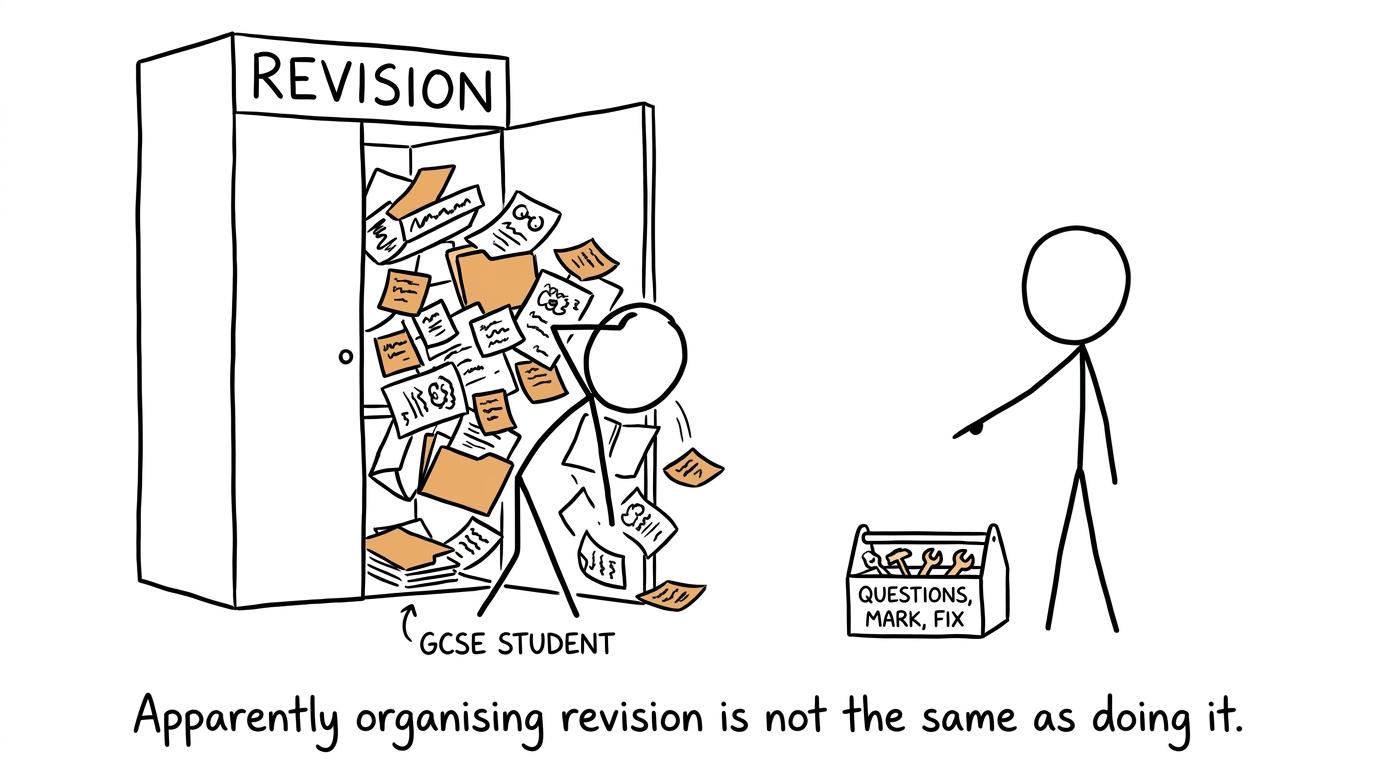 A student buried under revision notes while a calm figure recommends questions, marking and fixing
A weekly routine for moving towards grade 777
A useful week balances learning, retrieval and exam pressure.
Three focused sessions
Choose one weakness per session. Spend a short period reviewing the method, then devote most of the session to questions completed without notes. Finish by marking and writing one precise correction.
One mixed session
Combine old and new topics. Mixed questions train recognition because the method is no longer announced. Include both calculator and non-calculator work across the week.
One timed paper section
A half-paper or selected timed section is enough early in revision. Move towards full papers as the exams approach. Follow the exact rules for your qualification rather than borrowing the timing or calculator arrangements from standard GCSE Maths.
One repair session
Return to the week's error log. Redo questions from a blank page and without the solution beside you. A correction copied from a mark scheme is not yet a corrected skill.
If you need a broader timetable around your other GCSE subjects, adapt the structure in the GCSE one-month maths revision plan.
Common mistakes that keep students at grade 555
Revising only the hardest-looking topics
Students sometimes chase calculus while basic factorising still costs marks. Advanced ideas matter, but unstable foundations make them harder than necessary. Repair the prerequisite first, then return to the Further Maths application.
Watching solutions before attempting questions
A solution can feel obvious once someone else has made every decision. Attempt the question first. Even an incomplete attempt reveals the exact point where your understanding stops.
Cancelling terms rather than factors
In algebraic fractions, cancellation applies to common factors. Factorise fully before cancelling, and record excluded values where required.
Losing alternative solutions
Quadratics, trigonometric equations and intersections can produce more than one valid solution. Check the required interval or domain and verify that every answer satisfies the original conditions.
Rounding too early
Keep exact values such as fractions, surds and expressions involving π\piπ where appropriate. On calculator questions, retain full calculator accuracy until the final line unless instructed otherwise.
Treating the mark scheme as an answer sheet
A mark scheme shows what earns credit, including method and reasoning. Compare each line of your work with it. Then close it and reproduce the method independently.
Doing papers without repairing weaknesses
Repeated papers can repeatedly expose the same gap. The sequence must be paper, diagnosis, targeted practice and retest. Otherwise, you are measuring the problem rather than solving it.
Make the next mark easier to win
Moving from grade 555 to grade 777 in Further Maths is rarely one dramatic breakthrough. It is a change in how you revise: from reading to attempting, from scoring to diagnosing, and from recognising a solution to producing one independently.
Begin with one timed paper from MathsGenie's free AQA GCSE Further Maths past-paper collection. Mark it honestly, identify your three largest marks leaks and repair them with revision lessons, practice questions, mark schemes and video solutions. As the exam approaches, add mini tests and predicted papers where relevant to your qualification.
You do not need every question to feel easy. You need your reliable marks to grow, your avoidable losses to shrink and your reasoning to remain clear when a question looks unfamiliar. MathsGenie gives you the free resources to repeat that process until grade 777 becomes evidence, not hope.