GCSE French Time Pressure Mistakes: Easy Marks
GCSE French time pressure mistakes can cost easy marks. Learn how to manage listening, reading, writing and speaking tasks calmly and accurately.
The clock rarely makes you forget all your French. It does something subtler: it persuades you to rush the question word, overlook a negative or write a longer answer than the task needs.
The most damaging GCSE French time pressure mistakes are usually avoidable. Students misread instructions, chase one difficult item, omit required bullet points, translate too literally and leave no time to check basic grammar. The solution is not simply to work faster. It is to make fewer poor decisions while the clock is visible.
This guide explains how to protect accessible marks across listening, reading, writing and speaking. Start by confirming your board, tier and current specification through the GCSE French revision hub, because task formats and timings vary.
Your quick time-pressure checklist
Before looking at each paper in detail, remember this routine:
- Read the instruction and question before attempting an answer.
- Underline command words, time frames and required details.
- Give the amount of information requested: no less and no unnecessary essay.
- Leave a difficult item when it begins consuming disproportionate time.
- Keep your final minutes for missing answers and high-value checks.
- After practice, classify every lost mark as knowledge, interpretation, accuracy or timing.
These habits apply beyond languages. If French sits beside maths in your exam timetable, the same bank-move-return approach can be practised through the GCSE Maths revision hub.
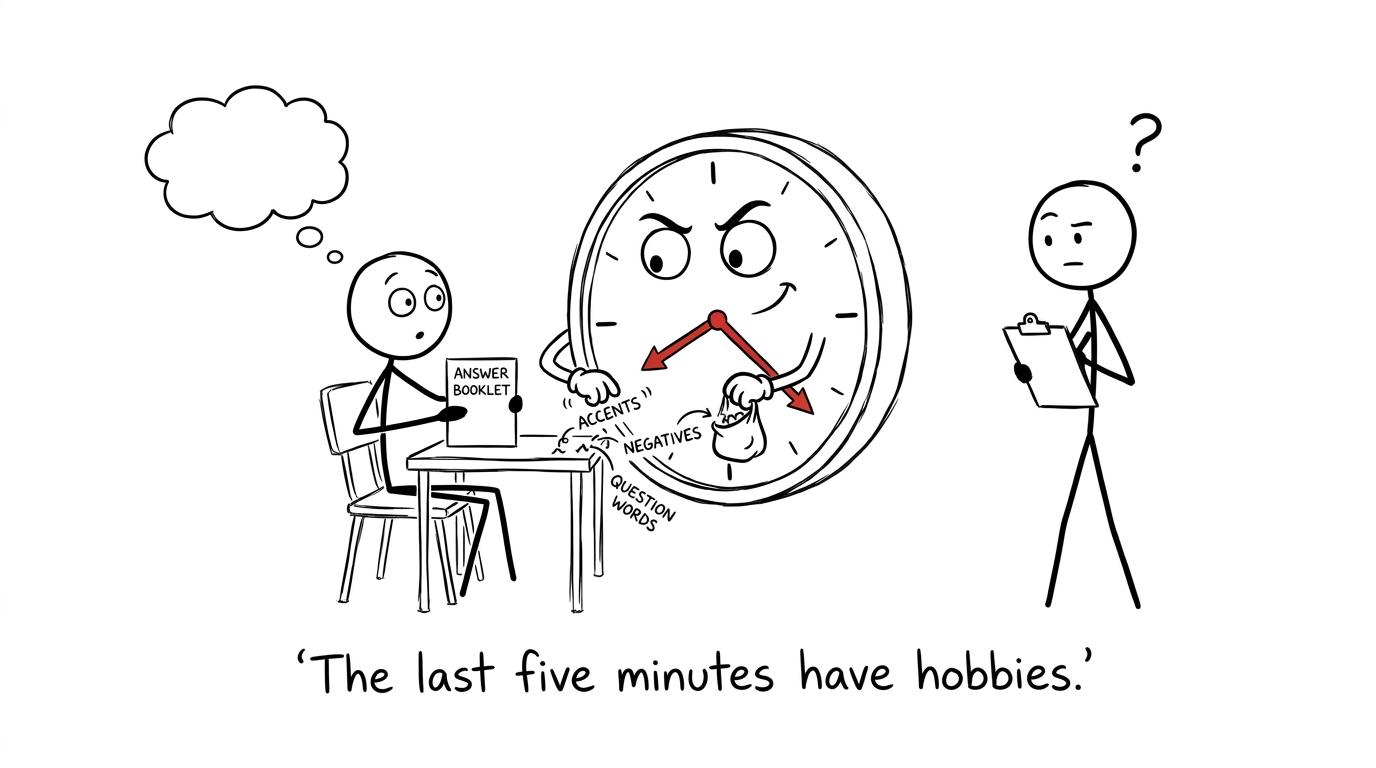 A cartoon clock steals accents and question words from a student's exam desk
Why the clock changes otherwise sensible decisions
Under pressure, students often confuse motion with progress. Writing immediately feels productive. Reading the complete question feels slow.
Yet ten calm seconds at the beginning of a task can prevent several minutes of correction. A question may ask for two details, an opinion, a past event or an answer in English. Missing one of those conditions changes what a successful answer looks like.
This matters particularly for students taking the reformed French qualifications first assessed in summer 2026. Official subject content continues to assess listening, speaking, reading and writing, while newer specifications also include features such as dictation and reading aloud. Exact arrangements differ by awarding organisation, so use materials for the specification you are actually taking. Do not assume that an older past paper perfectly reproduces your current exam.
AQA, Pearson Edexcel and Eduqas publish board-specific requirements. WJEC arrangements in Wales may differ, while OCR is familiar to many maths students but is not automatically their French board. Check the logo or qualification code supplied by your school rather than guessing.
Listening mistakes when there is no rewind button
Listening creates a particular kind of pressure because the recording controls the pace. If one phrase is missed, the mind can keep replaying it internally while the next answer disappears too.
Reading options too late
Use any reading time to identify what each item wants. Look for:
- who is speaking;
- whether the question asks for a reason, opinion or event;
- the likely time frame;
- how many details are required;
- whether the response must be in English, French or another prescribed form.
This turns listening from open-ended translation into targeted retrieval.
Treating the first familiar word as the answer
A familiar noun may be present only to introduce a contrast. Listen for negatives and turning words such as mais, pourtant, cependant and par contre. The decisive information often comes after them.
Do not select an option merely because you heard the same word. Decide whether the whole meaning matches.
Freezing after an unknown word
One unfamiliar word does not usually erase the surrounding message. Keep listening for tone, tense, negatives, quantities and familiar vocabulary. Record your best supported answer, mark the item discreetly and reset for the next question.
For dictation tasks on current specifications, spelling matters. Listen for sound-spelling patterns, grammatical endings and word boundaries rather than trying to remember the entire extract as one block.
Reading errors that look like vocabulary problems
Students often blame a reading mistake on an unknown word. Sometimes the real cause is that they read too quickly to notice the structure around it.
Ignoring the language of the response
Writing a correct French idea when the paper requires English can still fail to meet the instruction. Circle or underline the response language before reading the passage.
Translating every word before answering
Full translation is rarely the quickest route to a comprehension answer. Read the question first, scan for the relevant section and then establish enough context to answer precisely.
When an unfamiliar word appears, use its position, nearby vocabulary and grammar to infer a plausible meaning. Current GCSE subject content explicitly includes inference in reading, so getting stuck on a single unknown term is the wrong battle.
Missing negatives and time markers
Tiny words can reverse an answer. Check for structures such as ne...pas, ne...jamais, ne...plus and ne...rien. Also distinguish what happened, what normally happens and what will happen. A response about yesterday cannot safely be replaced by a general statement about weekends.
In translation into English, preserve the meaning rather than copying French word order. Once finished, read your English sentence on its own. It should sound natural while retaining every important detail.
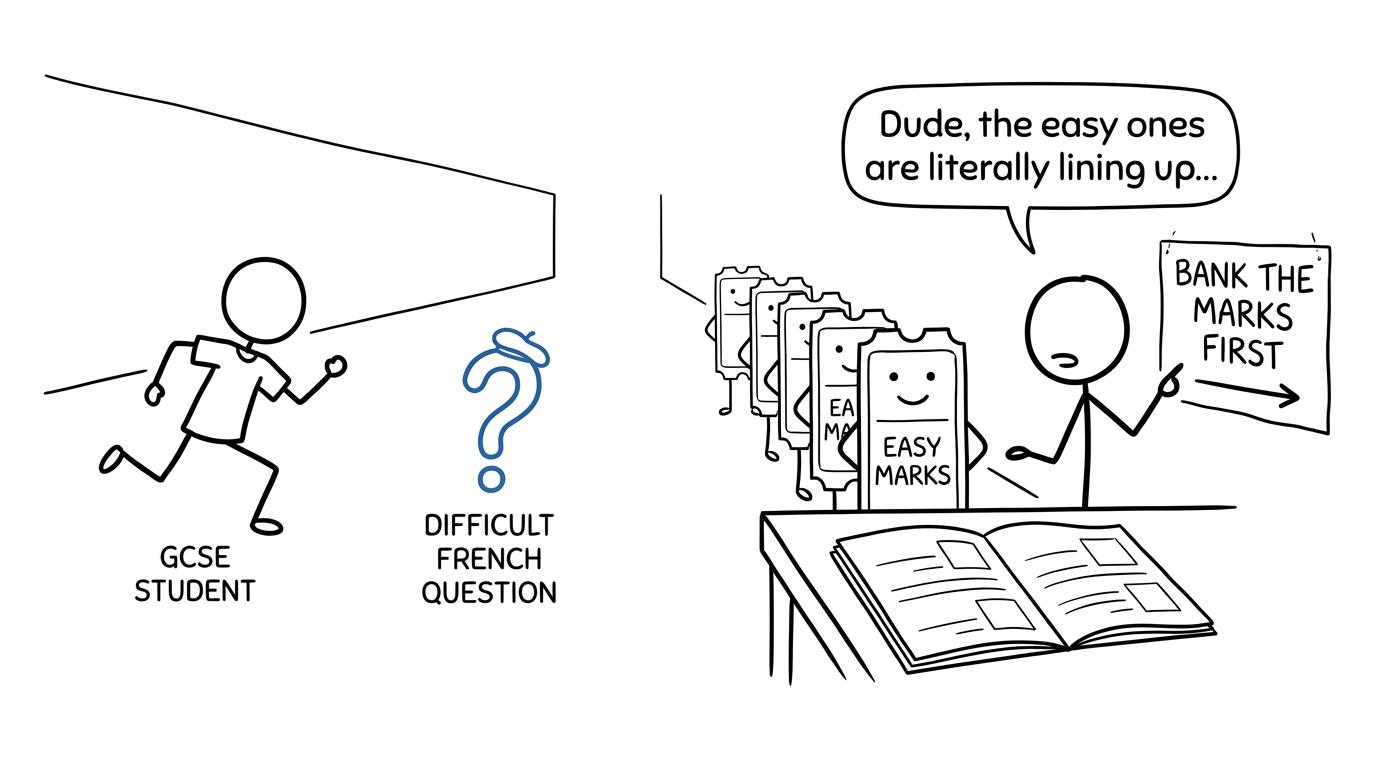 A student is tempted to chase one difficult question while easy marks wait nearby
Writing mistakes that cost avoidable marks
Writing feels controllable because you set the pace. That can become a trap: students spend too long creating an ambitious opening, then rush required content at the end.
Starting without a bullet-point map
Before writing, convert each bullet point into a tiny planning cue. Identify the topic, opinion and time frame required. Tick each point only after it has been answered clearly.
A beautifully written response that omits part of the task is still incomplete. Coverage comes before decoration.
Writing beyond your reliable French
Complex language can demonstrate range, but uncontrolled complexity creates errors and wastes time. Prefer structures you can manipulate accurately. Include different time frames and justified opinions when the task rewards them, but do not force a memorised paragraph into an unrelated prompt.
Memorised material is useful as a toolbox, not as a script. Adapt it to the precise audience, purpose and bullet points.
Translating English literally
If an English phrase does not convert naturally, simplify the idea before translating it. Clear French is stronger than an ambitious sentence built from English word order.
During your final check, prioritise errors that affect several words or the meaning:
- subject-verb agreement;
- tense and infinitive choices;
- adjective agreement;
- negatives;
- articles and gender;
- missing accents where they affect spelling;
- omitted words in translation.
Practise this checking hierarchy under realistic conditions. The MathsGenie past-paper platform includes timers and mark schemes for supported subjects, while the broader guide to using GCSE past papers properly explains the paper-mark-fix-retest cycle.
Speaking mistakes when the answer must be immediate
Speaking pressure can make silence feel much longer than it is. Students then rush, abandon a sentence or give an answer too short to show what they know.
Using preparation time to write a script
Preparation is better used to identify prompts, useful vocabulary, question forms and possible tense changes. A dense script is fragile: if the teacher asks something unexpected, it can be hard to recover.
Current reformed GCSE speaking assessments include tasks such as reading aloud, role play and discussion based on a visual stimulus, although the exact format must be checked against your board. Prepare for interaction, not recital.
Forgetting to ask a question
Where a role-play prompt requires you to ask something, make that requirement obvious in your notes. Under pressure, students can answer every prompt fluently and still overlook the one instruction that changes their role.
Panicking over a correction
A brief self-correction is better than abandoning the answer. Pause, correct the phrase and continue. Do not repeatedly restart the whole sentence in pursuit of perfection.
If you do not understand a question, use an appropriate request for repetition or clarification if the assessment rules allow it. Practise these recovery phrases before the exam so they are automatic.
Common GCSE French time pressure mistakes
The easiest marks are often lost through a chain of small decisions rather than one major knowledge gap.
| Mistake | Better exam habit |
|---|---|
| Answering before reading the complete instruction | Identify the task, response language and number of details first |
| Spending too long on one difficult item | Mark it, move on and return after securing accessible marks |
| Giving one detail when two are requested | Underline quantity words and count details before leaving the question |
| Missing a negative or change of opinion | Check the words immediately before and after the familiar phrase |
| Writing a memorised response that misses the prompt | Map every paragraph to a required bullet point |
| Checking accents while leaving blanks elsewhere | Complete missing answers before polishing smaller details |
| Practising without a timer | Build from short timed sections to complete papers |
| Looking only at the total mark | Record whether each loss came from knowledge, accuracy, interpretation or timing |
The final row matters most. A score tells you where you finished; an error log tells you what to do next. Maths students can develop the same discipline with forty-five-minute GCSE tests before progressing to complete timed papers.
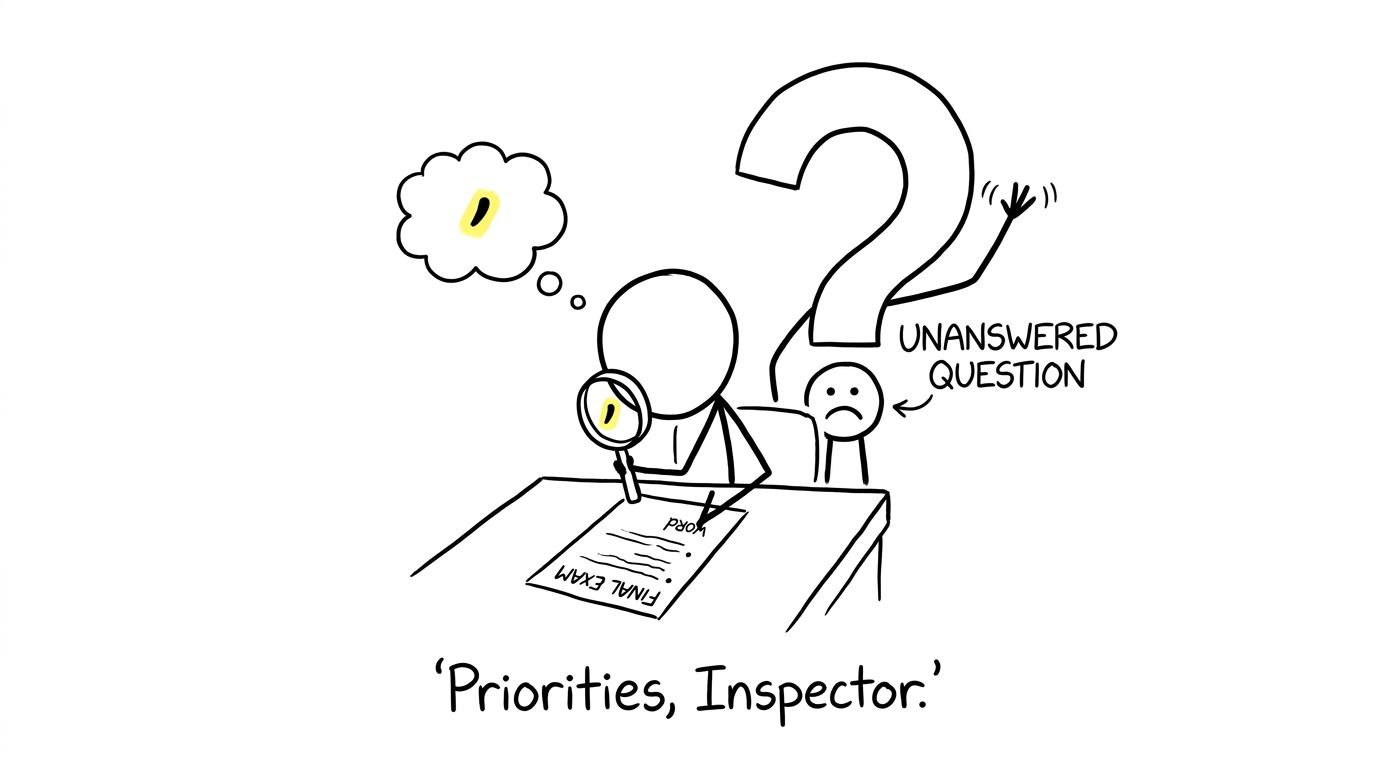 A student uses a tiny magnifying glass to inspect an accent while an unanswered question waves behind them
How to practise speed without learning to rush
Speed should be the result of familiar decisions. It should not be the aim of every revision session.
Begin untimed when learning vocabulary, grammar or task technique. Then add gentle limits to individual sections. Finally, complete full board-specific papers under the correct conditions. The progression is accuracy, fluency, then exam pace.
After each timed attempt:
- mark it using the relevant mark scheme;
- identify the exact point where each mark was lost;
- separate language gaps from timing errors;
- correct the answer without time pressure;
- repeat a similar task later under time pressure.
If running out of time is a recurring problem across your subjects, use the planning principles in the GCSE one-month revision plan. During the final run-in, the GCSE maths exam-week checklist can help you balance timed maths practice with French preparation without turning every evening into another mock exam.
Predicted papers can provide fresh maths practice, but they should never be treated as guaranteed forecasts. The same caution applies to any unofficial French prediction: prepare for the specification, not a guessed topic list. MathsGenie's Edexcel GCSE Maths predicted papers are most useful when completed under timed conditions and followed by careful correction.
Turn pressure into a familiar feeling
The aim is not to make the clock disappear. It is to stop the clock making your decisions.
Read before responding. Bank accessible marks. Move on before one question takes control. Check missing content before minor polish. Most importantly, rehearse those choices until they feel ordinary.
Begin with the free GCSE French revision resources and choose materials for your board and tier. For maths, make MathsGenie your revision base: use revision lessons to rebuild weak methods, practice questions and mini tests to improve accuracy, then past papers and predicted papers to develop timing. Mark each attempt with the mark scheme, use video solutions where available and let every mistake choose the next piece of revision.