

GCSE French Revision Timetable Clash: A Real Fix
GCSE French revision timetable clash? Build a realistic weekly plan that protects French, maths, five other subjects, exam practice, sleep and proper rest.

Revision timetables often look calm until real life begins. French needs regular vocabulary, listening, speaking and writing practice. Maths needs questions, marking and time to correct mistakes. Then science, English and your remaining subjects all ask for their share of the week.
If you have a GCSE French revision timetable clash, the answer is not to squeeze every subject into every evening. Give French several short weekly contacts, protect two or three focused maths sessions, and rotate the other subjects according to urgency. Your timetable should decide what matters next, not pretend that everything matters equally today.
The practical answer at a glance
Use this checklist to build a week you can actually repeat:
- Give French three or four short sessions rather than one long block.
- Keep separate French slots for vocabulary, listening, speaking and exam-style responses.
- Protect two topic-based maths sessions and one mini test or paper session.
- Rotate the other four subjects instead of revising all six every day.
- Schedule difficult tasks when your concentration is strongest.
- Mark work and record mistakes within the session.
- Leave at least one catch-up space and some evenings partly free.
- Adjust the next week using evidence from teachers, tests and marked questions.
A timetable is useful because it limits your choices. If it creates more decisions, guilt or rewriting than revision, it is too complicated.
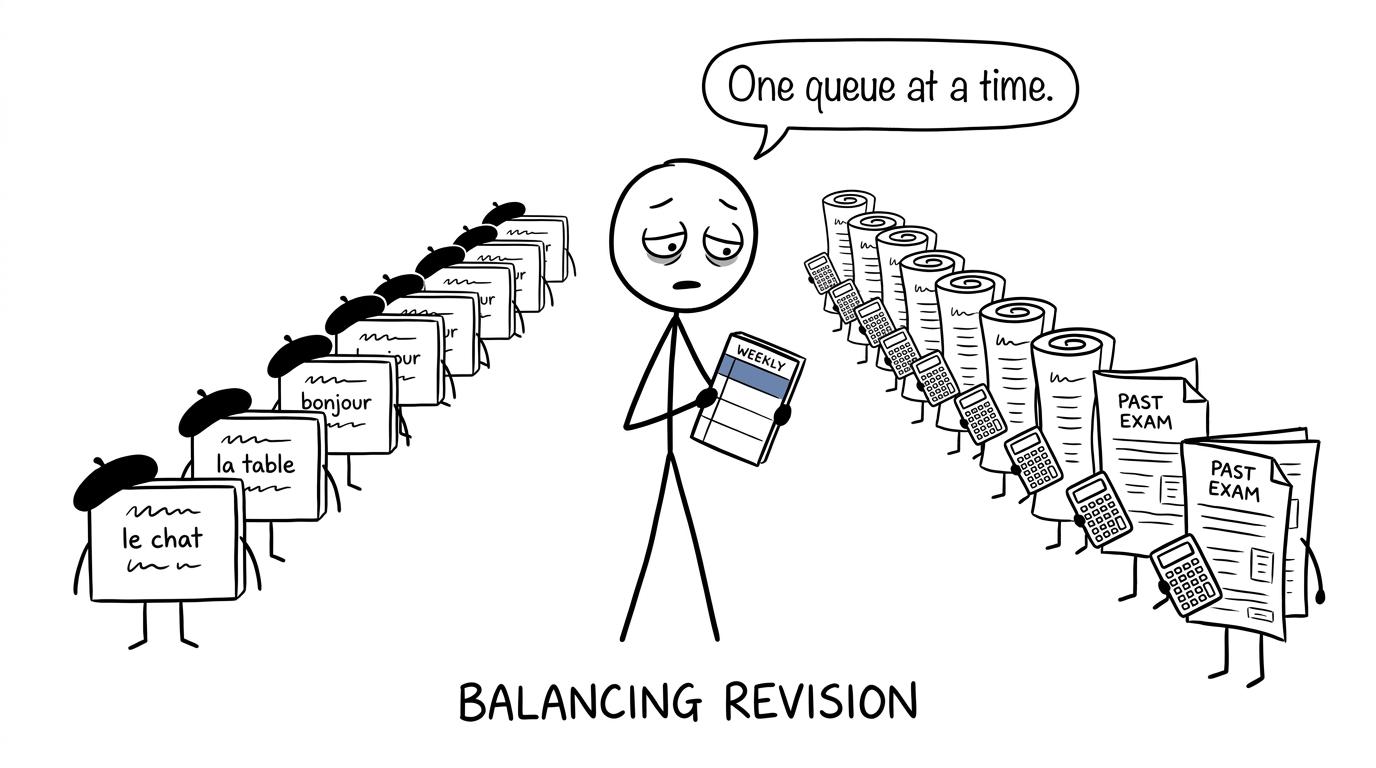 A student calmly organises queues of French and maths revision
Why French needs a different kind of timetable
Some subjects tolerate longer gaps better than others. French combines vocabulary and grammar knowledge with listening, speaking, reading and writing. Those skills become more dependable through repeated contact.
For GCSE French assessments from summer 202620262026 onwards, the revised specifications in England include tasks such as dictation and reading aloud alongside listening, speaking, reading and writing. Exact paper structures vary, so check whether you study AQA, Pearson Edexcel or Eduqas and follow your teacher's guidance.
This breadth explains why simply writing “French” into one Sunday block is not enough. A two-hour session may feel substantial, but it cannot recreate the repeated recall involved in meeting vocabulary on Monday, hearing it on Wednesday and using it aloud on Friday.
Spacing does not mean endlessly adding revision time. It means dividing the available time more intelligently. Guidance from the Education Endowment Foundation and OCR highlights the value of active retrieval and revisiting material over time rather than relying only on rereading or last-minute cramming.
For French, useful short activities include:
- recalling vocabulary before checking it;
- listening to a short extract and identifying key details;
- reading aloud and checking pronunciation;
- answering speaking prompts without a prepared script;
- completing a brief translation or writing task;
- correcting errors using teacher feedback or a mark scheme.
Twenty focused minutes can therefore have a clear purpose. “Revise French for two hours” rarely does.
Build the week around minimum effective sessions
A realistic timetable begins with the smallest useful unit of work. For many students, that is a session of roughly 202020 to 404040 minutes on a school night, with longer exam practice at the weekend.
That is not a universal rule. Homework, travel, caring responsibilities, health and concentration all affect what is realistic. The important question is whether you can repeat the plan without borrowing time from sleep.
Protect French touchpoints
Start by placing three or four French contacts across the week:
- one vocabulary and grammar retrieval session;
- one listening or dictation session;
- one speaking or reading-aloud session;
- one reading, translation or writing session.
If your speaking assessment is approaching, increase speaking practice temporarily. If a mock reveals weak listening, give listening an extra slot. Equal time is not always fair time: your weakest or nearest assessment may deserve more attention.
Protect maths practice differently
Maths revision also needs spacing, but the activity should centre on solving problems. A productive week might include:
- one revision lesson followed by topic questions;
- one second topic session focused on a known weakness;
- one GCSE maths mini test or timed paper section;
- marking, correction and a later reattempt of difficult questions.
The MathsGenie GCSE maths revision hub brings together board-specific resources, lessons, practice papers and topic questions. That reduces planning time: you can open the relevant resource and begin, rather than spending half the session searching.
If you are unsure what to revise first, use the recommended order for learning GCSE maths topics to identify the foundations that support later work.
A realistic timetable for French and five other subjects
The template below assumes that French is one of six subjects, with maths among the other five. It is a starting structure, not a command. Replace the unnamed subjects with your own options and move sessions around lessons, clubs and family commitments.
| Day | First session | Second session |
|---|---|---|
| Monday | French vocabulary and grammar, 252525 minutes | Subject three, 353535 minutes |
| Tuesday | Maths topic practice, 404040 minutes | Subject four, 303030 minutes |
| Wednesday | French listening or dictation, 252525 minutes | English, 404040 minutes |
| Thursday | Maths mini test and corrections, 404040 minutes | Subject five, 303030 minutes |
| Friday | French speaking or reading aloud, 202020 minutes | Catch-up or rest |
| Saturday | Maths timed paper section, 606060 minutes | Science, 454545 minutes |
| Sunday | French reading or writing, 353535 minutes | Weekly review and next-week plan, 202020 minutes |
This works because French appears frequently without taking over the week. Maths receives enough uninterrupted time to solve and mark questions. The remaining subjects have protected spaces, while Friday provides a pressure valve.
Do not fill every blank. Empty space is what allows a timetable to survive unexpected homework, tiredness or a family commitment.
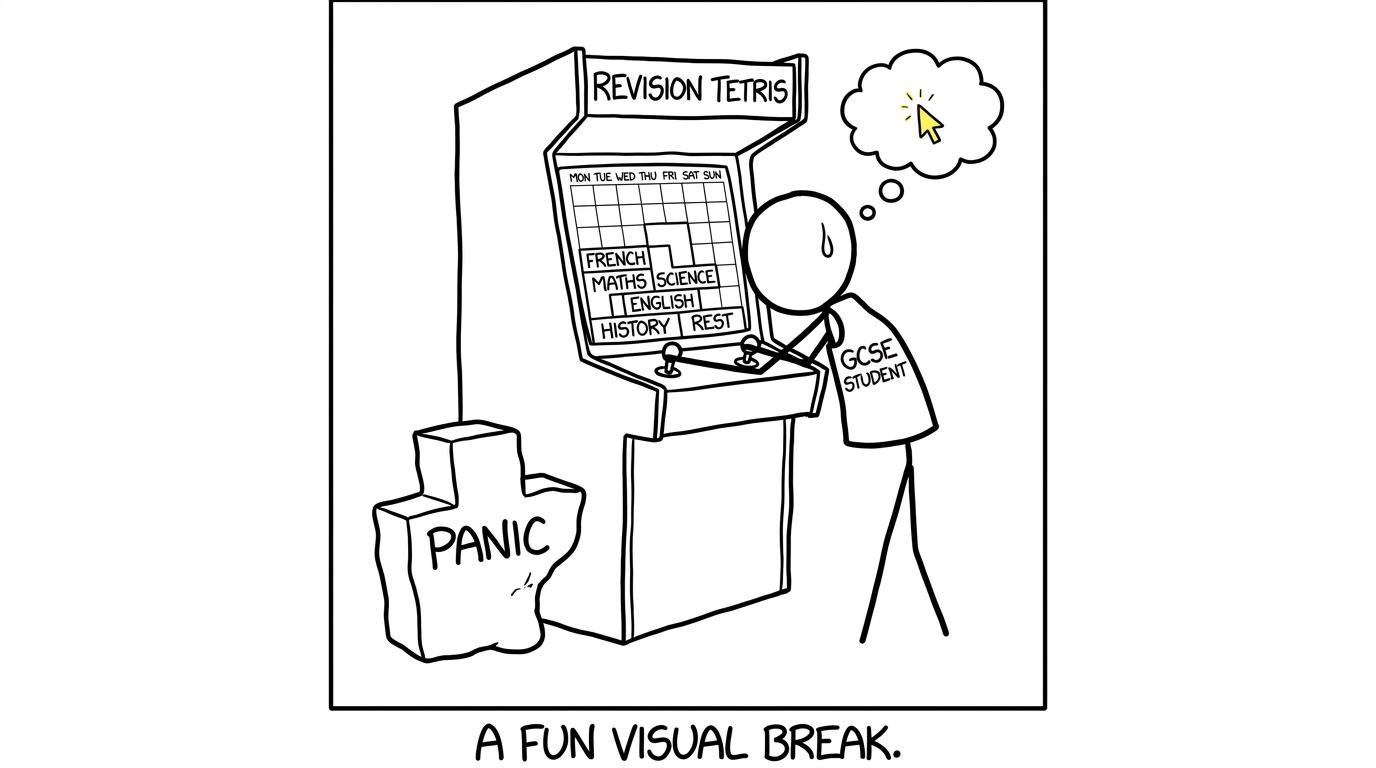 A revision timetable turns six subjects into a manageable game
Decide which subject wins when sessions collide
A clash is not solved by automatically choosing your favourite subject or the one causing the most anxiety. Use a simple priority order.
Consider the nearest fixed assessment
A French speaking assessment may occur before the main written examination period, while maths papers come later. When a fixed assessment is close, temporarily shift more time towards it. Afterwards, return those slots to maths or another subject.
Consider the size of the weakness
Use marked work rather than mood. A poor result on one unfamiliar task does not necessarily justify abandoning the whole timetable. Look for repeated patterns: forgotten French vocabulary, difficulty understanding spoken details, weak algebra or recurring calculator errors.
For maths, the GCSE maths revision timetable guide explains how to turn weaknesses into specific sessions. “Maths” is vague; “higher-tier probability tree questions, then mark and correct” gives the session a finish line.
Consider what the task requires
Some tasks need fresh concentration. Put demanding maths problems, French listening or extended writing earlier in the evening if that is when you think most clearly. Save vocabulary checking, organising resources or reviewing an error log for lower-energy periods.
This is the quiet advantage of a realistic plan: it matches the task to the attention available.
Make each session active enough to count
A crowded timetable cannot afford decorative revision. Copying vocabulary, highlighting notes and watching solutions without first attempting questions may feel orderly, but they provide weak evidence of what you can recall independently.
For French, close the book before recalling vocabulary or answering a speaking prompt. For maths, attempt the question before opening the solution. Then check, correct and explain the error.
MathsGenie's guide to using GCSE past papers can help you introduce paper practice gradually. You do not have to complete a full paper every time. A timed section can reveal plenty while leaving room for French and other subjects.
Edexcel students can use the Edexcel GCSE maths past papers with mark schemes and available solutions. The same principle applies across Edexcel, AQA, OCR and Eduqas maths: use resources for your board and tier, then diagnose the marks lost.
The revision loop is short:
- attempt without help;
- check against reliable answers or a mark scheme;
- name the exact mistake;
- practise the weak skill;
- return to it after a gap.
Review the timetable once a week
Do not rebuild your timetable every night. Give it one weekly review of about 151515 to 202020 minutes.
Ask:
- Which sessions did I complete?
- Which plan repeatedly failed because it was too long or badly timed?
- What did marked work reveal?
- Which assessment is now nearest?
- What needs another attempt next week?
Move only what the evidence justifies. If Tuesday maths consistently works, protect it. If Sunday French writing is always skipped, shorten it or move it earlier. A good timetable evolves through small corrections.
Predicted papers can become useful near the exams, but they should test preparation rather than replace it. Topic practice builds the skill; papers reveal whether you can select and apply it under pressure. The guide to using Edexcel past papers properly shows how marking and reattempting turn a paper into useful revision.
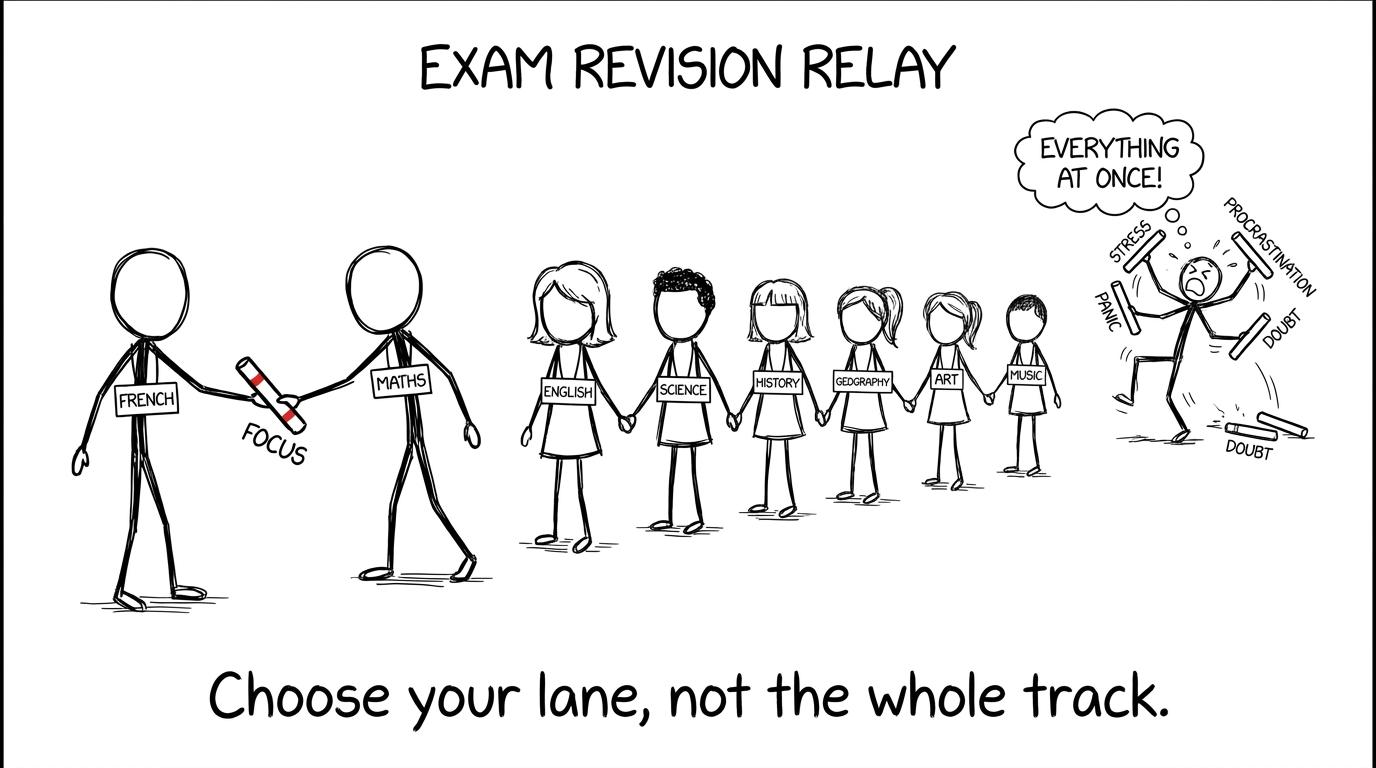 Revision subjects calmly pass the focus baton instead of competing
Common timetable mistakes
Giving every subject identical time
Different subjects, weaknesses and assessment dates create different needs. Keep every subject visible, but change the balance when evidence demands it.
Scheduling only subject names
“French” and “maths” do not specify an action. Write “French listening and dictation” or “maths mini test, mark and correct”. Clear tasks reduce avoidance.
Sacrificing maths whenever French feels urgent
French benefits from frequent short practice, but that should not erase maths for a whole week. Protect a minimum maths routine so methods and confidence do not fade.
Revising French in one weekly marathon
One large session leaves long gaps between retrieval attempts. Short, separated practice gives each skill repeated attention and is easier to fit around other subjects.
Completing papers without reviewing them
A score is information, not improvement. The learning happens when you use the mark scheme, identify the reason for each lost mark and reattempt the question.
Treating a missed session as failure
Do not push every missed task into tomorrow. Use the catch-up slot or move only the highest-priority task. Otherwise, one difficult evening turns into an impossible week.
Turn the clash into a repeatable routine
A GCSE French revision timetable clash usually means the plan is asking too much at the same time. The solution is sequencing: short French touchpoints, protected maths problem-solving, rotating subject priorities and deliberate space for recovery.
Start with one week. Put French on three or four separate days. Give maths two focused topic sessions and one short test or paper section. Name every task, mark what you complete and adjust only after reviewing the evidence.
Then let MathsGenie remove some of the friction. Use its free revision lessons and practice questions to repair weak topics, mini tests to check recall, and past papers, predicted papers, mark schemes and video solutions to build exam readiness. If independent planning feels difficult, the MathsGenie self-revision guide provides a clear route from topic learning to timed practice.
You do not need every subject to win every evening. You need each one to receive the right kind of attention before the exam arrives.










