Does Your GCSE French Revision Environment Matter?
GCSE French revision environment advice that separates useful changes from overrated ones, helping you improve focus, recall, speaking and exam practice.
A student can spend twenty minutes preparing to revise: clearing the desk, arranging highlighters and finding the perfect playlist. Then the phone lights up. The first French question has not yet been answered.
So, does your GCSE French revision environment genuinely affect how much you remember? Yes, but not because you need an immaculate desk or a silent private room. Your surroundings matter when they change what you actually do: whether you concentrate, retrieve vocabulary, speak aloud and practise without looking at notes. Environment supports effective revision; it cannot replace it.
The practical answer is to make distractions harder, useful actions easier and the space appropriate for the French skill you are practising. This principle also transfers directly to GCSE maths revision, where focused questions and honest marking matter far more than an impressive-looking workspace.
The quick revision environment checklist
Before revising, check these five things:
- Purpose: choose one specific task, such as vocabulary recall, listening or speaking.
- Distractions: place your phone out of sight and silence unnecessary notifications.
- Resources: have only the materials needed for that session within reach.
- Sound: use quiet for demanding reading and writing; use audio deliberately for listening.
- Feedback: prepare answers, a mark scheme or another method of checking your work.
A useful environment removes small decisions. When your book, questions and checking method are already waiting, beginning requires less negotiation with yourself.
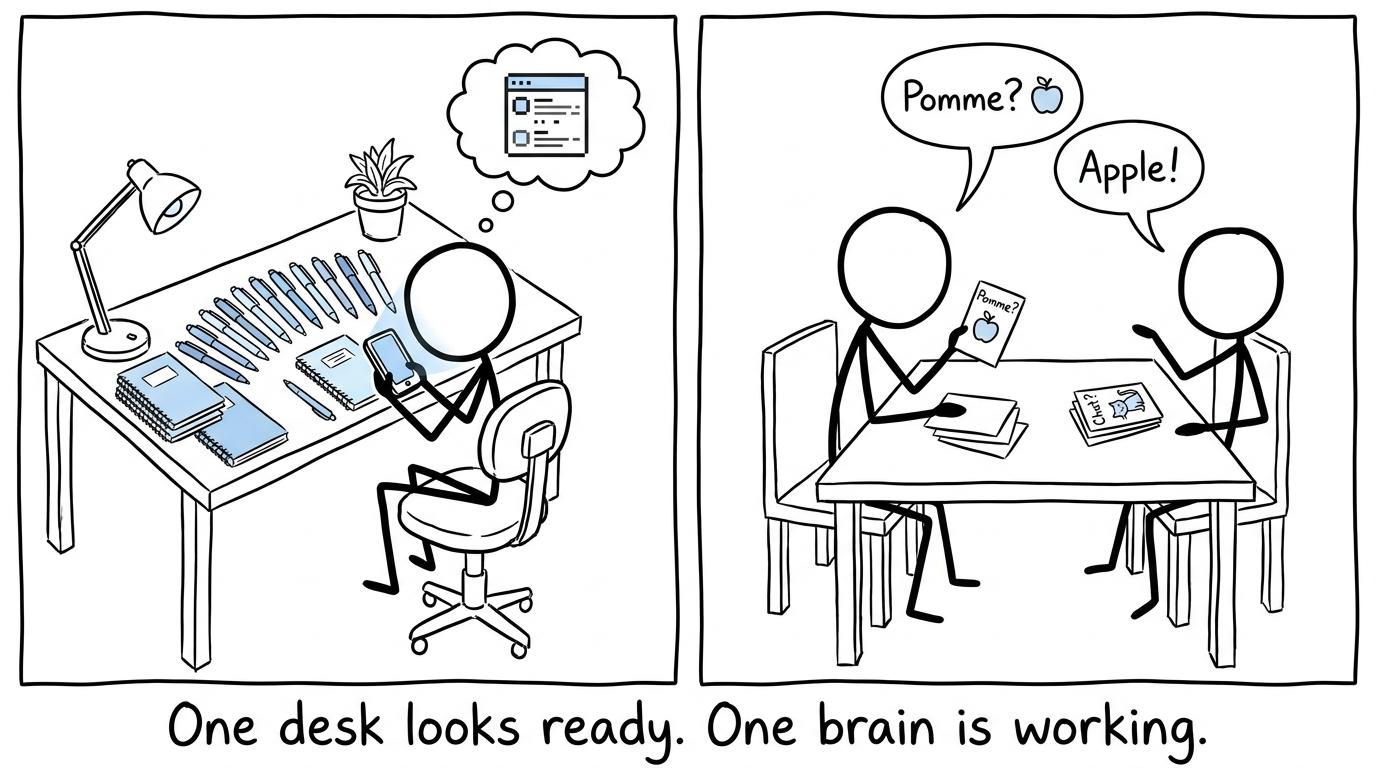 A polished revision desk competes with active learning at a plain table
What the evidence really suggests
Research strongly supports active retrieval: trying to produce an answer from memory rather than repeatedly reading it. The Education Endowment Foundation notes that retrieval practice has substantial research support, while also warning that classroom application depends on the subject, task and quality of the questions.
That distinction matters. A quiet desk does not create learning by itself. It simply gives retrieval practice a better chance to happen without interruption.
Evidence about phones is more nuanced than some revision advice suggests. Studies have linked mobile-phone access and media multitasking with reduced attention or weaker performance, particularly during demanding tasks. However, recent reviews caution that blanket phone bans are not a guaranteed standalone route to higher attainment. The sensible personal conclusion is narrower: if your phone repeatedly interrupts your revision, move it away for the duration of the task.
The same caution applies to music. Songs with lyrics can compete with the verbal information involved in learning French vocabulary, reading passages or planning written answers. Yet there is no need to turn personal preference into a universal law. Compare your recall under different conditions and keep the arrangement that produces better work, not merely the one that feels pleasant.
Why French needs more than one revision setting
GCSE French combines different kinds of performance. Exact assessment arrangements depend on your exam board and specification, but students need to develop understanding and production through spoken and written language. In England, the revised French GCSE specifications were first taught from September 2024, with their first assessments in summer 2026.
No single environment is ideal for every skill.
Quiet recall for vocabulary and grammar
Vocabulary revision should involve covering answers, recalling them and checking them. A calm space helps because French words are verbal information: conversations, lyrics and notifications can compete for the same attention.
Keep the desk simple. Use a specification vocabulary list, flashcards or questions, plus something with which to record errors. Saying an answer before turning over a card makes the task more active than silently recognising it.
Recognition can be misleading. A word may look familiar on a page without being available when you need it in a writing or speaking assessment. The useful question is not, “Have I seen this?” It is, “Can I produce it without help?”
A speaking-friendly place for oral practice
Silence becomes unhelpful if it makes you afraid to speak. For pronunciation, reading aloud, role-play and spontaneous answers, choose somewhere you can use your voice without feeling watched.
That might be a bedroom, an empty classroom with permission or a quiet corner at home. Record yourself when appropriate, then listen for hesitation, unclear pronunciation and answers that stop too early. If a phone is your recorder, use aeroplane mode or a focus setting so that the tool does not become the distraction.
The goal is not to sound perfect in private. It is to make speaking French feel less unusual before the assessment.
Controlled audio for listening practice
Listening revision obviously requires sound. Here, headphones can be useful rather than distracting because the audio is the task.
Choose a place where background noise does not hide endings, negatives or changes of speaker. Play an extract under the conditions required by the activity, commit to an answer and then check it. Constantly pausing every unfamiliar word may help during initial learning, but it does not always reproduce the pressure of an assessment.
Exam-like conditions for final practice
Some revision should resemble the conditions in which you will need the knowledge. Complete occasional reading or writing tasks without notes, messages or casual pauses. Use the time limit and permitted resources stated by your teacher or exam board.
This is not because memory only works in one room. It is because realistic practice develops timing, concentration and decision-making alongside subject knowledge.
The same idea is valuable in maths. MathsGenie’s guide to using Edexcel GCSE maths past papers properly explains how timed practice, marking and targeted correction turn a paper into useful revision rather than a score-gathering exercise.
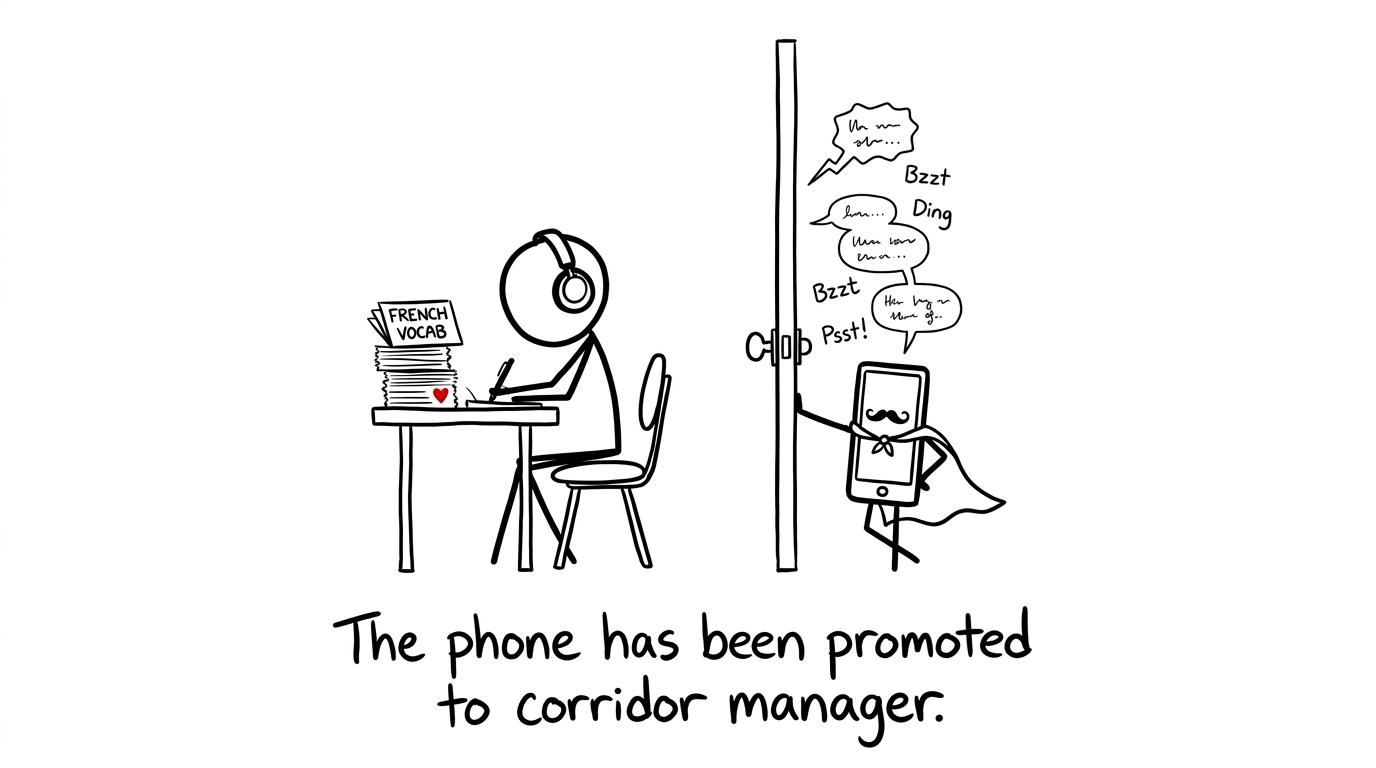 A smartphone becomes corridor manager while focused revision continues
The environment matters less than the revision method
A perfect room cannot rescue passive revision. You can sit in a silent library for an hour and learn very little if you only reread notes. Conversely, a student at a busy kitchen table may make progress by testing vocabulary, checking errors and returning to difficult material later.
A productive session has a visible output. By the end, you should have answered questions, recalled words, produced sentences, completed a listening task or identified mistakes.
Use this simple cycle:
- decide what you need to retrieve or practise;
- work without looking at the answer too soon;
- check accurately;
- record a small number of gaps;
- revisit those gaps in a later session.
Spacing revision across several occasions is generally more useful than relying on one large, exhausting session. Planning, monitoring and evaluating your approach are also central to effective self-regulated learning. In practical terms, ask: What am I doing? Is it working? What needs to change next time?
Maths students can build the same process through the GCSE maths revision hub, which brings together revision guides, questions, papers and testing resources. The subject changes, but the learning loop does not.
Build a workable environment, not an ideal one
Many students cannot control noise, space or other people at home. Advice that assumes everyone owns a quiet office is not useful. Instead, improve the conditions you can change.
If space is shared, try:
- agreeing on a short uninterrupted period with family;
- using a school library or supervised revision room;
- keeping a portable revision folder ready to move;
- using plain background sound to mask unpredictable noise;
- choosing speaking practice for times when the room is less crowded;
- downloading required material before switching off notifications.
A reliable twenty-minute setup is more valuable than an imaginary perfect room you rarely have. MathsGenie’s GCSE one-month revision plan demonstrates the wider principle: a modest routine that can be repeated is stronger than an ambitious plan that collapses after two days.
Run a simple personal test
Rather than debating whether music or a particular room “works”, collect evidence from your own revision.
Complete comparable vocabulary recall tasks under two different conditions. Keep the task length and difficulty as similar as possible. Record how many items you retrieved correctly, how often you became distracted and whether you could recall the same material later.
This is not a controlled scientific experiment, but it is better than judging a setup solely by comfort. Productive revision can feel effortful. A method that exposes forgotten words may be doing more for you than one that creates an easy sense of familiarity.
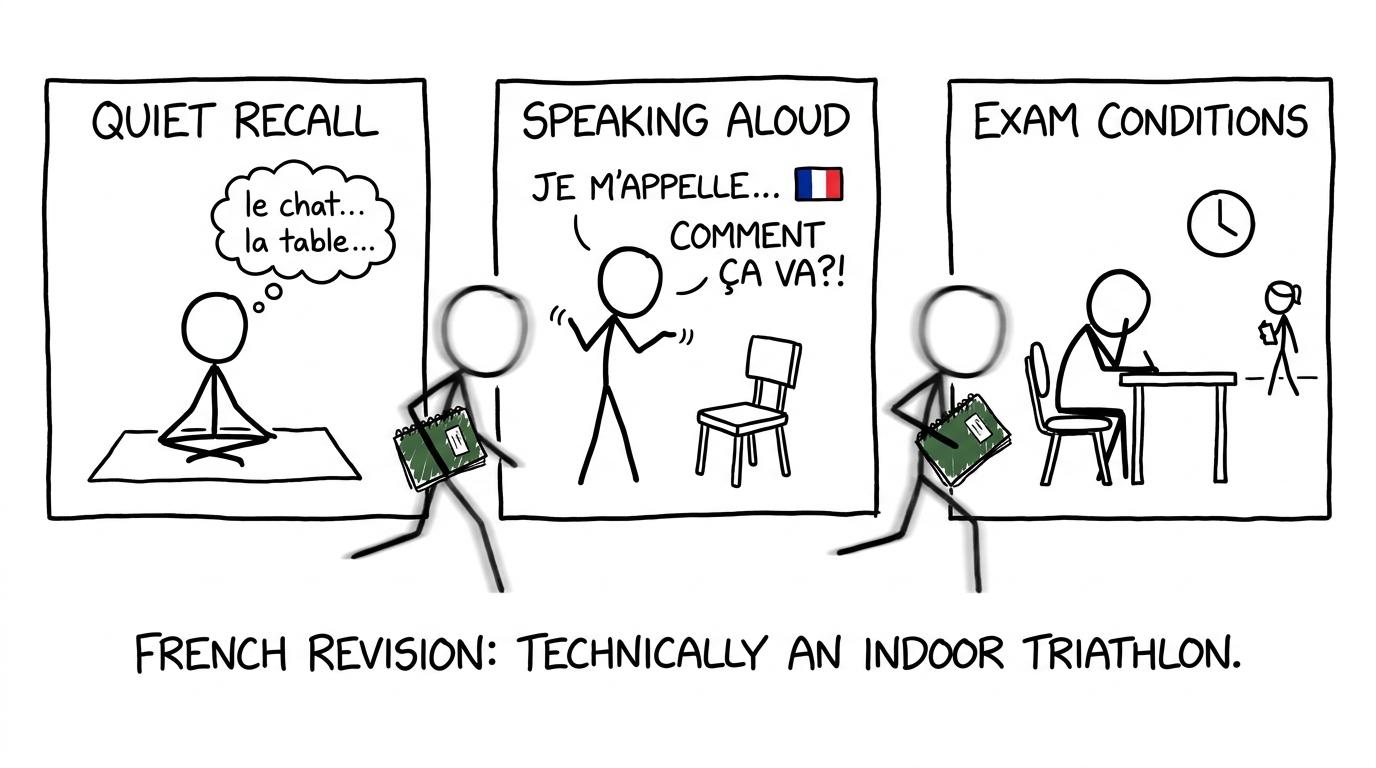 A student completes the indoor triathlon of French revision settings
Use different modes across French and maths
Students revising several GCSE subjects do not need a completely different system for each one. They need a stable routine with small task-specific changes.
For French, the session might involve retrieval cards, listening audio or spoken responses. For maths, it might involve a revision lesson, exam questions and a mark scheme. MathsGenie’s article on building a GCSE maths revision timetable can help you arrange these sessions without allowing one subject to consume every evening.
When a full paper feels too demanding, smaller assessments can reduce the barrier to starting. Maths students can use Edexcel GCSE maths 45-minute tests, while short vocabulary or listening sets can play a similar role in French.
Later, increase realism. MathsGenie provides GCSE predicted papers for fresh exam-style practice and guidance on when to start GCSE past papers. Predicted papers are a MathsGenie maths resource, not a substitute for your French exam board materials, but the underlying habit transfers: attempt unseen work, check it and repair the gaps.
Common revision environment mistakes
Optimising the desk instead of starting
Tidying can remove distractions, but it can also become respectable procrastination. Give setup a short limit, then begin with a question.
Keeping the phone face down beside you
Face down is still nearby. If you habitually check it, place it across the room or outside the door. Bring it back only when the task genuinely requires audio or recording.
Using one environment for every French skill
A library may suit reading but prevent speaking practice. Match the setting to the task rather than forcing every task into the same place.
Confusing quiet with effective revision
Silence helps concentration, but learning still requires action. Retrieve, answer, speak, listen and check.
Never practising under assessment conditions
Supported practice is valuable while learning. Eventually, however, remove notes and complete timed tasks so that you discover what is independently available.
Changing everything at once
If revision is not working, alter one feature: move the phone, shorten the session or change the task. You will learn more from a small measurable adjustment than from rebuilding your entire routine.
Your environment should make good revision easier
The best GCSE French revision environment is not the most attractive or expensive. It is the one that helps you begin promptly, concentrate on the right task and discover what you can retrieve without support.
Make the phone less available. Keep the required resource close. Use quiet for demanding verbal work, a private space for speaking and realistic conditions for occasional timed practice. Then judge the setup by what you can remember and produce later.
Carry that routine into maths revision with MathsGenie’s free GCSE resources. Start with a revision lesson, answer practice questions, check the mark scheme and use video solutions to repair mistakes. Build towards mini tests, past papers and predicted papers. Your surroundings set the stage; consistent, active practice does the learning.