GCSE French Last Minute Revision Plan: 3 Days
GCSE French last minute revision plan: follow a calm three-day routine for vocabulary, listening, reading, writing and speaking confidence.
The exam is three days away. Your vocabulary feels scattered, every listening track seems too fast, and suddenly the entire French language appears to be on the specification.
Pause. A GCSE French last minute revision plan cannot teach you the whole course in three days, but it can improve recall, repair common weaknesses and make the exam feel more manageable. The short answer is this: diagnose what matters today, practise the weakest skills tomorrow, then rehearse calmly and rest on the final day.
Panic asks you to cover everything. A useful plan asks a better question: what can I still improve?
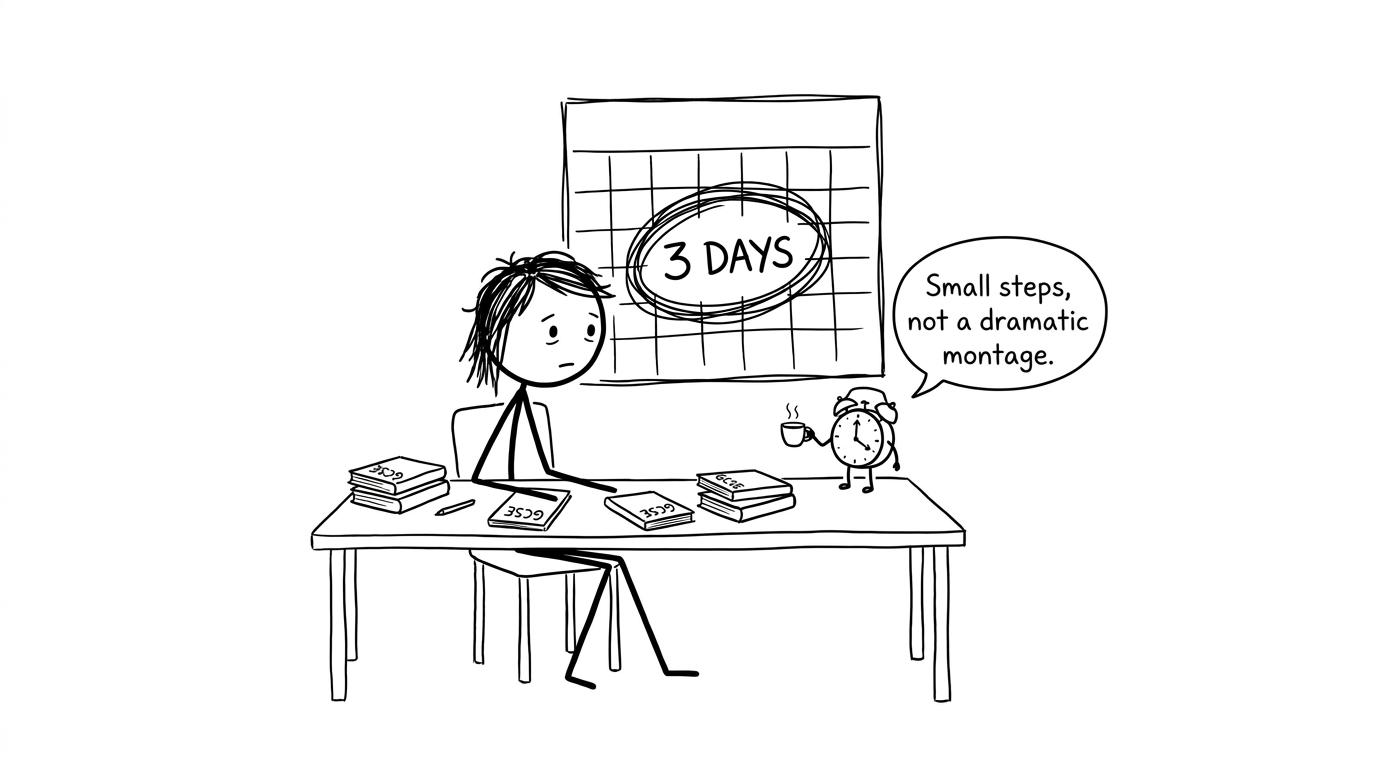 A calm three-day revision plan beats a dramatic montage
Your calm three-day checklist
Use this as the shape of the next three days:
- Day one: confirm the paper, diagnose your gaps and rebuild essential vocabulary.
- Day two: practise the exact skills being assessed and correct mistakes immediately.
- Day three: complete one controlled rehearsal, review your error list and stop early enough to sleep properly.
- Every day: use active recall, short timed tasks and immediate feedback.
- Avoid: rewriting notes, downloading new resources or attempting to memorise the entire vocabulary list.
First, check which assessment is actually approaching. GCSE French includes listening, speaking, reading and writing, but your next exam may test only one of them. Current AQA, Pearson Edexcel and Eduqas specifications differ in their precise timings and task structures. Check your board, tier and official information from your school rather than revising from a generic timetable.
For qualifications assessed from 2026, reformed specifications include tasks such as dictation in listening and reading aloud in speaking. Older papers can still provide language practice, but their format may not match your current assessment exactly.
Day one: turn panic into evidence
The first day is not for heroic revision. It is for finding out where the marks are most likely to disappear.
Confirm the exam in front of you
Write down:
- your exam board;
- foundation or higher tier;
- the skill being assessed;
- the date and start time;
- the permitted equipment;
- the question types and approximate timings.
Students must normally take the same tier across the French qualification, but do not rely on memory. Use the details given by your school.
This small administrative check matters. Revising extended writing when the imminent paper is listening is productive-looking avoidance.
Complete a short diagnostic
Choose a sample task or paper section that matches the approaching assessment. Work without notes for around thirty minutes, then mark it or compare it with the official guidance supplied by your teacher or exam board.
Create three categories:
- Secure: you can answer accurately without support.
- Nearly there: you recognise the language but make grammar, spelling or timing errors.
- Missing: you cannot understand the question or begin a response.
Spend most of the remaining time on “nearly there”. These weaknesses are often quickest to improve because some knowledge already exists.
This is the same evidence-first principle used in MathsGenie’s guide to finding your weakest GCSE topics quickly. A diagnostic is not a verdict. It is a map.
Rebuild a compact language bank
Do not copy hundreds of isolated words. Build a short bank containing:
- high-frequency verbs;
- common question words;
- negatives and time phrases;
- opinions and reasons;
- language for past, present and future time;
- vocabulary from your weakest two themes;
- words you repeatedly confuse.
Test yourself in both directions. Seeing French and recalling English supports comprehension, while seeing English and producing French supports speaking, writing and translation.
Use a cover-write-check routine. Keep only missed items in the next round. The pile should shrink as your recall improves.
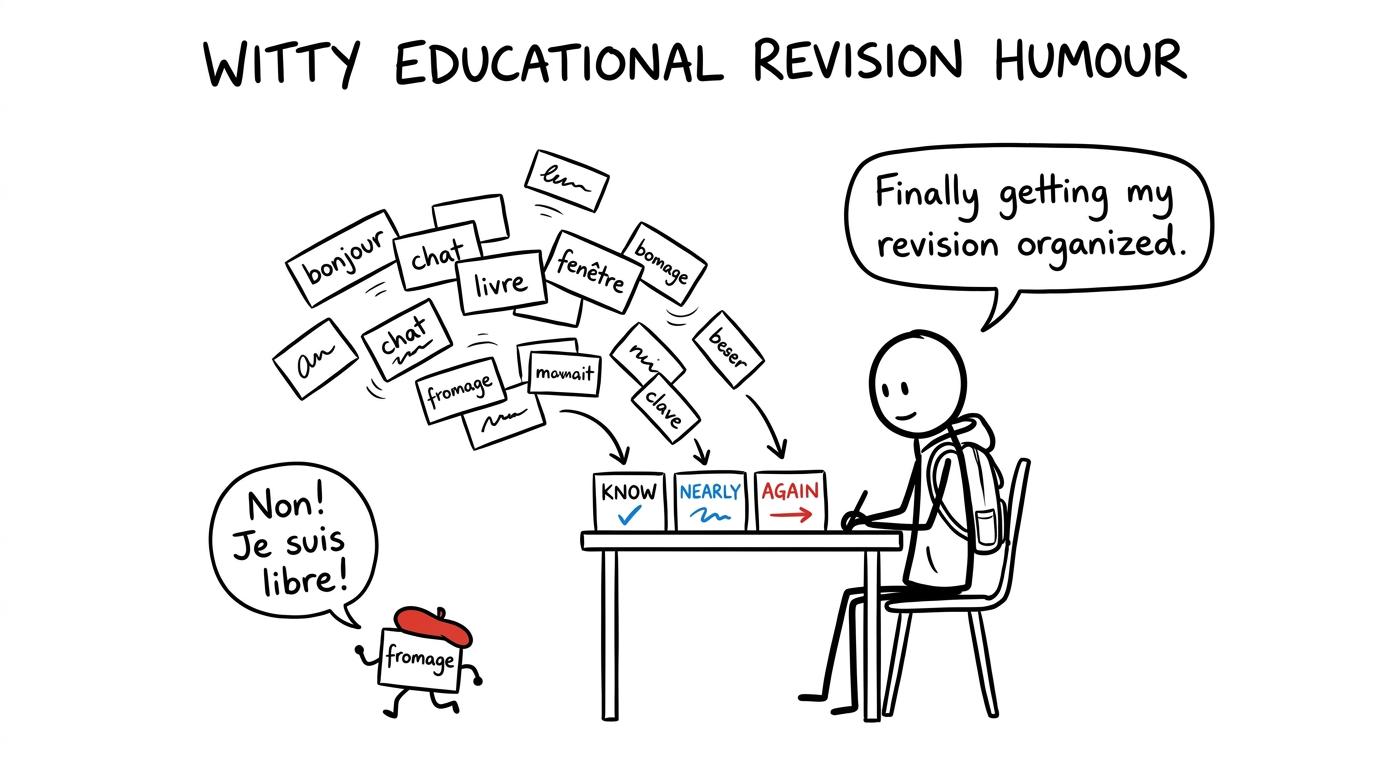 A student sorts French vocabulary into useful revision piles
Day two: practise the skill, not the feeling of revising
Day two is the main working day. Use three focused sessions with proper breaks rather than one exhausting marathon.
A simple rhythm is:
- short retrieval warm-up;
- one timed task;
- immediate marking or checking;
- a written correction;
- a fresh attempt at the same skill.
Maths students may recognise this loop from the MathsGenie twenty-minute revision routine: attempt, check, correct and retest. The subject changes, but useful revision still requires retrieval and feedback.
If listening is next
Practise listening for specific information rather than expecting to understand every word. Before the audio begins, scan the questions and predict whether each answer needs a person, place, time, opinion or reason.
Pay particular attention to:
- negatives;
- changes of opinion;
- time frames;
- numbers and dates;
- distractors that mention more than one possible answer.
For current specifications containing dictation, include short transcription practice. Listen for word boundaries, verb endings, agreements and familiar sound-spelling patterns. Do not repeatedly play an entire track without checking what you missed.
If reading is next
Read the question before the passage. Identify the required detail, then locate evidence rather than translating every sentence.
Practise:
- recognising synonyms and paraphrases;
- spotting negative constructions;
- distinguishing past, present and future references;
- inferring an unfamiliar word from its context;
- translating meaning naturally into English.
When reviewing, underline the exact phrase that supports each answer. This prevents answers based on a vague impression of the text.
If writing is next
Prepare a reliable checklist, not a memorised essay. Your response needs to address every required point while remaining accurate and understandable.
Check for:
- complete coverage of the task;
- clear opinions with reasons;
- appropriate time frames;
- accurate common verbs;
- agreements and spellings;
- a final proofread focused on recurring errors.
A complicated sentence that collapses is less useful than controlled language you can reproduce correctly. Memorised paragraphs can also become dangerous when they do not answer the actual prompt.
If speaking is next
Practise aloud. Silent reading cannot fully prepare you for pronunciation, pace or responding under pressure.
Current reformed assessments can include a read-aloud task, role-play and discussion based on visual material, although the exact structure depends on your board. Rehearse the task types specified for you.
Record brief responses and listen back once. Check whether you answered the question, gave enough detail and spoke clearly. If you become stuck, practise recovering with familiar language rather than abandoning the response.
Finish day two by writing a one-page error list. It should contain only specific reminders, such as missed negatives, uncertain verb forms or question words you misread.
Day three: rehearse, correct and stop
The final day should make your knowledge easier to access. It should not fill your head with new material.
Complete one controlled rehearsal
Choose one task or paper section in the correct format. Work under realistic timing, without pausing to consult notes. Then review it carefully.
A paper only becomes revision when you learn from it. MathsGenie explains this clearly in how to use past papers properly. The useful sequence is attempt, mark, identify the weakness, repair it and retest.
Do not complete several papers simply to feel busy. One properly reviewed task is more valuable than three abandoned ones.
Review only high-value material
Return to:
- your reduced vocabulary pile;
- your one-page error list;
- common question words;
- essential verb patterns;
- the instructions for your assessment format.
Say vocabulary and speaking prompts aloud. For reading and listening, practise identifying meaning quickly. For writing, rehearse planning and checking rather than producing another long answer late at night.
Protect the final evening
Pack what you need, check the time and location, set an alarm and stop heavy revision early. Exhaustion makes concentration, recall and careful reading harder.
If several GCSEs are competing for attention, put the remaining work into a realistic schedule using the free MathsGenie revision planner. A plan should reduce decisions, not create another source of guilt.
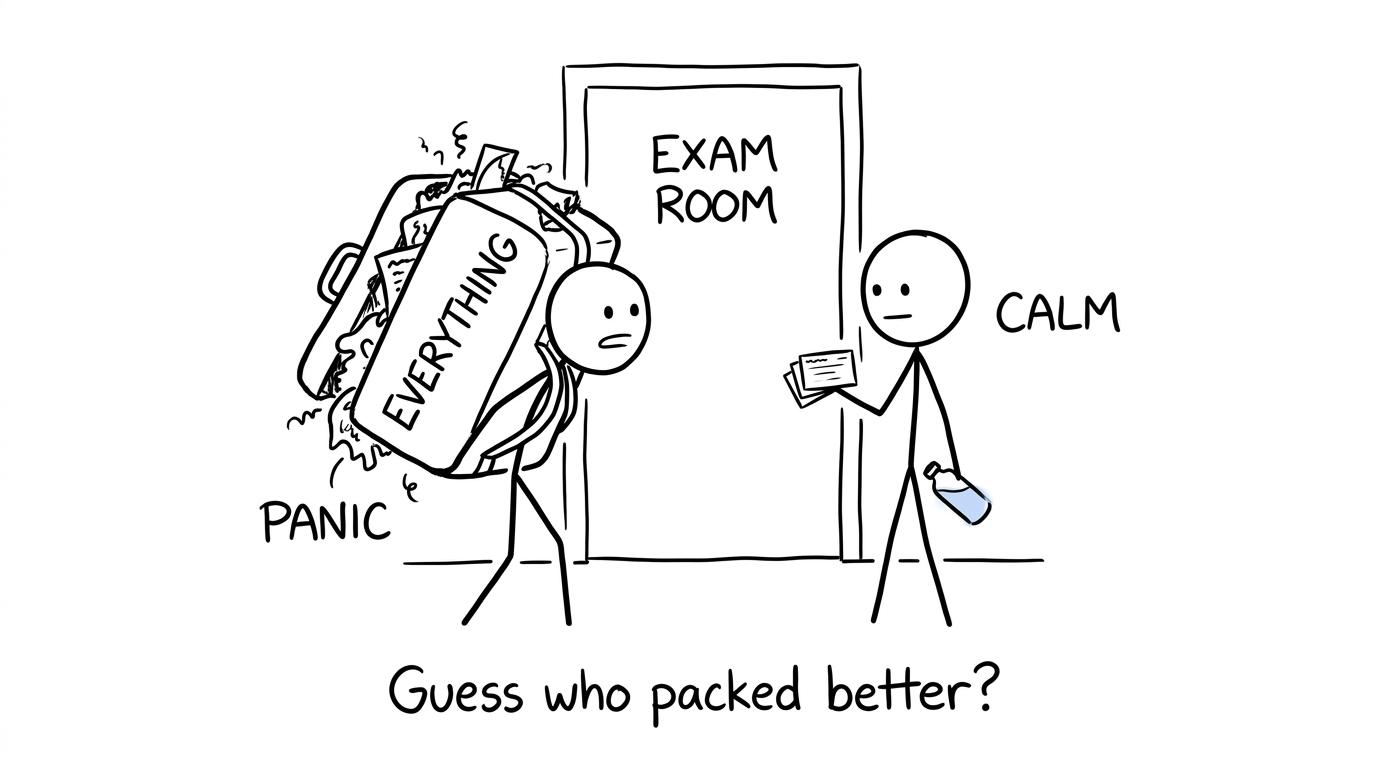 Calm packs lightly while panic tries to carry everything
Common last-minute French revision mistakes
Trying to revise every theme equally
Three days require prioritisation. Focus first on the imminent skill, then on recurring vocabulary and grammar weaknesses revealed by your diagnostic.
Rereading instead of retrieving
Recognition can feel like knowledge. Close the book and produce the word, meaning or response from memory. Difficulty during retrieval is not failure; it is the work revision needs to contain.
Ignoring the current specification
Old papers may use a different structure. From 2026, reformed GCSE French assessments include features such as dictation and reading aloud. Confirm your board’s current format before choosing practice materials.
Memorising language you cannot control
Overly ambitious phrases are fragile under pressure. Prioritise accurate, adaptable language that answers the prompt.
Marking without correcting
Writing a score at the top of a task changes nothing. Record why each mark was lost and repeat the skill. MathsGenie’s GCSE exam-week checklist uses the same calm principle: practise, mark, fix and make a short next-step list.
Sacrificing sleep for one more session
Late-night cramming often produces diminishing returns. Your final evening should make tomorrow easier, not turn the exam into an endurance test.
Calm revision is selective revision
Three days is not much time. That is precisely why every session needs a clear purpose.
Confirm the assessment. Diagnose the gaps. Retrieve essential language. Practise the correct task type. Correct mistakes. Rehearse once, then rest.
And remember that French is only one part of your GCSE timetable. When it is time to return to maths, use the GCSE Maths revision hub for free revision lessons and practice questions, the past-paper library for timed practice and mark schemes, and GCSE predicted papers for focused exam preparation. MathsGenie brings revision lessons, mini tests, past papers, predicted papers, practice questions, mark schemes and video solutions into one clear revision journey.
For now, choose the first French diagnostic task and begin. Calm usually arrives after the first useful action.