GCSE French Grade 7 Meaning: Ability & Old Grades
GCSE French grade 7 meaning explained: discover the ability it represents, how it compares with an old grade A, and what the result means for you.
A result can look precise while still leaving you with questions. You open the envelope, see a grade 777 in GCSE French and know it is good, but what does it actually say about your French?
The short answer to the GCSE French grade 7 meaning is this: it is a strong higher-tier result showing that you can understand and communicate French across listening, speaking, reading and writing, including less familiar material and more demanding language. Officially, the bottom of grade 777 is comparable with the bottom of the old grade A. It does not mean complete fluency, nor does it guarantee the same mark every year.
That distinction matters. A grade is evidence of performance in a defined assessment, not a permanent label for your ability.
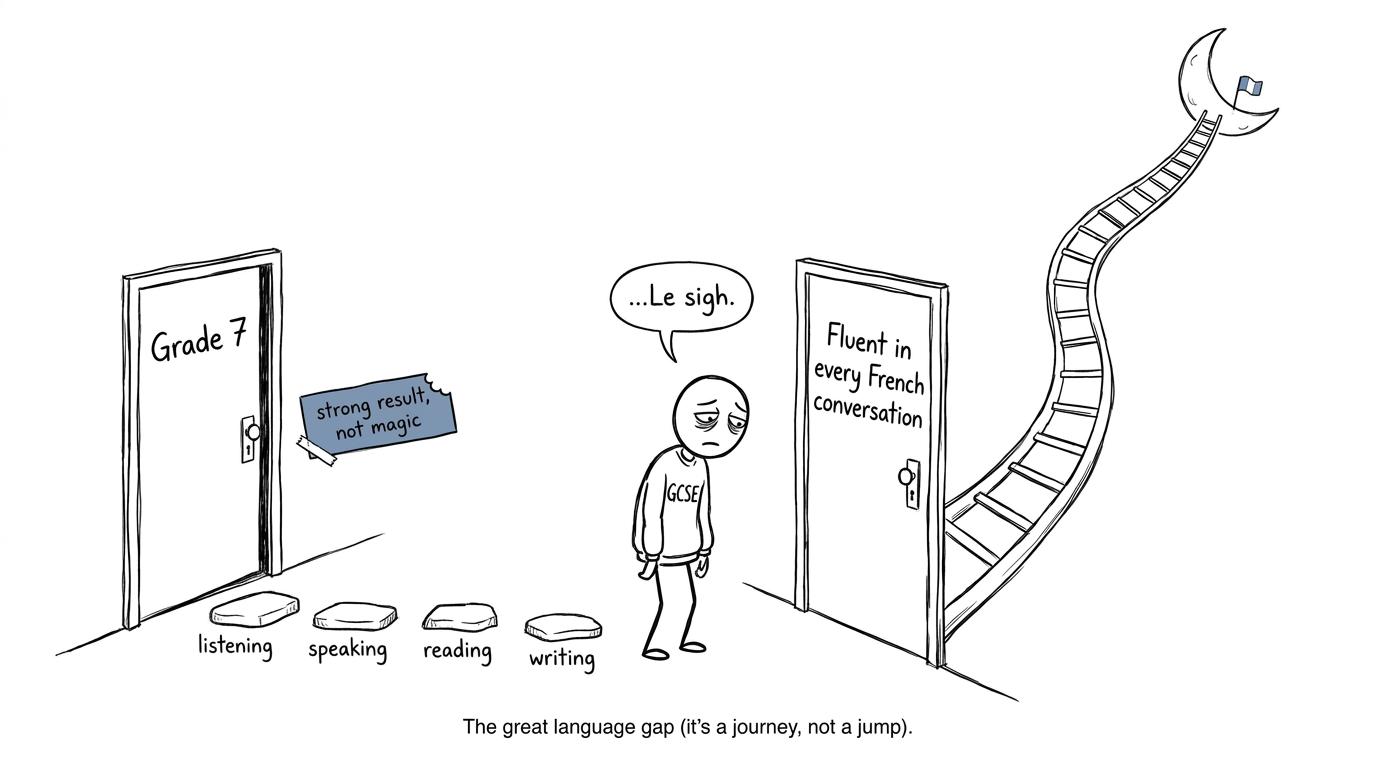 A student discovers that a strong GCSE result is a step towards fluency rather than a magic doorway
Grade 777 at a glance
Here is the practical interpretation:
- Grade 777 is one of the upper GCSE grades and is available through higher-tier French papers.
- Its lower boundary is officially comparable with the lower boundary of the former grade A.
- It reflects strong performance across the assessed language skills, not perfection in every component.
- It normally indicates that you can communicate beyond short, memorised statements and deal with a wider range of vocabulary and grammar.
- It is not a formal declaration that you are fluent or bilingual.
- The mark needed changes between exam series because grade boundaries are set after the papers have been taken and marked.
Students familiar with the structure of grade 777 in GCSE Maths may recognise the central idea: a grade describes the standard demonstrated across the whole qualification. It is not a percentage that remains fixed forever.
What does a grade 777 represent in actual French ability?
A grade 777 suggests a student can use French with a meaningful degree of independence within GCSE contexts. That includes understanding spoken and written passages, selecting relevant information, expressing ideas and applying prescribed grammar and vocabulary accurately enough to communicate clearly.
For students taking the reformed GCSE French qualifications first assessed in summer 202620262026, the course places explicit emphasis on communication, grammar, vocabulary and the relationship between written language and sound. Current AQA and Pearson Edexcel specifications organise assessment through listening, speaking, reading and writing components, each contributing 25%25\%25% of the qualification. Students should always check their own exam board's specification because task formats and total raw marks can differ.
Listening and responding
At grade 777, you would generally expect to follow spoken French across familiar topics and cope with some less predictable details. Strong performance involves more than recognising isolated words. You need to connect information, notice time frames, distinguish opinions from facts and avoid being misled by distractors.
The reformed qualifications also include dictation. This tests whether you can connect French sounds with accurate written forms. A student may understand the overall message yet lose marks through spelling, agreements or missing grammatical endings, so close listening matters.
Speaking with some independence
A grade 777 performance is likely to show clear, comprehensible speech and an ability to respond rather than simply recite. Depending on the exam board, tasks can include role-play, reading aloud, discussion of visual material and unprepared conversation.
You would not be expected to sound like a native speaker. Hesitation and occasional errors can still occur. The important qualities are successful communication, relevant development, understandable pronunciation and increasingly secure control of grammar and vocabulary.
Reading beyond word spotting
Stronger GCSE reading involves following meaning across a passage rather than translating every word individually. You may need to identify viewpoints, infer the plausible meaning of an unfamiliar word from context and translate French into natural English.
A grade 777 therefore suggests that familiar vocabulary has become usable knowledge. You can combine it with grammar and context to understand material that is not entirely predictable.
Writing accurately and with range
In writing, a grade 777 student should normally be able to develop ideas, address the task and communicate across different time frames. Accuracy still matters: verb forms, agreements, word order and spelling can affect both clarity and marks.
Range is not the same as forcing complicated phrases into every sentence. Controlled language that answers the question is more valuable than an ambitious structure used incorrectly. The strongest responses balance development, variety and accuracy.
Is a grade 777 the same as an old grade A?
The careful answer is: the bottom of grade 777 is comparable with the bottom of the old grade A.
That wording comes from the official comparison points used when England moved from A* to G grades to the 999 to 111 scale. Grades 777, 888 and 999 collectively occupy the part of the scale previously covered by grades A and A*. Grade 999 provides additional differentiation at the very top.
It is tempting to build a perfect conversion chart, but the scales do not match grade by grade. The official anchor points are:
| Current grade boundary | Comparable former boundary |
|---|---|
| Bottom of grade 777 | Bottom of grade A |
| Bottom of grade 444 | Bottom of grade C |
| Bottom of grade 111 | Bottom of grade G |
So describing grade 777 as broadly equivalent to an A is reasonable shorthand. Describing every grade 777 performance as identical to every old grade A performance is too simplistic because the qualifications, assessments and grading scales differ.
Maths students can see how topics were once organised under letters on MathsGenie's A* to G GCSE Maths revision archive, while the current GCSE Maths revision hub reflects the modern numerical system.
Does grade 777 mean you are fluent in French?
No. It means you have performed strongly against the GCSE assessment criteria.
Fluency is broader. It involves sustaining spontaneous communication across situations that may never appear in an examination, understanding different speakers and registers, and continuing when you do not know the ideal word. GCSE French tests valuable foundations, but it does so within prescribed vocabulary, grammar, themes and task types.
Earlier Ofqual research into the previous GCSE language qualifications placed grade 777 broadly around the middle of CEFR level A2. That comparison should be treated as context rather than an exact conversion, particularly because reformed French specifications are first being awarded in 202620262026. GCSE grades and CEFR levels are separate measures.
In everyday terms, grade 777 is better understood as strong developing independence. You can communicate successfully in many familiar situations and approach some unfamiliar material, but there remains a considerable journey towards advanced fluency.
Why there is no fixed grade 777 percentage
A common assumption is that grade 777 always requires a particular percentage. It does not.
Exam boards set boundaries after students have completed the assessments and the papers have been marked. If a paper proves more demanding, its boundaries may be lower; if it proves less demanding, they may be higher. The purpose is to maintain a comparable standard rather than make one raw percentage permanent.
Your result is based on the combined subject mark. You do not need to achieve grade-777 performance in every individual component to receive grade 777 overall. A weaker listening result, for example, can be balanced by stronger speaking, reading or writing marks, although relying on one component to rescue another is a risky revision strategy.
This is also why past boundaries should be used as guides, not promises. The same principle applies when using Edexcel GCSE Maths past papers and mark schemes: the useful information is not merely a predicted grade, but where and why marks were lost.
What grade 777 tells you about your next step
A grade 777 is evidence that your revision methods have produced a strong result. The useful question is not simply, “Am I good at French?” It is, “Which behaviours created this result, and can I repeat them?”
Successful language revision usually depends on retrieval, frequent practice, correction and returning to weaknesses. Maths improvement follows much the same pattern:
- retrieve knowledge without looking at notes;
- complete questions under realistic conditions;
- mark the work carefully;
- identify a precise weakness;
- practise that weakness;
- retest it later.
If you are preparing for maths exams, use the result as evidence that progress can be built skill by skill. MathsGenie's guide to finding your weakest GCSE Maths topics turns mistakes into a focused revision list. When exams are approaching, the GCSE past-paper timing guide explains how to progress from short diagnostic work to complete timed papers.
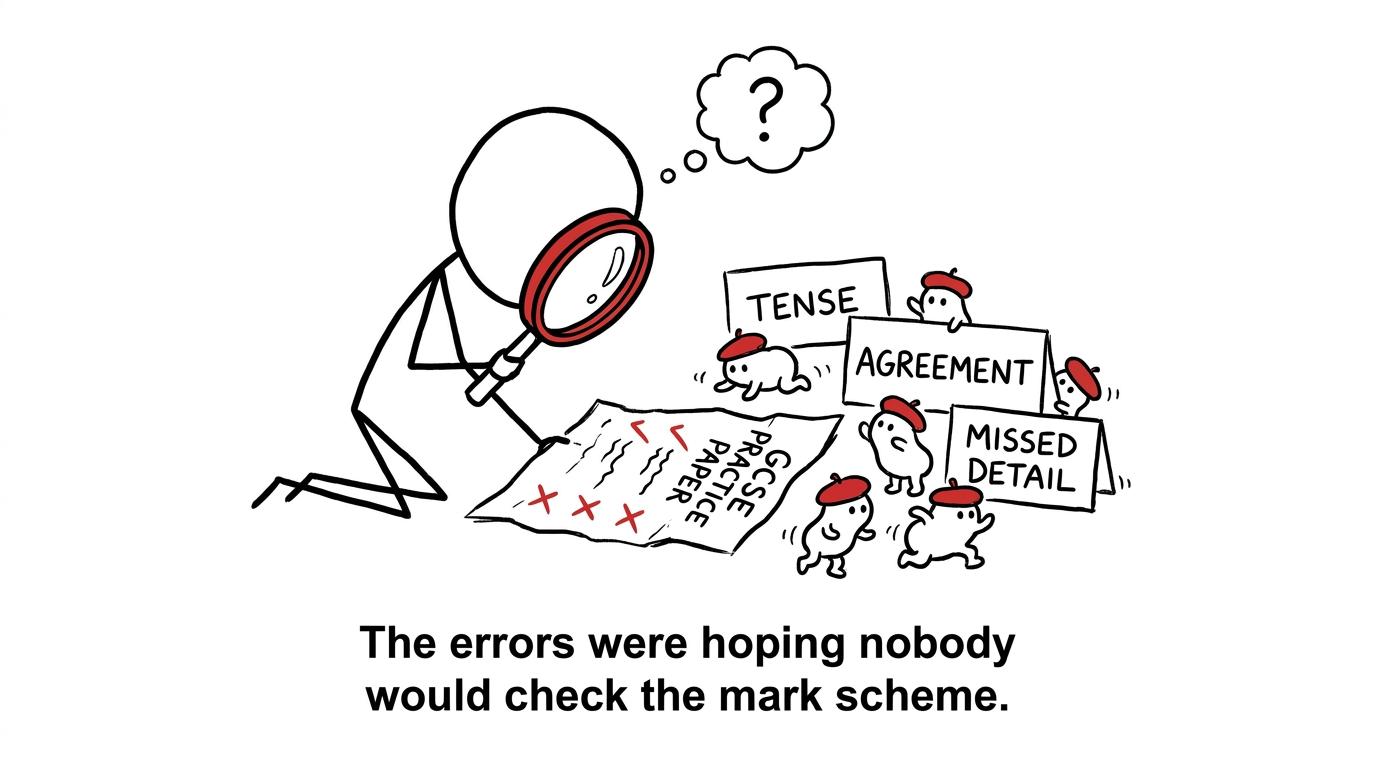 A revision detective catches grammar mistakes trying to escape from a marked paper
Common mistakes when interpreting a GCSE French grade 777
Treating grade 777 as a fixed percentage
Boundaries vary by exam board and exam series. Last year's threshold can help you review a practice paper, but it cannot guarantee this year's grade.
Calling it exactly the same as an old A
The lower boundaries are comparable, which makes an A the best concise comparison. However, the numbered qualification is not simply the old course with different labels.
Assuming every language skill is equally strong
The final grade combines performance across the qualification. Look at component feedback or mock-paper marks before deciding that listening, speaking, reading and writing are all at the same level.
Confusing exam success with complete fluency
Grade 777 represents strong GCSE performance. Real-world fluency is wider and develops through sustained listening, reading, conversation and writing beyond examination tasks.
Revising only the strongest area
Repeating comfortable tasks feels productive because the answers come quickly. It often produces little improvement. Mark schemes are most valuable when they expose a pattern you can repair.
The same trap appears in maths. A structured one-week GCSE Maths revision plan can help you alternate diagnosis, targeted practice and timed work rather than revising only familiar topics.
A strong grade is evidence, not an identity
A grade 777 in GCSE French is a strong achievement. It shows that, under examination conditions, you demonstrated secure knowledge and increasingly independent communication across the assessed skills. Its lower boundary is comparable with the old grade A, but it does not claim perfection or complete fluency.
More importantly, the grade captures one performance at one stage. It does not set a ceiling on what you can learn next.
Carry that perspective into maths revision. Start at the MathsGenie GCSE Maths hub, choose your exam board and tier, and use free revision lessons and practice questions to strengthen individual topics. Then test your progress with mini tests, past papers and predicted papers, checking mark schemes and video solutions after every attempt.
The number on results day matters. The revision system that helped you earn it can matter for much longer.