Grade 7 GCSE Maths Meaning: What Comes Next?
Grade 7 GCSE maths meaning explained, from A Level choices to resits and smart next steps. Build confidence with free MathsGenie revision resources.
Opening a results envelope can make several years of lessons, mocks and revision feel strangely small. One line. One number. If that number is 777, the grade 7 GCSE maths meaning is straightforward: you have achieved a strong result that demonstrates secure higher-tier mathematical ability. Official comparisons place the bottom of Grade 777 alongside the bottom of the old Grade A.
That deserves recognition. It may also leave you wondering what comes next. A Grade 777 can support entry to A Level Maths and many maths-related courses, but entry requirements vary. Your best next step is to celebrate, check your chosen course requirements and decide whether maths remains part of your future.
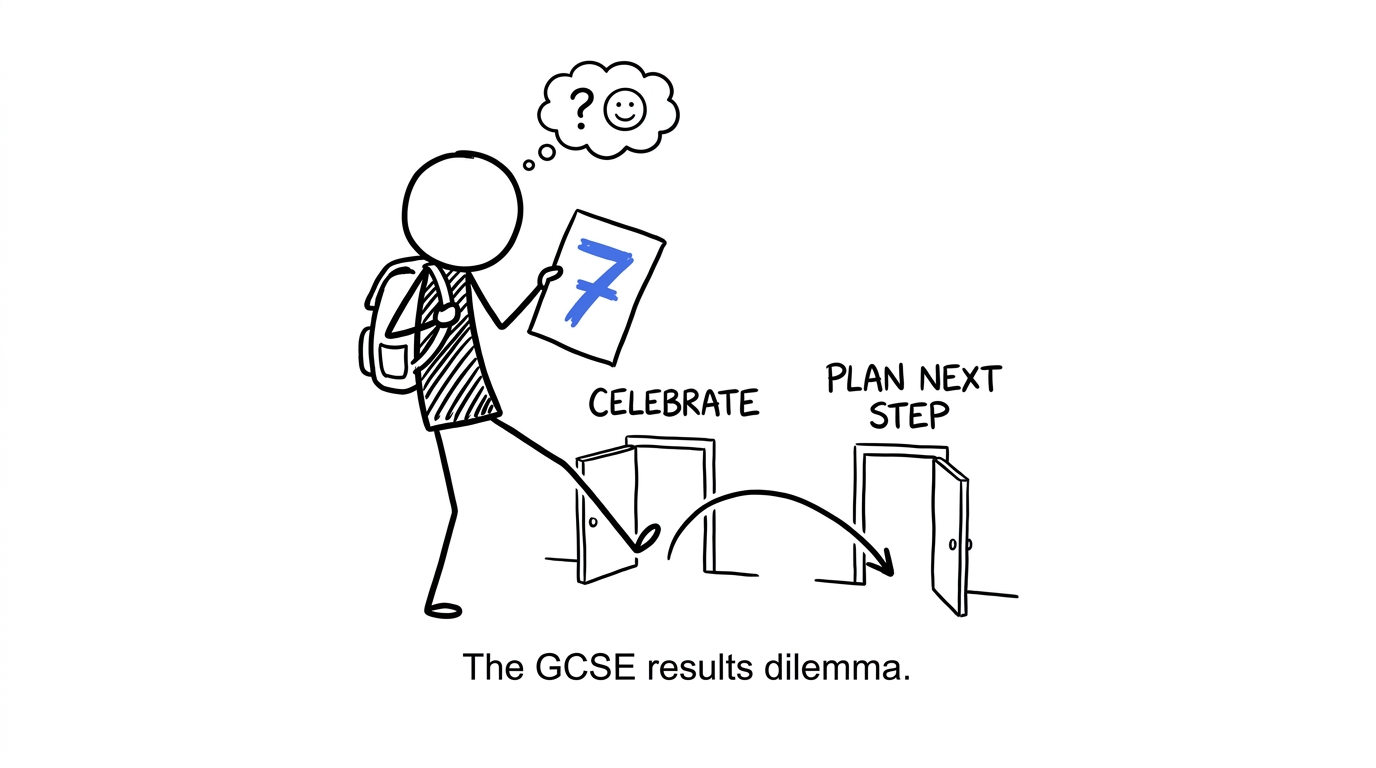 A student trying to celebrate and plan their next step simultaneously
Your Grade 7 results-day checklist
Before turning one result into a large decision, work through this short list:
- Recognise the achievement. Grade 777 is a high GCSE grade.
- Check your sixth form or college offer. Course-specific entry requirements differ between institutions.
- Speak to the maths department if you are considering A Level Maths or Further Maths.
- Review your wider results. Your best route depends on your complete set of grades, not maths alone.
- Keep your algebra active if you plan to continue with a mathematical subject.
- Do not arrange a resit automatically. A Grade 777 already exceeds the standard and strong pass thresholds.
What does a GCSE Maths Grade 7 mean?
England's reformed GCSEs use the scale from 999 to 111, with 999 as the highest grade. The scales are not exact translations at every level, but the bottom of Grade 777 is officially comparable with the bottom of the old Grade A.
A Grade 777 therefore suggests that you can handle a substantial range of higher-tier content. Depending on your exam board and paper, that may include demanding algebra, trigonometry, probability, geometry and multi-step reasoning.
It does not mean that every topic is completely secure. GCSE grades are based on your total marks across the qualification, so two students receiving the same grade may have different strengths. One might be fluent in algebra but lose marks on vectors; another might understand geometry yet make avoidable numerical errors.
That distinction matters because your next move should be shaped by your skills, not only the number on the certificate.
What next after Grade 7 Maths?
Choose A Level Maths if you enjoy mathematical thinking
Grade 777 meets the published GCSE Maths requirement at many sixth forms offering A Level Maths. However, requirements are set by individual schools and colleges: some accept Grade 666, many ask for Grade 777, and more selective providers may ask for Grade 888 or 999.
Check the precise requirement rather than assuming. Then ask a second question: do you enjoy algebra, graphs, problem-solving and explaining why a method works?
A Level Maths is not merely a longer GCSE. Algebra becomes the language through which topics such as functions, calculus, statistics and mechanics are developed. If that sounds appealing, explore the GCSE to A Level Maths transition guide and preview the free A Level Maths revision resources.
Consider Further Maths carefully
Further Maths usually has a higher entry threshold than A Level Maths. Some providers require Grade 888 or 999, while others consider Grade 777 alongside teacher recommendations, additional assessments or evidence of strong algebra.
A Grade 777 does not automatically close this route, but it makes a conversation with the department important. Ask about its entry requirement, support arrangements and whether summer bridging work is available.
Take a course that uses maths without choosing A Level Maths
A strong GCSE Maths result supports many other paths. Sciences, economics, computing, psychology, geography, engineering and technical courses may involve mathematical modelling, graphs, data or statistics.
You do not have to take A Level Maths simply because you earned Grade 777. A good result creates options; it does not create an obligation. Compare course content and future requirements before choosing.
Keep GCSE skills secure before September
If A Level Maths is your plan, the best summer preparation is usually consolidation rather than racing ahead. Focus particularly on algebraic manipulation, quadratics, rearranging formulae, indices, surds, graphs and trigonometry.
Use the MathsGenie GCSE Maths revision hub to find resources for your exam board. Edexcel students can revisit specification-aligned content through the GCSE Maths revision guides, supported by lessons, videos and practice questions.
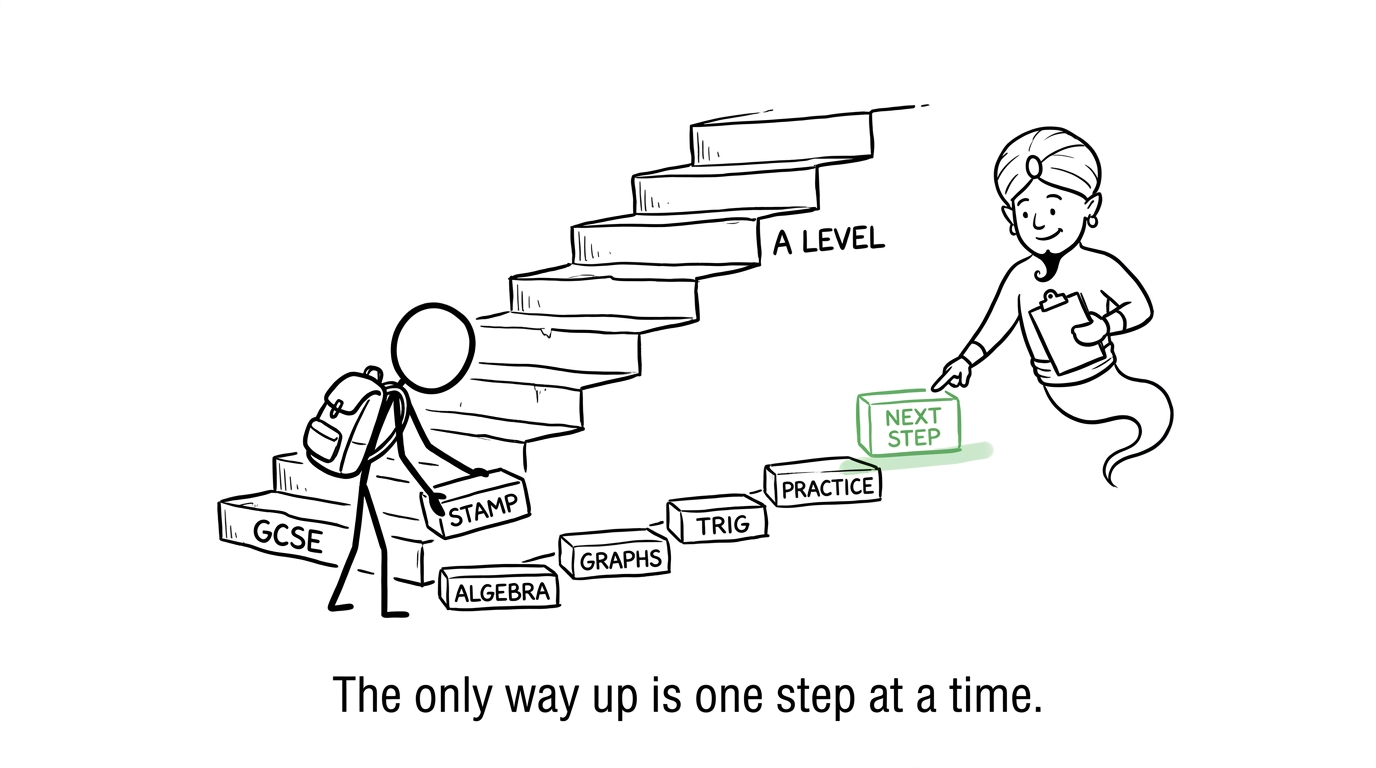 A student building small stepping stones from GCSE to A Level
Should you resit GCSE Maths after getting Grade 7?
For most students, resitting a Grade 777 is unnecessary. You already hold a strong pass and a high grade, so the time required to chase Grade 888 or 999 may be better invested in your new courses.
There can be exceptional reasons to investigate a resit, such as a specific published entry requirement. Before deciding, speak to your school or college and confirm the institution's resit policy, available exam series and approach to multiple results.
If you do resit, begin with diagnosis rather than repeating everything. Complete an appropriate paper from the Edexcel GCSE Maths past papers collection, mark it strictly and identify where marks were lost. The GCSE revision resources page also provides shorter tests and paper-style practice.
Common mistakes after receiving a Grade 7
Treating the grade as a verdict on your potential
Grade 777 records one examination outcome. It does not establish a ceiling. Students can strengthen weak topics through deliberate practice, just as secure skills can fade when they are not used.
Assuming every sixth form has the same rules
Entry requirements vary. Check the current prospectus or contact the provider directly, especially for A Level Maths and Further Maths.
Jumping straight into advanced calculus
The strongest preparation is often less glamorous: make GCSE algebra accurate and automatic. Weak manipulation creates unnecessary difficulty later.
Completing papers without learning from them
A score tells you where you finished, not what to change. Use mark schemes and video solutions to classify lost marks by topic, method, accuracy or communication. Predicted papers are useful practice, but they are not guarantees of future content; use the GCSE predicted papers alongside past papers and targeted revision.
Turn a strong result into a strong beginning
A GCSE Maths Grade 777 means you have done more than pass. You have built a foundation that can lead towards A Level Maths, support another analytical subject or simply give you confidence with the mathematics used beyond school.
The next step need not be dramatic. Check your course requirements. Choose the route that fits your interests. If maths remains in your plans, keep the foundations alive.
Start with the MathsGenie GCSE Maths revision resources: use revision lessons to refresh a topic, practice questions to rebuild fluency, and past papers, predicted papers, mini tests, mark schemes and video solutions to test what you genuinely know. Your Grade 777 is worth celebrating, and it can also be the first step towards what comes next.