

GCSE French Grade 4 Meaning: A Clear Guide
GCSE French grade 4 meaning explained: ability, old grade C comparison, tiers, grade boundaries and practical next steps for planning revision well.
Opening a results page can make one number feel much larger than it is. A grade 4 may sit beside your name, but it does not immediately explain what you can do, where you struggled or what should happen next.
The short answer to the gcse french grade 4 meaning question is this: a grade 4 is officially treated as a standard pass. Its lower boundary is comparable with the lower boundary of the old grade C. It indicates a functional, developing command of GCSE French across listening, speaking, reading, writing, vocabulary and grammar, not fluency, and not failure.
For a student focused mainly on GCSE maths, that distinction matters. Grade labels can influence sixth-form choices, applications and confidence, but they should be read carefully rather than treated as complete descriptions of ability.
Grade 4 in GCSE French at a glance
- It is known as a standard pass.
- The bottom of grade 4 is aligned with the bottom of the old grade C.
- It represents achievement across several language skills, not just vocabulary recall.
- It can be awarded through foundation or higher tier, depending on the specification and entry.
- A grade 4 from either tier has the same value on the certificate.
- It is below grade 5, which is commonly described as a strong pass.
- Exact grade boundaries are set after the assessments and can change between exam series and exam boards.
- Individual schools, colleges and courses may set entry requirements above grade 4.
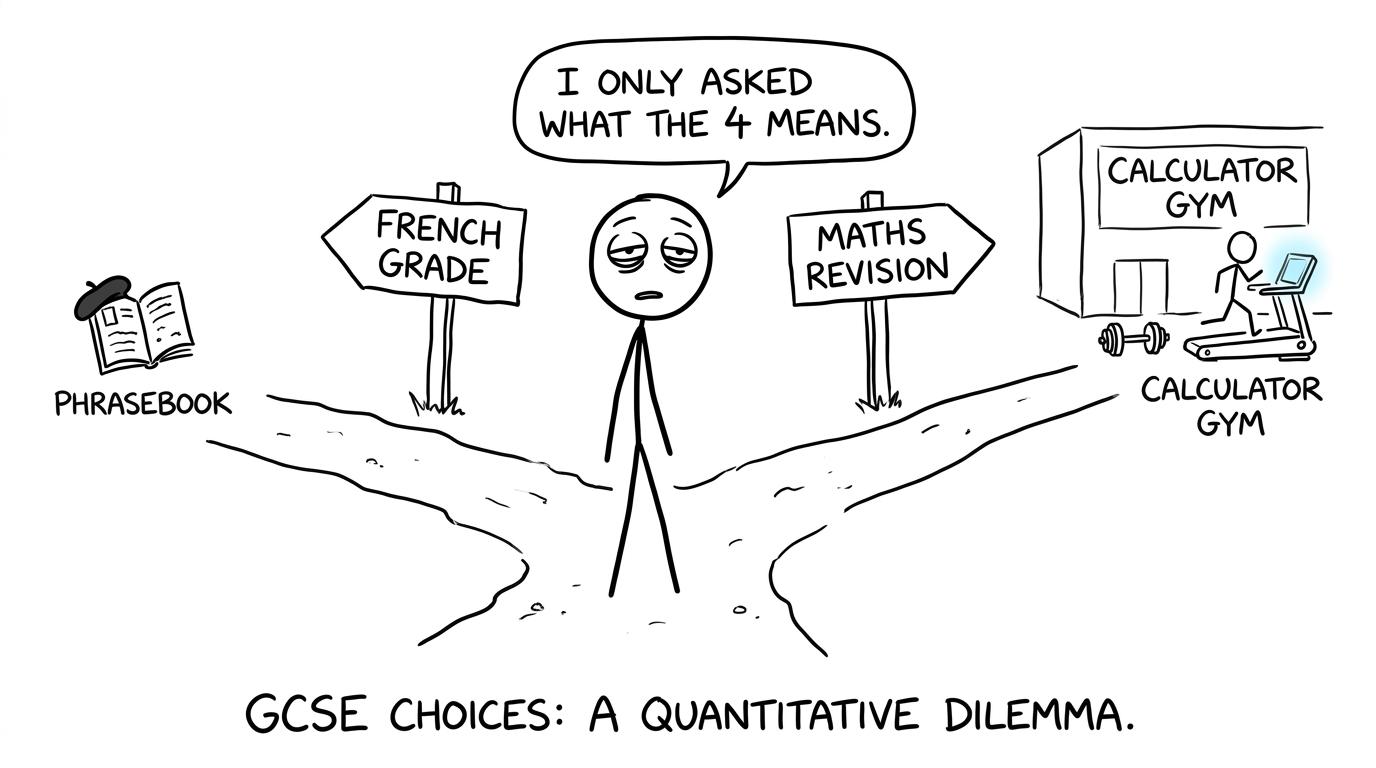 A student discovers that one grade can point towards several kinds of revision
What does a grade 4 actually represent?
A GCSE French grade is a combined judgement. It does not mean that a student performs at exactly the same level in every part of the language.
A student around grade 4 will generally be able to understand and communicate straightforward information in familiar GCSE contexts. These may include family, school, free time, travel, local areas, future plans and everyday experiences. They may identify main messages in spoken and written French, express opinions with reasons and produce connected responses using familiar vocabulary.
Their communication may still contain grammatical mistakes, pauses, repetition or gaps in vocabulary. Longer passages, unfamiliar language, fast speech and precise use of different time frames are likely to be less secure. The important point is that enough meaning is understood and conveyed to meet the grade standard across the qualification.
This is best viewed as usable but incomplete language ability. The student has built a bridge. They have not explored every road beyond it.
The grade covers several different skills
GCSE French assessments draw on:
- understanding spoken French;
- responding through speech or writing;
- understanding written material;
- communicating information and opinions;
- applying prescribed vocabulary and grammar accurately;
- pronunciation, reading aloud, dictation or translation where required by the specification.
The precise paper structure depends on the exam board and specification. Reformed French qualifications taught in England from September 2024 are being awarded for the first time in summer 2026. Students should therefore use materials written for their own specification rather than assuming that every older paper matches their course.
AQA, Pearson Edexcel and Eduqas materials can differ in layout and task design. Your teacher, statement of entry or exam-paper cover should confirm which board you are taking.
Grade 4 is not a fluency certificate
GCSE French tests performance within a defined school qualification. It does not certify that someone can handle every real conversation in France, study a university course in French or understand films without support.
Equally, it would be wrong to dismiss the result as mere phrase memorisation. Reaching grade 4 requires students to retrieve language, interpret meaning and communicate under assessment conditions. Those are genuine skills.
There is no simple official conversion that turns a GCSE grade into a complete real-world language profile. Comparisons with external language frameworks should therefore be treated cautiously unless a course provider states its own requirements.
How grade 4 compares with the old letter grades
The most accurate comparison is that the bottom of grade 4 is comparable with the bottom of the old grade C. This is an alignment point between the old A* to G system and the current 9-1 scale.
It does not mean that every grade 4 performance is identical to every old grade C performance. The specifications, assessment structures and content have changed. Nor does it mean that grade 5 is simply the new C. Grade 5 sits above the old C boundary and is usually called a strong pass.
A helpful summary is:
| Current GCSE grade | Broad interpretation |
|---|---|
| Grade 4 | Standard pass; lower boundary aligned with the old grade C boundary |
| Grade 5 | Strong pass; above the old grade C boundary |
| Grade 7 | Lower boundary aligned with the old grade A boundary |
| Grade 1 | Lower boundary aligned with the old grade G boundary |
These are comparison points, not exact one-to-one replacements for every student or every mark.
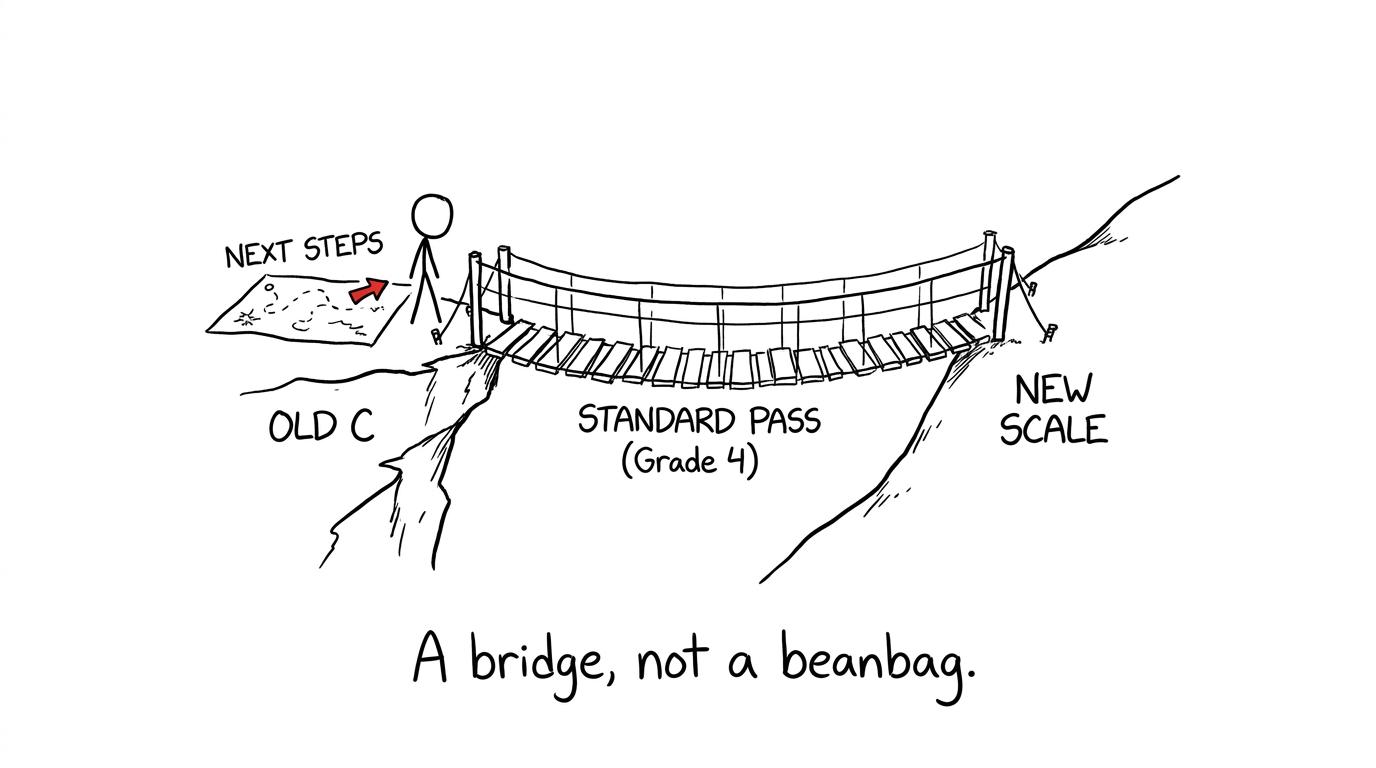 Grade 4 acts as a bridge between grading systems rather than a place to stop
Does foundation or higher tier change the meaning?
Under the reformed GCSE French arrangements, foundation tier targets grades 1 to 5, while higher tier targets grades 4 to 9. A narrow grade 3 safety net may be available to higher-tier candidates who fall just below the grade 4 boundary; below that range, the result may be unclassified.
The crucial fact is simpler: a grade 4 has the same standard whether it is achieved on foundation or higher tier. Exam boards are required to make grades 4 and 5 comparable across the two tiers, and the certificate does not display the tier of entry.
Tier still affects the assessment experience. Higher-tier questions target a wider range of demand, while foundation-tier papers are designed around the lower and middle grades. Tier decisions should be made with your teacher using current evidence, not pride or fear.
This resembles GCSE maths, where foundation and higher papers offer different grade ranges but overlapping grades retain the same qualification value. Students revising maths can explore the GCSE Maths revision hub for tier-appropriate lessons, questions and papers.
Why a grade boundary is not a fixed percentage
Students often ask what percentage is needed for grade 4. There is no permanent answer.
Grade boundaries are set for a particular exam series after the papers have been taken and reviewed. They can differ by exam board, tier, specification and year because the difficulty of assessments is not perfectly identical. A boundary from an older paper is useful for interpreting that paper, but it is not a guaranteed target for the next series.
That is why revision should focus on gaining secure marks rather than trying to land exactly on a historical boundary. Aiming for the minimum leaves no protection against a difficult task, a missed instruction or an uneven performance across papers.
The same principle applies in maths. Use official boundaries only with the paper they belong to, then examine the questions that cost you marks. MathsGenie's guide to starting GCSE past papers at the right time explains how to turn paper results into useful revision decisions.
What can a grade 4 mean for your next step?
For many purposes, grade 4 satisfies a requirement stated as a standard GCSE pass or the old grade C equivalent. However, there is no universal entry rule for every sixth form, college, apprenticeship or employer.
A course may require grade 4 in English and maths while setting different conditions for French. Continuing to A Level French commonly requires a higher grade because the course assumes stronger language knowledge, but the exact threshold belongs to the individual school or college. Always check the published entry requirements and ask the provider if anything is unclear.
If your immediate priority is maths, do the same there. Identify the actual grade required for your intended route, then build revision around evidence. A GCSE maths revision timetable can help you balance subjects without allowing one disappointing result to consume every available evening.
How to respond if you are currently working at grade 4
A grade is most useful when it changes what you do next. Begin by separating your performance into components. You might understand reading passages reliably but lose marks in speaking, or know plenty of vocabulary but struggle to apply grammar under time pressure.
Use this short review:
- Check which assessment areas produced the weakest marks.
- Identify whether the problem was knowledge, retrieval, timing or misunderstanding the task.
- Practise one narrow weakness at a time.
- Revisit that weakness after a short gap rather than completing it once and forgetting it.
- Use current specification materials from your own exam board.
- Ask your teacher what specifically separates your present responses from grade 5 work.
For maths revision, the same diagnostic habit is powerful. The one-month GCSE maths revision plan begins with weak-topic identification before moving into retrieval, exam questions and timed papers. If you take Edexcel maths, the guide to revising Edexcel GCSE Maths efficiently offers a focused lesson-practice-mark-retest cycle.
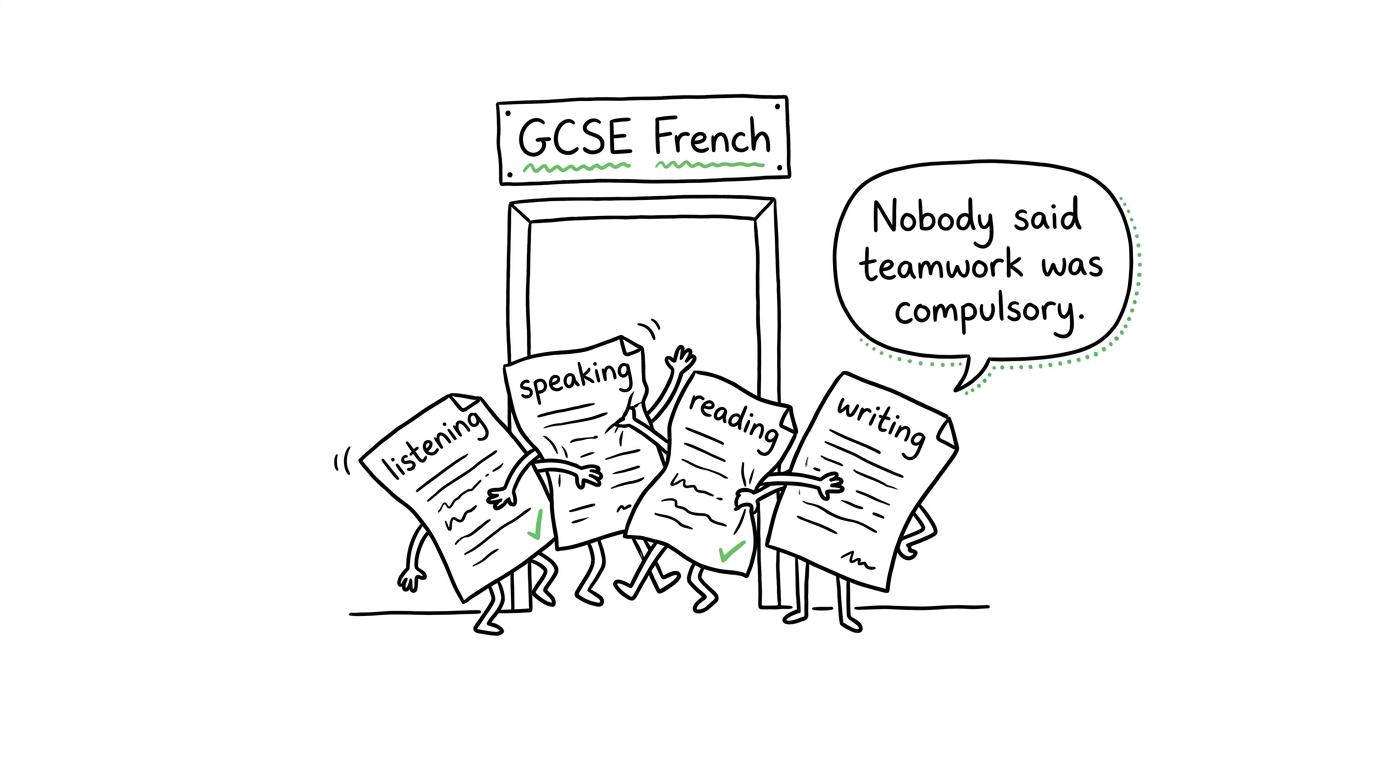 The four language skills attempt to enter one GCSE result together
Common mistakes when interpreting GCSE French grade 4
Calling it a fail
Grade 4 is officially described as a standard pass. Some selective courses may demand a higher grade, but that does not change the status of the result itself.
Saying grade 4 is exactly the same as every old grade C
The careful statement is that the lower boundaries are comparable. The qualifications are not identical, and the new scale creates more distinction among higher grades.
Assuming it proves equal ability in every skill
The final grade combines performance across the qualification. One strong component can sit beside a weaker one, so the result alone cannot diagnose your speaking, listening, reading or writing.
Treating last year's boundary as a promise
Boundaries can change. Use each historical boundary to assess the paper from that series, not to predict a guaranteed future requirement.
Believing foundation grade 4 is worth less
A grade 4 has the same value from either tier. The tier is not shown on the certificate.
Letting one subject grade define the whole revision plan
A grade is evidence, not an identity. If maths is central to your next step, return to the MathsGenie home page and choose resources based on the precise topics and tier you need.
A grade tells you where to look, not who you are
The clearest GCSE French grade 4 meaning is a standard pass showing functional but still developing performance across GCSE language skills. It broadly occupies the position once marked by the lower boundary of grade C, while the modern qualification and assessment remain distinct.
Read the result honestly. It is enough for some next steps and not enough for others. It may reflect balanced competence or a mixture of strong and weak components. Only your paper-level feedback and course requirements can reveal the difference.
Then apply the lesson to the subject in front of you. On MathsGenie, you can move from free revision lessons to targeted practice questions, mini tests, past papers, predicted papers, mark schemes and video solutions. Start with the complete GCSE Maths revision collection, diagnose the marks you are losing and make the next revision session answer one useful question: what can I now do that I could not do yesterday?











