GCSE French Exam Start Time: Exam-Day Guide
GCSE French exam start time explained: official sessions, school variations, arrival advice and a realistic walkthrough from entering to writing.
The strange thing about an exam timetable is that it can answer one question while creating another. It says “morning”, but when should you arrive? It says the paper begins at 9.00am, but will your school begin earlier? And does sitting down mean your time has started?
The short answer is that the published GCSE French exam start time is normally 9.00am for a morning paper or 1.30pm for an afternoon paper at UK centres. However, schools and colleges may begin up to 30 minutes earlier or later within the permitted session. Your individual candidate timetable and your school's instructions therefore take priority.
Speaking assessments are different: your school arranges your appointment within the exam board's speaking window.
The GCSE French exam timing checklist
Before exam day, confirm all of the following:
- your exam board and specification
- whether the paper is listening, reading, writing or speaking
- the date and whether it is an morning or afternoon session
- your school's stated arrival or queuing time
- your room, seat number and candidate number
- whether you have approved access arrangements
- whether a timetable clash changes your personal schedule
- which equipment your school has told you to bring
Do not rely on a friend's timetable, a social media post or last year's dates. Two students taking French can have different arrangements because they attend different centres, follow different exam boards or have individual access arrangements.
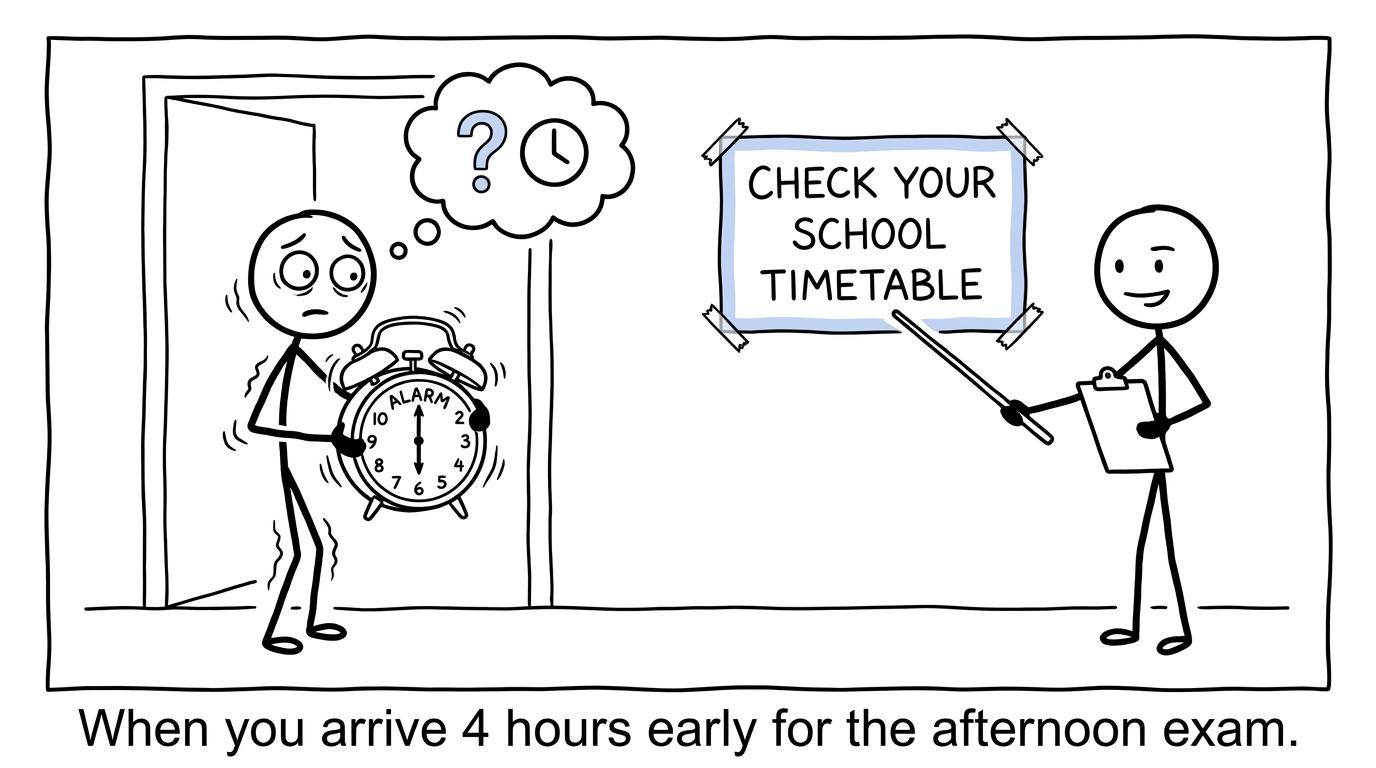 A student arriving early with an alarm clock while an invigilator points towards the school timetable
What time does a GCSE French exam officially start?
For JCQ-regulated examinations in the UK, the awarding bodies' published session times are:
| Exam session | Published start time | Permitted normal starting window | | --- | --- | | Morning | 9.00am | 8.30am to 9.30am | | Afternoon | 1.30pm | 1.00pm to 2.00pm |
The starting window explains why an exam board timetable might say “am”, while your school tells you to be seated for an 8.45am start. A centre can move the start by up to 30 minutes without requesting prior permission, provided it follows the examination security rules.
That flexibility is for centres, not candidates. It does not mean you can choose any time in the window. The time printed on your school timetable is the one you must follow.
JCQ instructions also require candidates to receive the full published duration of the examination. If the room takes longer than expected to settle, those administrative minutes should not simply disappear from your writing time.
GCSE French exam times depend on the paper
GCSE French is not one single written examination. Depending on the specification, the qualification includes assessments of listening, speaking, reading and writing. These may be held on separate dates or, in some specifications, combined within the same session.
The summer 2027 final timetables illustrate why checking the exact paper matters:
| Exam board | French paper | 2027 published session | | --- | --- | | AQA | Listening and reading | Morning, 26 May 2027 | | AQA | Writing | Afternoon, 8 June 2027 | | Pearson Edexcel | Listening | Morning, 26 May 2027 | | Pearson Edexcel | Reading | Afternoon, 8 June 2027 | | Pearson Edexcel | Writing | Afternoon, 14 June 2027 |
These dates were current when this guide was reviewed in August 2026. Always check the final timetable issued by your school because dates vary by year, board and specification. Students following Eduqas or another specification must use the corresponding timetable rather than assuming the AQA or Edexcel pattern applies.
The same habit matters in maths. Before beginning a paper, you need to know your board, tier and calculator rules. The GCSE Maths revision hub lets you choose the appropriate board and resources rather than revising for a paper you are not taking.
A realistic walkthrough from arrival to writing
A published start time is only one moment in a longer process. Understanding the whole sequence makes exam morning feel less mysterious.
Before leaving home
Check your individual timetable rather than a general national timetable. Pack the equipment your school permits and leave your phone, watch and other unauthorised items where your centre instructs you to leave them.
Plan to reach school at the arrival time it has given you. If no specific arrival time has been provided, ask the exams officer in advance rather than guessing. Many schools ask candidates to arrive or queue at least 15 to 30 minutes before the internal start, but this is a centre instruction rather than one universal national arrival rule.
A calm final preparation routine can help across every subject. Maths students can use the GCSE maths exam-week checklist to organise equipment, timed practice and last-minute revision without turning the evening into a marathon.
Arriving and finding the correct queue
When you arrive, check the displayed room and seating information. There may be separate lines for foundation and higher tier, different papers, access arrangements or alternative rooms.
Tell a member of staff immediately if your name is missing, your tier appears wrong or the displayed paper does not match your candidate timetable. Quietly solving the problem before entering is much safer than assuming everything will correct itself.
Entering the examination room
Formal examination conditions begin when you enter the room. From that point, you must not talk, communicate with or disturb other candidates. Follow the invigilator's directions, find your assigned seat and place permitted equipment on the desk.
You may be seated before the published session time. That does not necessarily mean the examination has begun.
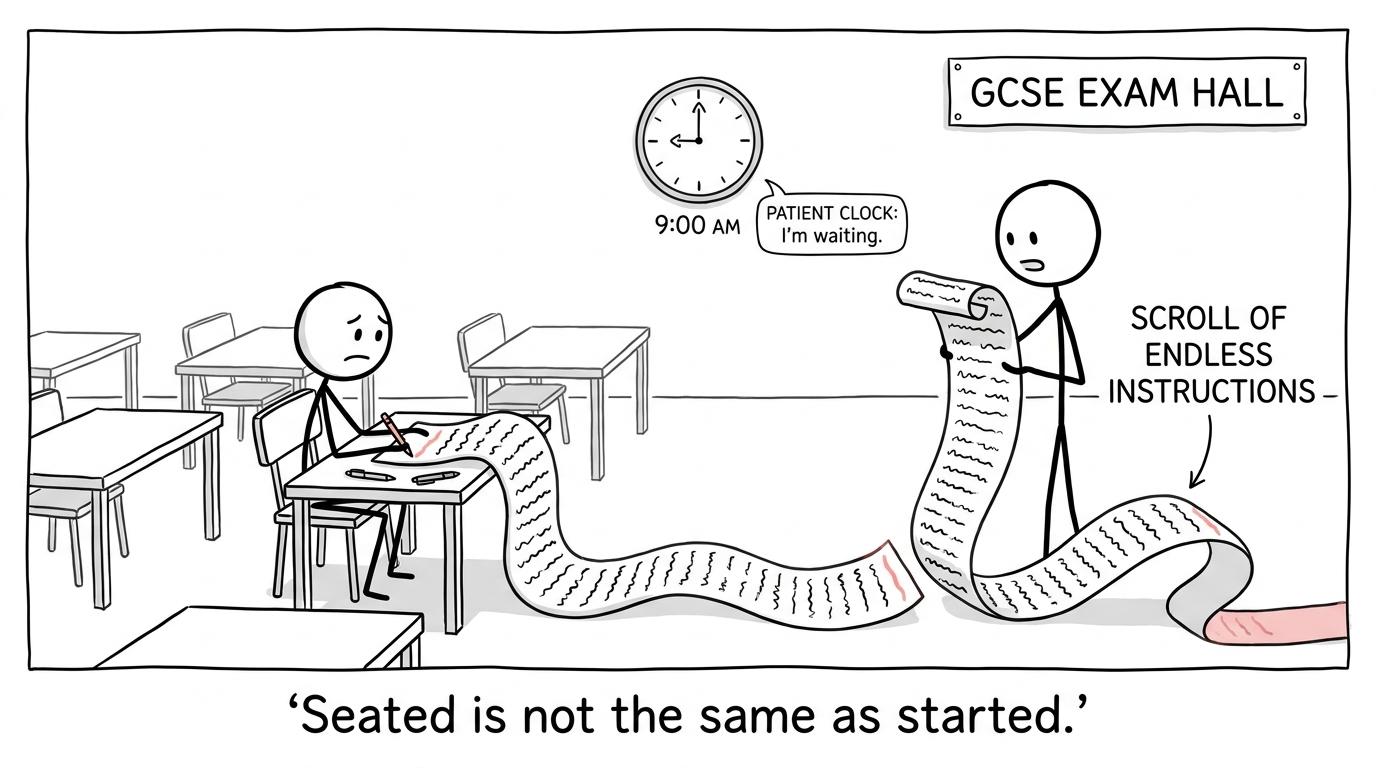 A seated student waits while an invigilator reads instructions from a very long scroll
Identity checks and instructions
Invigilators may check attendance and candidate details before reading the required notices. You will normally be told to check the information on your paper or answer booklet, including the subject, component and tier.
Listen carefully. French components can involve audio instructions, separate materials or paper-specific rules. Do not open the question paper until instructed to do so.
When the exam actually starts
Your working time begins when the invigilator announces the start and tells candidates they may begin. The official start and finish times will be recorded so that you receive the correct duration.
For a listening examination, follow the instructions given in the room. The structure and handling of the recording depend on the specification, so do not assume it will work exactly like a classroom practice task.
For reading or writing, begin only after permission is given. The minutes spent entering, sitting down and hearing formal instructions are not automatically part of your answer time.
If the room starts slightly late
A short delay does not mean that your paper has been cancelled or that everyone will lose answer time. Invigilators record the actual start and finish, and candidates must be allowed the full examination duration.
Stay quiet and follow instructions. An unsettled room often feels much longer than it really is because everyone is waiting for the same sentence: “You may begin.”
Why your school timetable is the final practical answer
The national timetable protects the security of the examination. Your school timetable translates that national session into instructions you can actually follow: when to queue, where to go and whether your centre is using an adjusted start.
Your personal timetable may also reflect:
- a clash between two examinations
- supervised arrangements between papers
- approved extra time or supervised rest breaks
- a smaller room or separate venue
- a specific speaking appointment
This is why searching for one universal clock time can only take you so far. The published session tells you the national framework; your candidate timetable tells you what you must do.
If the two seem inconsistent, contact your exams officer or teacher before the day. Do not try to resolve the difference by choosing whichever time is more convenient.
What happens if you are late?
Contact the school immediately and travel there safely. Do not decide at home that the examination is already lost.
A centre may still allow a late candidate to sit the paper, but very late arrivals involve additional rules and the awarding body may not always accept the script. Under current JCQ instructions, a candidate is generally considered very late if arriving more than one hour after the published start for an examination lasting at least one hour. For a paper lasting less than one hour, the threshold is after its published finishing time.
Those rules are not a target. Arriving even a few minutes late creates avoidable stress and may complicate the start of a listening paper. Build spare travel time into the morning and know who to contact if transport fails.
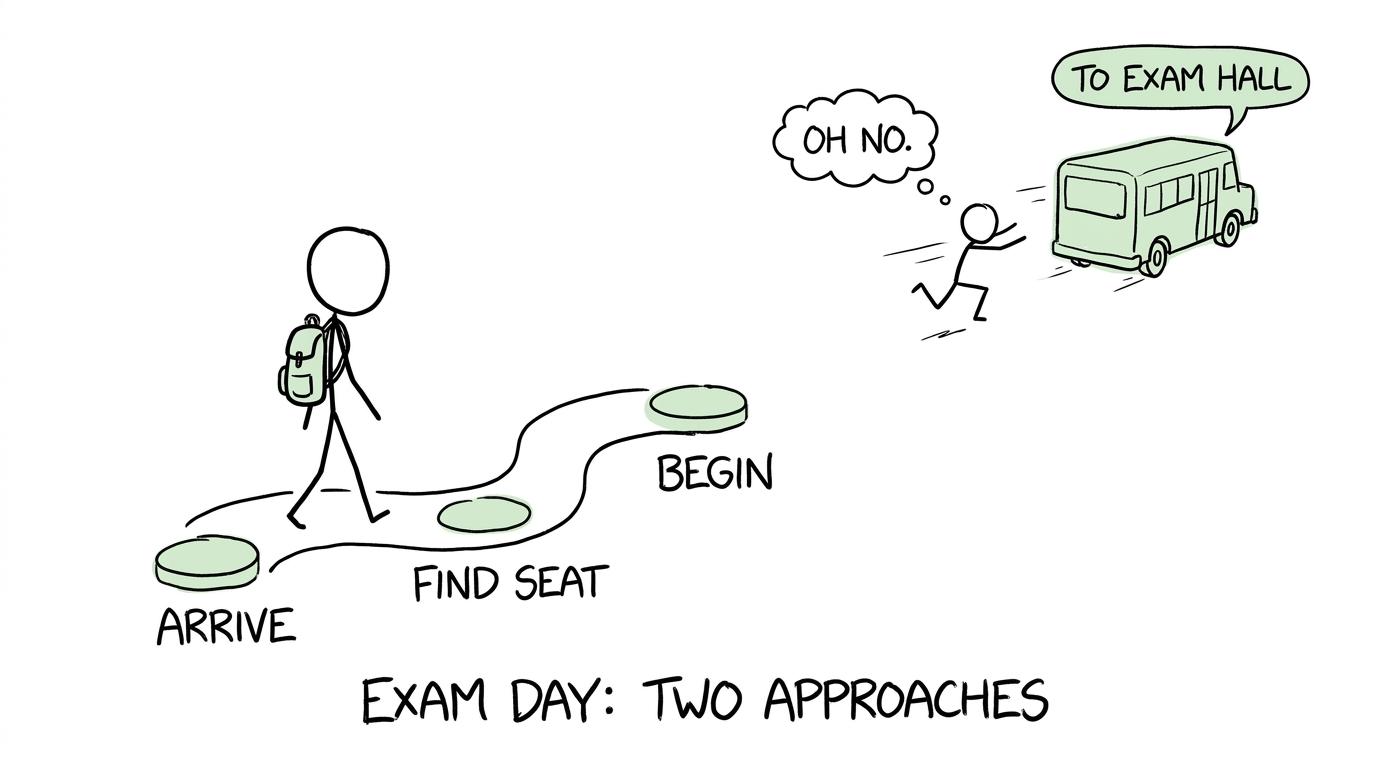 One student follows a calm arrive-find-seat-begin path while another chases a runaway bus
Managing French and maths during the same exam season
GCSE timetables can make revision feel fragmented. A French paper may sit between maths, science and English examinations, leaving you unsure which subject deserves attention that evening.
The useful response is not to revise everything at once. Give the next paper priority while keeping later subjects warm through short retrieval sessions. The 20-minute maths revision routine is designed for busy days when another subject has the immediate claim on your time.
Between examinations, use small, specific tasks:
- complete one mini test
- review one weak topic
- mark a short set of practice questions
- correct errors using the mark scheme
- check tomorrow's arrival time before going to bed
When you have a longer gap, use Edexcel GCSE Maths past papers or AQA GCSE Maths past papers under timed conditions. A structured one-month GCSE maths revision plan can help you place those sessions around French and your other subjects.
Common mistakes with GCSE French exam start times
Treating “morning” as an arrival time
“Morning” describes the national session. It does not mean you can arrive at any point before midday. Find your school's exact reporting or queuing time.
Assuming every French paper starts at 9.00am
Some French components are in afternoon sessions, whose published time is 1.30pm. Different components can also fall on different dates.
Using another student's timetable
They may follow another board, sit a different component or have individual arrangements. Use your own candidate timetable.
Confusing the speaking assessment with a written paper
Speaking tests are arranged by the centre within an official assessment window. Your teacher or exams officer should give you a specific appointment.
Starting when the paper reaches your desk
Wait for the invigilator's instruction. Receiving or checking a paper is not permission to begin answering it.
Ignoring a possible error
If the room, component, tier or time looks wrong, ask the exams office promptly. Quietly hoping for the best is not an exam strategy.
Make the timetable one less thing to worry about
The answer is simple once the layers are separated: the published GCSE French sessions normally begin at 9.00am or 1.30pm, centres may adjust the start within the permitted 30-minute window, and your own school timetable gives the instruction you must follow.
Check it the evening before. Arrive at the stated reporting time. Then let the invigilator tell you when your working time begins.
With the logistics settled, you can return your attention to preparation. Use MathsGenie's free GCSE resources to combine revision lessons and practice questions with mini tests, past papers, predicted papers, mark schemes and video solutions. If you are moving towards sixth form, the A Level Maths revision hub provides the same clear route through the next stage.
A timetable should be a plan, not a source of panic. Confirm the details, arrive early enough and make the next decision useful.