GCSE Food and Nutrition Time Pressure Mistakes
GCSE food and nutrition time pressure mistakes: learn how to protect easy marks in calculations, written answers and the three-hour practical assessment.
The clock changes how a question feels. A nutrition calculation that seemed straightforward in revision suddenly looks unfamiliar. A six-mark evaluation becomes a rushed list. In the practical assessment, several dishes appear to need attention at once.
The most common GCSE food and nutrition time pressure mistakes are not always gaps in knowledge. They are often small failures of process: missing a command word, using inconsistent units, giving an unlabelled calculation, repeating the question or spending too long chasing one difficult mark.
The solution is to build a short routine that survives pressure. Read precisely, plan briefly, show the essential working, answer in context and check before moving on.
The quick time-pressure checklist
Before submitting an answer or completing a practical stage, ask:
- Have I answered the command word?
- Have I used the information in the question?
- Are quantities and units consistent?
- Does my answer make sense in a food or nutrition context?
- Have I shown enough working to make my method visible?
- Am I spending time in proportion to the available marks?
- If I am stuck, should I move on and return later?
These checks apply to calculations, data interpretation and extended writing. They also transfer directly to GCSE maths, where proportion, percentages, averages, conversions and interpreting information regularly appear.
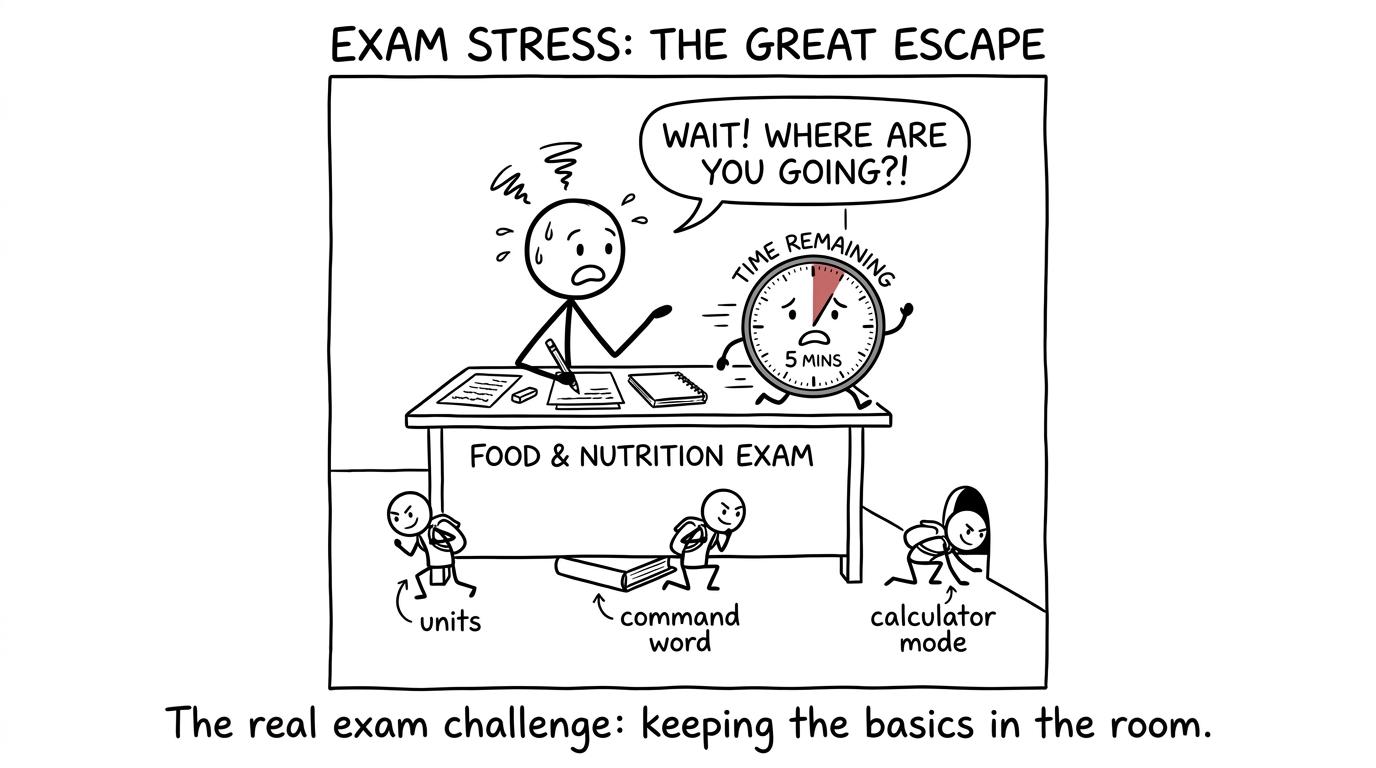 A student races a timer while units and command words escape
Why pressure creates avoidable mistakes
Under time pressure, students naturally try to speed up. The trouble is that effective speed does not come from thinking less. It comes from making fewer unnecessary decisions.
GCSE Food Preparation and Nutrition is divided equally between examination and non-exam assessment. Under Ofqual's assessment framework, 50%50\%50% of the qualification is assessed by examination and 50%50\%50% through non-exam assessment. The food investigation contributes 15%15\%15%, while the food preparation task contributes 35%35\%35% and includes a single three-hour session in which students prepare, cook and present three dishes.
The assessment objectives also distinguish between knowing, applying, planning, and analysing or evaluating. This matters because a correct fact may not answer a question asking you to apply that fact to a named person, product or dietary need.
Exact paper lengths, mark totals and task arrangements vary between AQA, OCR, Eduqas and other awarding organisations. Always check the current specification and instructions supplied by your school rather than relying on a timing rule remembered from another board.
Losing track of marks and time
One of the easiest mistakes is treating every question as if it deserves equal time. It does not. A short identification question should not consume the time needed for a developed evaluation.
At the beginning of a written paper, note its duration and total marks. A rough planning rate can be found using:
minutes per mark=available minutestotal marks\text{minutes per mark}=\frac{\text{available minutes}}{\text{total marks}}minutes per mark=total marksavailable minutesThis is a guide, not a command. Reading, checking and moving between sections also take time. Its purpose is to expose serious imbalance. If a low-mark question has already consumed several times its sensible allowance, mark it clearly, move on and return if time remains.
Timed practice is the only reliable way to make this judgement feel normal. MathsGenie's GCSE maths past papers include mark schemes and can help you rehearse the same move-on-and-return discipline before maths examinations.
Misreading command words
Time pressure encourages students to recognise a topic and begin writing before identifying the task. That often produces relevant knowledge but an incomplete answer.
Identify and state
Give the required fact or feature directly. Extra explanation may use time without earning another mark.
Explain
Build a causal link. A useful internal structure is:
cause →\rightarrow→ effect →\rightarrow→ relevance to the question
Do not stop after naming a nutrient, process or safety rule. Explain why it matters in the stated context.
Compare
Refer to both items and make the relationship explicit. Two separate descriptions are not automatically a comparison. Numerical evidence should be quoted accurately when data is provided.
Analyse and evaluate
Develop connected reasoning, consider the significance of evidence and reach a justified judgement. A long list of advantages and disadvantages can remain superficial if none is linked to the person, dish, investigation or nutritional objective in the question.
Command words are therefore a time-management tool. They tell you what kind of thinking deserves space.
Rushing food and nutrition calculations
The Department for Education's subject content requires students to understand how to calculate energy and nutritional values and use them when planning recipes, meals and diets. These questions may involve proportions, percentages, averages, quantities or interpreting tables and graphs.
Scaling every ingredient consistently
When changing the yield of a recipe, use one scale factor throughout:
scale factor=required number of portionsoriginal number of portions\text{scale factor}=\frac{\text{required number of portions}}{\text{original number of portions}}scale factor=original number of portionsrequired number of portionsThen apply it to every relevant ingredient. A common rushed error is to scale the main ingredient but forget liquids, seasonings or garnishes. Another is to reverse the fraction, producing quantities that move in the wrong direction.
If this process feels slow, revisit MathsGenie's proportion and ingredients revision and ratio revision guide.
Confusing an amount with a percentage
A percentage expresses a quantity out of 100100100:
percentage=partwhole×100\text{percentage}=\frac{\text{part}}{\text{whole}}\times 100percentage=wholepart×100The denominator must represent the correct whole. Students under pressure sometimes divide by the first number they see rather than identifying what the percentage is of. They may also leave a decimal answer without converting it into a percentage.
MathsGenie's percentage revision resources provide focused practice for both foundation and higher tier GCSE maths.
Mixing units
Food questions often combine grams and kilograms, or millilitres and litres. Convert before comparing, adding or forming a ratio:
1 kg=1000 g1\text{ kg}=1000\text{ g}1 kg=1000 g 1 litre=1000 ml1\text{ litre}=1000\text{ ml}1 litre=1000 mlWriting the unit beside each value makes errors easier to spot. A bare number may be impossible to interpret and can conceal a conversion mistake. Strengthen this habit with conversions and units revision.
Using the wrong average
The mean, median and mode answer different questions. If the question requests a mean, use:
mean=total of the valuesnumber of values\text{mean}=\frac{\text{total of the values}}{\text{number of values}}mean=number of valuestotal of the valuesDo not select the middle value unless the median is required. For sensory-testing or investigation data, also consider what the value represents rather than reporting it without interpretation. MathsGenie's averages revision guide reviews each measure and the range.
Writing calculations that can still earn marks
A calculator can produce an answer while hiding a faulty method. Under pressure, avoid filling the page with unexplained button presses or recording only the final number.
Use a compact structure:
- write the relationship or formula;
- substitute the relevant values;
- keep units visible;
- calculate without rounding too early;
- give the final answer to a sensible degree of accuracy;
- interpret it in the context of the question.
An estimate is also valuable. If a recipe is being increased, the new ingredient quantities should not become smaller. If a stated percentage is meant to describe a minority of a total, an answer above 100%100\%100% should trigger a check.
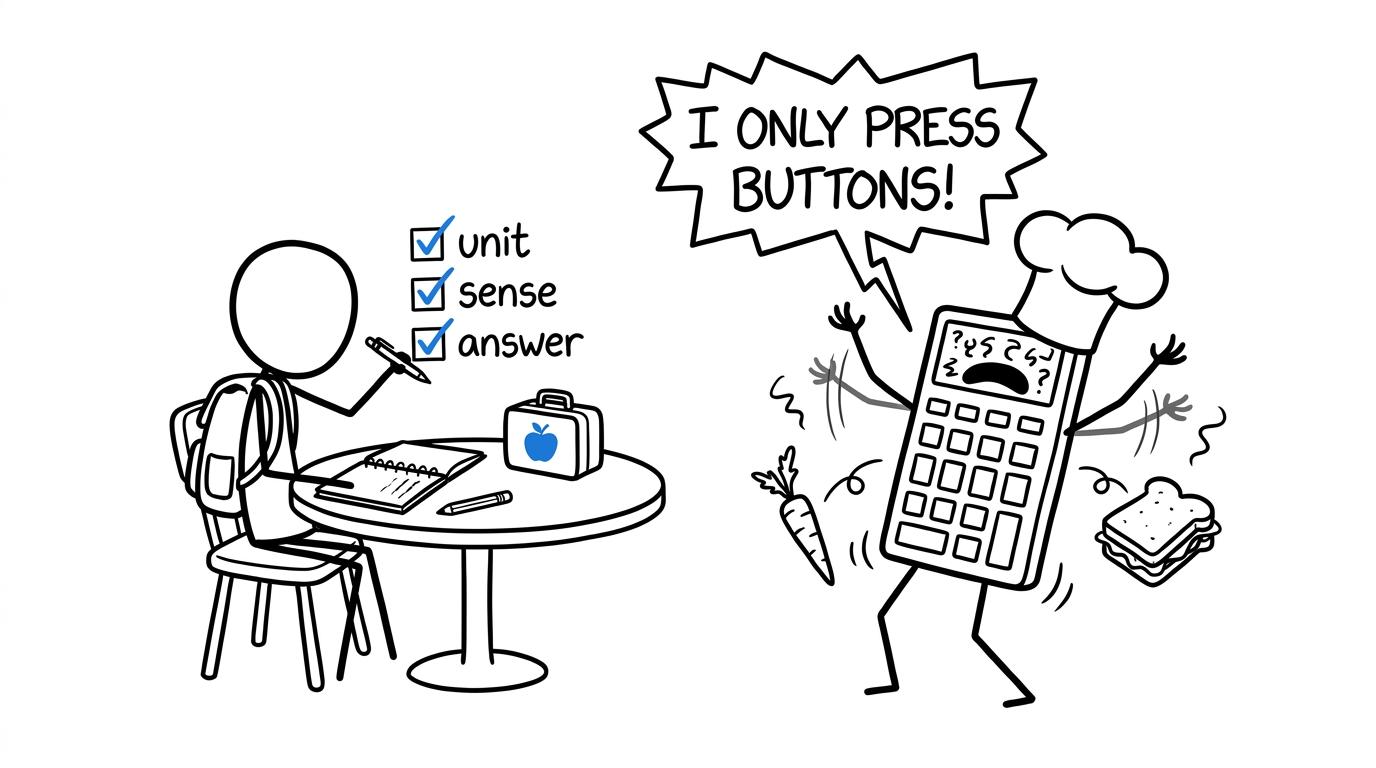 A calm student checks unit, sense and answer beside a chef-hat calculator
Practical assessment mistakes when the clock is running
The three-hour practical session rewards more than speed. Students must prepare, cook and present three dishes while demonstrating appropriate techniques, organisation, hygiene and food safety.
Starting without a workable sequence
A time plan should identify dependencies rather than merely list jobs. Processes requiring proving, chilling, baking, cooling or setting need to begin early enough. Tasks with inactive periods can overlap with preparation for another dish.
The plan should also include realistic time for:
- preheating equipment;
- weighing and preparation;
- cooking and resting;
- cleaning between stages;
- safe temperature checks where appropriate;
- final presentation.
Cleaning only at the end
A crowded workstation slows every later task. Cleaning as you go is not decorative neatness; it protects workspace, equipment access and food safety. It also reduces the chance of cross-contamination.
Abandoning accuracy to gain speed
Rushing measurements can damage proportions and therefore the outcome of a dish. Read the scale at eye level, confirm the unit and reset equipment where necessary. Ten seconds spent checking a quantity can prevent a much larger loss of time later.
Forgetting presentation time
A dish is not finished merely because it is cooked. Allow time for portioning, plating and any final accompaniment. Presentation should be planned as part of the workflow, not treated as an optional task if the clock permits.
Common mistakes that cost easy marks
These are the leaks to watch for in both written and practical work:
- Answering the topic rather than the question: underline the command word and context.
- Writing generic nutrition claims: connect each point to the named nutrient, life stage, dietary requirement or product.
- Giving a number without a unit: carry units through the calculation and include one in the answer.
- Comparing incompatible measurements: convert quantities into common units first.
- Rounding during intermediate stages: retain calculator accuracy and round only the final result unless instructed otherwise.
- Copying data without interpreting it: explain what the figure suggests and why it matters.
- Repeating one reason in different words: add a distinct causal link or move to another developed point.
- Leaving blank answers: write a relevant fact, method or calculation before moving on.
- Checking only arithmetic: also check the command word, context and reasonableness.
- Following the time plan blindly: adapt safely if a process takes longer, while protecting essential cooking and presentation stages.
How to practise calm decision-making
Pressure becomes manageable when it is familiar. Start with a short timed set rather than immediately attempting a full paper. Mark it, classify each lost mark and decide on one correction.
Useful categories include:
- knowledge gap;
- misread command word;
- incorrect method;
- unit or arithmetic error;
- unsupported judgement;
- poor time allocation.
For the numerical skills behind recipe and nutrition questions, combine topic lessons with GCSE predicted papers. Predicted papers are practice resources, not guarantees of future content, so use them alongside official past papers and your exam board's current specification.
A strong revision cycle is simple: learn the method, answer questions without notes, check the mark scheme, record the exact mistake and try the skill again after a gap. MathsGenie's guide to learning GCSE maths topics in a sensible order can help organise that process.
Turn rushed mistakes into reliable habits
The clock does not usually create a completely new weakness. It reveals which habits are not yet automatic.
Practise reading command words before writing. Keep units attached to quantities. Estimate before trusting a calculator. Build practical plans around dependencies, inactive cooking time and safe working. Most importantly, move on when one question begins taking more time than its marks justify.
Use MathsGenie as your free revision base for the maths behind Food Preparation and Nutrition and for your GCSE maths examinations. Begin with revision lessons on percentages, ratio, proportion, averages and conversions. Then use practice questions, mini tests, past papers and predicted papers under timed conditions, checking your work with mark schemes and video solutions.
The aim is not to make the clock disappear. It is to make your next decision clear even while the clock is running.