GCSE Food and Nutrition Revision: Silence or Noise?
GCSE food and nutrition revision silence or noise? Explore the evidence, match sound to each revision task and build a focused, exam-ready routine.
There is a familiar revision moment: your notes are open, the first question is waiting, and the room suddenly feels too quiet. You reach for music. A few minutes later, you are remembering the chorus more clearly than the functions of protein.
So, for GCSE food and nutrition revision, silence or noise? The most defensible answer is simple: use silence for demanding reading, recall and exam practice. If silence makes it difficult to settle, quiet instrumental audio may be a reasonable compromise, but music with lyrics and audible conversations are more likely to interfere with language and memory tasks.
That does not mean every student must revise in total silence. The effect depends on the sound, the task and the individual. What matters is performance, not whether a revision session feels pleasant.
The short answer: choose sound according to the task
Use this checklist before beginning:
- Choose silence for learning terminology, reading detailed explanations, writing extended answers and completing timed papers.
- Avoid lyrics when revising verbal material, even if you know the song well.
- Avoid nearby speech, television and podcasts during focused work.
- Try quiet instrumental sound only if it helps you begin and does not reduce recall or accuracy.
- Test your choice using questions completed under comparable conditions.
- Practise sometimes in exam-like silence, because that is the environment in which you must retrieve your knowledge.
This principle transfers directly to maths. A playlist may make repetitive practice feel easier, but unfamiliar problem solving, interpreting written questions and learning a new method require more attention. The GCSE Maths revision hub gives you topic lessons and questions with which to test your own working environment.
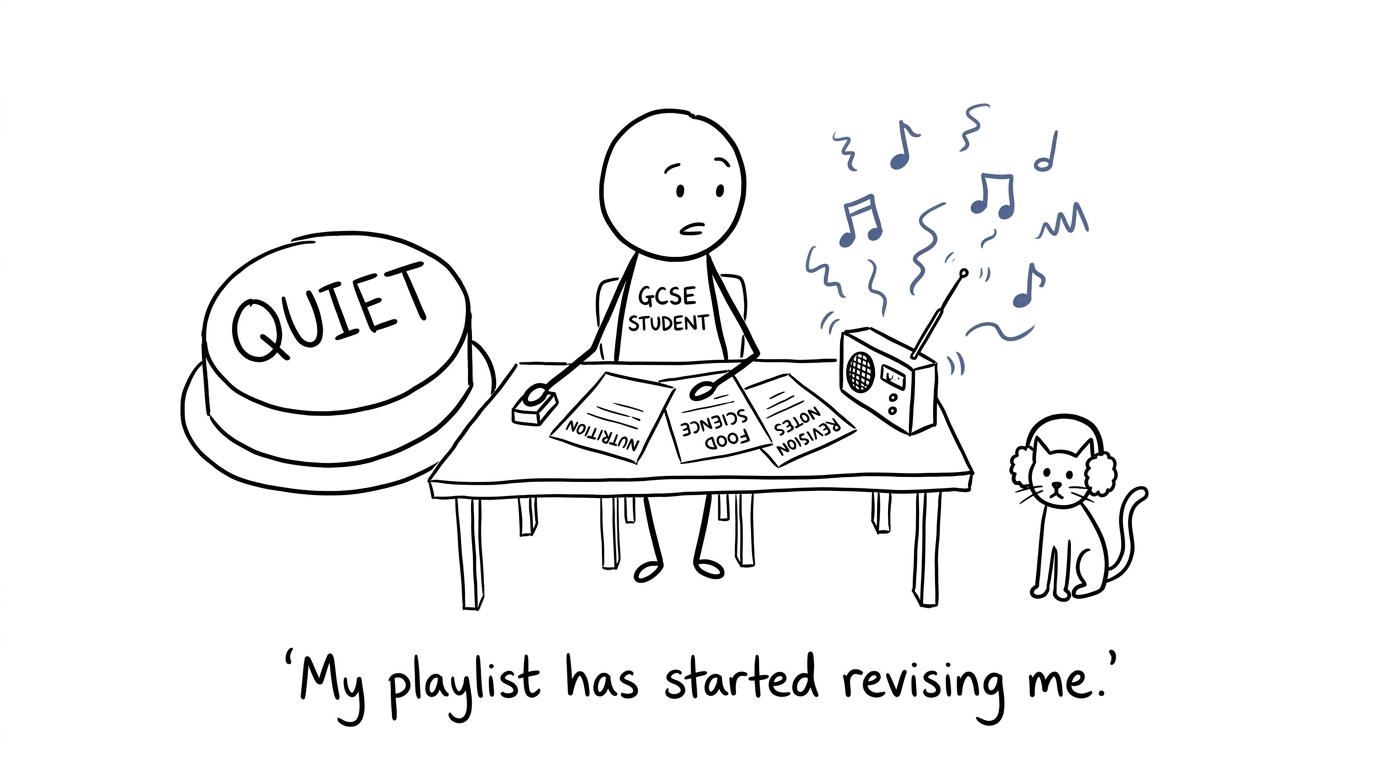 A student deciding between silence and a revision playlist while a cat wears ear defenders
What the evidence says about background music
The research does not support the broad claim that background music always improves revision. Nor does it show that every kind of music inevitably causes harm.
A systematic review published in 202220222022 examined 959595 articles containing 154154154 experiments across memory, language, attention, reasoning and other cognitive domains. Its overall findings were mixed, but an important pattern emerged: background music tended to be detrimental for memory and language-related tasks, particularly when it contained lyrics. Instrumental music often produced no clear difference from silence.
A controlled study published in 202320232023 compared silence, instrumental lo-fi music and music with lyrics. Lyrics impaired verbal memory, visual memory and reading comprehension. Instrumental music did not produce a credible improvement or decline compared with silence. Arithmetic performance was not clearly affected in that particular experiment.
This distinction matters. Food and Nutrition revision involves substantial verbal processing. You may be recalling scientific vocabulary, reading about functional properties, linking nutrients to health, explaining food safety or evaluating choices. Lyrics compete for some of the same language-processing resources.
The evidence is less clear for instrumental music. Calm, quiet audio may have little measurable effect for some people, but “not harmful” is not the same as “proven to improve learning”. If instrumental music helps you sit down and begin, it can have practical value. You should still check whether your answers remain accurate.
Why research cannot choose your playlist for you
Studies use different tasks, volumes, music styles and participant groups. Much of the experimental research involves adults or university students rather than pupils preparing for GCSEs. Research involving children also suggests that speech noise can disrupt verbal working memory, while findings for non-speech noise are more variable.
That means the evidence gives us a sensible default rather than a universal law:
Start with silence for difficult cognitive work. Treat quiet instrumental sound as an option to test, not as a revision technique that automatically raises marks.
Personal preference matters because it can affect motivation and willingness to start. However, preference is not reliable proof of learning. A session can feel smooth because familiar music reduces boredom while leaving you with weaker recall afterwards.
Why lyrics and conversations are especially distracting
The brain does not treat intelligible speech as neutral wallpaper. Words attract attention and can interfere with the temporary storage and processing of other verbal information.
Imagine trying to remember a sequence of food safety steps while a podcast explains a completely different idea. Your eyes may remain on the page, but attention keeps being pulled towards meaningful speech. The same problem can arise with television dialogue, family conversations or songs whose lyrics you know automatically.
This is sometimes described through the irrelevant speech effect: speech that is unrelated to the task can impair the recall of verbal sequences. You do not have to be consciously listening for it to become disruptive.
For revision involving definitions, processes and written explanations, use one of these environments:
- a genuinely quiet room;
- a library or supervised revision space;
- earplugs or passive noise reduction;
- headphones playing low-volume, non-lyrical sound if external speech cannot be removed.
Do not respond by turning instrumental audio up until it masks everything else. Excessive volume introduces another distraction and may be unsafe for your hearing.
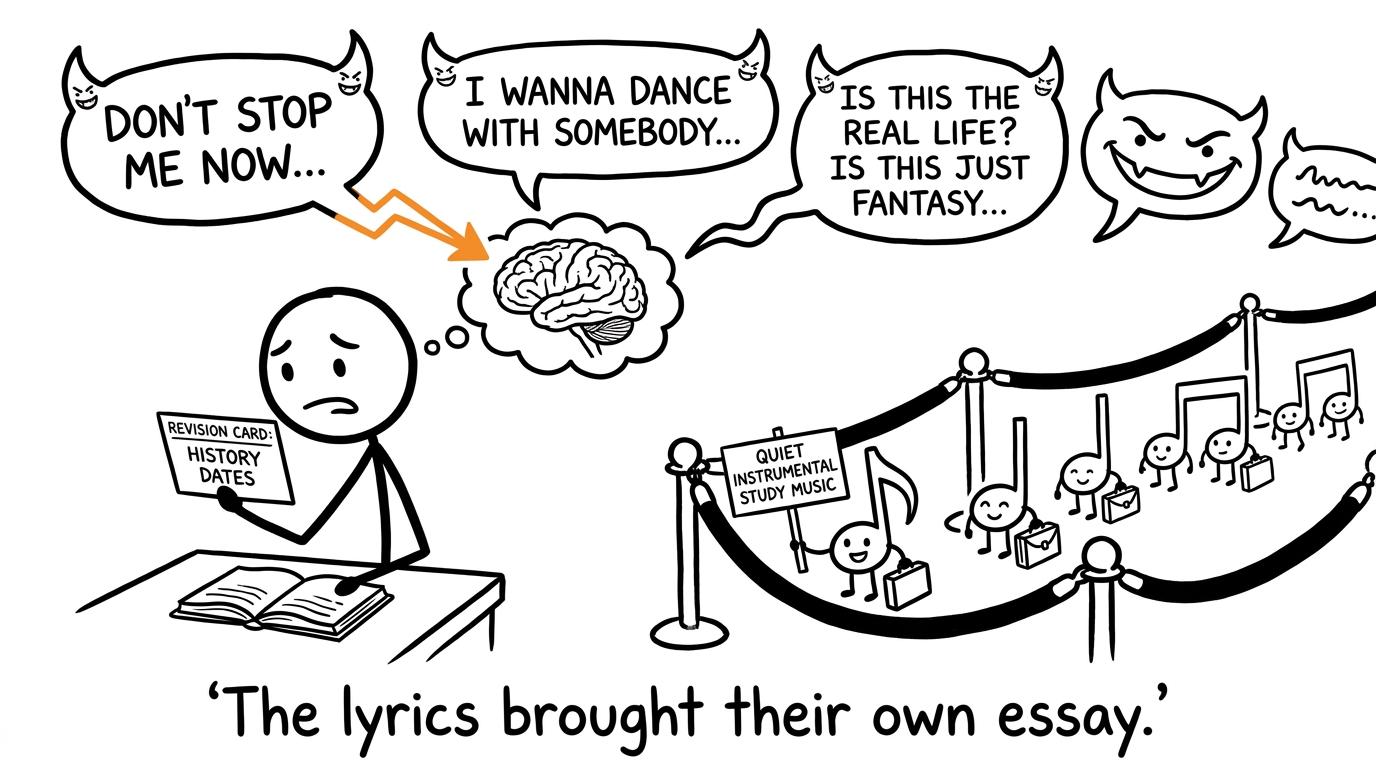 Song lyrics queuing to interrupt a student's revision while instrumental notes wait politely
Match your sound environment to Food and Nutrition tasks
Food Preparation and Nutrition is not one single kind of learning. It includes knowledge, application, analysis, evaluation and practical decision-making. Assessment arrangements vary by exam board, so check the current specification used by your school.
For example, the current AQA specification covers food, nutrition and health; food science; food safety; food choice; and food provenance. Its written examination assesses theoretical knowledge, while non-exam assessment includes investigation and practical preparation. Other specifications organise and assess content differently.
Learning facts and terminology
Use silence where possible. Nutrient functions, deficiency effects, food safety temperatures, scientific processes and specialist vocabulary depend heavily on accurate verbal recall.
Close your notes and retrieve information rather than repeatedly reading it. Music can create the feeling of momentum while rereading, but the real test is whether you can produce the answer without the page or playlist supporting you.
Reading and writing extended responses
Choose silence. Reading comprehension is one of the areas in which music, especially music with lyrics, has shown a small but credible negative effect across research.
Extended responses also require you to select relevant information, organise it and use precise terminology. Background speech adds unnecessary competition. The same applies when interpreting worded maths questions: practise extracting information through the MathsGenie GCSE topic lessons and questions without a podcast running beside you.
Organising notes or completing familiar tasks
Quiet instrumental audio may be acceptable when the cognitive demand is low. Examples include arranging flashcards, highlighting completed sections or tidying a revision folder.
Be honest about the boundary. As soon as you begin learning, evaluating or retrieving knowledge, the task is no longer administrative. Turn the audio off or lower it substantially.
Timed exam practice
Use silence. The purpose of a timed paper is not only to test knowledge; it is also to rehearse the conditions in which that knowledge must be used.
This is particularly important for maths students. Choose an appropriate paper from the Edexcel GCSE Maths past papers, work without music or hints, and then check the mark scheme. If a full paper feels too large, the GCSE Maths 45-minute tests provide a shorter test of concentration and stamina.
Run a fair revision experiment on yourself
“I concentrate better with music” is a hypothesis. Test it.
Choose two revision sets of similar length and difficulty. Complete one in silence and one with your usual background sound. Keep the time, location and resources as consistent as possible. After a delay, answer fresh retrieval questions without notes.
Record:
- how many answers were correct;
- how long the task took;
- how often you became distracted;
- how much you could recall later;
- whether errors involved missing knowledge or careless reading.
Repeat the comparison rather than trusting one session. A difficult topic can make either condition look worse by chance. Your aim is not to prove that your favourite environment is best. It is to discover which condition produces stronger work.
MathsGenie makes this kind of test straightforward. Select a weak area using the guide to finding your weakest GCSE topics, complete comparable practice sets and mark every response. For a repeatable structure, follow the 20-minute GCSE maths revision routine.
Build a routine that does not depend on perfect silence
Complete silence is not available in every home. The practical goal is to reduce intelligible, unpredictable sound and protect your attention.
Before starting, tell other people that you are completing a focused block. Put your phone in another room or use settings that prevent notifications appearing. If conversations remain audible, headphones with quiet neutral sound may be better than trying to overpower speech with loud music.
You can also divide revision by environment. Complete demanding recall at school, in a library or during a quieter part of the day. Save lower-demand organisation for noisier periods.
A good session has a clear output: a completed question set, retrieved definitions, a marked response or a short list of corrected mistakes. “Listened to revision music for an hour” is not evidence of progress.
For maths, use the revision cycle of learn, practise, mark and retest. The GCSE maths revision timetable guide explains how to combine topic work with timed papers rather than relying on long, unfocused sessions.
 A student discovering that even exam-room silence contains dramatic pencil noises
Common mistakes when choosing silence or noise
Assuming enjoyable revision is effective revision
Enjoyment can help you start, which matters. But it cannot replace retrieval and marking. Judge the environment by what you remember and apply, not by how quickly the session seemed to pass.
Playing familiar songs without noticing the lyrics
Familiar lyrics can be particularly difficult to ignore because your brain predicts what comes next. Save favourite songs for breaks or use them before revision as a transition into work.
Replacing household noise with louder noise
Masking speech can help, but increasing the volume creates a contest rather than a calm environment. Reduce the original noise where possible, then use low-level non-lyrical audio only if necessary.
Revising with music but sitting every mock in silence
If your concentration depends on a particular soundtrack, the exam room may feel strangely empty. Include regular silent practice, especially with papers and longer written responses.
Changing sound without improving the revision method
Silence cannot rescue passive rereading. You still need active recall, practice questions, marking and correction. Use the MathsGenie guide to using GCSE past papers properly to turn completed work into targeted improvement.
Make silence your default, not a punishment
The evidence does not say that every note of music destroys concentration. It says something more useful: lyrics and meaningful speech are risky during memory and language tasks, while instrumental sound often offers no reliable improvement over silence.
Begin difficult Food and Nutrition revision quietly. If silence genuinely prevents you from settling, test low-volume instrumental sound and measure the result. Then return to silence for retrieval and timed exam practice.
Apply the same discipline to maths. Start at the MathsGenie GCSE Maths revision hub, choose a topic, use the free revision lessons and practice questions, and mark your work carefully. As exams approach, add past papers, predicted papers, mini tests, mark schemes and video solutions.
Your revision environment does not need to be perfect. It only needs to help you do the work that eventually has to happen in your own head.