GCSE Food and Nutrition Busy Schedule Survival Guide
GCSE food and nutrition busy schedule? Build a realistic plan for theory, NEA and practical work while protecting maths revision and rest each week.
Some evenings disappear before revision has even begun. Training runs late. A shift changes. Maths homework expands. Then Food Preparation and Nutrition asks for theory, practical planning and NEA work at the same time. If a GCSE food and nutrition busy schedule is making you feel permanently behind, the answer is not to create a more heroic timetable. It is to reduce decisions, protect the work that must happen at school and revise the highest-value material in short, repeatable sessions.
This survival guide will help you keep Food Preparation and Nutrition moving without allowing it to consume the time needed for GCSE maths and your other subjects.
Your survival checklist
When time is limited, use these rules:
- Confirm your exam board and current specification.
- Separate theory revision, practical preparation and NEA tasks.
- Ask your teacher which NEA work must be completed under school supervision.
- Choose one precise topic for each short session.
- Use active recall and exam questions instead of repeatedly reading notes.
- Mark work immediately and record one correction.
- Protect fixed commitments, sleep and recovery time.
- Keep maths efficient with free GCSE maths revision resources, rather than letting it spread across every evening.
The goal is not to fit everything into today. It is to make sure the right work keeps moving each week.
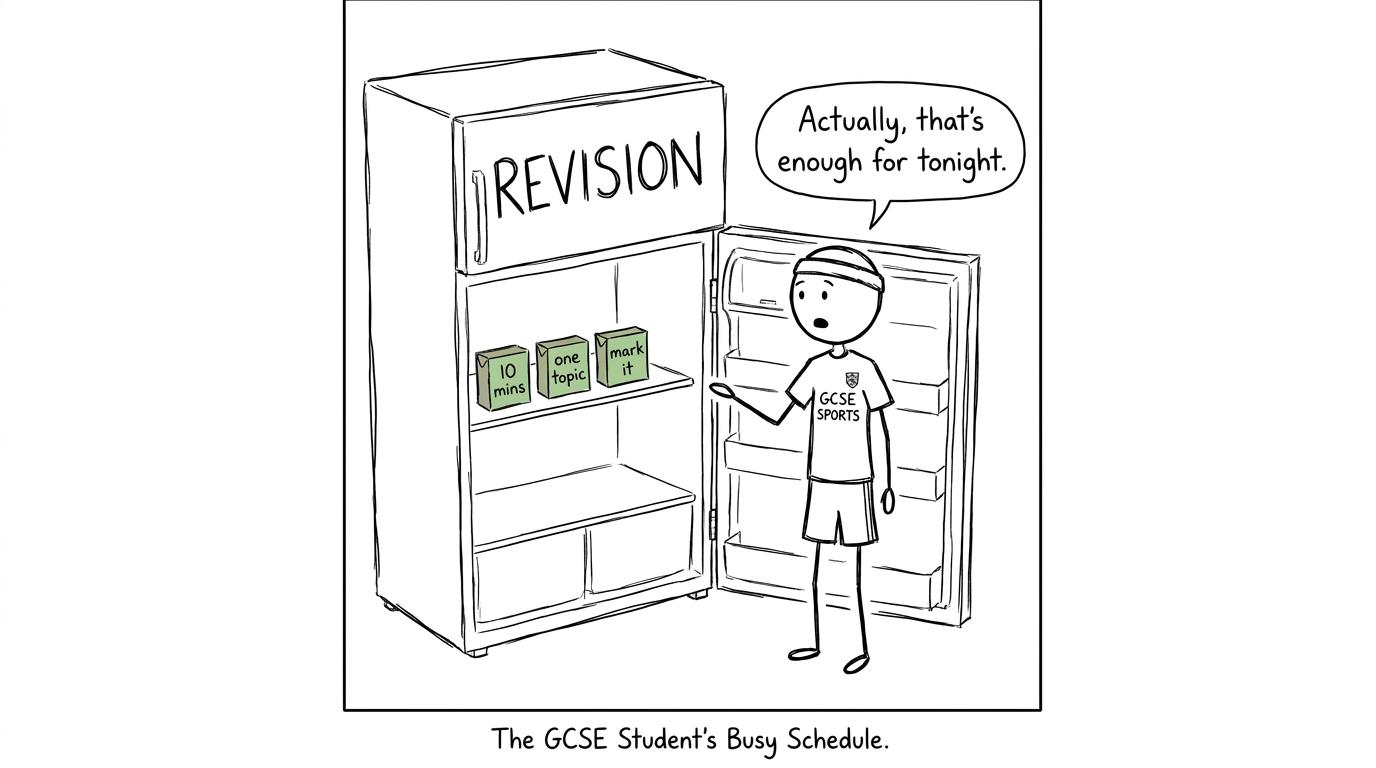 A busy student discovers that three small revision blocks are enough for tonight
Understand what you are actually preparing for
Food Preparation and Nutrition is not simply a cooking course. The national subject content includes nutrition and health, food science, food safety, food provenance, consumer choice, practical techniques and the application of knowledge when planning and preparing food.
Assessment structures vary by exam board, so use the specification named by your school. For the current AQA, OCR and Eduqas qualifications, the written examination contributes 50%50\%50% of the GCSE and non-exam assessment contributes the other 50%50\%50%. The exact examination length and organisation differ. For example, AQA and Eduqas currently use a written examination lasting 111 hour 454545 minutes, while OCR uses 111 hour 303030 minutes.
Your teacher and current exam-board materials should always be the final authority, particularly for live NEA instructions and internal deadlines. Do not rely on an old revision video or another student's task brief.
This assessment split suggests an important planning principle: theory cannot be postponed until the NEA is finished, and NEA work cannot be replaced by learning more theory at home. They need separate spaces in your week.
A GCSE food and nutrition busy schedule needs triage
Triage means deciding what requires attention now, what can wait and what should be dropped. It is not lowering your standards. It is using limited time honestly.
Divide your workload into three lists.
Fixed and supervised work
This includes practical lessons, teacher-set NEA sessions, controlled assessment requirements and deadlines. Some NEA evidence must be produced under conditions that allow your school to authenticate it as your own work. Never assume that you can finish controlled work independently at home.
Before a busy week, ask your teacher:
- What must I complete in school?
- What preparation may I do at home?
- What is the next genuine deadline?
- Which missing section would cause the greatest problem?
Four clear answers can prevent several evenings of working on the wrong thing.
Flexible theory revision
Nutrition, food science, safety, choice and provenance can usually be divided into small topics. Instead of writing “revise nutrition”, choose a task such as recalling the functions and sources of one nutrient group or comparing two food-storage methods.
A narrow target lowers the effort needed to start. The same principle works in maths: finding your weakest GCSE topics is more useful than vaguely deciding to “do algebra”.
Useful but optional work
Rewriting attractive notes, colour-coding an entire folder and searching endlessly for the perfect resource may feel productive. Under pressure, these tasks are often the first to remove. Keep anything that improves recall or earns marks. Question everything else.
Build a minimum viable week
A crowded timetable should be built around reality rather than your most optimistic Sunday evening.
Begin with fixed commitments: school, travel, sport, work, family responsibilities and sleep. Then identify the smallest weekly pattern that keeps both Food Preparation and Nutrition and maths alive.
A sustainable pattern might contain:
- two short Food theory sessions;
- one slot for permitted NEA preparation or organisation;
- two focused maths sessions;
- one flexible catch-up block;
- one period with no academic work.
Treat this as a framework, not a universal prescription. During an NEA deadline week, Food may need more time. Before a maths mock, the balance may reverse.
You can describe your weekly allocation as
T=F+M+O+R,T = F + M + O + R,T=F+M+O+R,where TTT is the revision time genuinely available, FFF is Food Preparation and Nutrition, MMM is maths, OOO is other subjects and RRR is reserved catch-up or recovery time.
The important condition is
F+M+O+R≤T.F + M + O + R \leq T.F+M+O+R≤T.If your plan exceeds the time available, motivation cannot repair it. Something must be shortened, moved or removed. The MathsGenie revision timetable guide can help you turn broad intentions into specific, usable sessions.
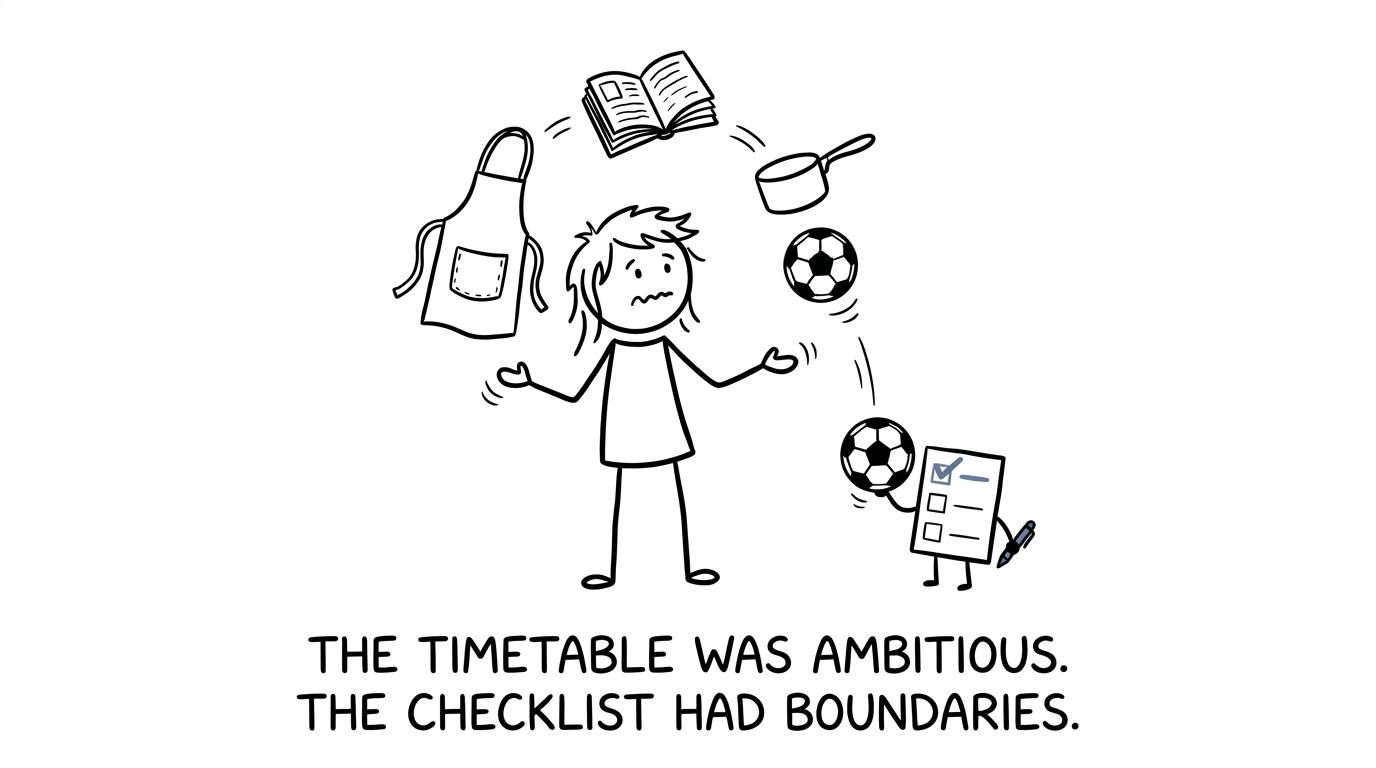 A checklist calmly reduces the load of a student juggling sport, work, books and cooking
Make short Food revision sessions count
A short session needs a visible finish line. Use a simple recall, check and repair cycle.
Recall
Close your notes and write or say everything you know about one tightly defined area. This could be the function and sources of a micronutrient, conditions required for bacterial growth, or the effect of heat on a food component.
Retrieval reveals what is available from memory. Reading alone can create familiarity without proving that you could produce an answer in an examination.
Check
Compare your recall with your class notes, textbook or specification-aligned material. Identify missing terminology, confused processes and unsupported claims.
For extended responses, check whether you have explained a chain of reasoning rather than produced a list. A strong answer often connects a property or process to its consequence and then to the question's context.
Repair
Write one correction in a compact form, then test it again on another day. Your correction should be precise enough to change the next answer. “Revise vitamins” is not a repair. “Distinguish the roles and food sources of the two vitamins I confused” is.
This resembles the MathsGenie 202020-minute revision routine: choose one target, retrieve the method, answer questions, mark promptly and decide the next action.
Use the overlap between food and maths
Food Preparation and Nutrition includes quantitative thinking. Depending on the question, you may need to interpret nutritional information, compare quantities, scale ingredients, use ratios, convert units or analyse results from an investigation.
Useful relationships include
percentage=partwhole×100,\text{percentage} = \frac{\text{part}}{\text{whole}} \times 100,percentage=wholepart×100,and, when adjusting a recipe,
new quantity=original quantity×required portionsoriginal portions.\text{new quantity} = \text{original quantity} \times \frac{\text{required portions}}{\text{original portions}}.new quantity=original quantity×original portionsrequired portions.These are not separate worlds. Secure maths makes food calculations quicker, while recipe and nutrition contexts give ratio, proportion, percentages and units a practical purpose.
If these skills cost you time, use MathsGenie's percentage change revision and practice or revisit fractions, percentages and ratio resources. Choose the page matching your actual gap rather than revising every number topic.
Protect practical and NEA progress
Practical work is difficult to recreate in a rushed evening, so preparation matters. Before a practical session, confirm the recipe, ingredients, equipment, sequence, hygiene controls and likely pressure points. A concise time plan is more useful than relying on memory while several processes compete for attention.
For investigation work, keep evidence organised as you go. File photographs correctly, label results and record observations while they are fresh. When evaluating, connect conclusions to the task and the evidence collected. Avoid claiming that a result proves more than the investigation supports.
Most importantly, follow your teacher's instructions on permitted assistance, supervision and authentication. Saving time is worthwhile; compromising the validity of assessed work is not.
When maths is also demanding attention
Maths can become an efficient subject when every session follows the same path: learn, practise, mark and repair. Start from the GCSE maths revision hub, select your exam board and tier, and focus on one weak skill.
On very crowded evenings, complete a mini test or a small group of practice questions rather than opening a full paper. When you have a longer protected block, use Edexcel GCSE maths past papers, or the corresponding page for your board, under timed conditions. Mark schemes and video solutions then turn lost marks into a revision list.
Predicted papers can provide fresh exam-style practice near the examination, but they do not guarantee future content. Use them to diagnose gaps, not to justify ignoring the rest of the specification.
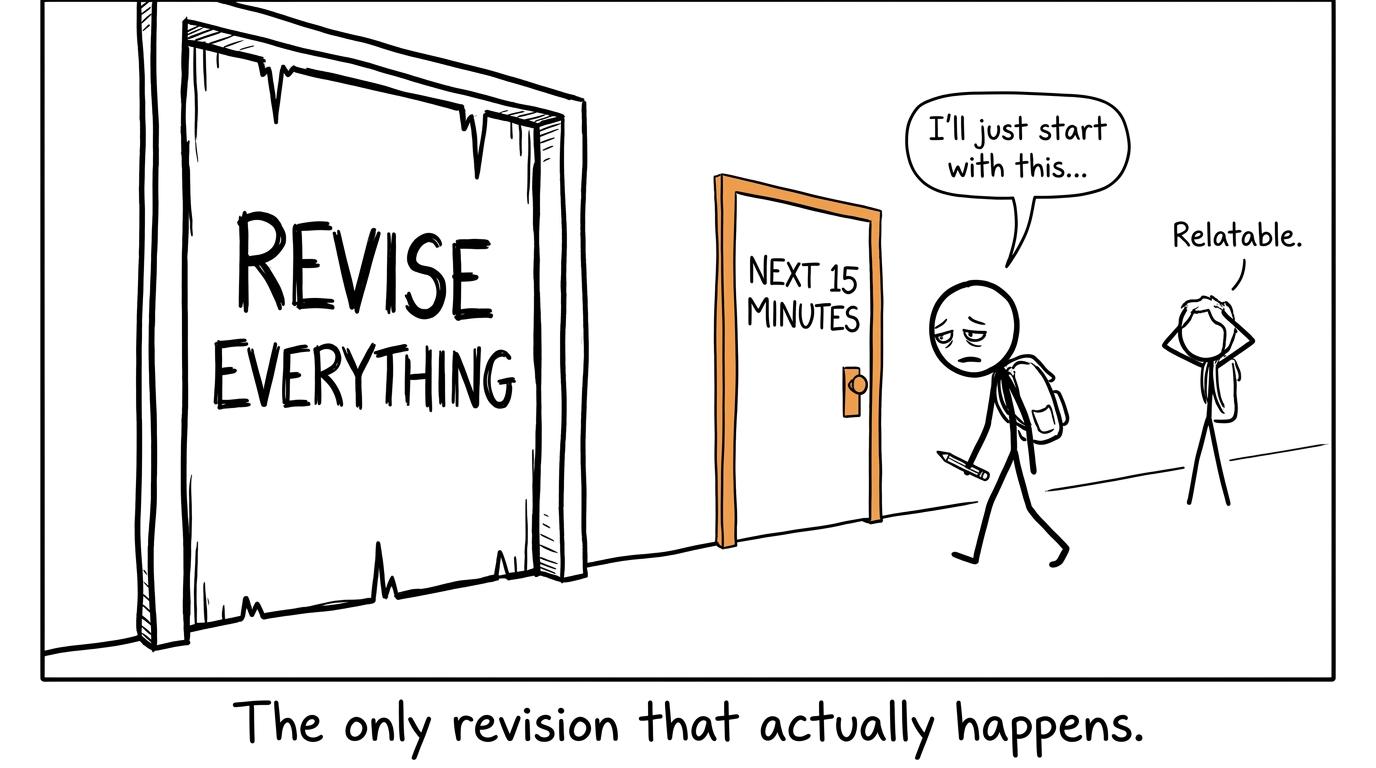 A tired student chooses the small door marked next fifteen minutes instead of revise everything
Common mistakes when revision time is scarce
Planning every available minute
A timetable with no travel delays, tiredness or catch-up space will break quickly. Leave margin. A plan should survive an imperfect week.
Treating all tasks as equally urgent
A supervised NEA deadline, tomorrow's practical preparation and a distant theory topic do not have the same priority. Rank work by deadline, consequence and current weakness.
Revising only what feels comfortable
Familiar topics produce reassuring sessions but limited improvement. Use questions and teacher feedback to locate gaps, then work on those gaps directly.
Making notes without testing recall
Notes are useful when they support retrieval. They are less useful when copying replaces thinking. Close the page and see what remains.
Sacrificing sleep to rescue an unrealistic plan
Late-night revision often creates a debt paid during tomorrow's lessons. Shorten the task before repeatedly shortening sleep.
Ignoring the mark scheme
An answer can be factually related to the topic without answering the command word. Practise distinguishing instructions such as describe, explain, compare, analyse and evaluate.
Keep the next step small
Busy students rarely need another speech about working harder. They need fewer decisions and a next action that fits the evening they actually have.
Choose one Food Preparation and Nutrition topic. Retrieve it without notes. Check it. Repair one gap. Then give maths the same disciplined treatment through MathsGenie's free revision lessons, practice questions, mini tests, past papers, predicted papers, mark schemes and video solutions.
Open the MathsGenie GCSE maths revision hub, select your exam board and tier, and complete one focused task today. A crowded schedule may limit the length of each session. It does not prevent small, well-chosen sessions from accumulating into real preparation.