GCSE Food and Nutrition 20 Minute Study Routine
GCSE food and nutrition 20 minute study routine: revise nutrition, food science and exam skills daily while keeping your GCSE maths practice on track.
The hardest part of revision is often not understanding the work. It is finding a place for it in a week already filled with lessons, homework and other GCSE subjects. A gcse food and nutrition 20 minute study routine solves that problem by making the task deliberately small: retrieve knowledge, practise one skill, check your answer and record what needs another visit.
You are not trying to revise the whole specification each evening. You are building familiarity in manageable layers, without allowing Food Preparation and Nutrition to consume the time you need for GCSE maths.
The 20-minute routine at a glance
Use the same four-part structure each day:
- Minutes 0-3: retrieve. Close your notes and write everything you remember about one topic.
- Minutes 3-10: repair. Check your specification or class materials and correct the gaps.
- Minutes 10-17: apply. Answer one exam question, label a process, interpret data or plan a response.
- Minutes 17-20: review. Mark the work and write one precise target for your next session.
Keep a timer, your specification checklist and a small error log nearby. Decide the topic before the session begins. A short routine loses much of its value if the first five minutes disappear while you choose what to do.
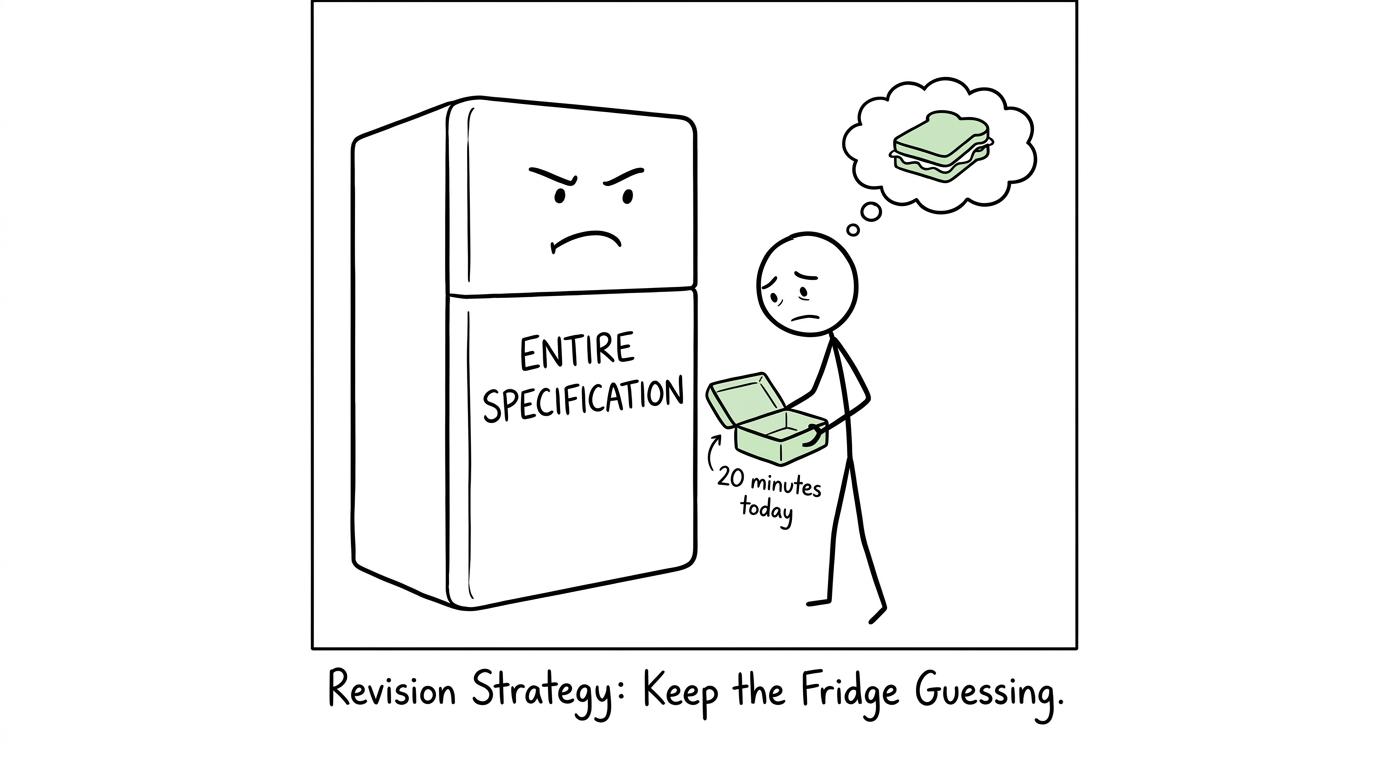 A student choosing a manageable revision lunchbox instead of the entire specification
Why short daily revision can work
Twenty minutes is not a magical number. Its value comes from repeatability. Learning research consistently supports spacing practice across separate sessions and retrieving information from memory rather than relying only on rereading.
That means a short closed-book quiz usually tells you more than another careful read through highlighted notes. It reveals which facts are available when the page is no longer helping you, much closer to the situation you will face in an examination.
The routine also protects your wider timetable. Food Preparation and Nutrition combines theoretical knowledge, practical understanding and non-exam assessment, but it is only one part of your GCSE programme. A fixed stopping point leaves space for maths, English and science rather than turning every evening into an improvised all-nighter.
If your whole revision timetable needs structure, the principles in MathsGenie's GCSE one-month revision plan can help you organise retrieval, targeted practice and later retesting across subjects.
Match the routine to your specification
Before planning topics, confirm the exact qualification shown by your school. GCSE Food Preparation and Nutrition is not divided into foundation and higher tier. That distinction applies to GCSE maths, not to this subject.
Current specifications from AQA, OCR and Eduqas all combine a written examination with non-exam assessment. The written component accounts for 50%50\%50% of the qualification on these specifications, although examination length, topic organisation and the division of NEA marks vary. For example, OCR separates its NEA into a food investigation worth 15%15\%15% and a food preparation task worth 35%35\%35%.
Do not build your routine from another student's checklist without checking that their exam board and specification match yours. Use the headings from your own official specification and your teacher's scheme of work. Broad areas commonly include:
- nutrition, health and dietary needs;
- food science and the properties of ingredients;
- food safety and microorganisms;
- food choice, provenance and sustainability;
- preparation methods, cooking processes and practical skills;
- analysis, evaluation and application to unfamiliar situations.
The written paper does not reward isolated facts alone. Official assessment objectives include knowledge, application, planning and evaluation. Your daily routine should therefore move beyond flashcards into explanation and exam-style use.
Build a weekly Food and Nutrition rotation
A rotation removes daily decision-making while ensuring that one comfortable topic does not receive all your attention.
Monday: nutrition and health
Retrieve the functions, sources, excesses and deficiencies associated with nutrients. Then connect the knowledge to a life stage, dietary need or health condition.
Avoid learning each nutrient as an isolated list. Build links between the nutrient, its function, suitable sources and the consequences of an unbalanced intake. On a later Monday, return to the same material without looking at your earlier answer.
Tuesday: food science
Focus on one process or functional property, such as coagulation, gelatinisation, dextrinisation, caramelisation, emulsification or aeration. Your goal is to explain what happens, why it happens and how it affects the finished food.
A labelled sequence, comparison grid or short written explanation is usually more useful than copying a textbook paragraph. If you cannot explain a process without the book, it is not yet secure.
Wednesday: food safety
Recall hazards, storage principles, contamination routes and safe working practices. Apply them to a kitchen scenario rather than simply producing a list.
Food safety questions often require cause and consequence. Practise connecting an unsafe action to the hazard it creates and the control measure that reduces the risk.
Thursday: choice and provenance
Rotate through cultural, ethical, environmental, economic and social influences on food choice. Include seasonality, food miles, sustainability, processing and consumer decisions where these appear in your specification.
Ask yourself whether you could compare two choices and reach a justified conclusion. Evaluation requires a judgement supported by relevant evidence, not merely advantages and disadvantages left unconnected.
Friday: exam response and review
Use the final session to answer a question under a short time limit. Check the command word carefully: state, describe, explain, analyse and evaluate demand different depths of response.
Mark the answer using materials supplied by your teacher or exam board. Record one improvement in your error log. A useful target is specific: “connect each safety control to its hazard” is more actionable than “write more”.
Keep the maths inside Food and Nutrition secure
Food Preparation and Nutrition contains numerical thinking even though it is not a maths qualification. Recipes, nutritional data, sensory results, costs and portions may involve proportion, percentages, averages, units and graphs.
For scaling quantities, the core proportional relationship is:
new quantity=original quantity×new number of portionsoriginal number of portions.\text{new quantity}=\text{original quantity}\times\frac{\text{new number of portions}}{\text{original number of portions}}.new quantity=original quantity×original number of portionsnew number of portions.Use the relationship as a checking tool rather than memorising disconnected tricks. If the number of portions increases, every directly proportional ingredient quantity should increase by the same scale factor.
You can strengthen this crossover through MathsGenie's proportion recipe questions and ingredient proportion practice questions. These are maths resources, but the context is directly relevant to recipe scaling.
For nutritional tables and test results, be ready to calculate a percentage using:
percentage=partwhole×100.\text{percentage}=\frac{\text{part}}{\text{whole}}\times 100.percentage=wholepart×100.MathsGenie's GCSE percentages practice can help if this calculation is costing you marks. You may also need to compare values, calculate a mean and interpret charts rather than simply describe what they look like.
Keep units visible throughout. Conversions between grams and kilograms, or millilitres and litres, can quietly change an otherwise sensible answer. An estimate can help you notice if the final quantity is implausibly large or small.
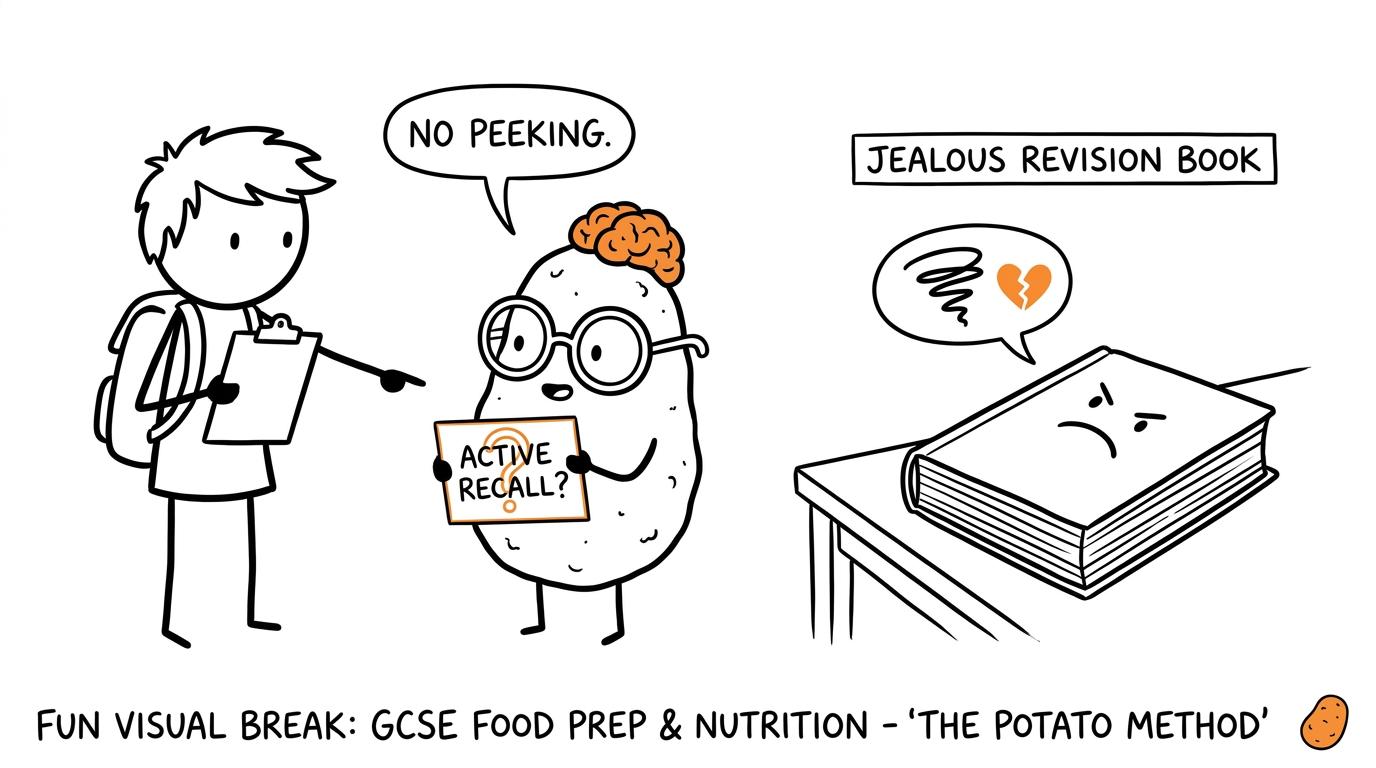 A potato invigilator insisting that a student retrieves knowledge without peeking
Fit Food revision around GCSE maths
A busy schedule works better when subjects have clear boundaries. On weekdays, complete the Food and Nutrition block, stop when the timer ends and move to the next planned subject.
For maths, begin from the GCSE maths revision hub, choosing your actual exam board and foundation or higher tier. MathsGenie organises free revision lessons, questions, worksheets and papers so that you can move from explanation to practice without spending the session searching for materials.
A sensible evening might contain the Food and Nutrition routine followed by a separate maths block focused on one weak skill. Use the GCSE maths topics by board and tier to check coverage, then complete focused questions rather than jumping randomly between chapters.
Do not attempt a complete maths paper inside a short daily slot. Mini tests and individual paper sections are better for ordinary evenings. Save full past papers for planned longer sessions and follow the guidance on when to start GCSE past papers.
Make the routine adapt to your energy
Consistency does not require every session to look identical. It requires you to keep returning.
On a normal day, complete the full routine. On a difficult day, use a minimum version: retrieve five facts, check them and write one correction. That is still more useful than postponing everything until the weekend.
When an assessment is approaching, extend the application stage rather than endlessly expanding your notes. Use more exam questions, timed responses and error correction. Closer to your maths examinations, MathsGenie's predicted papers, where appropriate for your board, can provide structured practice alongside past papers and mark schemes.
Protect sleep as part of the plan. The purpose of a daily minimum is to prevent work accumulating into a late-night emergency. When the timer finishes, record the next action and stop.
Common mistakes with a 20-minute study routine
Rereading for the whole session
Rereading can help repair a gap, but it should not occupy every minute. Begin with retrieval so that you discover what the gap actually is.
Revising only favourite topics
Nutrition may feel familiar while food science or provenance feels awkward. A weekly rotation prevents comfort from controlling your timetable. Give additional sessions to topics that repeatedly appear in your error log.
Making flashcards but never testing them
The learning happens when you try to recall the answer. Cover the back, answer aloud or in writing, then check. Shuffle cards so that the sequence does not provide clues.
Ignoring application and evaluation
Knowing that a process occurs is not the same as explaining its effect in a given product. Regularly practise applying knowledge to ingredients, dietary needs, practical decisions and unfamiliar evidence.
Confusing Food and Nutrition with GCSE maths structures
Food Preparation and Nutrition has no foundation or higher tier. Your maths resources must still match your own board and tier. Keep separate checklists even when the subjects overlap through ratio, percentage and data skills.
Failing to revisit mistakes
An error log is useful only if it changes tomorrow's work. Retest the idea after a gap, without notes. Correct once for understanding; return later for proof that it has stayed.
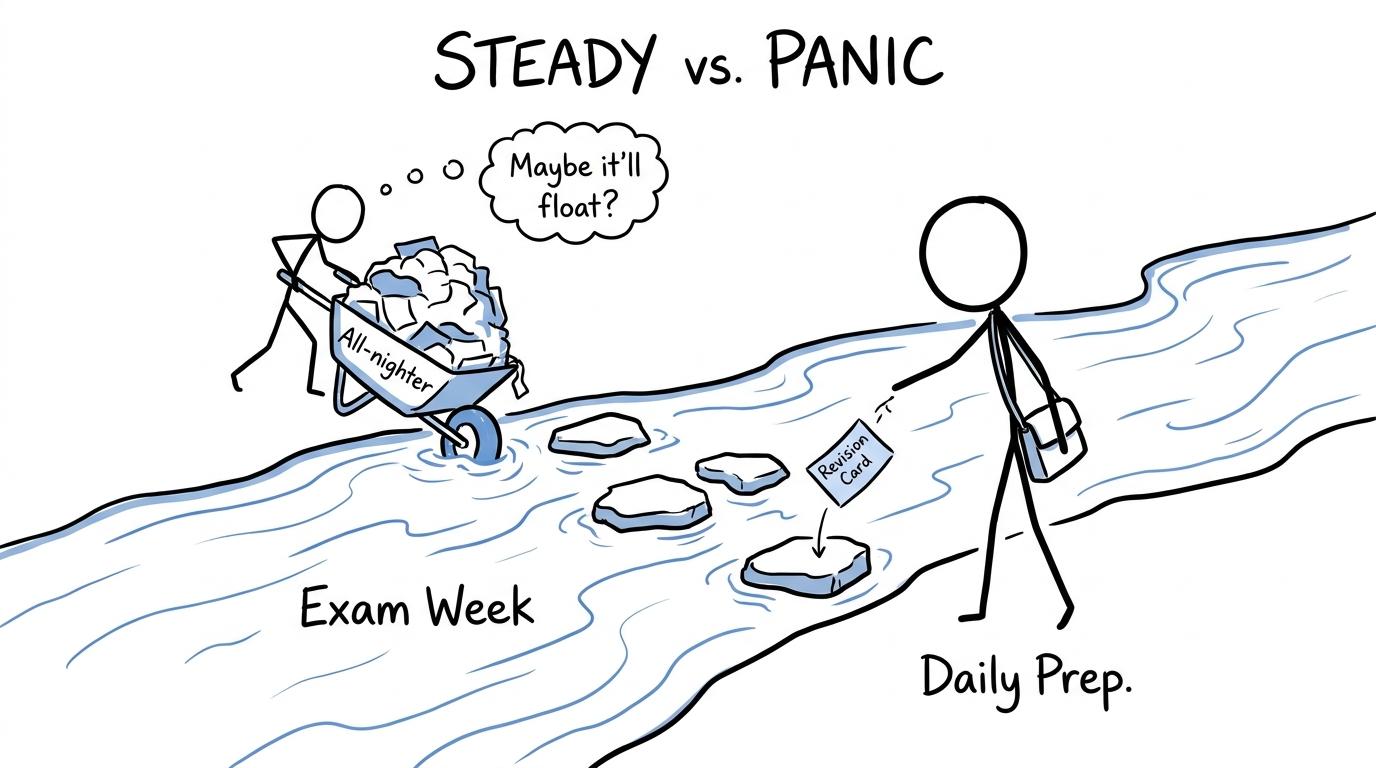 Daily revision cards crossing exam week while an all-nighter falls into the river
Small sessions create a calmer final week
Twenty minutes will sometimes feel almost too small. That is precisely why it can survive busy evenings. Over time, each session leaves behind something useful: a stronger explanation, a corrected misconception, a better exam response or one fewer numerical mistake.
Start tonight with one specification heading and one blank sheet of paper. Retrieve for three minutes, repair the gaps, apply the knowledge and record the next step. Then stop on time.
For the maths surrounding recipes, percentages and data, make MathsGenie your free revision base. Use revision lessons to rebuild methods, practice questions and mini tests to secure them, then move into past papers, predicted papers, mark schemes and video solutions. A routine does not need to be dramatic to work. It needs to be clear enough to repeat tomorrow.