GCSE Food and Nutrition Grade 4 Meaning Explained
GCSE food and nutrition grade 4 meaning: understand the standard pass, old grade C comparison, assessed skills and practical next steps for revision today.
A result can look precise while still leaving you unsure what it says about you. You open the envelope, see a 444, and immediately wonder whether it means you are good at practical cookery, secure in nutrition theory, or simply over the pass line.
The GCSE food and nutrition grade 4 meaning is straightforward at its core: a grade 444 is a standard pass. Its lower boundary is comparable with the lower boundary of the old grade C. It shows that your combined performance across the written examination and non-exam assessment met the grade 444 standard set for that exam series.
It does not mean you answered exactly 40%40\%40% of the course correctly, nor does it reveal one fixed ability profile. Your final grade reflects several kinds of knowledge and skill, brought together into one result.
Grade 4 at a glance
- A grade 444 is a standard GCSE pass.
- The bottom of grade 444 is comparable with the bottom of the old grade C.
- It sits below grade 555, which is commonly described as a strong pass.
- It is an overall qualification grade, not a separate judgement of cooking ability.
- It normally combines a written examination with non-exam assessment, or NEA.
- The number of marks needed changes between exam series and exam boards.
- It indicates a sound foundation, while leaving identifiable areas to develop.
 A student choosing between a grade boundary and dinner while a carrot holds a clipboard
What does a grade 4 actually represent?
GCSE Food Preparation and Nutrition is designed to connect theory with practice. The national subject content includes nutrition, food science, food safety, food provenance, food choice, practical preparation and cooking techniques. Students are also expected to make informed decisions, apply scientific principles and understand the relationship between diet and health.
A grade 444 therefore suggests that you have demonstrated enough of this combined knowledge and application to reach the standard-pass threshold. In practical terms, a student working around this standard may be able to:
- recall important facts about nutrients, diet, safety and food science;
- use relevant knowledge in familiar situations;
- plan and carry out a selection of food preparation tasks with some competence;
- explain choices using appropriate subject vocabulary;
- interpret straightforward nutritional information or experimental findings;
- offer some analysis and evaluation, although this may lack the consistency or depth seen in higher grades.
These points are a broad interpretation, not a universal checklist. A final grade cannot tell you precisely which skills were strongest. One student might produce confident practical work but lose marks in extended written answers. Another might understand nutrition theory well but provide limited evaluation in the NEA.
That distinction matters. A grade is a summary, not a complete portrait.
How grade 4 compares with the old letter grades
The numbered scale is not a direct one-to-one translation of the former A* to G system. Ofqual identifies comparable points rather than assigning every number an exact letter.
| Current grade | Broad comparison with the old system |
|---|---|
| 999, 888 and 777 | Cover the former A* and A range |
| Bottom of 777 | Comparable with the bottom of an old A |
| 666, 555 and 444 | Cover the former B and C range |
| Bottom of 444 | Comparable with the bottom of an old C |
| Bottom of 111 | Comparable with the bottom of an old G |
The safest statement is therefore that the bottom of grade 444 aligns with the bottom of the old grade C. Calling every grade 444 simply “a C” is convenient, but slightly imprecise because the newer scale divides performance differently.
For students, the practical message is more important than the historical conversion: grade 444 is recognised as the standard-pass benchmark. If a college, apprenticeship provider or employer has a particular entry requirement, check its current wording rather than assuming that every course treats grade 444 identically.
How the final grade is produced
The formal qualification is usually called GCSE Food Preparation and Nutrition. It is offered by boards including AQA, OCR and Eduqas, with differences in paper length and component organisation. You should always check the specification used by your school.
Across these specifications, the broad structure combines a written examination with NEA. For example, AQA allocates 50%50\%50% of the qualification to a written paper and 50%50\%50% to NEA. Its NEA includes a food investigation and a food preparation assessment. OCR and Eduqas also use a written component worth 50%50\%50% and practical or investigative NEA making up the remaining 50%50\%50%, although their detailed mark structures differ.
Where components are equally weighted, the general relationship can be represented as:
overall weighted mark=0.5(written component)+0.5(NEA component)\text{overall weighted mark} = 0.5(\text{written component}) + 0.5(\text{NEA component})overall weighted mark=0.5(written component)+0.5(NEA component)This is not a worked grade calculation, because component marks may be scaled or weighted according to the board's rules. It simply shows why both halves matter. Strong practical performance can support the overall result, but it does not make the written examination irrelevant. The reverse is also true.
Why grade 4 is not a fixed percentage
One of the most persistent GCSE myths is that grade 444 always means 40%40\%40%. It does not.
A grade boundary is the minimum mark required for a grade in a particular exam series. Awarding organisations set boundaries after papers have been marked, using evidence about how demanding the assessments were and the quality of students' work. Boundaries can therefore move from year to year.
The percentage of available marks would be calculated using:
percentage of marks=marks achievedtotal available marks×100\text{percentage of marks} = \frac{\text{marks achieved}}{\text{total available marks}} \times 100percentage of marks=total available marksmarks achieved×100But the resulting percentage only becomes meaningful when compared with the correct boundary for your board, specification and exam series. A boundary from an earlier year is useful for reviewing an old paper, not as a guaranteed target for a future examination.
Treat boundaries as measurement tools, not promises. During revision, aim above the most recent grade 444 boundary on several complete assessments. That gives you more protection against difficult questions, avoidable errors and normal variation between papers.
The maths skills hidden inside Food and Nutrition
Food Preparation and Nutrition contains more numerical thinking than its title initially suggests. The national subject content includes calculating energy and nutritional values, while practical work requires accurate measurement and sensible interpretation of results.
Useful GCSE maths skills include:
- ratio and direct proportion when scaling recipes;
- fractions, decimals and percentages in nutritional information;
- converting between units of mass and volume;
- reading tables, charts and experimental data;
- calculating costs and comparing quantities;
- recognising sensible levels of accuracy;
- measuring time, mass, volume and temperature reliably.
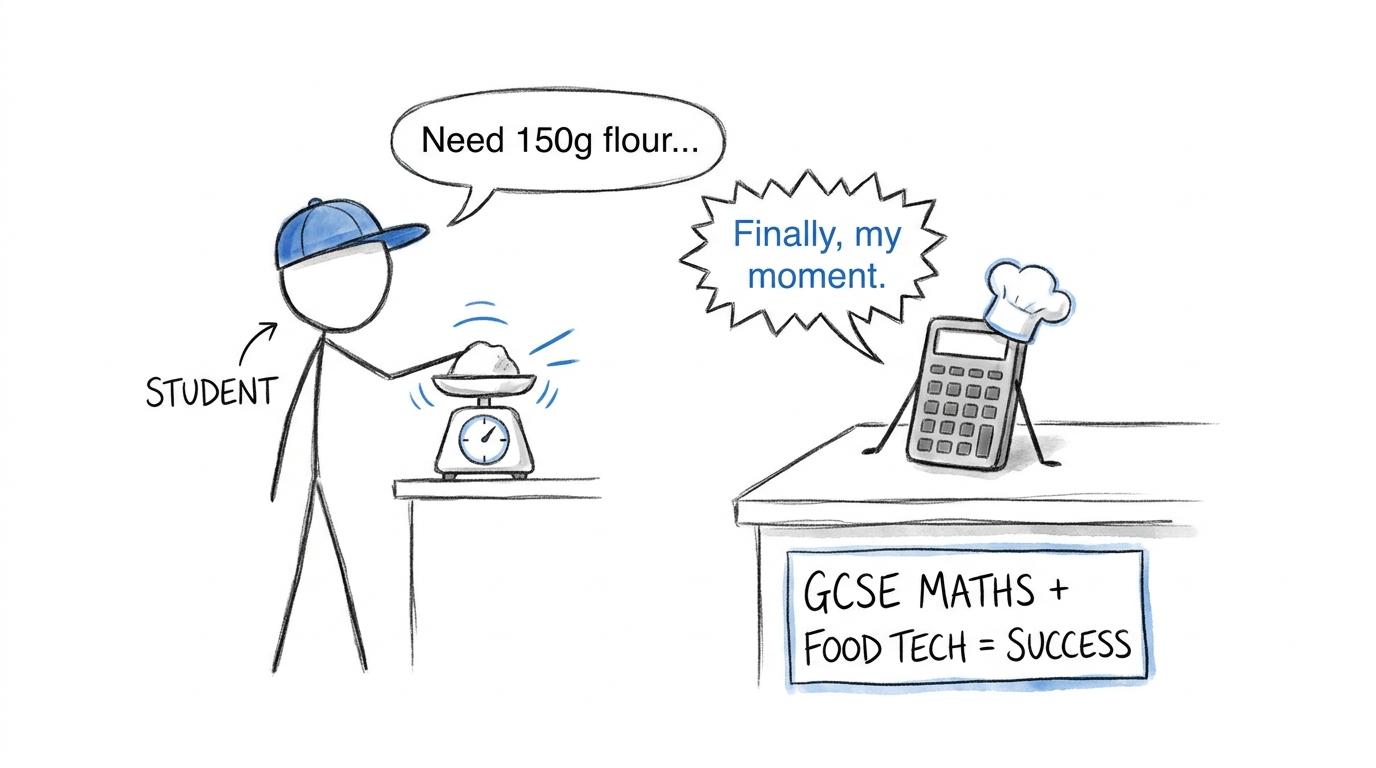 A calculator in a chef hat celebrates beside a student using kitchen scales
If these calculations slow you down, use MathsGenie's GCSE Maths revision hub to identify the precise gap. The proportion revision lesson is particularly relevant to scaling recipes, while the ratio revision guide helps with comparing quantities in the correct order.
Nutritional labels and test results often rely on parts of a whole, so the percentages revision resources can strengthen both your maths examination performance and your confidence with food-related data. These are transferable skills: improving one subject can quietly remove friction from another.
What separates grade 4 from higher grades?
Higher grades are not earned merely by writing more. They usually reflect greater accuracy, independence, depth and consistency.
A grade 444 response may identify a relevant point and give a straightforward explanation. A stronger response is more likely to connect cause and effect, use precise terminology, apply knowledge to the situation given and support a conclusion with evidence.
In practical and investigative work, progression may involve:
- making choices that are clearly justified rather than merely described;
- linking ingredient properties to the result produced;
- using observations and data when drawing conclusions;
- evaluating limitations rather than listing generic improvements;
- demonstrating a wider or more secure range of technical skills;
- maintaining accuracy, organisation and food safety consistently.
A useful revision ladder is know, apply, explain, analyse, evaluate. Recall gets an answer started. Application makes it relevant. Analysis and evaluation make it convincing.
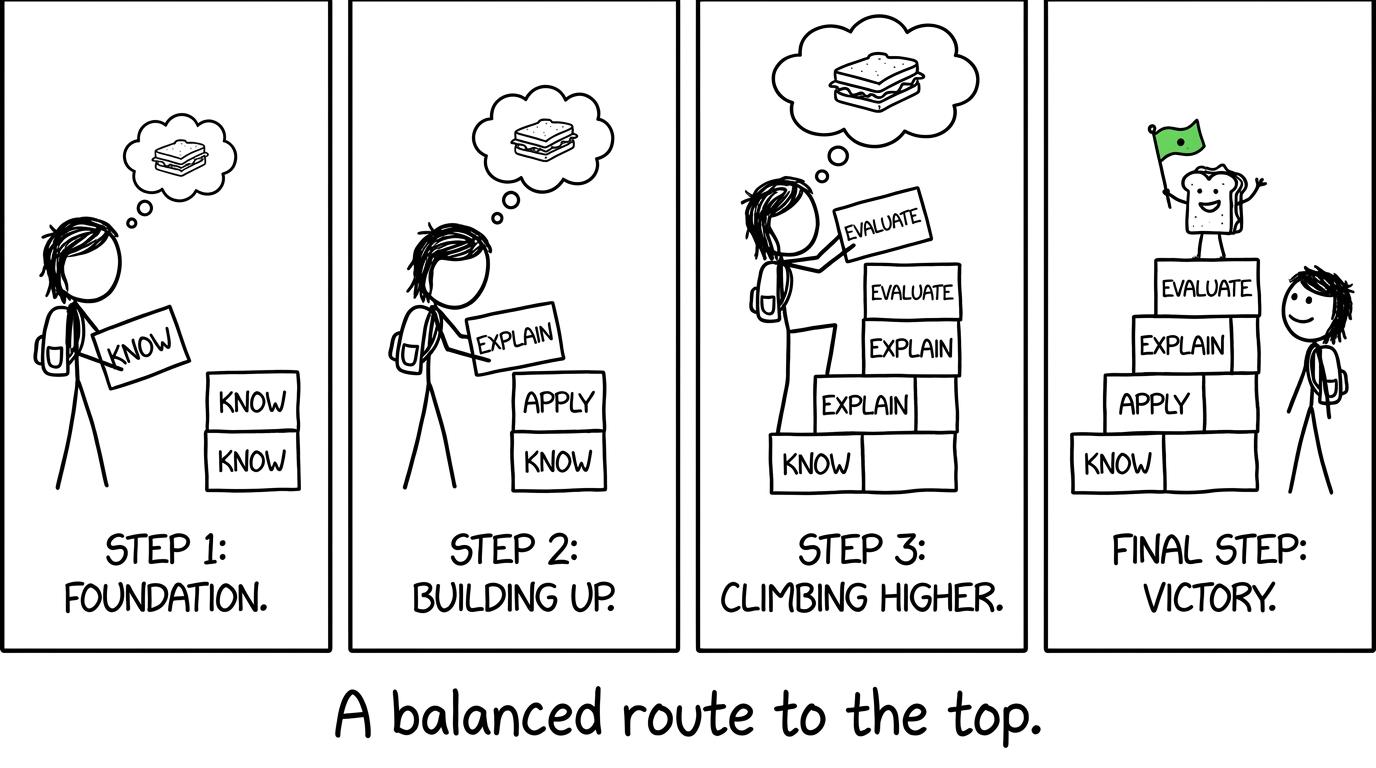 A student climbs revision blocks labelled Know, Apply, Explain and Evaluate towards a flag-waving sandwich
How to move beyond a grade 4
Begin with evidence rather than a vague promise to “revise harder”. Review a marked assessment and separate lost marks into three groups:
- Knowledge gaps: facts, processes or terminology you did not know.
- Application gaps: knowledge you knew but could not use in context.
- Communication gaps: incomplete explanations, weak conclusions or missing evidence.
Then repair one category at a time. Learn the missing content, answer focused questions, check the mark scheme and return to the question later without notes.
The same loop works in maths. MathsGenie's guide to using GCSE past papers properly explains how to turn each lost mark into a specific next action. If your revision feels disorganised, the best order for learning GCSE maths topics provides a structured route through number, ratio, algebra, geometry and statistics.
For maths exam preparation, move from topic lessons to practice questions, then to mini tests and full papers. Nearer the examination, Edexcel GCSE Maths predicted papers can provide fresh exam-style practice. Predicted papers should test your preparation, not replace full specification coverage.
Common mistakes when interpreting a grade 4
Assuming grade 4 always equals 40%40\%40%
The number on the grade scale is not a percentage. Boundaries depend on the assessment, board and exam series.
Treating grade 4 as a judgement of practical cooking alone
The qualification combines theoretical, investigative and practical performance. Your overall result cannot isolate one of those areas.
Calling it an exact old grade C
The precise comparison is between the bottom of grade 444 and the bottom of the former grade C. The scales are not identical at every point.
Ignoring NEA after it has been submitted
NEA can form a substantial part of the final qualification, but the written component still matters. Once NEA is complete, focus on the marks you can still influence.
Revising only comfortable topics
Repeatedly reviewing familiar notes creates recognition, not necessarily recall. Use questions and mark schemes to reveal what you cannot yet explain independently.
A grade is a starting point, not a ceiling
The gcse food and nutrition grade 4 meaning is ultimately less mysterious than it first appears: it is a standard pass showing that your overall work reached the required grade 444 standard. It is comparable at its lower boundary with the old grade C, but it is not a fixed percentage or a detailed diagnosis of every skill.
The useful question is not only, “What does this grade mean?” It is, “What should I do next?” Identify whether knowledge, application, evaluation or numerical confidence is holding you back, then practise that weakness deliberately.
For your maths exams, make MathsGenie your free revision base. Use revision lessons to rebuild methods, practice questions and mini tests to develop fluency, then past papers, predicted papers, mark schemes and video solutions to turn mistakes into a clear plan for improvement.