GCSE Food and Nutrition Early Entry: Is It Wise?
GCSE food and nutrition early entry: weigh workload, NEA timing, readiness and maths revision before deciding whether taking it early is right for you.
The promise sounds attractive: finish one GCSE in Year 10, reduce the pressure in Year 11 and walk into the main exam season with one less subject competing for attention. But GCSE food and nutrition early entry is only a good idea when readiness, practical experience and assessment timing all line up. It should not be treated as an easy way to collect a qualification early.
The short answer is this: taking the subject early can make sense for a capable, well-supported student who has covered the full specification and can complete the non-exam assessment properly. It is less sensible when it compresses a two-year course, clashes with maths revision or relies on the hope that there will always be time for a resit.
Early-entry decision checklist
Before agreeing, check whether you can answer yes to most of these questions:
- Have you been taught the whole specification rather than only the enjoyable practical topics?
- Are your practical preparation, food safety and time-management skills secure?
- Can your school schedule and supervise both non-exam assessment tasks correctly?
- Are your written explanations, analysis and evaluation strong enough?
- Is your current maths progress stable at the tier you are taking?
- Will the early course create extra pressure during Year 10 mocks or Year 11 teaching?
- Has the school explained what happens if the result is below your target grade?
- Do you personally want to take the subject early, rather than simply following a timetable decision?
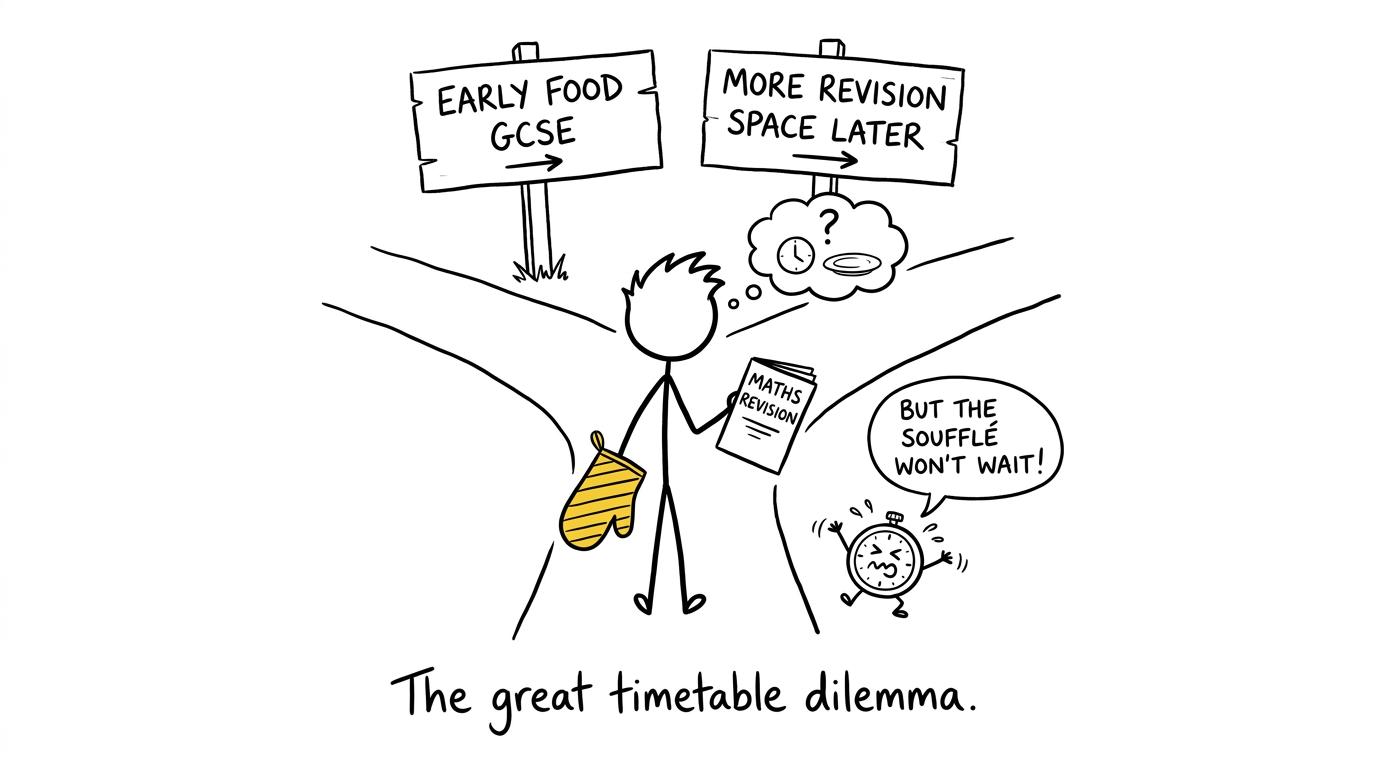 A student choosing between early Food GCSE and later revision space
What GCSE Food Preparation and Nutrition involves
The qualification is usually called GCSE Food Preparation and Nutrition, even though students and schools often shorten this to food and nutrition. The precise structure and paper length depend on the awarding body, so you should confirm whether your school follows AQA, OCR, Eduqas or another approved specification.
Across the regulated specifications, the course combines theoretical knowledge with practical and investigative work. Students study areas such as nutrition, food science, food safety, food choice, provenance, preparation techniques and cooking skills.
A crucial fact for an early-entry decision is the assessment balance. Official requirements allocate 50%50\%50% of the qualification to a written examination and 50%50\%50% to non-exam assessment. Within the overall qualification, the food investigation contributes 15%15\%15%, while the practical food preparation task contributes 35%35\%35%.
That means early entry is not simply a matter of memorising content and sitting a paper ahead of schedule. A student must also have enough classroom access, practical experience and supervised assessment time to produce valid NEA work. The cooking assessment includes planning, preparing, cooking and presenting three dishes during a single three-hour task.
Some specifications, including AQA and OCR, also expect the food investigation to be evidenced in a report of around 1,5001,5001,500 to 2,0002,0002,000 words. The exact administrative arrangements must be checked against the current specification used by your school.
When taking the GCSE early can be a good idea
You have genuinely completed the course
Being ahead means more than being confident in the kitchen. A ready student can explain why ingredients behave as they do, apply nutritional knowledge, justify choices and evaluate results using appropriate evidence.
If lessons have covered the full content and your teacher has assessed your practical and written performance, early entry may be a reasonable next step. Teacher judgement matters because NEA quality can be difficult to estimate from ordinary homework alone.
The timetable creates a real Year 11 benefit
Completing the qualification early may create more space for English, science and maths in Year 11. For a student aiming to strengthen a foundation-tier maths result or reach the higher-tier grades needed for a future course, that space could be valuable.
But the benefit must be real. Ask what will happen in the lesson periods after the examination. Will they become supervised revision, another qualification or ordinary study time? Finishing early only helps if the released time is used deliberately.
The MathsGenie revision planner can help you turn that time into a structured routine rather than letting it disappear into unplanned homework.
You manage long-term tasks reliably
NEA rewards steady progress. Research, investigation, trialling, planning, practical execution and evaluation cannot all be repaired through a last-minute revision session.
Early entry is more suitable when you already meet deadlines, organise evidence carefully and respond to permitted teacher guidance without depending on constant reminders. It is not about being unusually fast. It is about being consistently prepared.
When early entry may be the wrong choice
The course is being compressed too aggressively
AQA states that its qualification is designed to be taken over two years. Sitting it early may still be possible, but the full course and assessment requirements remain. The calendar becoming shorter does not make the specification smaller.
A compressed timetable can reduce opportunities to practise technical skills, learn from unsuccessful dishes and develop better evaluation. Those experiences matter because practical confidence usually grows through repetition.
It competes with GCSE maths at the wrong time
The hidden cost of early entry is not only the hours spent in food lessons. It is the mental switching between NEA writing, practical preparation, mock examinations and ordinary homework.
If your maths foundations are fragile, several weeks of reduced practice can matter. Skills such as algebra, fractions and problem solving become reliable through repeated use. MathsGenie's GCSE maths revision hub lets you select your exam board and work through lessons, questions, papers and revision tools at the appropriate level.
Consider your whole timetable rather than judging one subject in isolation. A decision that looks efficient for food may be inefficient for your overall set of GCSEs.
The main reason is that the subject appears easy
Food Preparation and Nutrition is practical, but it is not merely a cooking course. Half of the qualification comes from a written examination, and the NEA requires scientific understanding, analysis, justification and evaluation.
Enjoying practical lessons is a good reason to value the subject. It is not evidence that you are ready to be assessed a year early.
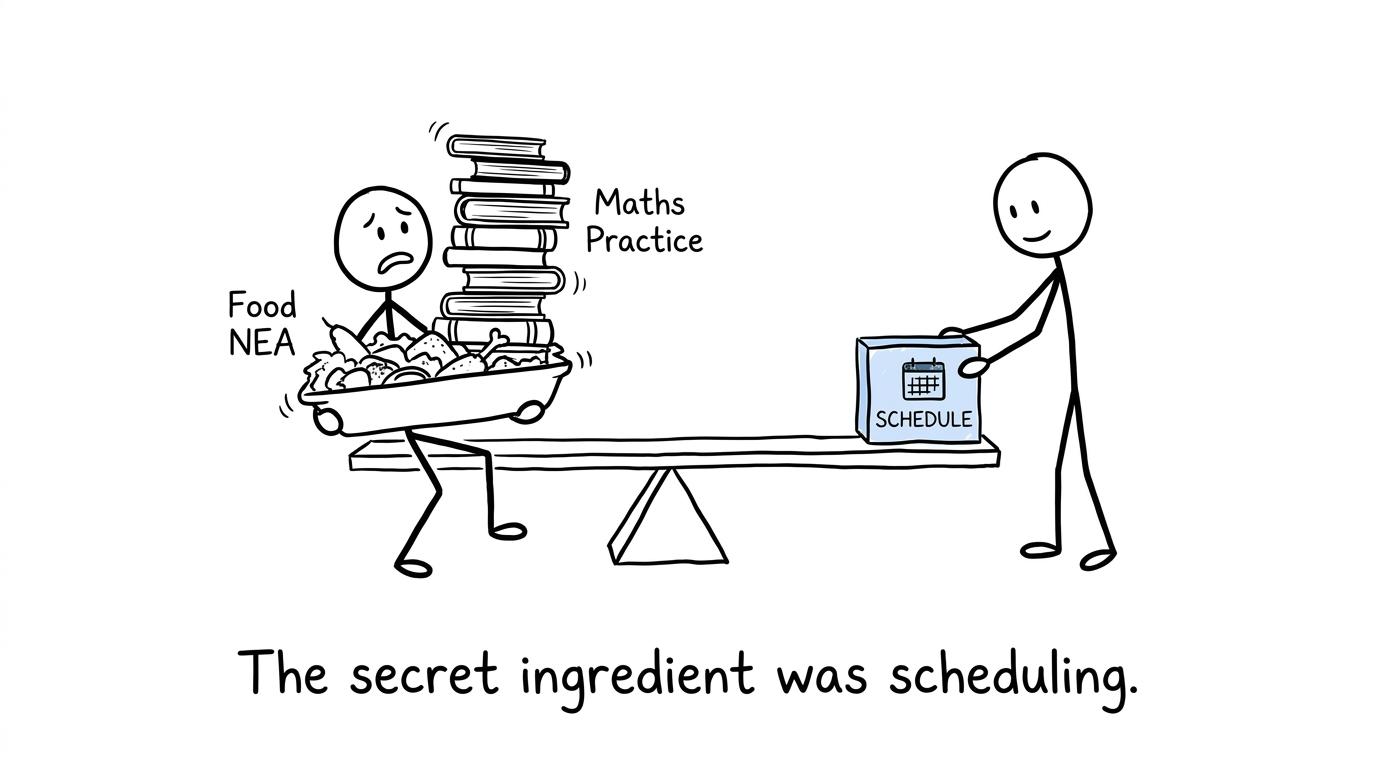 A GCSE student balancing Food NEA and maths practice
Questions to ask your school before agreeing
A productive conversation should move beyond, “Do you think I can pass?” Passing may not be the right target if you are capable of a substantially stronger grade with another year of development.
Ask your teacher or exams officer:
- Which exam board and current specification are we following?
- Has every required content area been taught?
- When will each NEA task be released, completed and authenticated?
- How many supervised practical sessions will I receive?
- What evidence shows that I am working at my target grade?
- What happens to my timetable after the early examination?
- Would a later entry improve my likely grade or practical performance?
- What are the school's arrangements and implications if re-entry is considered?
In England, first-entry rules can affect which result counts in a school's Key Stage 4 performance measures. Current government guidance generally means that an early GCSE result counts for school accountability when the student reaches the end of Key Stage 4, although exceptions and re-entry rules can apply. This is not the same as saying that a student's later grade simply vanishes, but it is a reason to ask the exams officer for advice based on your exact circumstances.
How food and nutrition connects with GCSE maths
Although this decision concerns another subject, food preparation uses several mathematical skills. You may need to interpret nutritional data, compare quantities, understand percentages, convert units or scale ingredients in proportion.
These links can support maths revision when they are recognised deliberately. The following MathsGenie resources are particularly relevant:
- Proportion revision for recipe quantities
- Percentages GCSE maths revision
- GCSE maths topics by exam board and tier
This overlap is useful, but it should not be overstated. Completing a recipe calculation does not replace practising the wider number, algebra, geometry, probability and statistics content required by Edexcel, AQA, OCR or Eduqas GCSE Maths.
Protecting maths revision during an early-entry course
The safest approach is to give maths a minimum weekly commitment that survives busy NEA periods. Do not wait for food coursework to become quiet, because long projects rarely feel completely finished.
A manageable routine could include:
- one short lesson or revision-video session for a weak topic;
- one set of focused practice questions;
- one mini test or timed paper section;
- immediate marking and correction;
- a return to the same weak skill later in the week.
The GCSE one-month maths revision plan provides a fuller structure, while the guide to when to start GCSE past papers explains how to move from topic practice into timed work.
Your target is continuity. A modest routine repeated every week is safer than abandoning maths during the NEA and attempting to recover through a large revision burst afterwards.
Common mistakes with GCSE food and nutrition early entry
Deciding from one strong practical result
A successful dish shows useful practical skill, but the qualification also tests scientific knowledge, planning, analysis and written communication. Look at evidence across the whole course.
Assuming Year 11 will automatically become easier
The freed timetable space may be reassigned, and other subjects often become more demanding. Ask for the actual plan rather than imagining an empty year.
Ignoring the assessment calendar
NEA tasks are controlled and released according to awarding-body arrangements. Schools cannot simply complete every task whenever they wish. Confirm the schedule before committing.
Treating a possible resit as a safety net
A further entry may involve timetable, specification, accountability and workload implications. It also means preparing for the subject again while completing Year 11. Early entry should be chosen because you are ready now, not because you assume a later attempt will fix everything.
Dropping regular maths practice
Maths knowledge can feel secure until mixed questions reveal forgotten methods. Use MathsGenie Edexcel predicted papers, appropriate past papers and mini tests to check that your confidence is supported by marks.
 A revision timetable discovered inside an exam-season oven
Making the final decision
Early entry is a tool, not an achievement by itself. The important outcome is not being able to say that you completed a GCSE first. It is earning a grade that reflects your ability without weakening your preparation elsewhere.
Agree when the course is complete, your teacher has strong evidence of readiness, NEA arrangements are secure and the Year 11 timetable benefit is clear. Pause when the plan depends on rushing practical development, sacrificing core-subject revision or assuming that another attempt will be simple.
If you do enter early, protect the opportunity it creates. Use MathsGenie to maintain your maths through free revision lessons, practice questions, mini tests and video solutions. Then build examination confidence with past papers, mark schemes and predicted papers matched to your board and tier.
Start by opening the MathsGenie GCSE revision area, identify one topic currently costing you marks and schedule your next practice session. Finishing one subject early only becomes valuable when the time gained is invested wisely.