

GCSE Food and Nutrition 6 to 8: Grade Guide
GCSE food and nutrition 6 to 8: improve application, food science, evaluation, practical evidence and exam technique to gain more marks consistently.

Moving from a secure grade 6 to a grade 8 rarely means learning twice as many facts. More often, it means doing more with the facts you already know. For a GCSE food and nutrition 6 to 8 improvement, the priorities are precise scientific explanations, answers tailored to the question, stronger practical evidence and conclusions that follow logically from results.
A grade 6 student may know that gluten gives bread structure. A grade 8 student is more likely to connect protein, hydration, kneading, gluten development, gas retention and the final texture. The difference is not longer writing for its own sake. It is a clearer chain of reasoning.
This guide explains the changes that tend to move students into a higher grade band. Grade boundaries vary by exam board and exam series, so there is no permanent mark that guarantees a grade 8. Your aim is to improve the quality and consistency of the evidence you give across both the written paper and non-exam assessment.
Your grade 6 to grade 8 checklist
Focus on these changes:
- Move from recalling facts to applying them to the food, person or situation in the question.
- Explain food science as a sequence of cause and effect.
- Select practical skills for a reason, rather than simply choosing complicated dishes.
- Record measurable evidence during investigations and trials.
- Analyse patterns, anomalies and limitations instead of describing results.
- Make specific improvements linked to evidence.
- Use accurate calculations, graphs, units and comparisons.
- Practise timed extended responses and learn from mark schemes.
The key word is consistency. One excellent evaluation cannot compensate for repeated vague answers elsewhere.
What separates a grade 6 from a grade 8?
GCSE Food Preparation and Nutrition is assessed through four objectives set across regulated specifications. Their overall weightings are AO1 at 20%20\%20%, AO2 at 30%30\%30%, AO3 at 30%30\%30% and AO4 at 20%20\%20%.
In simple terms, they assess whether you can:
- recall and understand relevant knowledge;
- apply that knowledge in context;
- plan, prepare, cook and present dishes effectively;
- analyse and evaluate food, decisions and evidence.
This helps explain why memorising revision cards can take you to a reasonable level but may not take you all the way to grade 8. Recall is only part of the qualification. Application, practical decision-making and evaluation account for much more.
AQA, OCR and Eduqas organise their papers and NEA documentation differently, so use the specification and assessment criteria for your board. Across regulated GCSE Food Preparation and Nutrition qualifications, the written examination contributes 50%50\%50% and NEA contributes 50%50\%50%. The NEA normally combines a food investigation worth 15%15\%15% with a food preparation task worth 35%35\%35%.
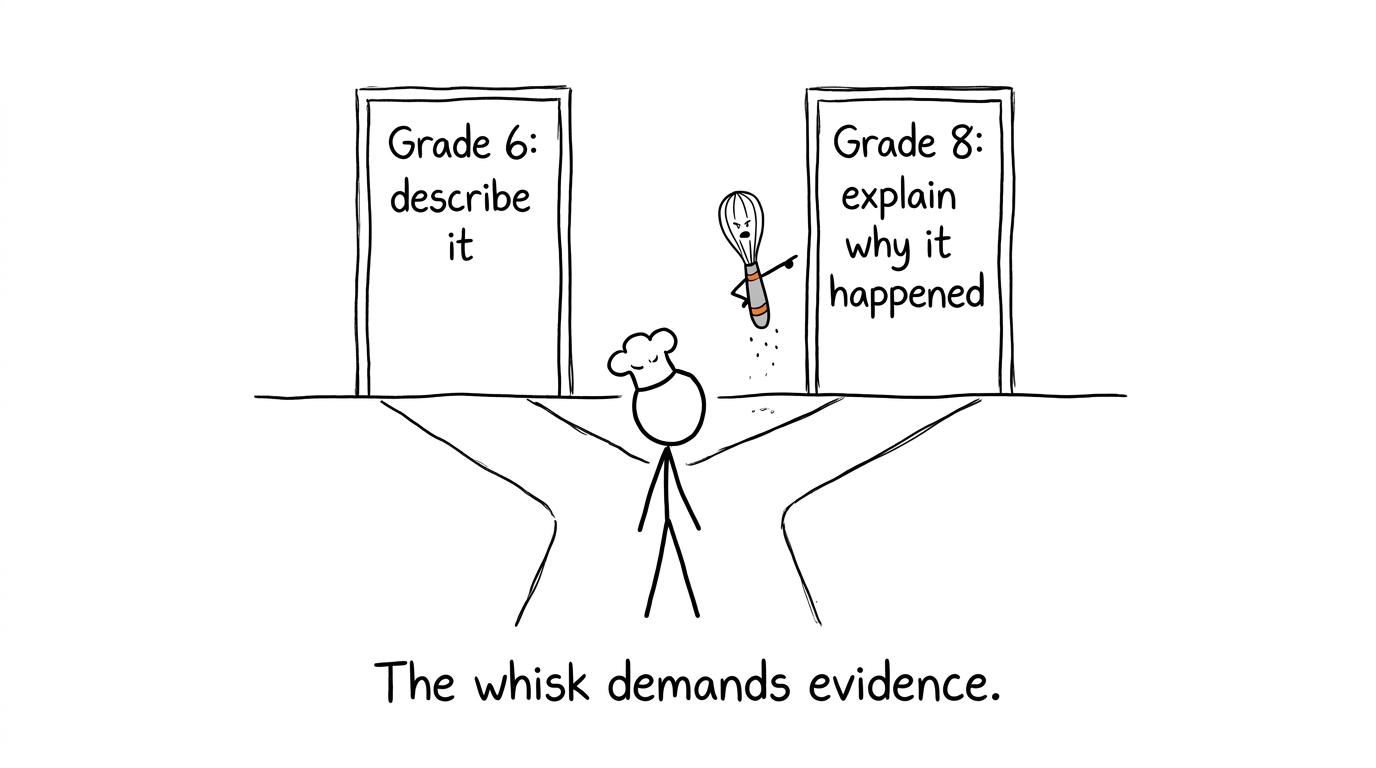 A student chooses between describing food and explaining it
Turn knowledge into connected explanations
A grade 6 response often contains correct but separate facts. A stronger response links each fact to the context and traces its effect.
A useful structure is:
- Identify: name the relevant nutrient, process, ingredient or safety issue.
- Explain: state what it does or why it matters.
- Apply: connect it to the named dish, consumer or practical situation.
- Develop: explain the likely consequence.
Suppose a question concerns modifying a meal for an adolescent. Listing nutrients is not enough. You need to select relevant nutritional needs, connect them to growth or health, suggest realistic food choices and explain the effect of each modification.
The same principle applies to food science. Learn connected chains for processes such as gelatinisation, coagulation, denaturation, dextrinisation, caramelisation, aeration and gluten formation. Include the relevant conditions and resulting sensory or structural change. Avoid treating these processes as interchangeable.
Create retrieval cards with a question on the front and a cause-and-effect chain on the back. Then practise recalling the chain without notes. A structured routine such as the GCSE one-month revision plan can help you space this practice instead of leaving it until the final week.
Write answers that fit the command word
Students often lose marks despite knowing the topic because they answer a different command word.
- State requires a concise fact.
- Describe requires relevant features or changes.
- Explain requires reasons and consequences.
- Compare requires direct similarities or differences.
- Analyse requires patterns, relationships and evidence.
- Evaluate requires a balanced judgement supported by evidence.
- Justify requires a choice and convincing reasons for it.
Before writing, underline the context and command word. If the question is about a particular age group, dietary requirement, production method or dish, generic information may not receive the available application marks.
For an extended response, spend a brief moment selecting distinct points. Each paragraph should add a new reason rather than restating the same idea. Relevant science, nutrition, safety, cost, provenance and sensory quality may all matter, but only include factors that answer the actual question.
Improve the food investigation NEA
The strongest food investigations are controlled enquiries, not collections of photographs. Your evidence should show that you changed a relevant independent variable, kept important conditions controlled and measured the effect consistently.
Plan evidence before the practical work
Decide in advance:
- what you will change;
- what you will measure or observe;
- which quantities, temperatures, timings and methods must remain constant;
- how many trials are realistic;
- how results will be recorded;
- what would make the investigation valid and repeatable.
Avoid claiming that a test proves something beyond the evidence. A small sensory panel, for example, can show the preferences of that panel. It does not establish what every consumer would prefer.
Analyse rather than narrate
Description tells the reader that one sample scored more highly. Analysis explains the pattern and uses food science to account for it. Evaluation then considers reliability, anomalies, limitations and improvements.
Where numerical data is suitable, you may need the mean:
Mean=total of the resultsnumber of results\text{Mean} = \frac{\text{total of the results}}{\text{number of results}}Mean=number of resultstotal of the resultsPercentage change can help compare results measured on the same scale:
Percentage change=new value−original valueoriginal value×100\text{Percentage change} = \frac{\text{new value} - \text{original value}}{\text{original value}} \times 100Percentage change=original valuenew value−original value×100Do not use a calculation simply because it looks impressive. It must answer the investigation question. MathsGenie's AQA GCSE Maths revision hub includes free support for averages, percentages, ratio, graphs and units. The analysing research revision guide is also useful for reviewing reliability, validity, bias and data presentation.
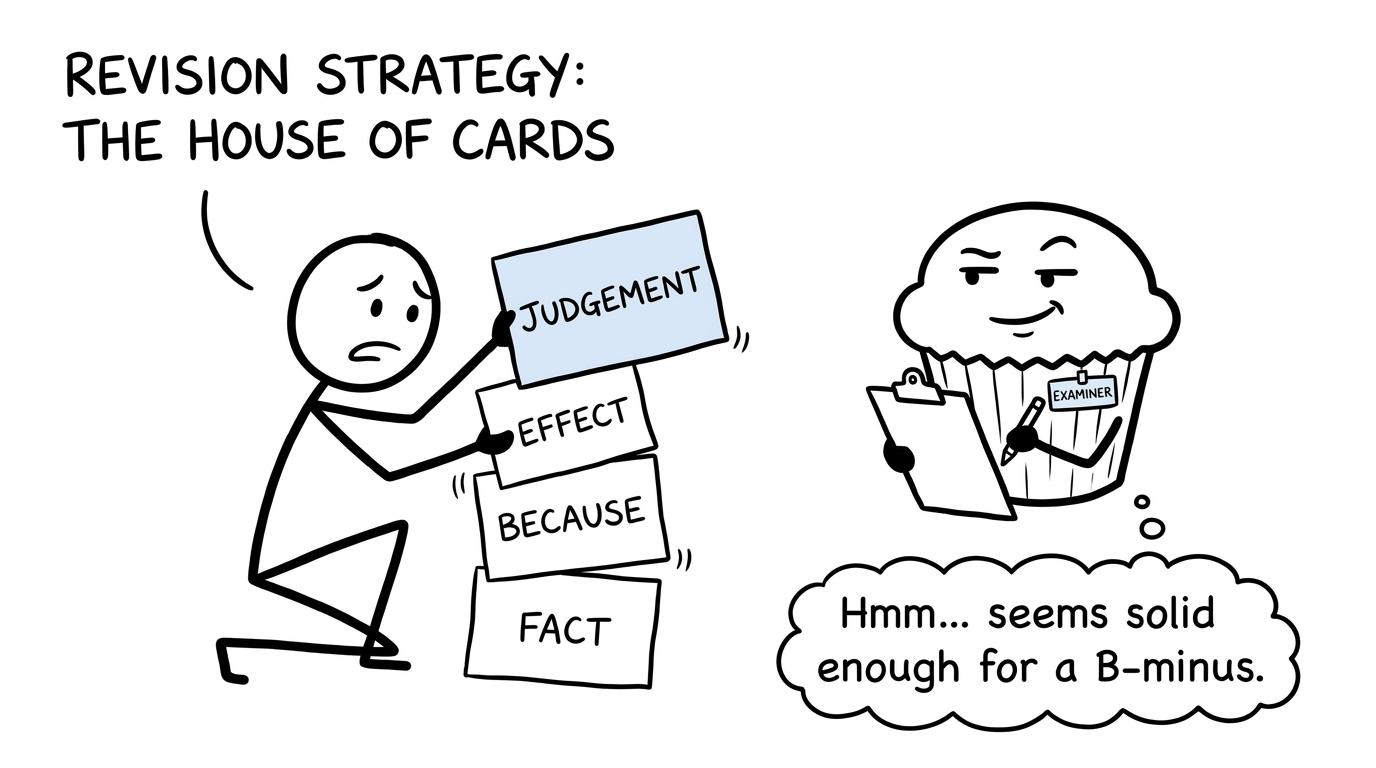 A cupcake examiner checks a tower of evidence
Raise the quality of your practical task
Complexity alone does not produce high marks. A dish with many components can still be a weak choice if it does not meet the brief, demonstrate controlled techniques or fit the available time.
Choose a menu that lets you demonstrate appropriate skills reliably. For every dish, be able to explain:
- how it meets the brief;
- which technical skills it demonstrates;
- how nutritional needs have been addressed;
- why the ingredients and cooking methods are suitable;
- how quality, safety and timing will be controlled;
- what trials led you to modify.
A strong time plan is operational. It should include preparation order, cooking periods, simultaneous tasks, food-safety checks, washing up and presentation. Practise the plan under realistic conditions. If two dishes need your full attention at the same moment, the plan needs changing.
Photographs should support evidence, not replace explanation. Capture significant stages and final outcomes clearly, then annotate only what the image genuinely demonstrates.
Your evaluation should refer to the brief, sensory properties, technical execution and trial evidence. Replace comments such as “make it better next time” with a precise modification and its intended effect.
Use maths accurately in food and nutrition
Food preparation contains more quantitative reasoning than many students expect. You may scale recipes, interpret nutritional information, compare costs, calculate energy values, process sensory data or present investigation results.
The general recipe multiplier is:
Scale factor=required number of portionsoriginal number of portions\text{Scale factor} = \frac{\text{required number of portions}}{\text{original number of portions}}Scale factor=original number of portionsrequired number of portionsEach ingredient quantity is then multiplied by that scale factor. Keep units consistent and round only when practical measurement requires it.
Ratios can compare ingredients or test conditions, while percentages can describe nutrient contributions and changes. Revise these foundations through the GCSE maths topics by exam board and tier guide.
Graphs must match the data. Bar charts suit separate categories, while a line graph may suit measurements across an ordered continuous variable. Label axes, include units and use a sensible scale. The Eduqas pie charts revision guide supports proportional data, while the statistical skills revision guide covers averages, percentage change, scatter graphs and interpretation.
 A calculator and saucepan hold a committee meeting
Build an exam routine that produces feedback
Revision becomes useful when it changes your next answer. Use this cycle:
- Recall one specification area without notes.
- Check what you missed.
- Complete short-answer and extended-response questions.
- Mark strictly using the mark scheme.
- Record why each mark was lost.
- Rewrite weak explanations.
- Retest the topic after a gap.
Classify lost marks as knowledge, application, analysis, calculation, communication or timing errors. That turns an uncomfortable result into a practical plan.
Past questions are especially valuable because they reveal how familiar content is placed in unfamiliar contexts. If you repeat a paper, repair the underlying weaknesses first. The guide to redoing GCSE past papers explains how to use a mark-and-retest cycle rather than memorising answers.
Maths papers cannot replace Food Preparation and Nutrition questions, but MathsGenie's predicted papers can sharpen the percentage, ratio, data and calculator skills that support your written work and NEA analysis.
Common mistakes that keep students at grade 6
Writing everything you know
A long answer is not automatically a developed answer. Select facts that address the command word and context.
Naming a process without explaining it
Terms such as coagulation or gelatinisation gain value when you explain the conditions, structural change and effect on the finished food.
Describing NEA results
Listing which sample was highest is description. Explain the pattern scientifically, identify anomalies and judge the strength of the evidence.
Choosing dishes only because they look difficult
Select techniques that meet the brief and can be executed safely, independently and consistently.
Giving subjective evaluations
“I liked the taste” is weak evidence. Use sensory vocabulary, measurements, panel results and comparison with success criteria.
Ignoring units and scales
A correct method can be undermined by mixed units, unsuitable graph scales or premature rounding. Check every quantity and axis.
Treating grade boundaries as fixed targets
Boundaries can change between exam series. Build a margin of safety by improving performance across the examination and NEA rather than aiming for an assumed minimum mark.
Make the next change specific
The journey from grade 6 to grade 8 is usually less dramatic than it appears. It is built from small upgrades: one more link in a scientific explanation, one better-controlled variable, one conclusion tied to evidence and one calculation checked before submission.
Start by choosing a single weakness from your latest assessment. Repair it, practise it and test it again. Then move to the next.
For the quantitative skills supporting your Food Preparation and Nutrition work, use MathsGenie as your free revision base. Combine revision lessons with practice questions and mini tests, then use past papers, predicted papers, mark schemes and video solutions to make every mistake useful. Better grades tend to follow when feedback stops being the end of a task and becomes the start of the next one.











