GCSE Food and Nutrition 4 to 7: A Practical Plan
GCSE food and nutrition 4 to 7 guidance: improve subject knowledge, practical evidence, evaluation, exam technique and the maths behind food data.
A grade 444 often means you understand the main ideas but do not yet express, apply or evaluate them consistently. A grade 777 usually requires something more deliberate: accurate subject vocabulary, explanations linked to the question, justified practical decisions and conclusions supported by evidence.
That is the short answer to the gcse food and nutrition 4 to 7 challenge. You do not need to become a completely different student. You need to turn partial knowledge into precise, repeatable performance across the written paper and non-exam assessment.
The subject also contains more maths than it first appears. Recipe scaling, nutritional data, percentages, ratios, averages, units and graphs can all influence the quality of an answer. Strengthening those skills removes avoidable errors and leaves more attention for the food science.
Your grade 444 to grade 777 checklist
Focus on these changes:
- Replace broad statements with precise food and nutrition terminology.
- Explain cause and effect rather than listing disconnected facts.
- Apply knowledge to the named ingredient, dish, dietary need or investigation.
- Support conclusions with observations, measurements and sensory evidence.
- Select practical techniques for a reason, not simply because they appear difficult.
- Check percentages, ratios, units, averages and graphs carefully.
- Use mark schemes to identify what your answers repeatedly omit.
- Practise retrieval and exam questions rather than only rereading notes.
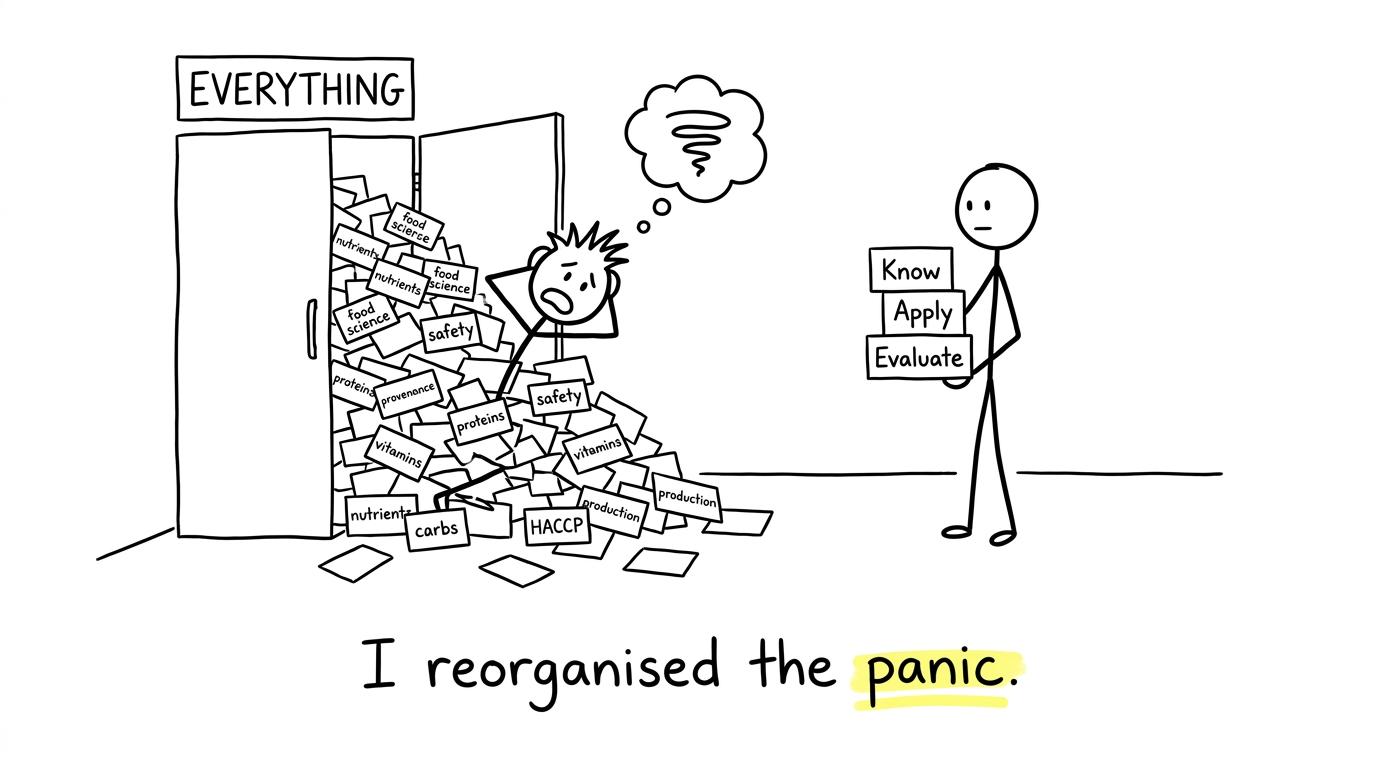 A student calmly reorganising food revision panic into know, apply and evaluate
What separates a grade 444 from a grade 777?
There is no permanent raw-mark boundary that defines a grade 777. Grade boundaries are set for each examination series and can vary, so your target should be the quality of performance required rather than one assumed mark total.
Current AQA, OCR and Eduqas specifications share four assessment objectives. In summary, students must demonstrate knowledge, apply it, carry out practical planning and preparation, and analyse or evaluate food-related evidence. Across these specifications, the written examination contributes 50%50\%50% of the qualification and NEA contributes the other 50%50\%50%, although component details and timings differ by board.
A student working around grade 444 may often:
- recall common nutrients and cooking methods;
- give one relevant reason;
- complete practical work safely with some competence;
- describe a result without fully explaining it;
- make a judgement based mainly on personal preference.
A grade 777 response tends to do more:
- use accurate terminology and develop linked explanations;
- adapt knowledge to the context in the question;
- connect ingredients, processes and outcomes;
- justify choices against the task requirements;
- interpret evidence before reaching a balanced conclusion.
The difference is depth and consistency. Knowing that protein is needed for growth and repair is useful. Higher-quality thinking connects a person's needs, suitable food sources, possible recipe choices and the consequences of deficiency or excess without drifting away from the question.
Build knowledge that can survive an exam question
Food Preparation and Nutrition covers connected areas rather than isolated lists. Depending on your exam board, these include nutrition and health, food science, food safety, food choice, provenance, commodities and preparation techniques.
Begin with a specification checklist. For each area, test whether you can:
- define the key term accurately;
- give a relevant food example;
- explain the underlying process;
- apply it to a person, product or practical situation;
- evaluate a decision involving it.
This exposes an important difference between recognition and recall. A page may look familiar when you read it, but an exam gives you a blank space. Close the notes and retrieve the answer first. Then check it, correct it and return to it later.
Use compact comparison grids for ideas that are easily confused, such as fat-soluble and water-soluble vitamins, enzymic and non-enzymic browning, or primary and secondary food processing. Each grid should compare function, source, process, consequence and example. The purpose is not attractive notes. It is faster, more accurate recall.
Turn knowledge into applied explanations
Grade 777 answers rarely stop at naming a fact. They build a chain:
Relevant fact →\rightarrow→ effect in the stated context →\rightarrow→ justified outcome.
If a question names a target group, ingredient or cooking process, every paragraph should remain attached to it. Generic material may be scientifically correct but still fail to answer what was asked.
Command words provide your route:
- State requires a concise fact.
- Describe requires relevant features or what happens.
- Explain requires reasons and linked consequences.
- Analyse requires you to interpret relationships or evidence.
- Evaluate requires a supported judgement that recognises strengths, limitations or alternatives.
For longer responses, plan briefly before writing. Select a few developed ideas rather than producing a long list of undeveloped facts. Technical vocabulary matters, but only when it sharpens the explanation. Terms such as gelatinisation, coagulation, denaturation, dextrinisation and aeration should be connected to ingredients, conditions and observable results.
Improve practical work by making every choice defensible
Practical complexity alone does not guarantee high marks. A technically demanding dish chosen without reference to the task can be less convincing than a well-selected menu that demonstrates appropriate skills and meets the stated requirements.
Before choosing dishes, ask:
- How does each dish answer the brief?
- Which preparation and cooking skills will it demonstrate?
- Can the menu be completed safely within the available time?
- Does it show suitable variety in ingredients, techniques, flavour, texture and presentation?
- What evidence will demonstrate success?
Planning should be realistic. A strong time plan considers preparation order, cooking and cooling periods, safe storage, equipment, washing up and final presentation. Identify stages that can run concurrently, but do not create a schedule that depends on everything going perfectly.
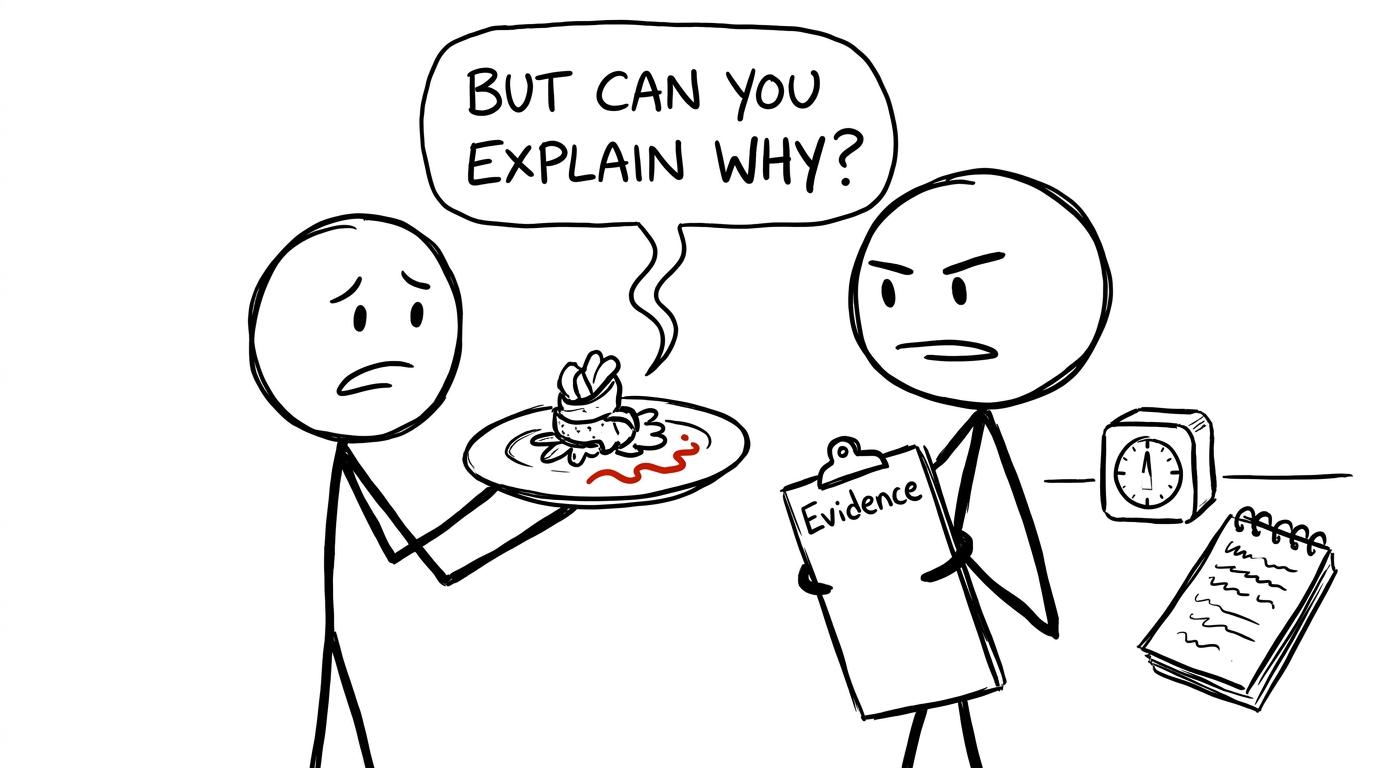 A plated dish asking whether the student can explain why it was chosen
Your photographs and written evidence should help a moderator understand what you did. Follow your teacher's instructions and your board's current NEA rules carefully because supervised conditions, task wording and permitted support matter.
Make investigation and evaluation evidence-led
Description reports what happened. Analysis interprets why it happened. Evaluation judges how convincing or useful the result is.
A stronger food investigation controls variables, records results consistently and connects observations to food science. Identify:
- the independent variable you deliberately change;
- the dependent variable you measure or observe;
- relevant control variables kept consistent;
- a repeatable procedure;
- suitable quantitative and qualitative evidence.
When evaluating, avoid relying only on words such as “nice” or “better”. Refer to measurable results, visible structure, texture, aroma, appearance and relevant sensory feedback. Then explain the scientific reason for the pattern and acknowledge uncertainty.
Repeats can make findings more dependable, and an average may summarise repeated measurements:
mean=sum of measurementsnumber of measurements\text{mean}=\frac{\text{sum of measurements}}{\text{number of measurements}}mean=number of measurementssum of measurementsUse the MathsGenie averages revision guide if calculating or interpreting means is a weak point. A conclusion should answer the investigation question directly, while an evaluation should also discuss limitations and realistic improvements.
Secure the maths behind food and nutrition
Small numerical mistakes can weaken otherwise good work. The most useful supporting areas are ratio, proportion, percentages, averages and unit conversion.
Recipe scaling depends on proportional reasoning. The general structure is:
new quantity=original quantity×new number of portionsoriginal number of portions\text{new quantity}=\text{original quantity}\times\frac{\text{new number of portions}}{\text{original number of portions}}new quantity=original quantity×original number of portionsnew number of portionsBuild confidence with proportion revision and practice and the ratio revision guide.
When analysing nutritional information or investigation results, a percentage is commonly calculated using:
percentage=partwhole×100\text{percentage}=\frac{\text{part}}{\text{whole}}\times 100percentage=wholepart×100The denominator must represent the correct whole. The MathsGenie percentages revision guide reinforces this distinction.
Units deserve equal care. Confusing grams and kilograms, or millilitres and litres, can make a result implausible. Review conversions and units, label graph axes and state units alongside measurements.
Use practice as a feedback loop
Revision becomes effective when it changes your next answer. Use this cycle:
- Retrieve one topic without notes.
- Answer a short exam question.
- Check the mark scheme.
- Record the precise reason for each lost mark.
- Improve the answer.
- Reattempt a similar question several days later.
Your error log might identify missing terminology, weak application, incomplete explanations, calculation errors or misread command words. That is more useful than recording only a total mark.
The same principle powers effective maths revision. MathsGenie's guidance on using past papers properly explains how to turn errors into targeted practice. For your supporting numerical skills, GCSE Statistics resources can strengthen data interpretation, while GCSE maths predicted papers provide fresh practice under timed conditions.
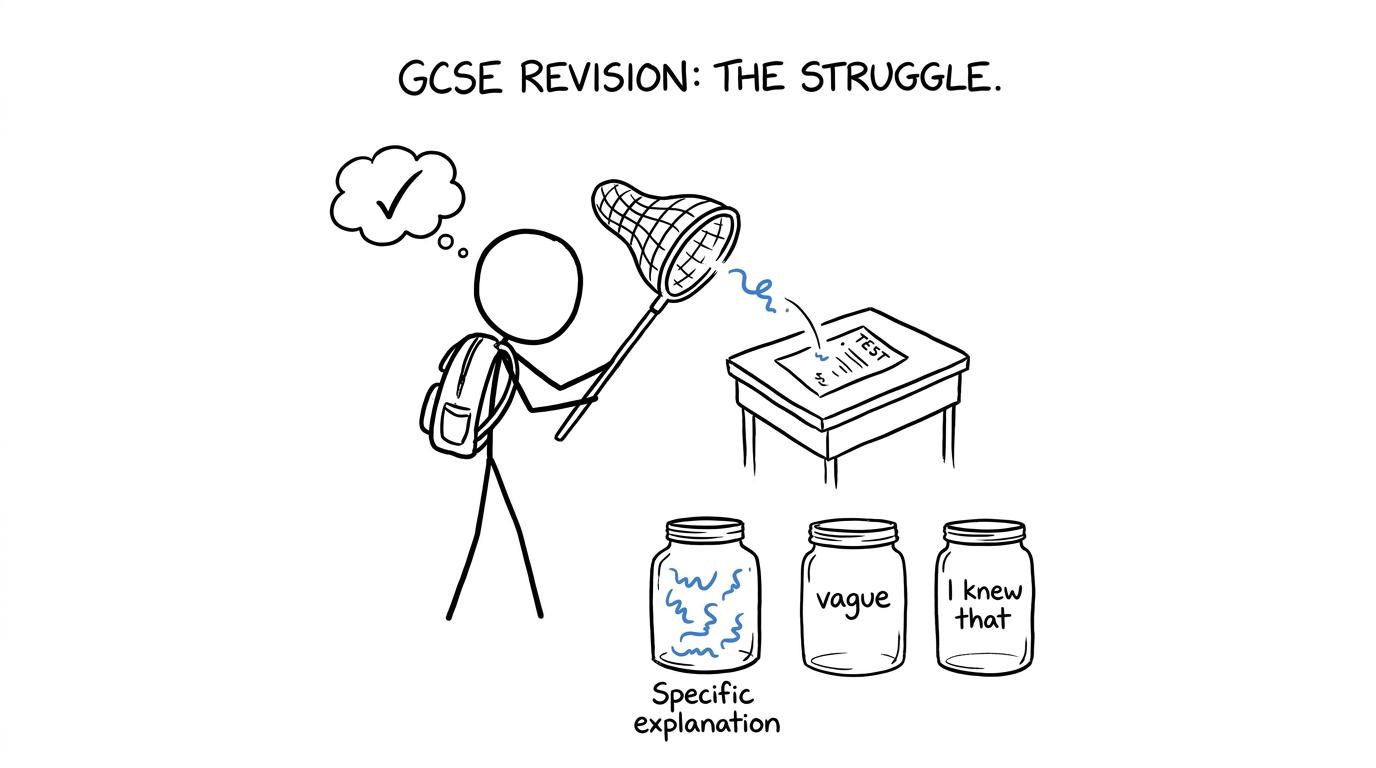 A student catching an escaping mark and storing it in a specific-explanation jar
Common mistakes that keep students near grade 444
Writing everything you know
A long answer is not automatically a developed answer. Select information that addresses the named food, person or process, then connect each fact to its effect.
Describing instead of explaining
“The sample was firmer” is an observation. An explanation must connect that change to the relevant ingredient property, condition or cooking process.
Giving unsupported evaluations
Personal preference is weak evidence on its own. Use results, sensory criteria, nutritional requirements, practical constraints and food science to support a judgement.
Choosing dishes only for appearance
Presentation matters, but task suitability, technical skill, nutrition, timing and execution matter too. Make every menu choice answerable with “because”.
Ignoring the denominator or unit
A percentage with the wrong whole, an average based on the wrong number of results or a measurement without a unit can undermine the conclusion. Estimate whether the answer is sensible before accepting it.
Treating the mark scheme as a score sheet
A mark scheme is also a map of what your answer lacked. Translate every lost mark into a specific action rather than simply moving to another paper.
A calm route from grade 444 to grade 777
Moving upwards is less about collecting more notes and more about improving the quality of each decision. Know the science. Apply it to the context. Measure carefully. Explain the outcome. Evaluate the evidence.
Start with one weak area this week, complete an exam-style task and inspect the gap between your answer and the mark scheme. Then repeat the process. For the numerical side of Food Preparation and Nutrition, use MathsGenie's free revision lessons, practice questions, mini tests, mark schemes and video solutions. As your confidence grows, use past papers and predicted papers to make accurate working feel normal under time pressure.
A grade 777 is not built from one heroic revision session. It is built when clear thinking becomes your default, in the kitchen, in the written paper and whenever the numbers appear.