GCSE Food and Nutrition 4 to 6: A Practical Plan
GCSE food and nutrition 4 to 6: learn the exam, NEA and practical changes that produce stronger answers, sharper analysis and more reliable marks.
A grade 444 often means you know more than your answers reveal. You can name nutrients, follow a recipe and describe what happened in an investigation, yet marks disappear when the question asks you to apply, analyse or justify.
Moving from gcse food and nutrition 4 to 6 is therefore less about collecting more facts and more about using knowledge precisely. You need secure subject vocabulary, explanations linked to the question, controlled practical work and conclusions supported by evidence. You also need to understand where your marks are currently being lost.
There is no universal checklist that automatically converts a grade 444 into a grade 666. Grade boundaries change between exam series, while paper structures and NEA requirements depend on your exam board. However, the qualities rewarded by the assessment objectives are clear, and they reveal the changes that usually matter most.
Your grade 4 to 6 checklist
Focus on these six improvements:
- Replace isolated facts with linked scientific explanations.
- Apply nutrition knowledge to the person, dish or context in the question.
- Use accurate food-science terminology instead of vague descriptions.
- Support analysis with results, observations and sensory evidence.
- Choose practical techniques for a reason, then execute them consistently.
- Practise calculations, data interpretation and timed written responses.
Before planning your revision, confirm whether you study AQA, Eduqas or another available specification. Use your own specification, teacher guidance and current NEA instructions rather than assuming every board uses identical tasks.
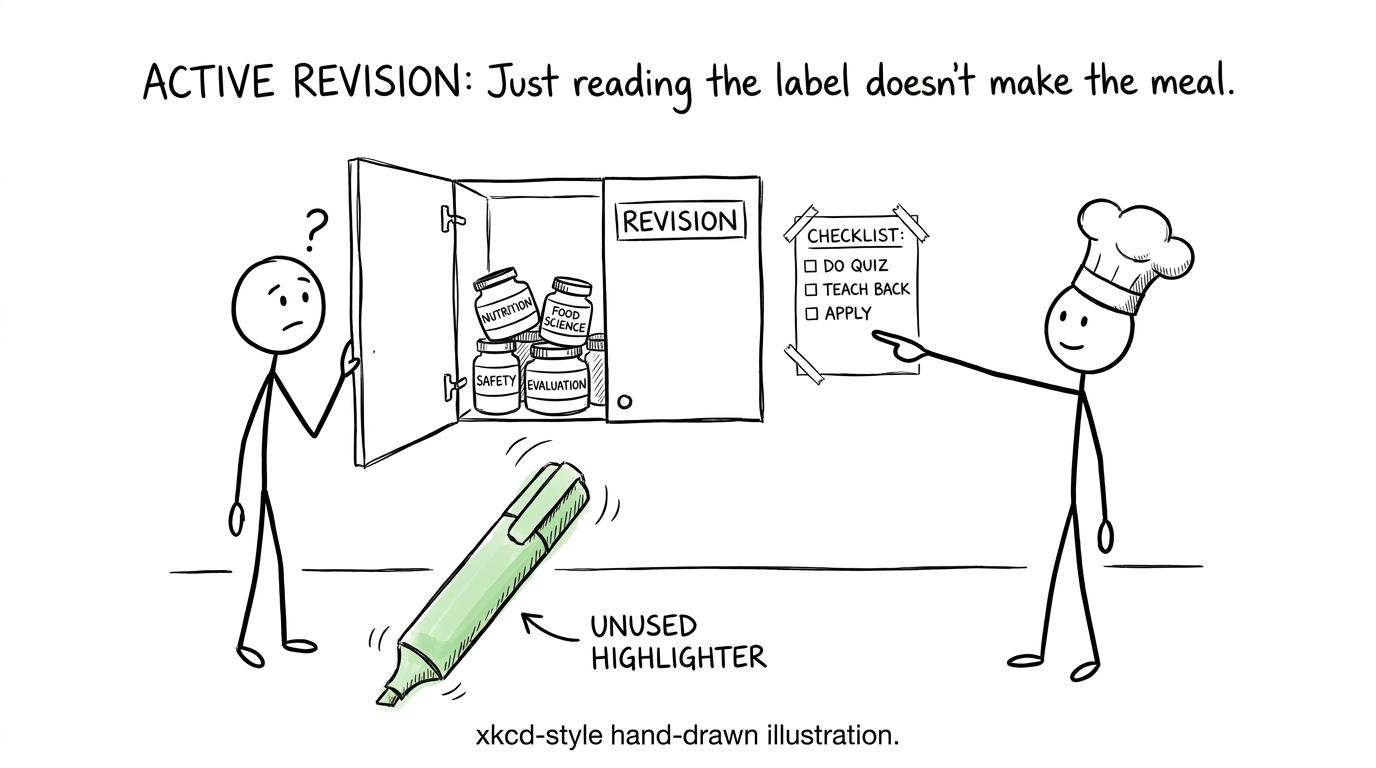 A student discovers that active revision needs several small ingredients rather than one enormous highlighter
What separates a grade 4 from a grade 6?
Official GCSE grade descriptors describe performance holistically rather than providing a separate recipe for every individual grade. A grade is also awarded from the combined assessment, not from one particular question. The distinction below is therefore a practical interpretation of assessment objectives and mark-scheme language, not a guaranteed boundary.
| A developing grade 4 response | A stronger grade 6 response |
|---|---|
| Recalls relevant facts | Selects relevant facts and applies them to the context |
| Describes what happens | Explains how or why it happens using food science |
| Makes a general judgement | Reaches a judgement supported by evidence |
| Gives a suitable dish | Justifies the dish using nutrition, skills and task requirements |
| Records practical results | Identifies patterns, anomalies and limitations in results |
| Uses broad words such as “healthy” | Names the nutrient, function, source and likely consequence |
Across regulated GCSE Food Preparation and Nutrition qualifications, the assessment objectives cover knowledge and understanding, application, practical planning and execution, and analysis and evaluation. Their overall weightings are 20%20\%20% for AO1, 30%30\%30% for AO2, 30%30\%30% for AO3 and 20%20\%20% for AO4.
That balance matters. Pure recall represents only part of the qualification. Students aiming higher must demonstrate what their knowledge means in a particular situation.
Turn knowledge into applied explanations
Imagine a question about adapting a meal for an adolescent, an older adult or somebody following a particular diet. Listing nutrients may establish basic knowledge, but it does not fully answer the context.
A stronger response creates a chain:
relevant feature →\rightarrow→ scientific or nutritional reason →\rightarrow→ effect on the stated person or product
For example, when discussing a nutrient, be ready to connect its source to its function and then to the needs identified in the question. When discussing a cooking process, explain the change taking place, how the ingredient causes it and how that affects texture, flavour, appearance or structure.
Words such as gelatinisation, coagulation, denaturation, aeration, emulsification, dextrinisation and caramelisation are useful only when used accurately. Memorising impressive vocabulary without understanding it rarely improves an answer.
Build revision around retrieval rather than rereading. Close your notes and explain one process from memory. Then check the specification wording, correct the gaps and repeat it later. MathsGenie’s guide to stopping content from being forgotten explains a learn, retrieve, space and mix routine that can be adapted to Food and Nutrition.
Make analysis visible in your writing
Analysis is not a longer description. It means breaking evidence apart, recognising relationships and explaining what the evidence suggests.
In an investigation or extended response, look for:
- a clear pattern in the results;
- evidence that supports or challenges a prediction;
- an anomalous result;
- a scientific explanation for the outcome;
- limitations affecting reliability or validity;
- a justified improvement.
Evaluation then asks how successful, suitable or trustworthy something was. A grade 666-style judgement is rarely just “it worked well”. It identifies the criterion, cites evidence and acknowledges any limitation before reaching a conclusion.
Sensory data also require care. Use specific descriptors such as crisp, aerated, viscous or tender where appropriate. Explain why the sensory method was suitable and avoid claiming that a small preference test proves what every consumer would choose.
The statistical ideas behind investigations are worth revising through MathsGenie’s GCSE Statistics revision hub. When calculating a mean sensory score, use:
mean=total of all scoresnumber of scores\text{mean} = \frac{\text{total of all scores}}{\text{number of scores}}mean=number of scorestotal of all scoresA mean can summarise the data, but it may conceal unusual results. Tables, bar charts and appropriate averages must be labelled clearly and interpreted rather than inserted as decoration.
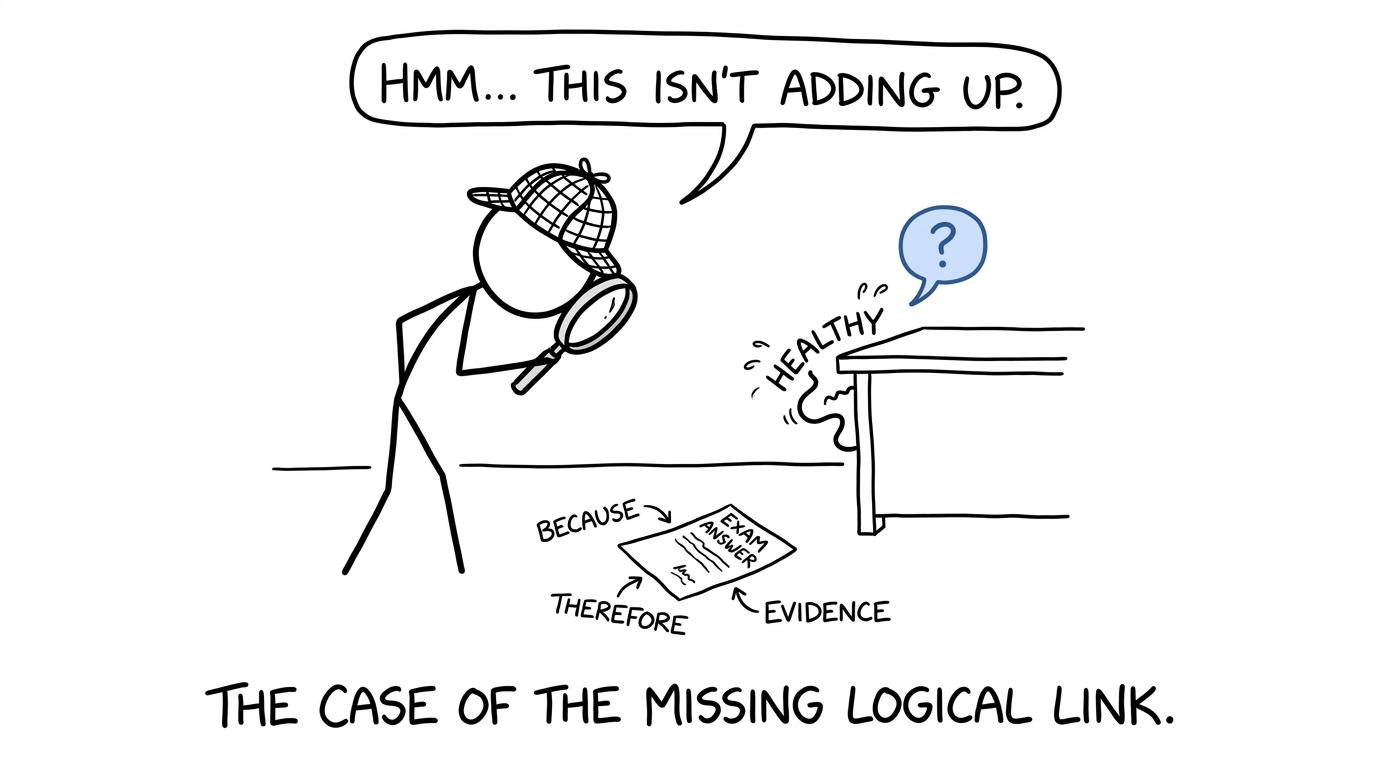 A student detective searches for evidence while the vague word healthy attempts to escape
Strengthen the maths inside Food and Nutrition
Food and Nutrition is not a GCSE maths paper, but quantitative accuracy supports both theory and NEA work. Common demands include scaling ingredients, interpreting nutritional information, calculating costs, comparing results and presenting data.
For a percentage, the underlying relationship is:
percentage=partwhole×100\text{percentage} = \frac{\text{part}}{\text{whole}} \times 100percentage=wholepart×100For recipe scaling, use:
scale factor=required portionsoriginal portions\text{scale factor} = \frac{\text{required portions}}{\text{original portions}}scale factor=original portionsrequired portionsMultiply every ingredient by the same scale factor and retain sensible units. Do not change quantities by guesswork, particularly when the balance of ingredients affects structure or a chemical process.
Use MathsGenie’s free percentages revision lesson and practice questions to repair percentage gaps. The GCSE revision question collection also includes ratio, proportion, averages and charts, all useful when handling recipe or investigation data.
Always show working. A calculator answer without a clear method is difficult to check, and one mistyped value can distort every conclusion that follows.
Raise the quality of practical and NEA work
Practical ambition is helpful only when it is supported by control. A complicated menu does not automatically earn more marks than a well-selected menu completed with independence, accuracy and strong technical execution.
For each proposed dish, ask:
- Does it answer the task closely?
- Which technical skills will it demonstrate?
- Can I produce it safely within the permitted time?
- Have I trialled the difficult stages?
- Can I explain its nutritional and sensory suitability?
- What evidence will allow me to evaluate it honestly?
During trials, record decisions while they are still fresh. Note timings, ingredient changes, temperatures where required, problems, sensory observations and the exact modification for the next attempt. Photographs should support the evidence and comply with your board’s current instructions; they should not replace written analysis.
Food hygiene must be routine rather than an afterthought. Plan workflow to reduce cross-contamination, use equipment safely and follow the food-safety procedures taught by your school. If a practical plan depends on remembering everything during a pressured session, it is not yet a reliable plan.
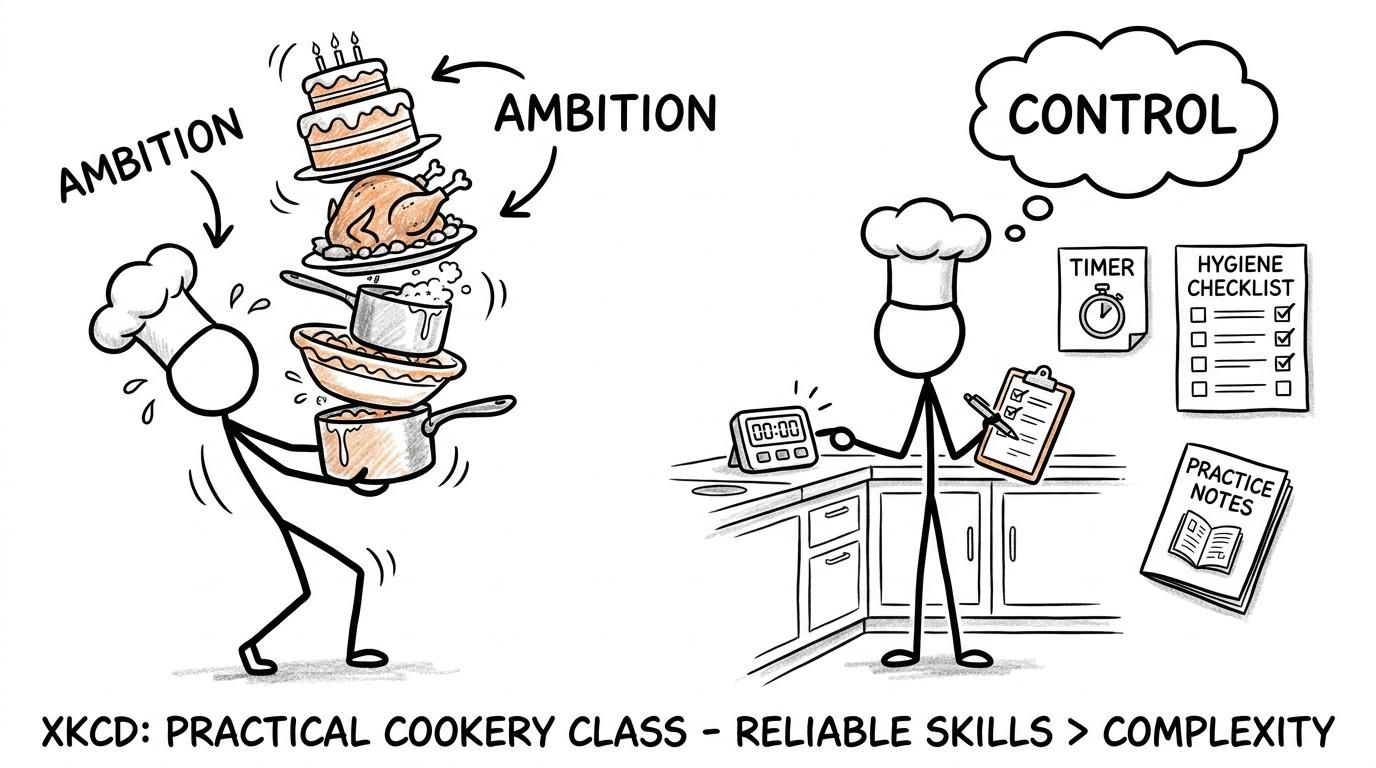 One cook builds a tower of ambition while another calmly relies on control, timing and practice
Use mark schemes to change your answers
Completing question after question is not enough if you keep repeating the same response style. Mark schemes show whether a question rewards recall, application, analysis or evaluation.
After each timed section, classify every lost mark:
- Knowledge gap: the fact or process was unknown.
- Application gap: the fact was not connected to the context.
- Precision gap: the answer was vague or used incorrect terminology.
- Evidence gap: the judgement lacked supporting data.
- Timing gap: the response was unfinished.
Then rewrite one answer, concentrating on the missing quality. This is more valuable than simply reading the accepted answer and moving on.
A manageable revision schedule helps this feedback accumulate. Adapt the structure in MathsGenie’s one-month GCSE revision plan, or use the free revision planner to schedule short retrieval sessions, calculations and timed questions.
A weekly routine for moving towards grade 6
A balanced week might contain:
- one nutrition and health retrieval session;
- one food-science explanation session;
- one short calculation or data task;
- one timed exam section followed by marking;
- one NEA or practical review, where permitted by your teacher and board rules;
- one later reattempt of mistakes.
Keep the routine sustainable. MathsGenie’s GCSE revision timetable guide shows how focused weeknight sessions and longer weekend practice can work together without turning revision into an unrealistic daily marathon.
Common mistakes that hold students at grade 4
Writing everything known about the topic
Extra facts do not compensate for failing to answer the question. Underline the command word and context, then select only relevant knowledge.
Treating description as explanation
“The mixture became thicker” is an observation. A complete explanation identifies the process, conditions and reason for the change.
Calling every modification healthier
State what changes nutritionally, why it matters and whether the modification creates another trade-off involving taste, texture, cost or suitability.
Using evidence without interpreting it
A table or graph records results. Your writing must identify the pattern and explain what it means for the investigation or product.
Leaving evaluation until the end
Evaluation quality depends on evidence gathered throughout planning, testing and practical work. Record useful observations as you go, following your teacher’s NEA guidance.
Make the next mark easier to earn
The distance between grades 444 and 666 is often built from small changes: one explanation that reaches the context, one result interpreted correctly, one practical decision justified, and one calculation checked.
Begin with a diagnostic task. Identify whether your weakest area is knowledge, application, analysis, practical control or quantitative accuracy. Then practise that exact weakness and return to it after feedback.
MathsGenie is your free home for the mathematical side of GCSE revision. Use its revision lessons, practice questions, mini tests and mark schemes to strengthen percentages, ratio, averages and graphs. Then build exam confidence with MathsGenie’s wider GCSE revision guidance, past papers, predicted papers and video solutions. The aim is not to revise everything at once; it is to make your next answer more precise than your last.