GCSE English Literature Weekend Revision Plan
GCSE English literature weekend revision plan: build a calm two-day routine for quotes, themes, timed essays, feedback and confident exam preparation.
The hardest part of weekend revision is often not the work. It is deciding where to begin when Shakespeare, poetry, a nineteenth-century novel and a modern text all appear to need attention at once.
A useful GCSE English literature weekend revision routine does not attempt to relearn the entire course. It combines focused recall, one or two timed responses, careful feedback and enough rest to make Sunday useful. In the final weeks, your aim is to retrieve what you know and turn it into clear analysis under exam conditions.
This plan gives you a practical Saturday-and-Sunday structure. Use the texts, questions and mark schemes supplied by your school or exam board, and adjust the sessions to match your exact specification.
Your weekend revision checklist
By Sunday evening, aim to have completed:
- a check of your exam board, papers and set texts;
- retrieval practice for quotations, themes and characters;
- one planned essay and one timed response;
- focused work on poetry or an unseen text;
- marking and improvement using an official mark scheme;
- a short priority list for the following week;
- normal meals, breaks and a sensible bedtime.
The principle is simple: revise less material, but interact with it more deeply. Reading ten pages of notes may feel productive. Recalling ideas without the notes and applying them to a question gives you much better evidence of what you can actually do.
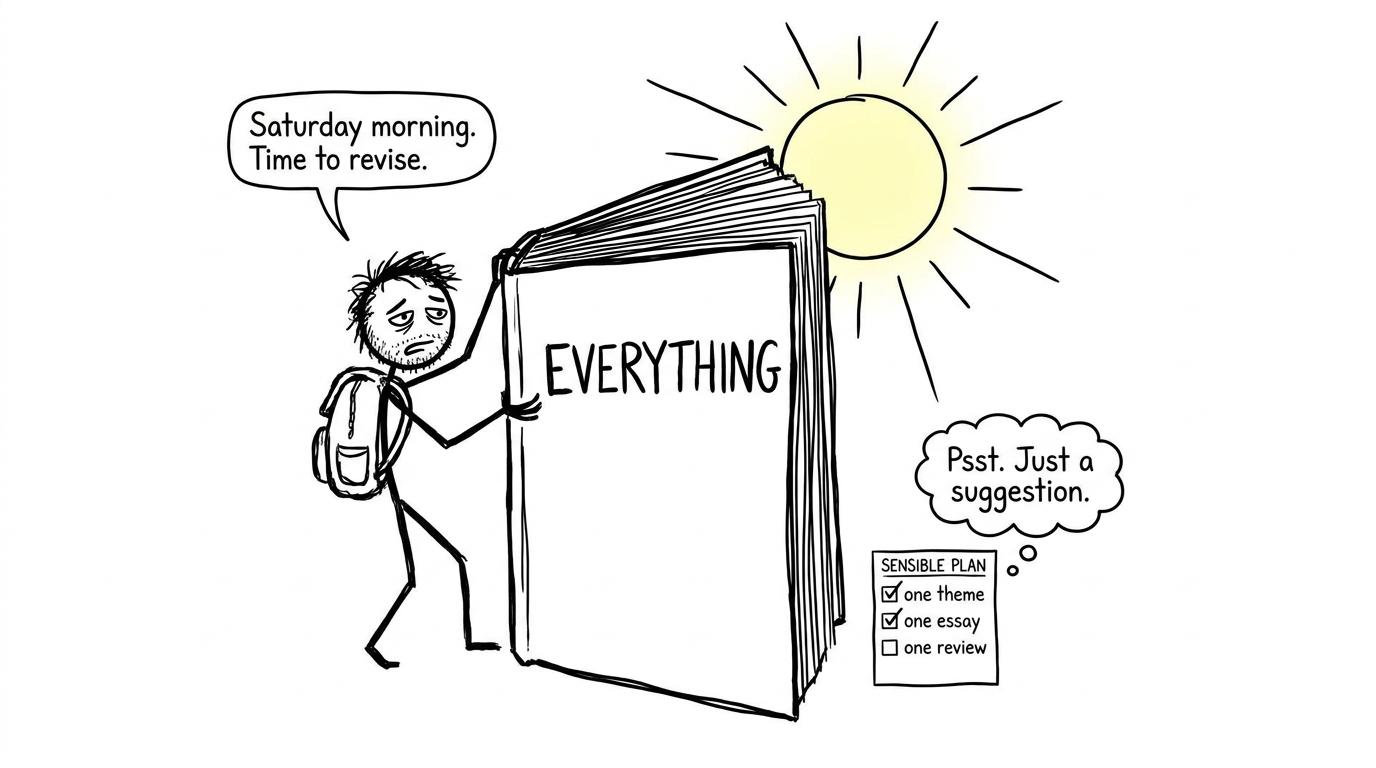 A student choosing a manageable revision checklist instead of trying to learn everything at once
Before Saturday: confirm what your exam requires
English Literature arrangements vary between AQA, Pearson Edexcel, OCR and Eduqas. Do not build your weekend around another student's paper structure.
Check:
- your exam board and specification;
- the set texts you have studied;
- which paper comes first;
- the length and marks available for each section;
- whether an extract or named poem is provided;
- where comparison, context and spelling, punctuation and grammar are assessed.
GCSE English Literature in England is untiered, unlike foundation and higher tier GCSE maths. The regulated course covers Shakespeare, a nineteenth-century novel, post-1914 prose or drama, studied poetry and unseen material, although exam boards organise these areas differently.
Across specifications, the central assessment skills are consistent. You must respond thoughtfully to texts, support interpretations with references, analyse language, form and structure, connect texts to relevant contexts, and write clearly. These are commonly organised as AO1 to AO4, but their exact application and weighting should be checked against your board's current specification and mark scheme.
Spend a few minutes gathering the right materials on Friday evening. Put your question papers, mark schemes, quotation cards, exercise book and texts in one place. Removing decisions from Saturday morning makes starting easier.
Students balancing English with maths may also find the structure in the GCSE Maths revision timetable guide useful. The subjects differ, but focused blocks, active practice and honest review work well in both.
Saturday morning: retrieve the knowledge you need
Saturday morning should reveal what you know before your notes rescue you.
Begin with a closed-notes knowledge check
Choose the text most likely to need attention. On blank paper, recall:
- the main events in sequence;
- the development of major characters;
- four or five central themes;
- short, flexible quotations;
- recurring images, contrasts or structural changes;
- relevant contextual ideas that genuinely illuminate the text.
Then compare your page with your notes. Add missing material in another colour, but do not copy whole paragraphs. Your additions should be concise enough to retrieve again later.
A quotation is valuable because of what you can do with it, not because it is long. For each quotation, attach a theme, character, method and possible interpretation. A small bank of versatile textual references is usually easier to recall and apply than a large collection learned without purpose.
Build connections rather than isolated lists
Turn the text into a network. Connect a character to two themes, each theme to several moments, and each moment to a writer's method. This prepares you for unfamiliar question wording.
Context belongs inside this network. Do not treat historical information as a separate speech that must be inserted into every essay. Select context only when it sharpens your interpretation of the writer's ideas, choices or audience.
After a break, repeat the retrieval process with a second text or poetry cluster. Stop while your concentration is still usable. The goal is not exhaustion; it is a reliable picture of your current knowledge.
Saturday afternoon: move from knowledge to an argument
Knowing the plot is necessary, but the exam asks you to shape an answer around a question. Saturday afternoon is where recall becomes argument.
Plan one essay before writing one
Choose an authentic question from your exam board or teacher. Without writing the full response, identify:
- exactly what the question asks;
- your central interpretation;
- three distinct supporting ideas;
- the best textual references for each idea;
- the language, form or structural choices you can analyse;
- where context is genuinely relevant;
- how each paragraph will return to the question.
A plan should show movement. If every paragraph makes the same point using a different quotation, the argument has not developed. Aim for stages such as an initial impression, a complication and a final consequence.
Write a timed response
After planning practice, complete one response under the conditions required by your paper. Use the correct permitted materials and remove distractions. If the full task is too long for your current stamina, begin with a timed introduction and two analytical paragraphs, then build towards complete answers on later weekends.
Do not pause to perfect every sentence. Examination writing needs a sustained line of thought, relevant evidence and analysis that answers the question. Clear reasoning is more valuable than decorative terminology.
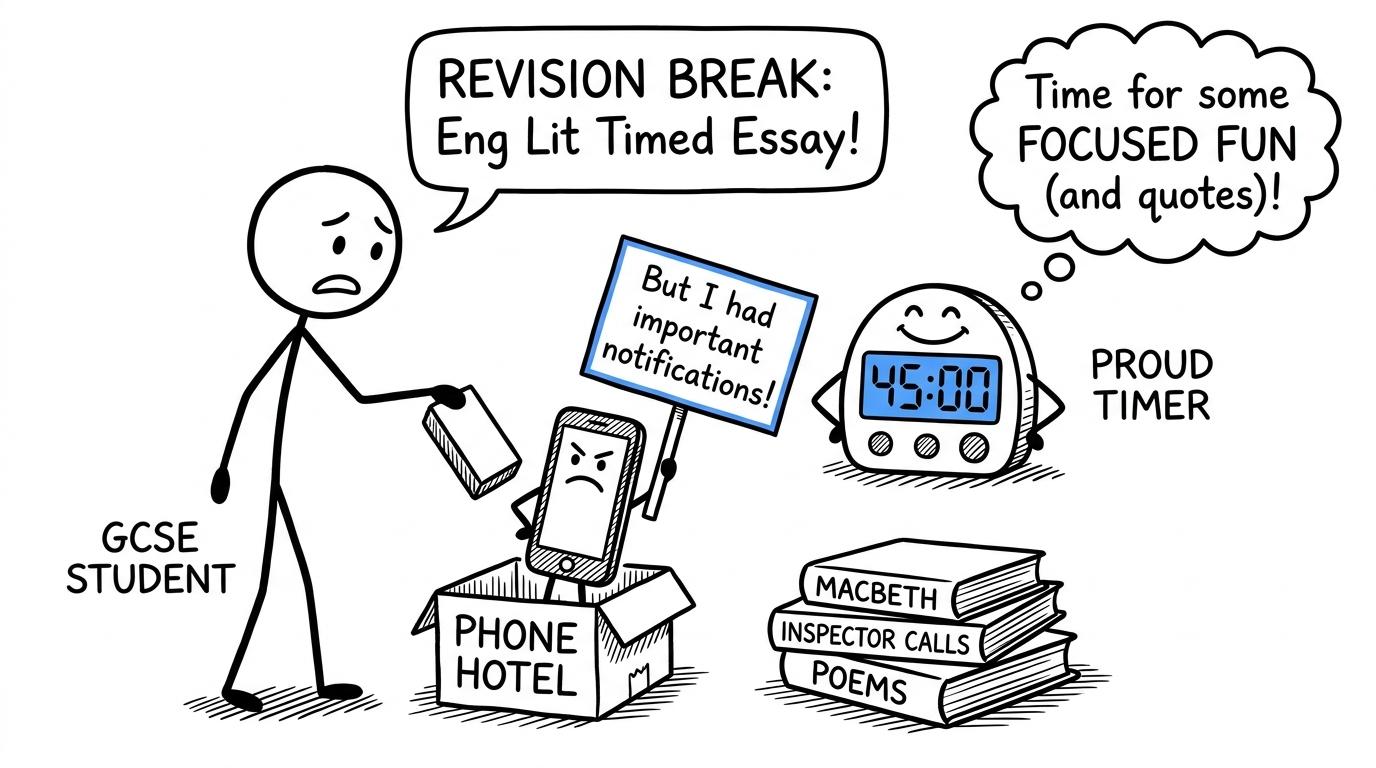 A phone objecting to being placed out of reach during a timed essay
Saturday evening: mark, improve and stop
The response is not finished when the timer ends. The useful part begins when you examine it honestly.
Use your board's official mark scheme and, where available, examiner guidance supplied by your teacher. Highlight where you have:
- maintained a clear response to the question;
- selected relevant textual evidence;
- analysed how the writer creates meaning;
- considered form or structure as well as individual words;
- integrated useful context;
- written accurately and coherently.
Choose one paragraph to improve. Strengthen its opening claim, select more precise evidence or push the analysis beyond identifying a technique. Do not rewrite the entire essay unless your teacher has asked you to. One carefully improved paragraph can expose a pattern that applies across the answer.
Finish by writing two specific targets. For example, you might need to analyse structural change or connect evidence to the question more consistently. Avoid vague targets such as revise poetry.
This attempt, mark, and fix cycle mirrors the process explained in MathsGenie's guide to using GCSE past papers properly. In maths, the correction might be a method; in literature, it might be a more precise interpretation. In both cases, feedback matters more than simply completing another paper.
Sunday morning: poetry and unseen practice
Sunday morning is a good time for poetry because comparison demands fresh concentration.
For a studied anthology, organise poems by themes, attitudes, methods and useful contrasts. Practise selecting a comparison for an unfamiliar question rather than always pairing the same two poems. Your choice should help you answer the question, not merely reproduce a memorised essay.
For unseen poetry, use a short sequence:
- establish the poem's central situation and viewpoint;
- notice a shift, contrast or development;
- select a few significant details;
- examine language, form and structure;
- form a personal interpretation supported by the text;
- compare throughout if the task requires comparison.
Do not try to uncover a secret correct meaning. An interpretation becomes persuasive when it is clear, relevant and grounded in evidence.
Complete either a timed poetry plan or a response. Check the exact format for your board: AQA, Edexcel, OCR and Eduqas do not arrange anthology and unseen tasks identically.
Sunday afternoon: repair the weakest area
By now, the weekend has generated evidence. Use it.
Choose one weakness revealed by Saturday's essay or Sunday's poetry work. It might be quotation recall, analysing structure, writing comparative sentences, selecting context or sustaining an argument.
Spend one focused session repairing that weakness. Then test it with a fresh paragraph or plan. This prevents revision from becoming a tour of comfortable topics.
If you also need to revise maths, switch subjects after a proper break. The MathsGenie GCSE Maths revision hub provides board-specific lessons, questions and papers, while the OCR GCSE Maths revision area is available for OCR students. Alternating subjects can make a long weekend feel more manageable, but avoid changing tasks every few minutes.
For a broader final-weeks structure, adapt the priorities in the GCSE one-month revision plan: diagnose weaknesses, practise actively, review errors and revisit them later. Apply that cycle separately to each subject.
Sunday evening: make Monday easier
Sunday evening should close the loop, not begin another exhausting revision session.
Without notes, retrieve the quotations and ideas you reviewed on Saturday. Revisit your two targets and decide when you will test them again. Then write a short plan for the week containing no more than three English Literature priorities.
If a maths examination is also close, reserve a separate slot for a paper, mini test or topic repair. MathsGenie's GCSE predicted papers can provide fresh maths practice in the final run-up, while the Edexcel GCSE Maths past-paper collection includes papers and mark schemes. Predicted papers are rehearsal tools, not guarantees of what an exam will contain.
Then stop. Pack what you need for Monday and protect your sleep. A weekend routine should leave you more prepared, not simply more tired.
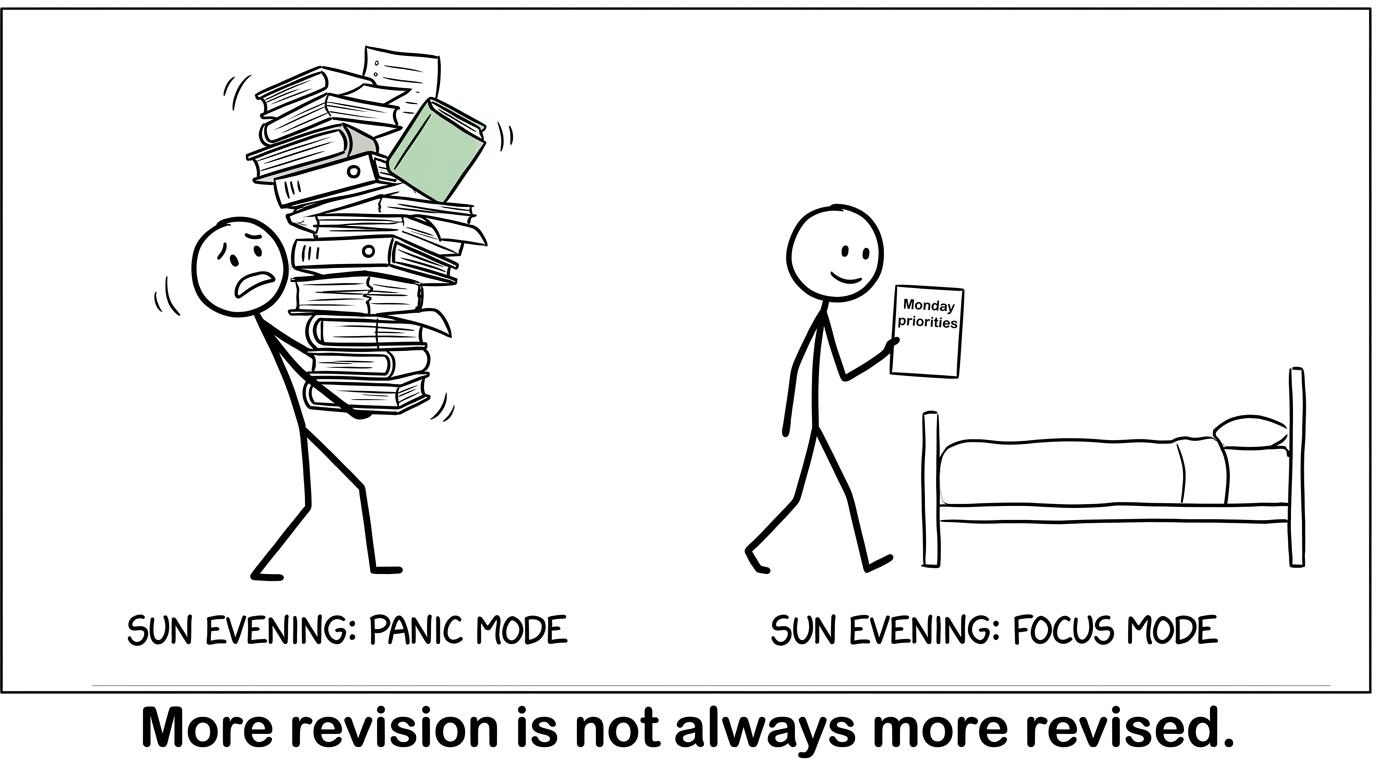 One student carrying too many notes while another calmly takes a short priority list to bed
Common GCSE English Literature weekend revision mistakes
Rereading instead of retrieving
Notes can create familiarity without recall. Close the book first, write what you remember, and then check the gaps.
Memorising complete essays
A memorised response may not answer the question on the paper. Learn flexible evidence, interpretations and connections, then practise adapting them.
Collecting quotations without analysis
For every quotation, ask what it suggests, how the writer creates that meaning and why it matters to the question.
Treating context as a separate paragraph
Context should clarify an interpretation. Unsupported historical facts can interrupt rather than strengthen an argument.
Ignoring form and structure
Word-level analysis matters, but so do changes, contrasts, narrative viewpoint, dramatic form, poetic voice and the organisation of a text.
Writing constantly without reviewing
Two unmarked essays may teach less than one response that is marked, diagnosed and improved. Build feedback into the timetable.
Revising every subject in one continuous block
English Literature and maths require different kinds of attention. Give each a clear session and an appropriate resource. Maths students can use the MathsGenie past-paper platform to keep paper practice and mark schemes organised.
Finish the weekend with evidence, not panic
A productive weekend is not measured by the height of the notes beside your desk. It is measured by what you can retrieve, apply, evaluate and improve.
Begin with closed-notes recall. Build an argument. Write under time. Use the mark scheme. Repair one weakness and revisit it on Sunday. That routine is small enough to repeat, which is precisely why it can work in the final weeks.
For English Literature, continue using the current specification, questions and mark schemes supplied by your exam board, school and teacher. For your maths preparation, make MathsGenie your free revision base: use revision lessons to rebuild uncertain topics, practice questions and mini tests to secure methods, then past papers, predicted papers, mark schemes and video solutions to prepare for exam conditions. Choose your next task now, make it specific, and begin.