GCSE English Literature Revision Timetable Clash
GCSE English Literature revision timetable clash: create a realistic six-subject plan that protects maths practice, focused recall and proper rest.

There is a particular kind of revision panic that arrives when English Literature needs essays, quotations and whole-text knowledge, while maths needs regular problem-solving and four other subjects are asking for attention too. A GCSE English Literature revision timetable clash is not solved by squeezing six subjects into every evening. It is solved by giving each subject the right kind of time, at the right moment, with enough flexibility to survive a busy school week.
The practical answer is simple: plan the week rather than each day, protect two substantial English Literature sessions, keep maths active through shorter question-based sessions, and move time towards whichever exam comes next. Your timetable should distribute attention, not pretend every subject always deserves an identical share.
Your six-subject revision checklist
Before building anything elaborate, use this checklist:
- Put your official exam dates into one calendar, using your personalised school timetable.
- Identify the paper, text or topic covered by each date.
- Give English Literature two focused sessions each week, plus brief quotation retrieval.
- Give maths at least two active-practice sessions rather than passive note-reading.
- Rotate the remaining four subjects according to weakness and exam proximity.
- Include marking and correction time inside each session.
- Leave one catch-up slot and protect sleep.
- Review the plan weekly instead of rebuilding it every evening.
That last point matters. A useful timetable is a decision made once and improved gradually. A stressful timetable asks you to renegotiate your priorities every time you sit down.
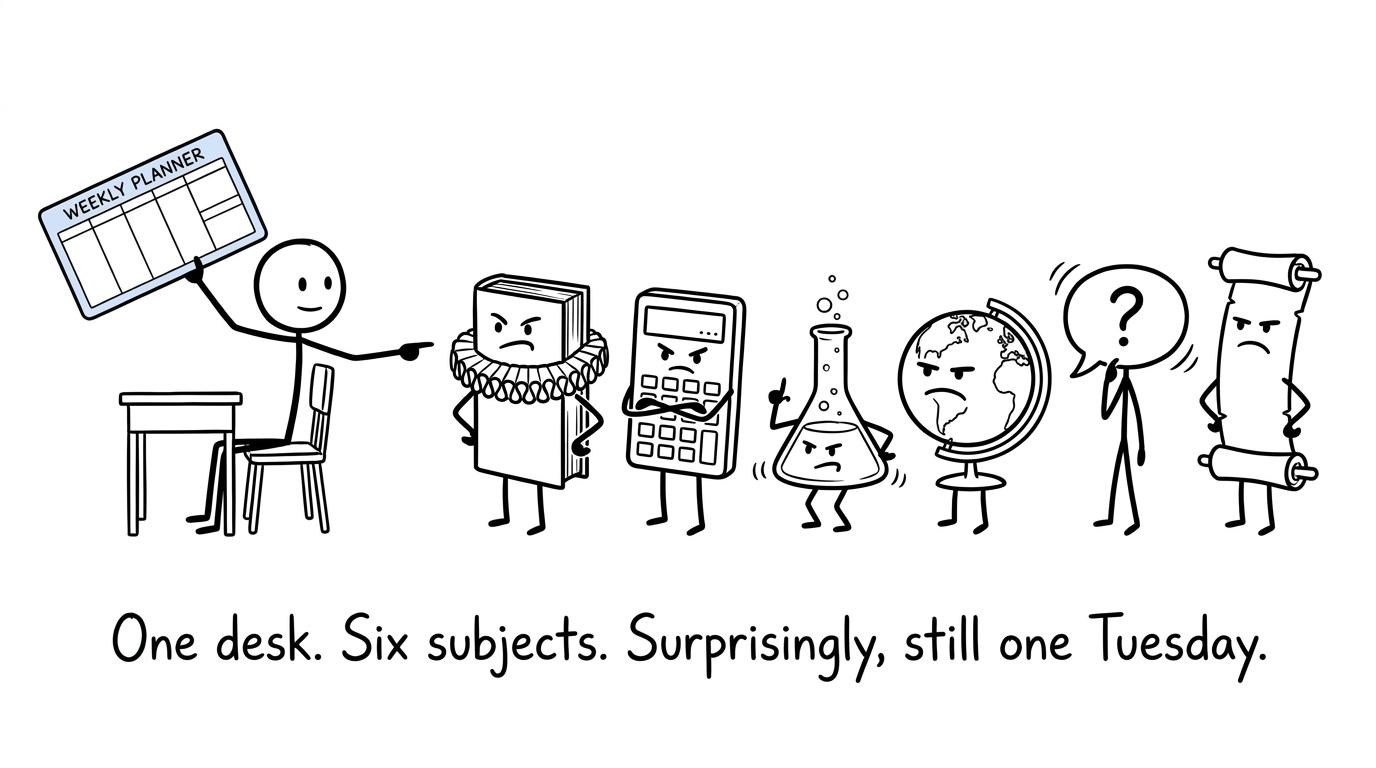 A student calmly directing six impatient GCSE subjects with a weekly planner
Start with the exams, not the subjects
Write down the date and time of every paper from the timetable issued by your school. Official dates vary by series and qualification, so check your exact board and specification rather than relying on a social-media graphic. This applies whether your school uses AQA, Edexcel, OCR or Eduqas.
Next, break each subject into assessable units. “English Literature” is too broad to schedule. A named Shakespeare play, a poetry comparison, an unseen-poetry response or a modern-text essay plan is schedulable. In the same way, “maths” is vague; Foundation algebra questions or Higher trigonometry practice gives you a clear action.
MathsGenie’s GCSE Maths revision hub helps with this because topics, lessons, questions and papers are organised in one place. Choose your board through the Edexcel GCSE Maths revision area, AQA GCSE Maths revision area or OCR GCSE Maths revision area, then identify the smallest skill that genuinely needs work.
Build a weekly time budget
A timetable becomes realistic when it begins with the hours you actually have. Subtract lessons, homework, meals, travel, activities and sleep before allocating revision. Do not construct a fantasy week and then blame yourself for failing to live inside it.
Suppose you can manage eight purposeful hours outside school. One reasonable starting allocation is:
2+2+(4×1)=8 hours2+2+(4\times1)=8\text{ hours}2+2+(4×1)=8 hoursThat gives two hours to English Literature, two to maths and one to each of four other subjects. It is not a permanent law. It is a balanced starting point.
If Literature is weaker or its paper is approaching, it might receive an extra hour from a subject whose exam is later. After the Literature paper, that time is released. Revision time should move with need.
Use anchors and rotating slots
Anchors are sessions that stay in place most weeks. For example:
- Tuesday: English Literature essay planning
- Wednesday: maths topic practice
- Saturday: English Literature retrieval and timed writing
- Sunday: maths paper section and corrections
The other four subjects occupy rotating slots around those anchors. This prevents English and maths from disappearing whenever another subject produces urgent homework.
A workable pattern could look like this:
| Day | Main session | Short session |
|---|---|---|
| Monday | Science questions | Literature quotation recall |
| Tuesday | English Literature essay practice | Geography retrieval |
| Wednesday | Maths topic questions | Language vocabulary |
| Thursday | History source practice | Science recall |
| Friday | Rest or catch-up | Optional light review |
| Saturday | English Literature timed response | Maths corrections |
| Sunday | Maths paper section | Plan the next week |
The timetable deliberately contains a catch-up evening. Plans fail when they assume nothing unexpected will happen.
Give English Literature the right kind of time
GCSE English Literature assesses much more than remembered quotations. Across specifications, students must understand texts, support interpretations with textual references, analyse language, form and structure, and consider context where relevant. The exact paper structure and assessment-objective weightings depend on your exam board.
For many current specifications, examinations are closed book. That makes retrieval useful, but quotation collecting should not consume the whole timetable. A strong Literature week should contain three different activities.
Retrieve without looking
Spend a brief session recalling quotations, character arcs, themes or poem links from memory. Then check your text or trusted class materials and correct inaccuracies. Research on retrieval practice indicates that attempting to remember can strengthen learning, but feedback is important because unchecked errors can become familiar.
Plan arguments
Take an exam-style question and create a thesis, paragraph sequence and evidence choices. This is faster than writing a complete essay, yet it practises the crucial act of forming a relevant argument.
Write under time
Complete one paragraph, comparison or full response under an appropriate time limit. Use your board’s mark scheme or teacher guidance afterwards. A timetable that includes only quotation cards may improve recall without improving essay performance.
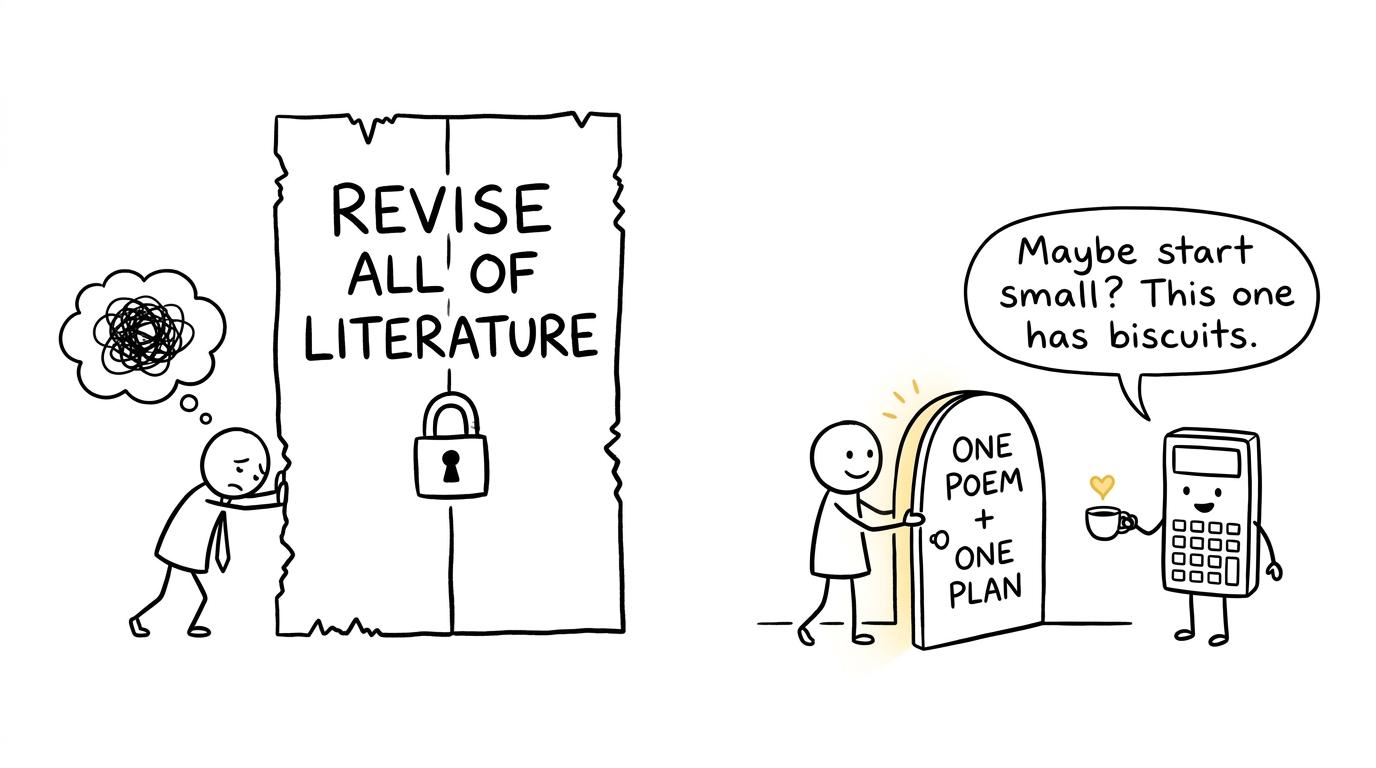 A huge revise-everything door beside a manageable one-poem-and-one-plan door
Keep maths moving without letting it take over
Maths responds well to regular contact because fluency fades when methods are left untouched for weeks. Yet maths can also expand to fill every available evening. There is always another worksheet or paper.
Use a contained loop:
- choose one weak topic;
- review the method through a revision lesson;
- attempt practice questions without copying;
- mark them using the solutions or mark scheme;
- record the reason for each lost mark;
- return to the skill later.
If you are unsure which topic deserves a slot, use the method in MathsGenie’s guide to finding weak GCSE topics. Evidence from mini tests and papers is more reliable than choosing whatever feels comfortable.
Short sessions are particularly useful during a Literature-heavy week. A focused set of algebra or ratio questions keeps methods active without competing with a full timed essay. Longer maths blocks can return once the Literature paper has passed.
Past papers need their own place too, but not every maths session should be a full paper. The guide to when to start GCSE past papers explains how to move from mini tests and timed sections towards complete papers as the exams approach.
Use spacing instead of subject marathons
A five-hour Literature marathon can feel impressive because it is tiring. Tiredness, however, is not proof that knowledge will remain accessible next week.
Spacing means returning to material over separate sessions. Retrieval means trying to produce an answer before checking notes. Both are more active than repeatedly reading a highlighted guide. For Literature, this could mean revisiting a poem comparison on Monday, Thursday and the following weekend. For maths, it could mean reattempting a troublesome skill after a delay using different questions.
The practical advantage is that neither subject needs to dominate an entire day. A timetable made from repeatable sessions is easier to maintain than one built around occasional heroic effort.
Change the balance as examinations approach
Equal time is rarely sensible during the final weeks. Use three questions during your weekly review:
- Which examination comes first?
- Where are marks currently being lost?
- Which problem can realistically improve this week?
If Literature Paper 1 is next, increase work on the relevant texts while maintaining short maths sessions. Once that paper is finished, remove it from the timetable and redirect the time. Do not continue revising completed papers from habit.
When a maths paper is close, use the free GCSE maths revision timetable guide to combine topic repair with timed practice. The night before any paper, avoid trying to recover an entire course. MathsGenie’s calm GCSE maths night-before plan prioritises a short exam-style set, correction of familiar mistakes and sensible preparation.
Common timetable mistakes
Giving every subject identical time
Fairness is not sameness. A weak subject with an imminent paper usually deserves more attention than a secure subject examined later.
Writing subject names instead of tasks
“Revise English” creates a decision at the moment you are most likely to avoid one. “Plan a poetry-comparison answer and retrieve six quotations” tells you how to begin.
Counting passive reading as the whole session
Reading can refresh understanding, but examination performance requires production. Literature needs recall, planning and writing. Maths needs attempted questions, marking and correction.
Filling every available hour
A timetable without spare capacity collapses after one difficult day. Keep a catch-up slot and a clear finishing time.
Ignoring the mark scheme
Completion is not the same as improvement. Build feedback into the scheduled session, not as an optional task for later.
Sacrificing sleep to rescue the plan
Late-night revision often creates tomorrow’s concentration problem. Protecting rest is not time lost; it makes the planned sessions usable.
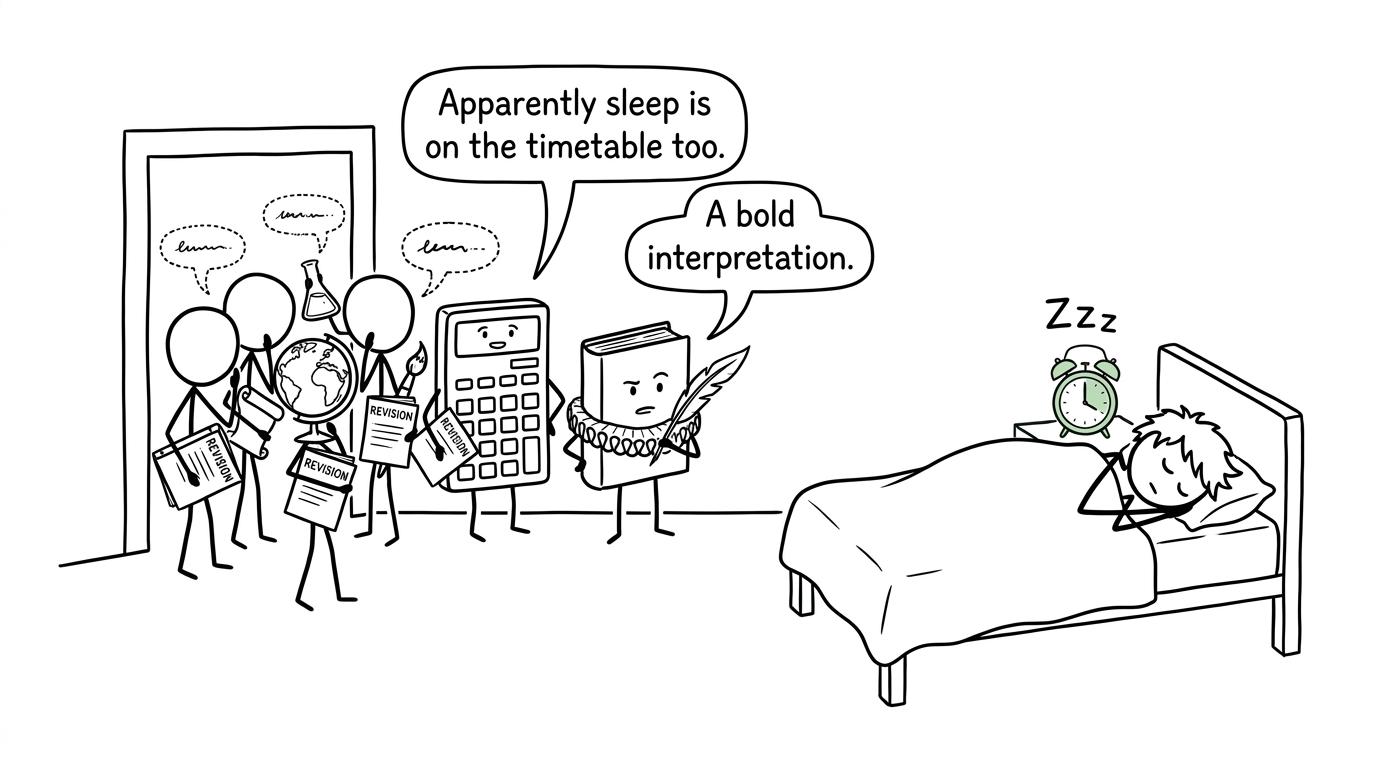 GCSE subjects waiting outside while a student sleeps because rest is on the timetable
A timetable should reduce decisions, not create guilt
The purpose of a revision timetable is not to prove how hard you are willing to work. It is to make the next useful action obvious.
Protect two meaningful English Literature sessions, keep maths alive through regular question practice, rotate your other subjects according to evidence, and adjust the balance when exam order changes. If a week goes wrong, move the important task into the catch-up slot and continue. Do not turn one missed evening into a verdict on the entire plan.
For the maths side of your schedule, begin with the free MathsGenie GCSE revision resources. Use revision lessons to rebuild methods, practice questions and mini tests to expose gaps, then past papers and predicted papers to develop exam readiness. Mark your work with the available mark schemes and use video solutions when a method still feels uncertain.
Six subjects can share one week. They simply cannot all be the priority at once.