GCSE English Literature Revision Bootcamp: Worth It?
GCSE English Literature revision bootcamp costs can be worthwhile. Learn what courses offer, what to check and when free revision is the smarter choice.
The word bootcamp makes revision sound decisive. A few intensive days, a confident teacher and perhaps the promise that everything will finally make sense. When exams are close, that certainty can feel worth paying for.
But is a GCSE English Literature revision bootcamp genuinely worth the cost? Sometimes. It can be valuable when it provides exam-board-specific teaching, individual feedback on essays and a clear plan for repairing known weaknesses. It is less likely to be worthwhile when it offers crowded lectures, generic notes or long sessions that replace active practice with passive listening.
For students also preparing for GCSE maths, there is another cost to consider: time. A holiday course may occupy hours that could have been used to repair gaps elsewhere. The right question is not simply, “Is this course good?” It is, “Is this the best use of my money, energy and remaining revision time?”
The quick bootcamp value checklist
Before booking, check whether the course:
- matches your exam board and the exact texts you study
- teaches the question formats you will actually face
- includes timed writing rather than lectures alone
- gives personal, actionable feedback on your work
- covers relevant assessment objectives
- has a sensible group size and named, suitably experienced tutors
- provides a timetable, materials and clear learning outcomes
- explains its safeguarding arrangements, cancellation terms and total cost
- leaves enough time for independent revision in maths and other subjects
- fills a specific gap that school support and free resources cannot fill
If several answers are unclear, do not let urgency make the decision for you. Ask the provider directly.
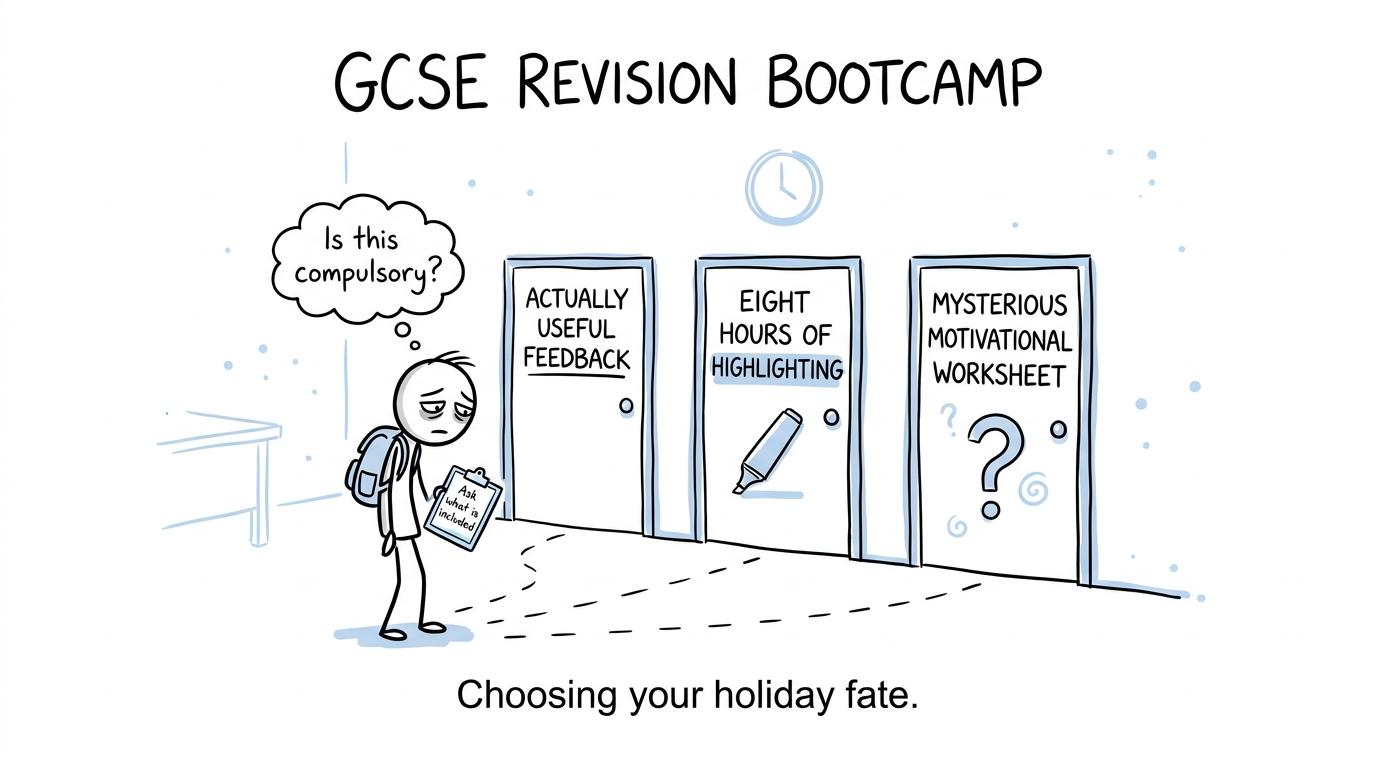 A student choosing between useful feedback and endless highlighting at a revision bootcamp
What GCSE English Literature bootcamps actually offer
Bootcamps and holiday courses vary considerably. Some are one-day workshops; others run across several mornings or a full week. Online versions may use live classes, recorded lessons or a mixture of both.
A useful course commonly includes several of the following.
Text and theme revision
The tutor may revisit characters, themes, relationships, key scenes, quotations and context for set texts. This can help organise knowledge that currently feels scattered.
However, English Literature is not just a memory test. Government subject content requires students to read critically, develop interpretations, analyse writers’ choices, compare texts where required and write clearly. A course that only supplies quotation lists is therefore addressing part of the qualification, not the whole task.
Assessment-objective guidance
Across GCSE English Literature specifications, the core assessment objectives concern:
- responding critically and supporting interpretations with textual references
- analysing language, form and structure
- understanding relationships between texts and their contexts
- writing accurately and effectively
The precise weighting and the questions through which these skills are assessed depend on the specification. AQA, Edexcel, OCR and Eduqas do not organise every paper in the same way. A worthwhile tutor should know your board, your texts and where each skill earns marks.
Essay planning and timed responses
Strong courses move beyond explaining content. They ask students to plan arguments, select evidence and write under time pressure. This reveals problems that neat revision notes can hide: weak topic sentences, undeveloped analysis, irrelevant context or poor time allocation.
Marking and feedback
This is usually the feature with the greatest potential value. A teacher can identify why an essay has stopped progressing and specify what the student should change next.
Look for feedback that is precise. “Add more detail” is vague. Guidance such as “connect the language analysis to your interpretation of the character” gives the student something they can practise. Ask whether every participant receives marked work and whether feedback is individual or delivered only to the group.
Models, notes and post-course materials
Some providers supply essay frameworks, quotation banks, model paragraphs or recordings. These can extend the course beyond the hours taught, but quantity is not the same as usefulness. Fifty pages that remain unopened have little value.
When a GCSE English Literature revision bootcamp is worth paying for
A course is most defensible when it solves an identifiable problem.
You need expert feedback that is not otherwise available
Perhaps you know the plot and quotations but cannot turn them into a sustained interpretation. If school feedback is limited and the bootcamp includes careful marking, a short course may reveal the bottleneck.
Your knowledge is disorganised rather than absent
An intensive course can bring themes, characters and quotations into a coherent structure. This is especially useful when you have already studied the texts but need help seeing how ideas connect.
The course precisely matches your specification
AQA, OCR, Eduqas and Edexcel have different paper structures and requirements. Even courses covering the same popular text may teach different response strategies. Confirm the board, specification, texts and components before paying.
A scheduled environment helps you begin
Structure has value. Some students work well independently; others lose much of a holiday deciding what to revise. A fixed course can remove that friction. Still, structure should lead to writing and feedback, not merely keep you occupied.
The cost is affordable without unrealistic expectations
No responsible course can guarantee a grade. It can provide teaching, feedback and practice; the student must still retrieve knowledge and produce responses independently. Treat confident grade promises cautiously.
When the course is probably not worth the cost
A bootcamp is unlikely to offer good value if you already receive regular, detailed feedback from your English teacher and know exactly what to improve. In that situation, disciplined independent practice may be enough.
It may also be poor value when:
- the content is generic rather than specification-specific
- most of the day consists of listening or copying notes
- one tutor is responsible for a very large group
- marked feedback is not included
- the provider will not identify tutors or explain safeguarding procedures
- travel and course hours create exhaustion before other exams
- the marketing relies on fear, countdowns or guaranteed outcomes
- you hope the course will replace reading, quotation recall and repeated writing
The course fee is only the visible price. Add travel, meals, materials and the revision hours surrendered elsewhere. Students preparing for several subjects should protect a balanced timetable using a plan such as the GCSE maths revision timetable.
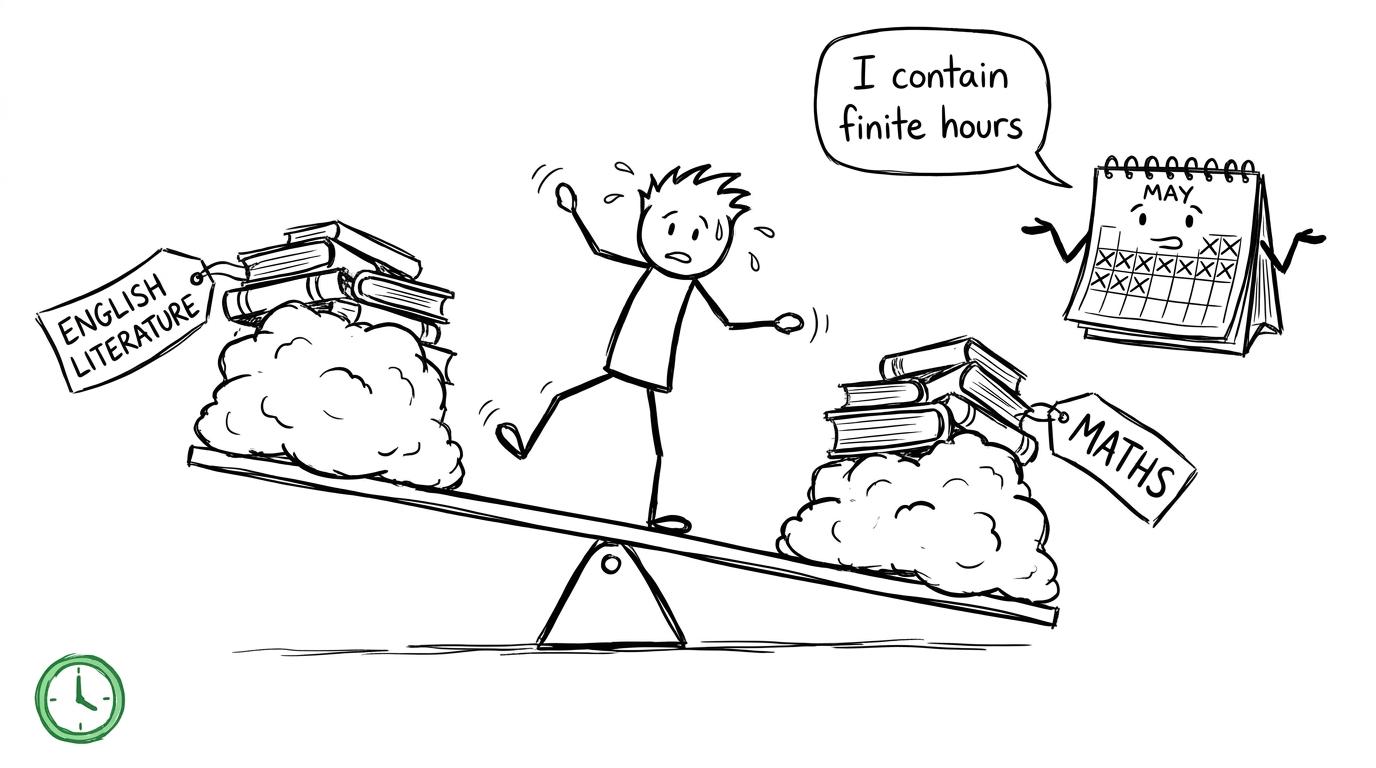 English Literature and maths revision competing for space on a student's calendar
How to judge value before you book
Calculate the real cost per useful hour
A simple comparison is:
cost per taught hour=total course costlive taught hours\text{cost per taught hour}=\frac{\text{total course cost}}{\text{live taught hours}}cost per taught hour=live taught hourstotal course costBut this figure alone can mislead. An hour containing individual feedback may be more useful than several hours of generic presentation. Include travel time and ask how much of each session involves active writing.
Ask what you will produce
By the end of the course, will you have completed essay plans, timed responses and corrected work? Outputs are easier to evaluate than claims such as “complete revision” or “grade booster”.
Check the tutor and safeguarding arrangements
Government safeguarding guidance advises parents and carers to ask out-of-school providers about staff suitability, safeguarding policies, the designated safeguarding lead, DBS checks and procedures for raising concerns. For an independent tutor or online course, establish who will be present, how communication works and whether sessions are recorded.
A DBS check is useful evidence, but it should sit alongside references, qualifications, supervision and clear policies. Parents or carers should be involved in these checks.
Read the terms rather than the headline
Check whether VAT, resources, mock marking or recordings cost extra. Read cancellation and refund terms, and find out what happens if the tutor changes or a student misses a session.
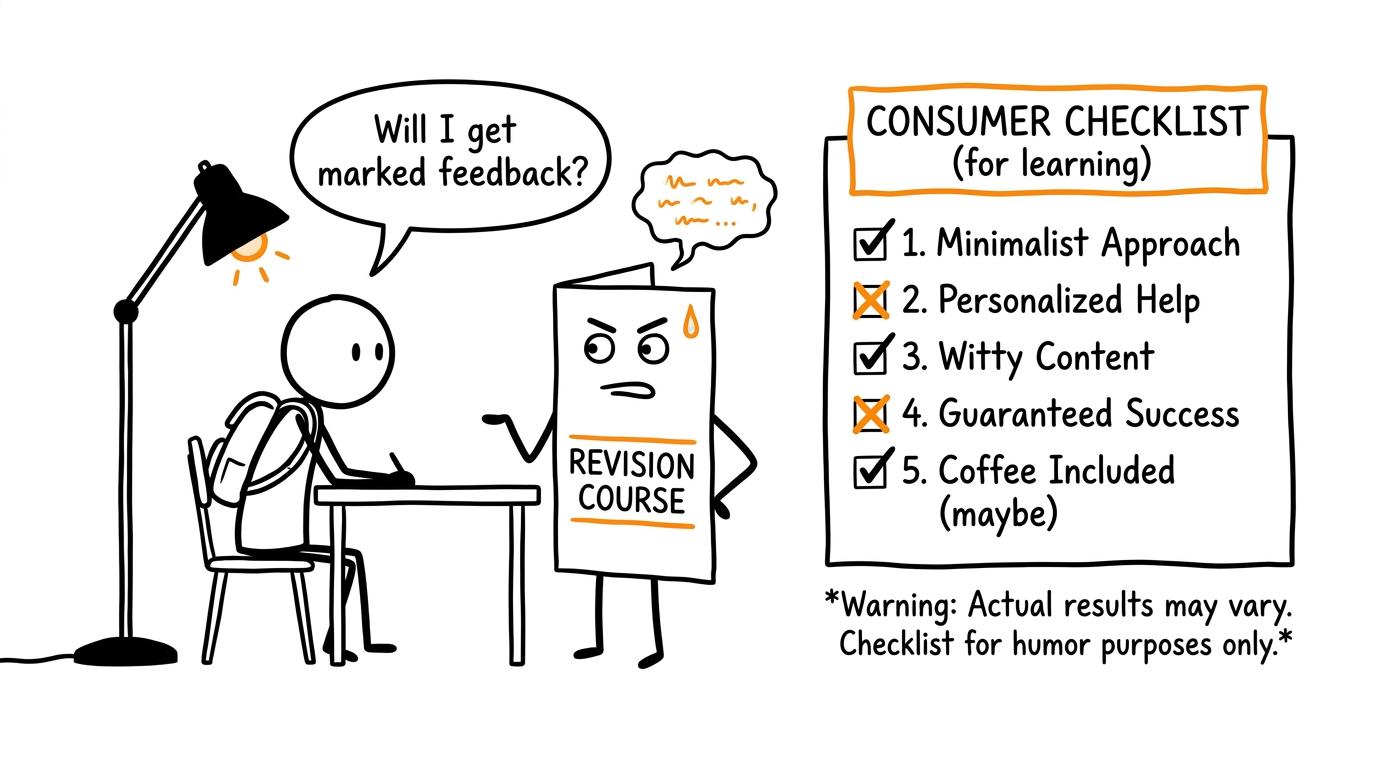 A student carefully interviewing a suspiciously vague revision course brochure
Protecting your maths revision during an English course
For a student preparing for maths exams, an English holiday course should fit inside the revision plan rather than consume it.
Before booking, use the GCSE Maths revision hub to identify your board, tier and weakest topics. If the course occupies several days, keep a short maths maintenance routine around it. The 20-minute maths revision routine is designed for busy periods when a full session is unrealistic.
After the bootcamp, return to active maths practice rather than trying to compensate with one exhausting day. Use GCSE maths past papers where appropriate, mark them carefully and repair the topics responsible for lost marks. The broader one-month GCSE maths revision plan can help restore balance.
This matters because revision has an opportunity cost. Four hours spent in a weak English lecture are four hours unavailable for algebra, geometry or rest. Four hours of targeted essay feedback may justify that trade. The label bootcamp tells you almost nothing; the learning design tells you far more.
Common mistakes when choosing a revision bootcamp
Booking before diagnosing the problem
Do not buy “more English” when the real need is narrower. Is the difficulty quotation recall, unseen poetry, comparison, essay structure, timing or analysis? Choose support only after naming the gap.
Assuming expensive means personalised
A high price may reflect venue costs, branding or group size. Ask exactly how much individual marking and tutor contact are included.
Ignoring the exam board
General literary discussion can be valuable, but exam preparation must fit the relevant specification and question format. Confirm everything rather than assuming a familiar text means a familiar paper.
Sacrificing every other subject
Intensive English revision can create a false sense that other subjects have paused. Keep small, repeatable maths sessions alive with MathsGenie's free GCSE revision resources, then use mini tests and timed questions to check that methods remain secure.
Expecting attendance to create improvement
Sitting in a classroom is not the same as learning. Improvement requires retrieval, writing, feedback, correction and another attempt. The same principle applies in maths: revision lessons build understanding, but practice questions and mark schemes reveal whether you can use it.
Make the decision based on the gap, not the fear
A GCSE English Literature revision bootcamp can be worth paying for when it is tightly matched to your board and texts, provides genuine individual feedback and addresses a problem you cannot easily solve elsewhere. It is not automatically valuable because it is intensive, expensive or scheduled close to the exams.
Ask what will be taught, what you will write and what feedback you will receive. Then compare that benefit with the full cost, including lost revision time.
Keep the rest of your preparation steady with MathsGenie. Use the free GCSE Maths revision hub for revision lessons and practice questions, build stamina with past papers, and use mark schemes, video solutions, mini tests and predicted papers to turn mistakes into a clear next step. Paid support should fill a real gap. Your everyday progress can still begin for free.