

GCSE English Literature November Resit Rules
GCSE English Literature November resit rules explained: learn when you can retake, which qualification matters and how to plan your revision calmly.
A results sheet can turn several different questions into one anxious thought: Can I fix this in November? Unfortunately, the answer for a GCSE English Literature November resit is usually no. In England, the standard November GCSE series offers English Language and Mathematics to eligible students aged 161616 or over, but not the separate English Literature qualification. Most students wishing to retake English Literature must therefore wait for the next summer exam series.
That distinction matters. English Language and English Literature sound closely related, yet they are separate GCSEs with different papers, content and resit arrangements. Before planning months of revision, confirm exactly which qualification appears on your results statement and speak to your school, college or exams officer.
The answer at a glance
For most students following AQA, Edexcel, OCR or Eduqas qualifications in England:
- A separate GCSE English Literature resit is not normally available in November.
- English Literature is generally examined in the summer series.
- November GCSE examinations are available for English Language and Mathematics, subject to eligibility rules.
- In the 2026 arrangements published by Ofqual, November English Language and Mathematics entries in England are restricted to students aged 161616 or over on 31 August of that year.
- You cannot usually retake only one English Literature paper because GCSEs are linear qualifications. You should expect to complete the required assessment components in the same available series.
- Arrangements can differ in Wales and Northern Ireland, particularly where qualification titles or structures are different.
The safest next step is simple: ask your exams officer to check the current timetable, your awarding body, your qualification title and your entry options.
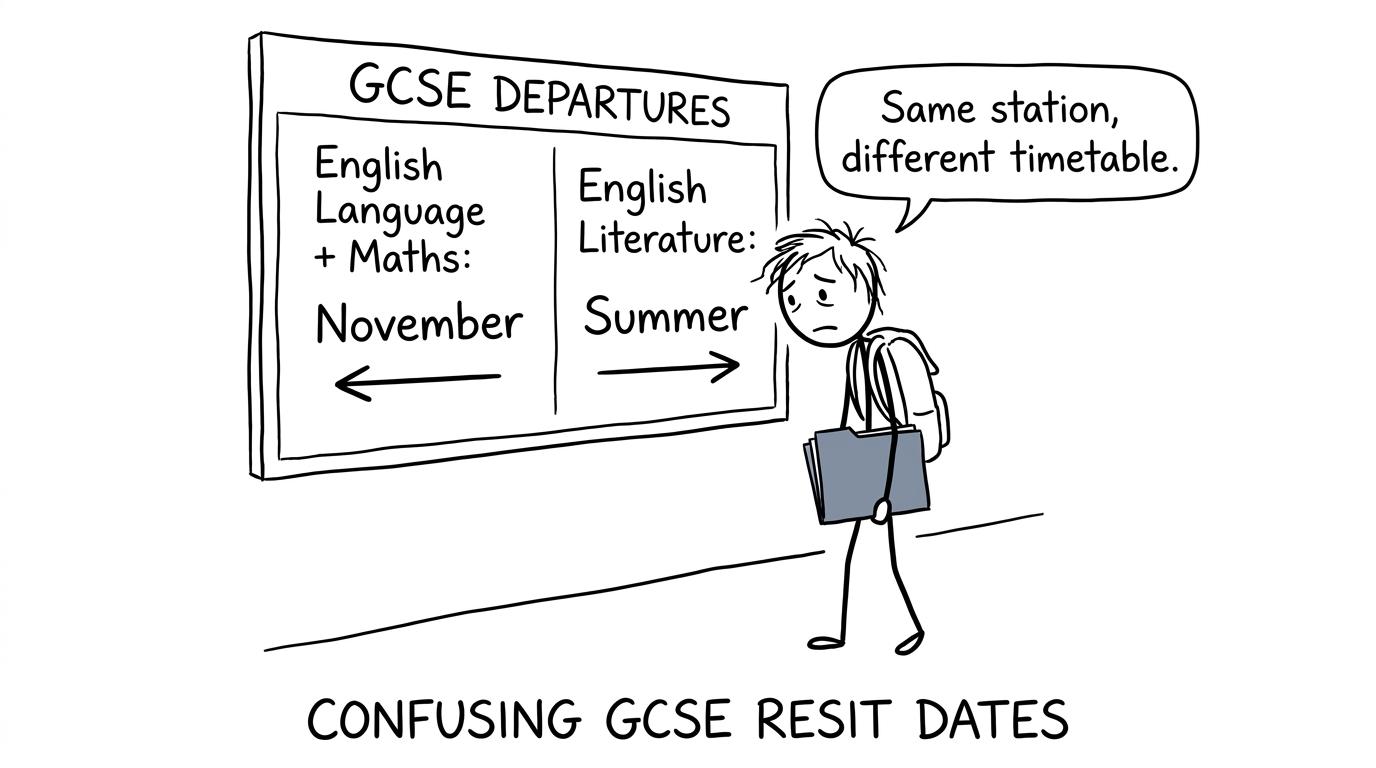 A student comparing November and summer GCSE routes on a railway board
Why English Language can be resat in November but Literature cannot
The November series exists primarily to provide another opportunity in key qualifications. In England, the nationally available November GCSE subjects are English Language and Mathematics. Ofqual's current student guidance explicitly identifies those two subjects and notes the age restriction.
English Literature is not included simply because it contains the word “English”. It is a separate subject focused on literary texts, interpretation, comparison, context and written analysis. English Language assesses reading and writing skills through a different specification.
This creates a common misunderstanding after results day. A student may hear that “English resits happen in November” and reasonably assume that both English GCSEs are included. In practice, that phrase almost always refers to English Language.
The same principle applies across the major English exam boards. Current timetable and qualification information from AQA, Edexcel and OCR indicates that the standard November series covers GCSE English Language and Mathematics rather than the separate English Literature GCSE. Eduqas students entering through an English centre should also have their centre confirm the current series availability.
Does the rule apply everywhere in the UK?
Students in England
If you took a separate GCSE English Literature qualification with AQA, Edexcel, OCR or Eduqas in England, a November resit is not normally available. Your realistic resit opportunity will usually be the following summer.
This may mean returning to your former school, entering through your college or finding an approved centre that accepts private candidates. A centre is not automatically required to accept an external entry, so make enquiries early.
Students in Wales
Wales has its own qualifications and examination arrangements. Some November timetables may contain titles such as English Language and Literature or Welsh Language and Literature. An integrated qualification is not automatically the same as the separate English Literature GCSE offered in England.
Check the precise qualification title and specification code on your results statement. Your school or exams officer can then confirm whether an autumn entry exists for that qualification.
Students in Northern Ireland
Northern Ireland also has distinct qualification arrangements. Students should check directly with their centre and awarding body rather than assuming that an English November timetable applies.
The wider lesson is useful: the subject name, awarding body and nation all matter. “GCSE English” is not specific enough for an entry decision.
Who is an English Literature resit realistic for?
Waiting until summer does not automatically mean that retaking Literature is the right decision. A resit is most realistic when three conditions are met.
You genuinely need a higher Literature grade
Universities, sixth forms, colleges and employers set their own entry requirements. Many requests for “GCSE English” specifically mean English Language rather than Literature, but you should never guess. Ask the organisation which qualification it accepts and what grade is required.
For students in England, post-161616 funding requirements focus on approved English and maths qualifications. A pass in English Literature does not normally remove the need to continue with English Language if the relevant English requirement has not been met. Your school or college should explain how the rule applies to your programme.
If your next course already accepts your existing combination of grades, a Literature resit may add workload without changing your options.
You can find a centre willing to enter you
Former schools sometimes support resits, but policies differ. Private candidates may need to contact several centres and pay entry or administration fees. Availability, deadlines and charges are set by the centre, so obtain written confirmation before organising your revision around an assumed entry.
Ask the centre:
- whether it accepts private English Literature candidates;
- which exam board and specification it uses;
- which papers or components you must take;
- the entry deadline and total fee;
- whether access arrangements can be provided;
- when and where the examinations will take place.
You can prepare for the correct specification
English Literature specifications do not all use the same set texts or paper structure. Retaking with a different board may mean learning unfamiliar material. That is possible, but it is a much larger commitment than revising texts you have already studied.
Whenever possible, identify a centre offering your original specification. Then compare its current text choices with the course you completed, because specifications and centre options can change.
What to do if your Literature grade was unexpected
A resit is not the only possible response. If the result is significantly different from your teacher's expectations, ask your school about post-results services promptly.
A teacher may be able to obtain or review your script and compare the marking with the published mark scheme. If the centre believes a marking error may have occurred, it can explain whether a review of marking is appropriate. Reviews are not a second attempt at the paper, and marks can stay the same, rise or fall.
There are strict deadlines. Speak to your school or college immediately rather than waiting until November. If the grade remains unchanged and you still need a higher result, you can then investigate a summer resit.
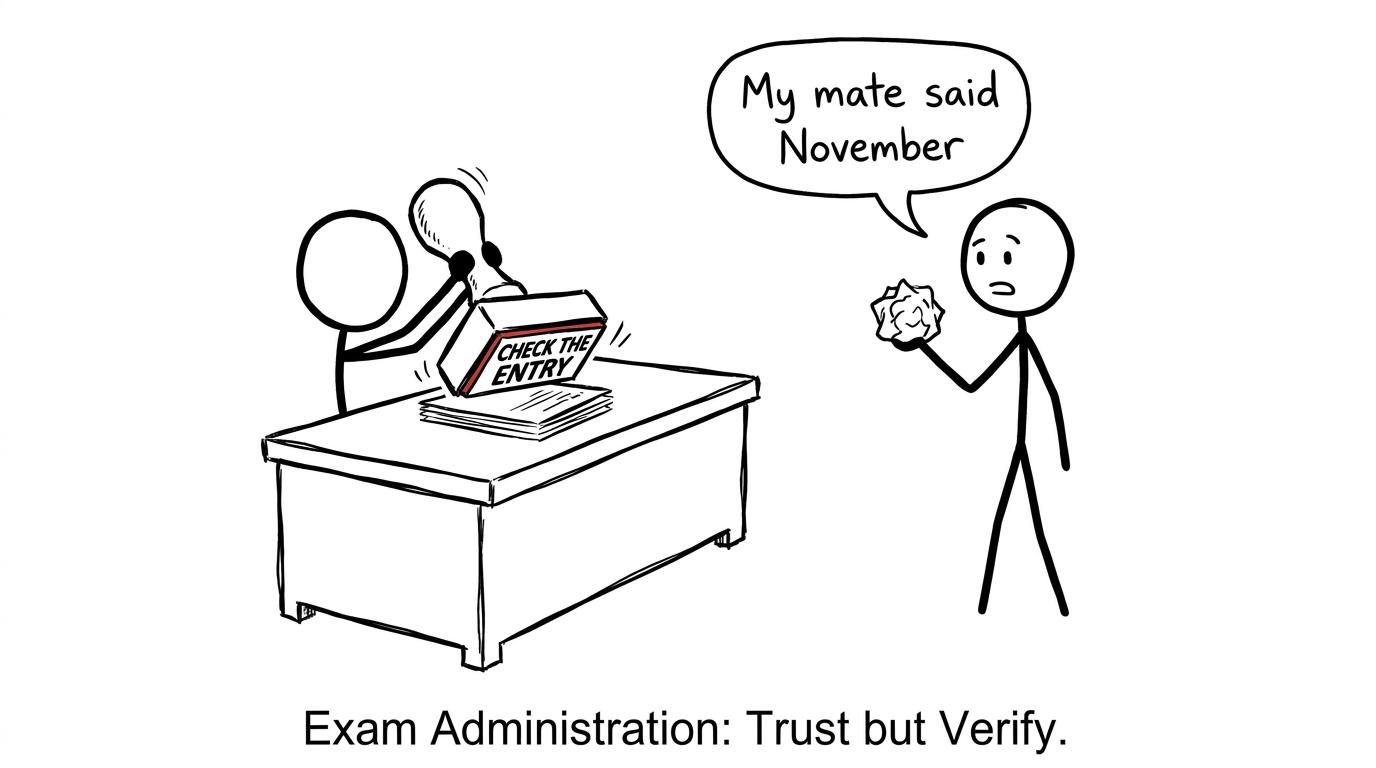 An exams officer stamping CHECK THE ENTRY beside a GCSE rumour
How to plan a summer Literature resit alongside GCSE maths
For a student also resitting Mathematics, the calendar may be uneven: maths could be available in November, while Literature may have to wait until summer. That can feel inconvenient, but it also allows you to separate two demanding goals.
Begin with a written confirmation of both entries. For maths, record your exam board, tier and paper dates. Foundation and Higher papers assess overlapping content but lead to different available grade ranges, so practise at the tier you will actually sit. The GCSE Maths revision hub lets you choose the appropriate board and work through lessons, questions and exam resources.
A calm plan might use three phases:
- Before the November maths resit: give maths most of your exam practice time while maintaining light Literature recall.
- After November: rebuild Literature knowledge systematically and keep maths active if another summer attempt remains possible.
- Before the summer series: move from notes to timed papers, marking and targeted correction.
Revision works best when it produces evidence. Instead of counting hours, complete questions, mark them and record what caused each lost mark. MathsGenie's guide to finding your weakest GCSE topics shows how to turn marks into a focused revision list.
For maths, use short topic sessions when Literature work is mentally demanding. Then build stamina with Edexcel GCSE Maths past papers or the shorter GCSE Maths 45-minute tests. Students on other boards can begin at the main revision hub and select the correct specification.
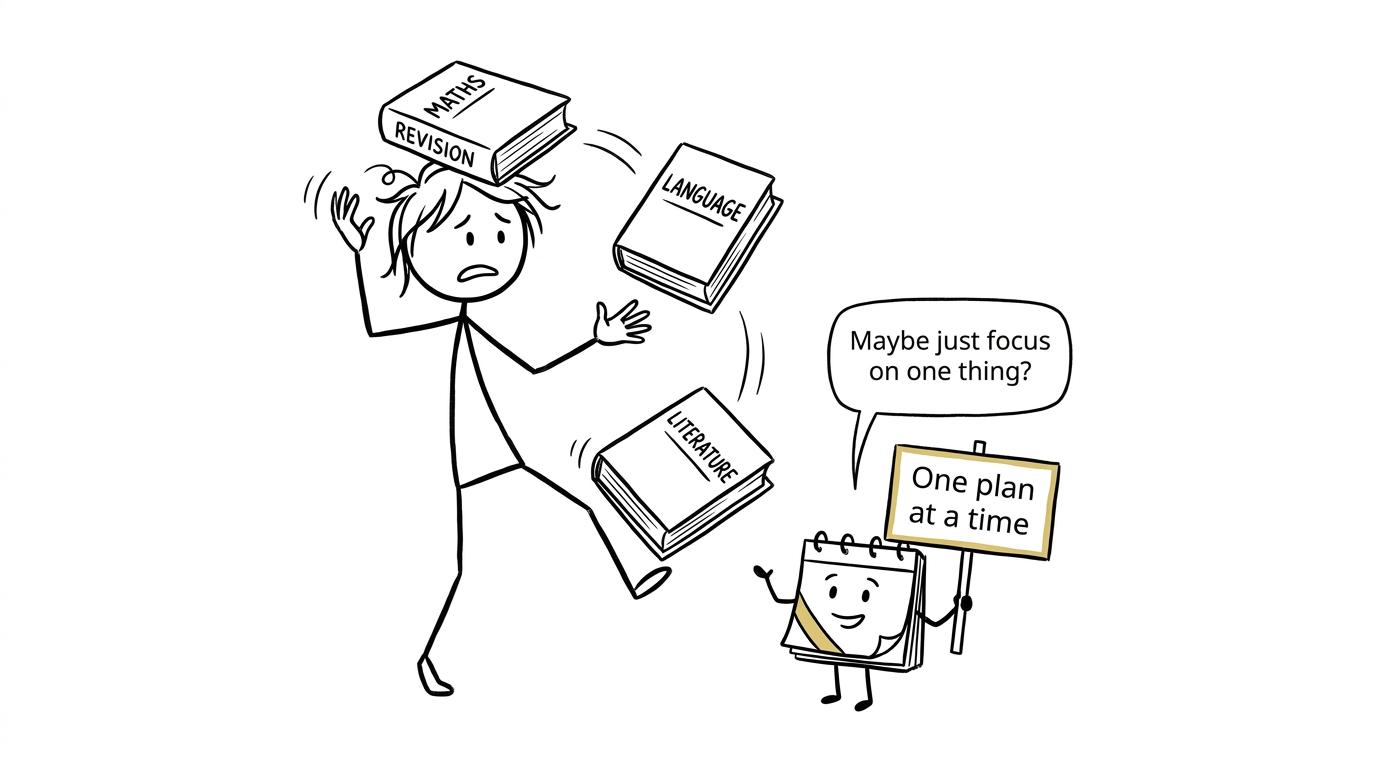 A GCSE student juggling Maths, Language and Literature revision books
A practical resit checklist
Use this checklist before paying for an entry or beginning a long revision plan:
- Read the exact qualification title on your results statement.
- Confirm whether the result is English Language, English Literature or an integrated qualification.
- Record the awarding body and specification code.
- Ask the organisation requiring the grade whether Literature is necessary.
- Check whether a post-results review is still possible.
- Ask an exams officer which series offers the qualification.
- Confirm that a centre will accept your entry.
- Obtain the fee, deadline, paper requirements and access-arrangement details in writing.
- Build separate plans for November and summer examinations.
- Use current resources matching your board and tier.
For maths, the GCSE topics by exam board and tier guide can help you check that your revision matches Edexcel, AQA, OCR or Eduqas. When you move into full-paper practice, follow a repeatable cycle: sit, mark, diagnose, repair and retest. The guide to using GCSE past papers properly explains that process clearly.
Common mistakes to avoid
Assuming “English resit” means English Literature
In November, it usually means English Language. Always use the full qualification name when speaking to a centre.
Booking the wrong specification
An exam centre may offer English Literature but not your original board or set texts. Check the specification before paying an entry fee.
Expecting to resit one paper
English Literature is normally assessed as a linear qualification. Do not assume that a strong mark from one previous paper can simply be combined with a new mark from another series.
Resitting a subject you do not need
Confirm the exact entry requirement with your intended sixth form, college, apprenticeship provider, university or employer. English Language and English Literature are not interchangeable in every context.
Letting Literature uncertainty stop maths revision
A delayed Literature opportunity does not change the value of preparing for maths. Start with one diagnostic paper, mark it honestly and repair the topics losing the most marks. MathsGenie's free GCSE Maths resources bring revision lessons, practice questions, mini tests, past papers, predicted papers, mark schemes and video solutions into one place.
Make the timetable work for you
For most students in England, the conclusion is clear: a GCSE English Literature November resit is not available, and the next realistic opportunity is the summer series. November provision is normally for eligible English Language and Mathematics candidates.
That answer may not be the one you hoped for, but certainty is useful. It prevents you from preparing for an exam series that does not contain your qualification. Confirm your entry with an exams officer, decide whether Literature is genuinely required, and use the extra time deliberately.
Meanwhile, keep your maths progress moving. Open MathsGenie's GCSE Maths revision area, choose your board and tier, and begin with one weak topic. Use revision lessons to rebuild the method, practice questions and mini tests to develop accuracy, then past papers and predicted papers to prepare under exam conditions. One confirmed entry and one well-marked paper are more valuable than a week spent revising around a rumour.











