GCSE English Literature: No Background Knowledge?
GCSE English literature no background knowledge? Learn if you can start late, what schools decide and how to catch up without losing valuable maths time.
A late start can make English Literature feel like arriving halfway through a film. Everyone else seems to know the characters, quotations and historical setting, while you are still trying to work out what happens.
The reassuring answer to gcse english literature no background knowledge is that starting without the usual preparation can be realistic. Some specifications explicitly state that there are no formal prior-learning requirements. However, your school or college decides whether it will enter you, and you must still learn the prescribed texts and analytical skills before the exams.
You do not need years of literary knowledge. You do need enough time to read the correct texts, understand how your exam board assesses them and practise writing under timed conditions.
The short answer and your starting checklist
Before committing, confirm these essentials:
- Ask whether your school will allow you to join the course or enter the examination.
- Identify your exam board: AQA, Edexcel, OCR or Eduqas.
- Get the exact set-text and poetry lists used by your school.
- Check the current specification, paper structure and assessment objectives.
- Complete one diagnostic question to test your reading and writing skills.
- Estimate how much time remains for reading, quotation recall and timed practice.
- Protect enough space for maths and your other GCSE subjects.
Start from the GCSE English Literature revision hub, where you can choose the relevant exam board and find revision resources, questions and past papers.
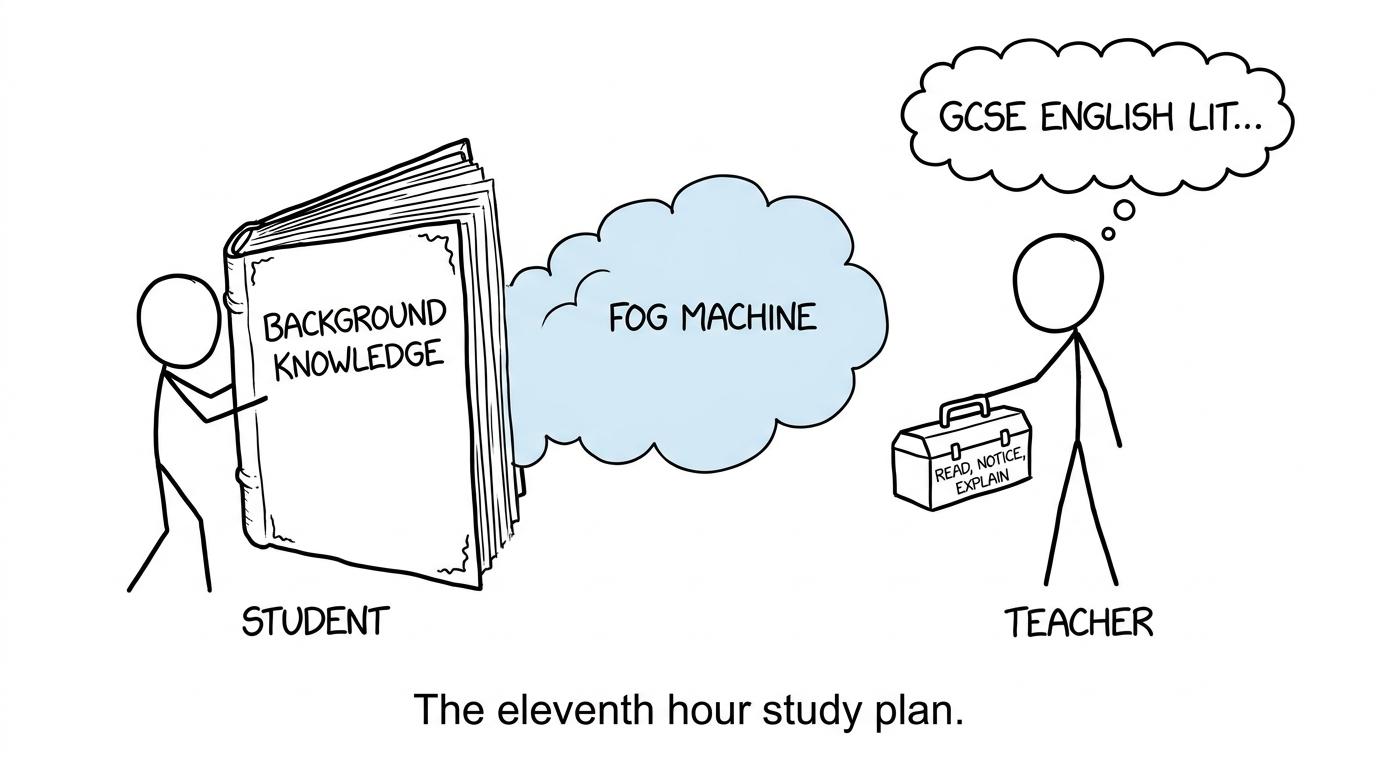 A student discovers that practical reading tools are more useful than mysterious background knowledge
Can you take GCSE English Literature without prior study?
There is an important difference between a qualification requirement and a school entry decision.
Official specifications from major exam boards do not generally require a previous English Literature qualification. OCR states that no prior knowledge is required, while Eduqas says there are no previous learning requirements and that course-entry decisions belong to the school or college. AQA also permits private-candidate entry, although candidates must arrange this through an approved centre.
That does not mean every school must let a student begin late. A school may consider timetable space, staffing, predicted performance, safeguarding of your wider GCSE programme and whether there is enough time to cover all the required texts. Speak to your English teacher, head of department and examinations officer before building a revision plan.
If your school cannot enter you, an approved examination centre may be an alternative. Private entry involves practical questions such as fees, deadlines, examination-board codes and access arrangements, so these details must be checked directly with the centre.
GCSE English Literature is also different from GCSE maths because it is not divided into foundation and higher tiers. Students following the same specification sit the relevant common papers and receive a grade from the available grades 999-111.
What background knowledge do you actually need?
The phrase “background knowledge” can make the challenge sound larger than it is. You do not need to have read every classic novel or know British history by heart. You need a defined body of knowledge connected to your specification.
Knowledge of the prescribed texts
GCSE English Literature subject content requires the detailed study of substantial whole texts. In England, this includes:
- at least one Shakespeare play;
- at least one nineteenth-century novel;
- poetry published since 178917891789, including representative Romantic poetry;
- fiction or drama from the British Isles written from 191419141914 onwards;
- unseen material in the examination.
The precise titles and question arrangements vary between AQA, Edexcel, OCR and Eduqas. Never revise a text simply because it is popular online. Confirm that it belongs to your board and your school’s chosen route.
Reading summaries alone is risky. A summary can tell you what happens, but it rarely gives you the detailed sense of character development, recurring imagery, structure and tone needed for a convincing interpretation.
Knowledge of the assessment objectives
Across GCSE English Literature specifications, the core assessment objectives reward your ability to:
- understand and respond to texts while supporting ideas with references;
- analyse how writers use language, form and structure;
- connect texts with relevant contexts;
- write clearly and accurately in Standard English.
Context matters, but it is not a competition to include the most historical facts. A contextual point earns its place when it helps to explain the writer’s choices or deepens your interpretation.
A small bank of flexible evidence
You need accurate textual references, including useful short quotations. Ofqual has clarified that the qualification is about learning and understanding rather than reproducing long passages from memory.
Build a compact bank of versatile quotations connected to several themes and characters. The aim is not to memorise the entire text. It is to select evidence that you can analyse precisely.
The guide to revising English Literature efficiently explains how to organise quotations, arguments and paragraph practice without creating endless notes.
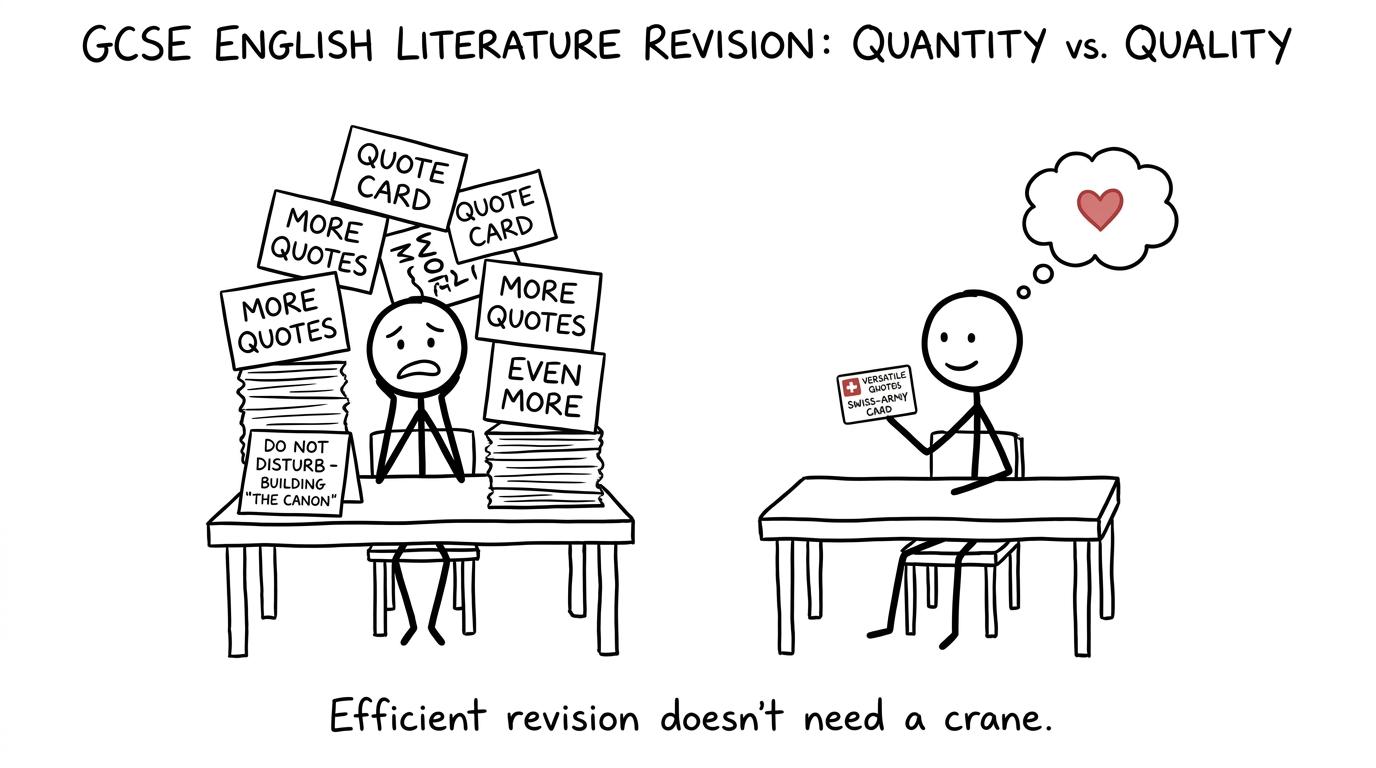 One student builds a quotation skyscraper while another keeps a small set of versatile quotations
How to catch up quickly if your school allows it
Fast catch-up does not mean rushing through every resource. It means doing the most valuable tasks in the right order.
Confirm the route before revising
Write down your board, set texts, poetry cluster, paper structure and examination date. Specifications and set-text options can change, so use current information supplied by your teacher and exam board.
Then collect the full texts, your school’s core materials and the appropriate mark schemes. This prevents the expensive mistake of revising the wrong poems or paper format.
Read for structure before detail
Complete a purposeful first reading of each text. Track:
- the sequence of essential events;
- major character relationships and changes;
- central themes and conflicts;
- recurring images, settings or structural patterns;
- moments that could support several different questions.
Annotate selectively. If every line is highlighted, nothing has been prioritised.
Build one-page maps
Create one concise map for each text containing its plot arc, characters, themes, adaptable quotations and useful contextual links. Poetry maps should also include comparison routes, because official GCSE subject requirements include comparison across texts.
Turn those maps into prompts rather than rereading them passively. The active-recall guide for English Literature notes shows how to convert headings and quotations into questions you can answer from memory.
Practise the assessed skill early
Do not wait until you feel fully prepared before writing. After learning the basic shape of a text, attempt one question or timed plan. Use the mark scheme to identify whether the main problem is:
- insecure text knowledge;
- weak evidence;
- limited analysis of methods;
- disconnected context;
- unclear argument;
- timing or paragraph control.
The English Literature weakest-topics method helps turn vague worries into specific actions. If you cannot recall evidence, work on retrieval. If you know the text but merely retell the story, focus on analysis.
Move towards closed-text conditions
Several major GCSE English Literature assessments are closed text, although the precise stimulus material and question format vary by board. Begin with your notes available, then gradually remove them. Your final practice should match the conditions of your actual paper.
Students returning to the qualification can also adapt the staged approach in the GCSE English Literature resit revision plan.
How to protect your GCSE maths revision
Taking on Literature late should not quietly consume the time needed for maths. Maths rewards frequent procedural practice; Literature needs sustained reading, retrieval and writing. Treat them as different kinds of training.
A balanced week might contain short, regular maths sessions alongside fewer but longer Literature sessions. Use the GCSE maths revision hub for topic lessons, practice questions, mini tests, papers and solutions rather than spending revision time searching across several websites.
For example, a Literature session can focus on one character map or timed paragraph. A maths session can focus on one weak skill followed by immediate marking. Keep separate error logs:
- for Literature, record missing evidence, weak analysis and unclear arguments;
- for maths, record knowledge gaps, calculation errors, omitted working and misunderstood command words.
A realistic schedule matters more than an impressive one. The GCSE maths revision timetable guide can help you arrange topic practice, timed sections and review without letting the new subject displace everything else.
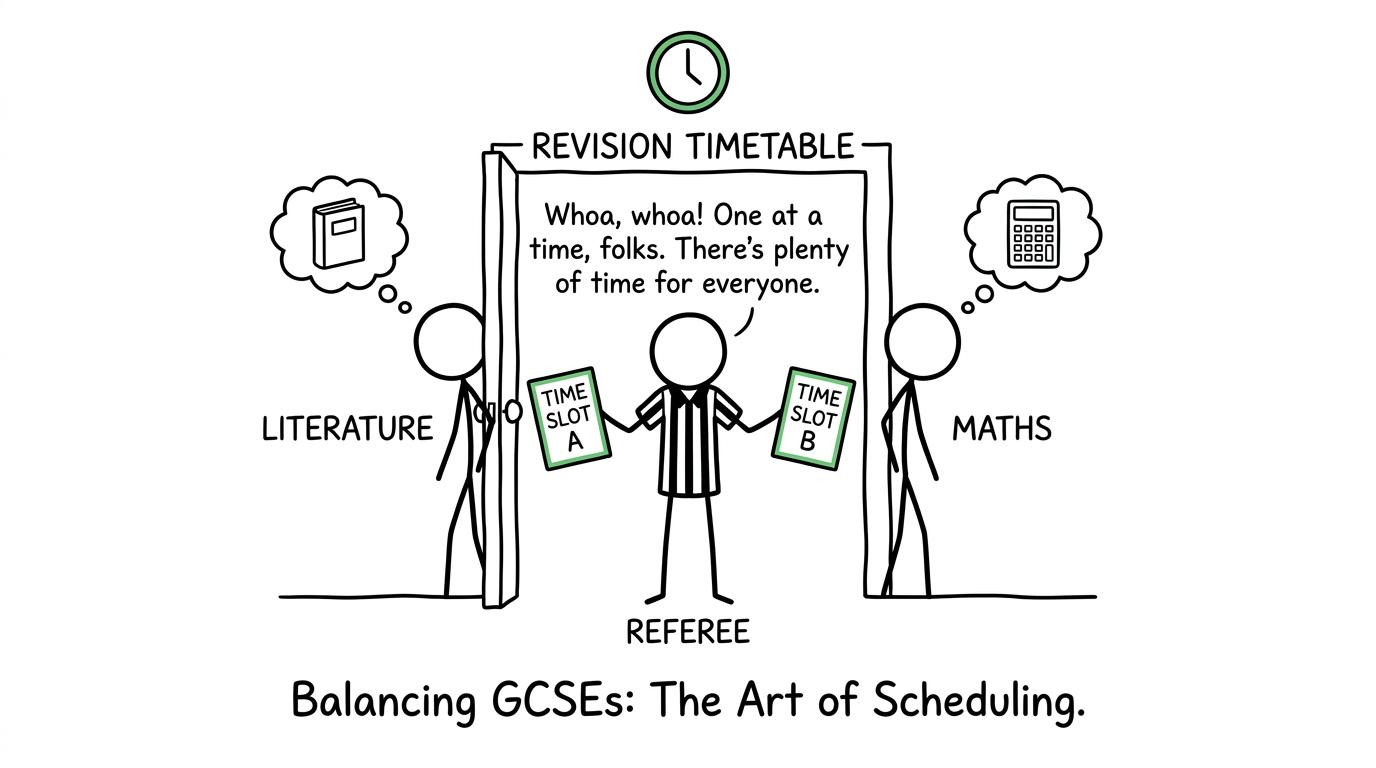 Maths and Literature are assigned separate spaces in a calm revision timetable
How to judge whether the plan is realistic
A late start is more realistic when you can answer yes to most of these questions:
- Will your school or an approved centre enter you?
- Can you obtain and read every prescribed text?
- Do you have enough weekly time without damaging other subjects?
- Can you already write clear analytical paragraphs?
- Are you willing to complete timed responses and use mark schemes?
- Can a teacher give you occasional feedback?
Your diagnostic response matters more than confidence alone. A student with secure reading and writing skills may close a knowledge gap relatively quickly. A student who must simultaneously develop basic comprehension, essay structure and detailed text knowledge will need more time and support.
Common mistakes when starting without the usual background
Revising before confirming the specification
Different boards prescribe different texts and organise their papers differently. Confirm every title, poetry selection and assessment detail first.
Replacing whole texts with summaries
Summaries are useful for orientation and recall, not as a substitute for reading. Examinations reward informed responses grounded in the text.
Memorising quotations without interpretations
A quotation is evidence, not a complete point. Connect it to the question, analyse the writer’s method and explain why it matters.
Treating context as a separate history paragraph
Use context only where it illuminates meaning. Detached facts can interrupt an argument rather than strengthen it.
Writing endlessly without reviewing feedback
Practice only improves performance when it changes the next attempt. Mark each response, choose one precise target and test that target again.
Abandoning maths while catching up
A late Literature start can feel urgent, but maths skills fade without practice. Use short mini tests or targeted questions to maintain continuity, then return to longer past-paper sessions when appropriate. The guide to finding weak GCSE maths topics quickly can keep those sessions focused.
Start with facts, then build momentum
You can begin GCSE English Literature without the usual background knowledge, provided your school or examination centre permits the entry and you have a realistic plan for covering the correct texts. The gap is not mysterious. It consists of identifiable knowledge, analytical skills and examination practice.
Confirm your board and texts today, complete one diagnostic task and turn the result into a catch-up list. Then use MathsGenie as your free revision base: combine English Literature resources with maths revision lessons, practice questions, mini tests, past papers, predicted papers, mark schemes and video solutions. Small, accurately chosen tasks will take you further than panic ever will.