GCSE English Literature Half-Term Revision Plan
GCSE English Literature half-term revision: follow a focused seven-day plan to recall quotations, practise essays, protect maths time and enjoy your break.
Half-term revision often begins with an ambitious timetable and ends with an uneasy Sunday evening. The problem is rarely laziness. It is usually scale: “revise English Literature” is too vague to begin, while “learn every quotation” is too large to finish.
Effective GCSE English Literature half-term revision is smaller and more active. Choose the texts and skills that need attention, complete short closed-book tasks, check your work, then stop. You do not need to surrender the whole break. A focused week containing five or six purposeful sessions can improve recall, expose gaps and leave room for maths, other subjects and genuine rest.
Your half-term revision checklist
Before building a detailed plan, make these decisions:
- Confirm your exam board, set texts and paper structure.
- Choose three weaknesses rather than trying to cover everything.
- Schedule revision blocks with definite finishing times.
- Retrieve quotations and ideas without notes before checking them.
- Practise planning and writing responses to real exam questions.
- Review each attempt using a mark scheme or teacher guidance.
- Revisit mistakes later in the week.
- Protect time for maths and your other GCSE subjects.
- Keep at least part of the break completely free.
The purpose of a timetable is not to make the holiday look busy. It is to remove the daily argument about what to do next.
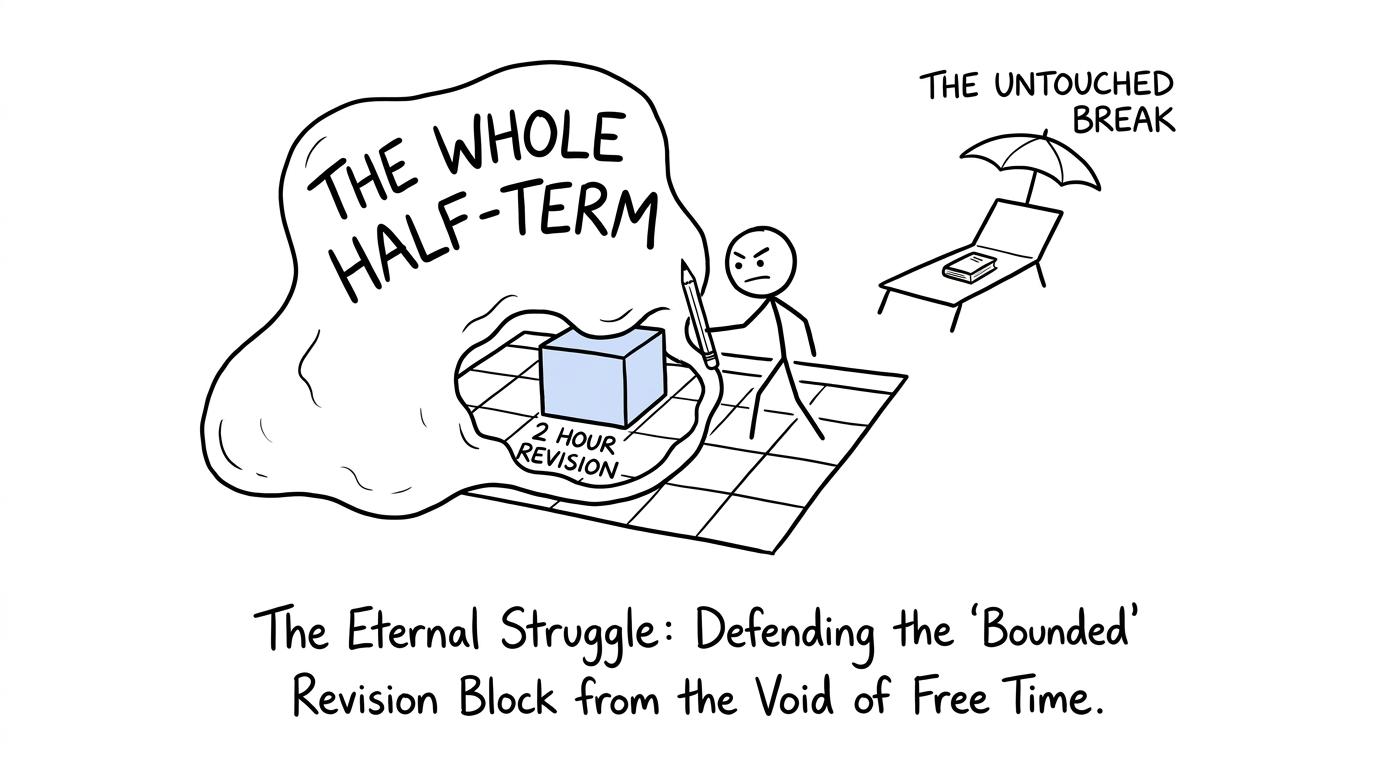 A student protects a small revision block from the whole half-term
Start with the exam you will actually sit
English Literature is an untiered GCSE, but its exact assessment structure depends on your exam board. AQA, Edexcel, OCR and Eduqas do not arrange every text, section or mark in the same way. Check your teacher’s information and the current specification before deciding what deserves the most time.
Across GCSE English Literature specifications, the central assessment objectives concern:
- informed responses supported by textual references;
- analysis of language, form and structure;
- relationships between texts and their contexts; and
- accurate, effective writing where that objective is assessed.
Their weighting and location within papers vary. Context, for example, is not a signal to attach a memorised historical paragraph to every answer. It should illuminate the text and the question. Likewise, terminology only earns its place when it helps explain an effect.
Write down your papers, texts and question types on one sheet. Then label each area secure, uncertain or weak. This diagnosis is more useful than beginning with the first page of your exercise book.
Turn vague intentions into finished tasks
“Revise Macbeth” has no visible endpoint. You could read for three hours and still feel behind. A finished task is concrete:
- retrieve quotations for one character or theme;
- create a plot sequence from memory and repair the gaps;
- plan one essay without notes;
- annotate an unfamiliar extract;
- compare two anthology poems around one idea;
- write one timed paragraph and improve it after checking;
- analyse one unseen poem under a short time limit.
Each session should produce evidence: a quotation grid, essay plan, paragraph, comparison map or corrected response. Evidence prevents revision from becoming quiet page-turning.
Use a simple three-part cycle. First, recall what you know without support. Next, check against the text, class materials or an authorised mark scheme. Finally, record one precise repair for a later session. Research on learning consistently supports spacing and retrieval over relying entirely on massed rereading, particularly when retrieval is followed by corrective feedback.
A seven-day plan that leaves room for a break
This plan is deliberately restrained. Adapt the order around family plans, homework and your own energy. If school has set specific work, place it first rather than creating a competing programme.
| Day | English Literature task | Suggested outcome |
|---|---|---|
| Saturday | Diagnose your weakest text and skill | A three-item priority list |
| Sunday | Retrieve one text’s plot, themes and quotations | A corrected recall sheet |
| Monday | Plan one exam response | A clear argument and paragraph sequence |
| Tuesday | Rest from English Literature | No catch-up unless genuinely necessary |
| Wednesday | Practise poetry comparison or unseen poetry | One timed plan or response |
| Thursday | Revisit Monday’s weak points | A stronger second attempt |
| Friday | Complete a short timed section and review it | An error list for the next fortnight |
A session of roughly 30 to 50 focused minutes is often more realistic than an open-ended afternoon. Put your phone outside reach, open only the materials needed and decide the final task before starting. When the task is complete and checked, finish.
If a day disappears, do not rebuild the week around guilt. Move the most valuable unfinished task into the next available slot and discard something lower priority.
Recall quotations without turning the week into a memory contest
Quotation knowledge matters because textual references support interpretation. But revision should not become a competition to memorise the longest speeches.
Choose short, flexible quotations connected to major characters, relationships, turning points and themes. For each quotation, know:
- who speaks or narrates;
- where it occurs;
- the idea it can support;
- one meaningful feature of language, form or structure;
- how its significance changes across the text.
Then close the book. Use a theme, character or opening phrase as a cue and write the quotation from memory. Check it immediately. Keep uncertain material in tomorrow’s pile and move secure material to a later review. This creates spacing naturally.
Small inaccuracies do not automatically destroy an argument, but invented wording can weaken analysis. If exact recall is uncertain, a concise textual reference may be safer than constructing a confident but false quotation. Follow your teacher’s advice on how your exam board’s mark scheme treats evidence.
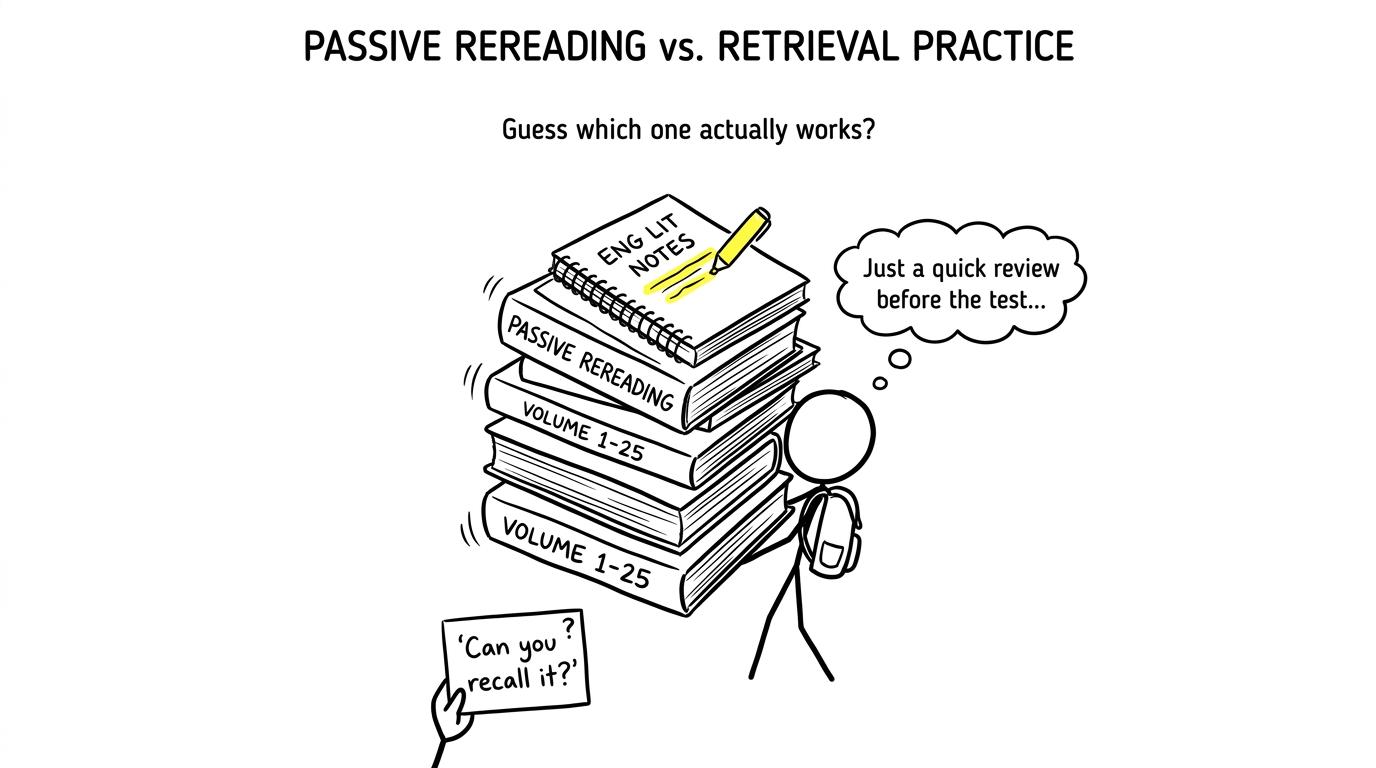 A tower of highlighted notes meets one awkward recall question
Practise the decisions an exam requires
Notes can help rebuild knowledge, but the exam asks you to select, interpret and organise ideas under time pressure. Half-term should therefore include at least one genuine exam task.
Begin with plans, not endless full essays
A useful plan contains a direct answer to the question, a developing argument, carefully chosen references and a logical order. It should show what each paragraph contributes rather than listing everything you remember about the text.
Planning several different questions can expose whether your knowledge is flexible. If every answer uses exactly the same three quotations and conclusions, your preparation may be too narrow.
Add timed writing selectively
Complete one paragraph or one paper section under a realistic time constraint. Afterwards, review it slowly. Ask:
- Did the opening answer the exact question?
- Is each reference connected to an interpretation?
- Does the analysis explain an effect rather than merely identify a technique?
- Is context integrated only where relevant?
- Does the argument develop?
- Is the writing clear and controlled?
A mark scheme is not a treasure map containing one perfect answer. Use it to understand the qualities being rewarded, then compare that standard with your own response. Teacher feedback is especially valuable because broad level descriptors require judgement.
Keep English Literature and maths from competing
Students preparing for maths exams cannot give every half-term day to one subject. The better approach is to give different subjects distinct jobs.
For example, complete English Literature recall in the morning and a short maths practice block later, rather than switching between a play and algebra every few minutes. MathsGenie’s GCSE Maths Revision Hub lets you choose your exam board and move directly to relevant lessons and questions. If time is tight, the 20-minute maths revision routine provides a contained alternative to an entire paper.
Your maths work should be as specific as your English work. Choose one weak skill, practise questions, mark them and record the error. Target Tests and mini tests are useful when you need a short timed task. Students wanting a broader structure can adapt the GCSE maths revision timetable.
When you are ready for paper practice, use the correct board and tier. MathsGenie provides Edexcel GCSE Maths past papers, AQA GCSE Maths past papers and an OCR GCSE Maths revision hub. Past papers should generate the next revision task, not merely a score.
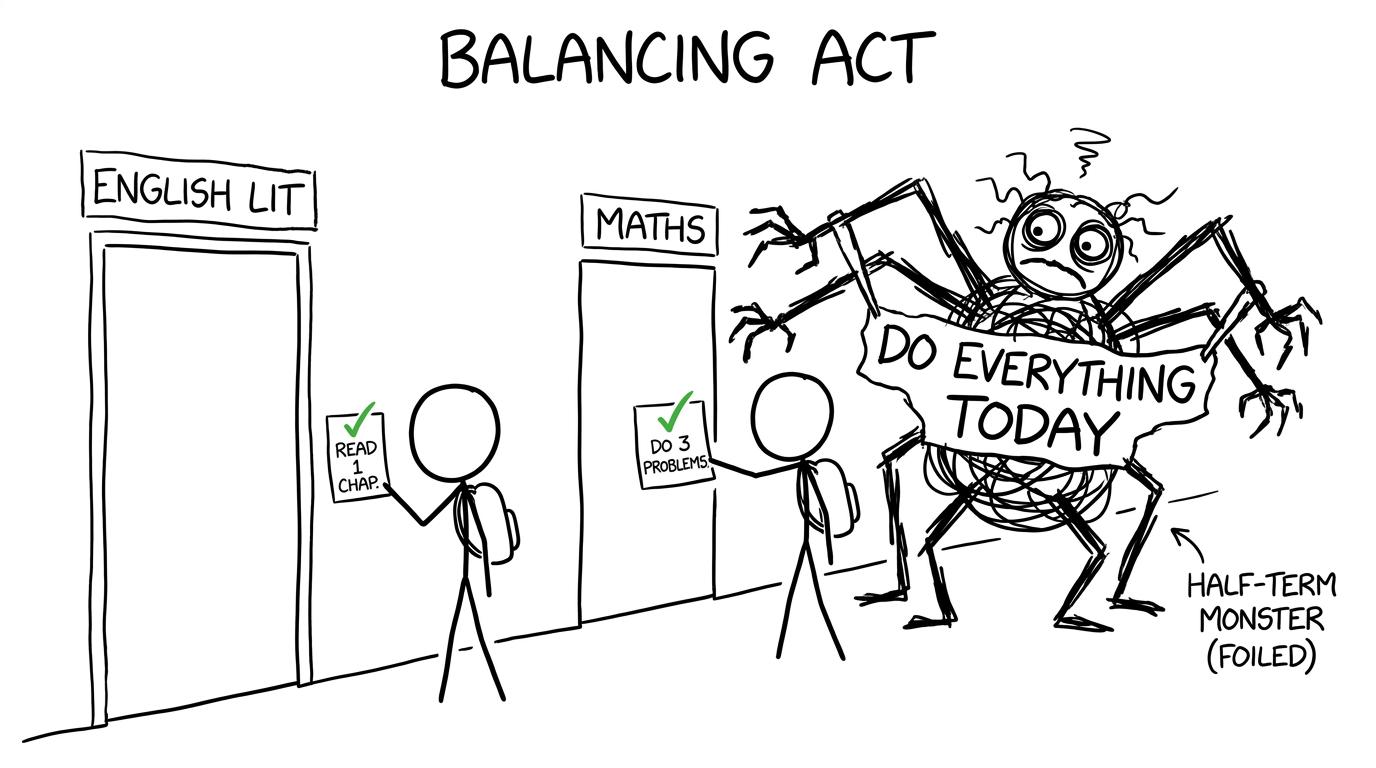 A student balances one English task and one maths task while an impossible timetable sulks
Common half-term revision mistakes
Building a timetable before identifying weaknesses
A colourful schedule can allocate equal time to everything, including material you already know. Diagnose first. Then spend more time where recall or analysis actually fails.
Rereading until the text feels familiar
Familiarity is not the same as recall. After a brief review, close the material and retrieve the plot, quotation, theme or argument. The difficulty you feel is information about what needs work.
Collecting quotations without interpretations
A quotation bank is only useful if you can deploy it. Connect each quotation to possible questions, interpretations and developments elsewhere in the text.
Writing full essays but never reviewing them
Unmarked writing can repeat the same weakness. Check every substantial attempt against the question, assessment objectives and available feedback. Rewrite the weakest part while the lesson is still clear.
Treating predicted content as a promise
Do not build English Literature revision around guesses about a character or theme. Questions can test familiar material from an unexpected angle. In maths, predicted papers and past-paper guidance are best used to test readiness, not forecast an exact paper.
Removing every enjoyable part of half-term
A plan that assumes unlimited concentration usually collapses. Set finishing times, keep a free day or substantial free periods, and preserve sleep. Rest is not evidence that revision has failed. It is part of making the plan repeatable.
Finish the week with a smaller next step
Successful half-term revision does not end with the feeling that English Literature is “finished”. It ends with better evidence: quotations you can retrieve, questions you can plan, a response you have reviewed and a short list of weaknesses that is now more accurate.
Choose your first 30-minute English Literature task today and put a finishing time beside it. Then protect a separate maths block. MathsGenie can provide the free revision lessons, practice questions, mini tests, past papers, predicted papers, mark schemes and video solutions for that side of your timetable. Start with the GCSE Maths Revision Hub, complete one focused task and let the result decide what comes next.
The aim is not to lose the break to revision. It is to return to school knowing that the important work genuinely moved forward.