GCSE English Literature Grade 5 Meaning Explained
GCSE English Literature grade 5 meaning explained: learn what it shows, how it compares with old letter grades and why boundaries change each year.
A result can look precise while still feeling strangely unclear. You open the envelope, see a grade 5 beside English Literature and wonder: is that good, average or only just enough?
The GCSE English Literature grade 5 meaning is straightforward at its core: it is a strong pass on England's grades 9-1 scale. It shows performance above the grade 4 standard-pass benchmark and is broadly situated within the territory covered by the old grades B and C. It is not an exact new version of either letter grade, however, and it does not mean that you answered a fixed percentage of the paper correctly.
For a maths student balancing equations, essays and several exam timetables, that distinction matters. A grade is a summary of performance, not a complete description of your ability.
Grade 5 at a glance
Here is the short version:
- A grade 5 is described as a strong pass.
- Grade 4 is the standard pass benchmark.
- A grade 5 is commonly described as being around a high C to low B under the former system, but this is only a broad comparison.
- GCSE English Literature is not divided into foundation and higher tiers.
- The marks needed for grade 5 can change between exam boards and exam series.
- The grade reflects performance across the complete qualification, not one isolated essay.
- English Literature and English Language are separate GCSE qualifications.
If you are also trying to understand what this result means across your wider GCSE profile, read MathsGenie's guide to whether a grade 5 is good at GCSE.
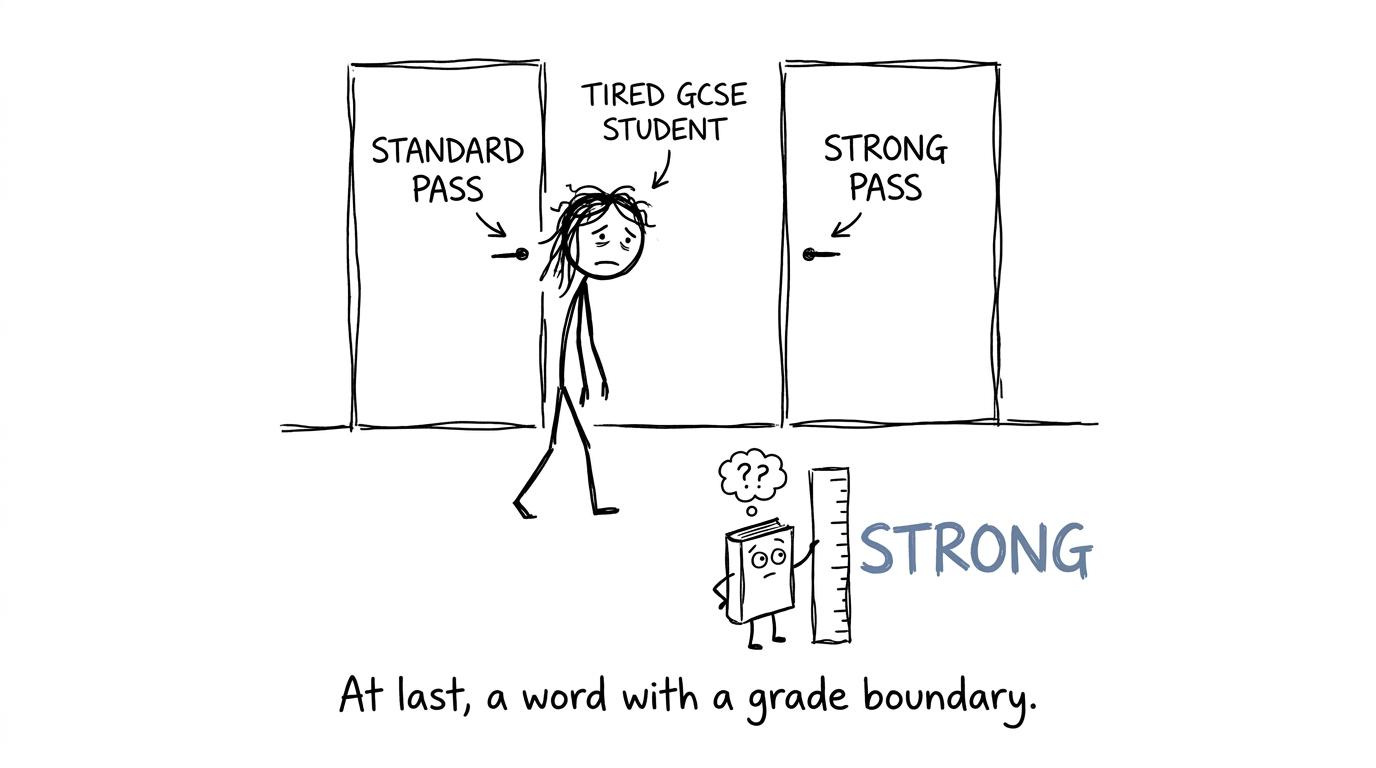 A student discovers that strong pass is a surprisingly measurable phrase
What ability does a grade 5 actually represent?
A grade 5 normally indicates that you can engage with literary texts in a relevant and reasonably developed way. You are doing more than retelling the plot. Across the papers, you have shown enough ability to interpret texts, select supporting references and explain some of the effects created by a writer's choices.
The assessment objectives used across GCSE English Literature specifications focus on four broad areas:
- understanding and responding to texts, supported by references or quotations;
- analysing language, form and structure;
- understanding relationships between texts and their contexts;
- writing clearly and accurately where spelling, punctuation and grammar are assessed.
A grade 5 does not require every paragraph to be sophisticated or every quotation to be perfectly remembered. It suggests that your performance across these areas was secure enough to sit above the standard-pass threshold, although individual strengths can differ. One student might analyse language well but offer limited context. Another might know the text thoroughly but struggle to develop analysis under time pressure.
That is why the grade cannot diagnose your exact strengths by itself. Your marked practice, teacher feedback and individual question scores provide the more useful detail.
What a grade 5 does not mean
It does not mean you understand exactly five ninths of the course. The grades are ordered categories, not equal slices of knowledge.
It also does not mean that every answer reached a particular level. GCSE grades are awarded from the total mark across the assessed components. Strong work in one section can balance weaker work elsewhere.
Most importantly, grade 5 does not automatically correspond to 50%50\%50%. Grade boundaries are set after the papers have been taken and marked. They account for differences in demand between one exam series and another, helping to maintain a comparable standard.
How grade 5 compares with the old letter grades
The safest comparison is broad rather than exact. The numerical and former letter scales have official comparison points, but there is no one-to-one conversion for every grade.
| Current grade | Broad comparison with the former scale | Interpretation |
|---|---|---|
| Grade 7 | Bottom aligned with the bottom of old grade A | A clear official comparison point |
| Grade 6 | Within the former B/C range | Above a grade 5 |
| Grade 5 | Within the former B/C range | Strong pass, often described informally as high C to low B |
| Grade 4 | Bottom aligned with the bottom of old grade C | Standard pass benchmark |
| Grade 1 | Bottom aligned with the bottom of old grade G | Another official comparison point |
The important word is broad. Ofqual's formal comparison points align the bottoms of grades 7, 4 and 1 with the bottoms of the former A, C and G grades respectively. Grades 4, 5 and 6 collectively provide more differentiation across the territory previously occupied by B and C.
So it is reasonable to explain grade 5 as roughly a high C or low B. It is not accurate to declare that grade 5 is always identical to one particular old letter grade.
Grade 5 compared with grade 4 and grade 6
Grade labels can make neighbouring results seem worlds apart. In reality, a student near a boundary may be separated from the next grade by relatively few raw marks.
A grade 4 indicates that the standard-pass benchmark has been reached. Grade 5 is the stronger benchmark used in school performance measures. Grade 6 represents a further step up, usually reflecting more consistent and developed responses across the qualification.
In terms of written performance, the movement from grade 4 towards grades 5 and 6 often involves:
- answering the precise question rather than relying on a prepared general essay;
- selecting references that genuinely support the interpretation;
- explaining how language, form or structure creates meaning;
- developing ideas instead of identifying techniques without analysis;
- maintaining a clear argument across the response;
- managing time well enough to complete every required section.
These are tendencies, not a universal checklist for awarding an individual grade. Examiners award marks using the relevant exam board's mark scheme, and the final grade comes from the total mark.
Why there is no fixed grade 5 percentage
Students often ask, “What percentage is a grade 5?” It feels like the natural question, especially if you are used to tracking your GCSE maths scores numerically. But there is no permanent national percentage.
Grade boundaries vary by exam board, specification and exam series. As an illustration of that variation, AQA GCSE English Literature had a grade 5 boundary of 727272 marks out of 160160160 in June 2023, 747474 in June 2024 and 777777 in June 2025. You can inspect the current and historical figures on MathsGenie's AQA GCSE English Literature grade boundaries page.
Those figures do not create a prediction for a future paper. If an assessment is more demanding, a lower raw boundary can preserve the intended grade standard. If it is more accessible, the boundary may be higher. Boundaries are therefore confirmed after marking rather than promised before the examination.
Your safest revision target is not last year's boundary. It is to collect as many secure marks as possible.
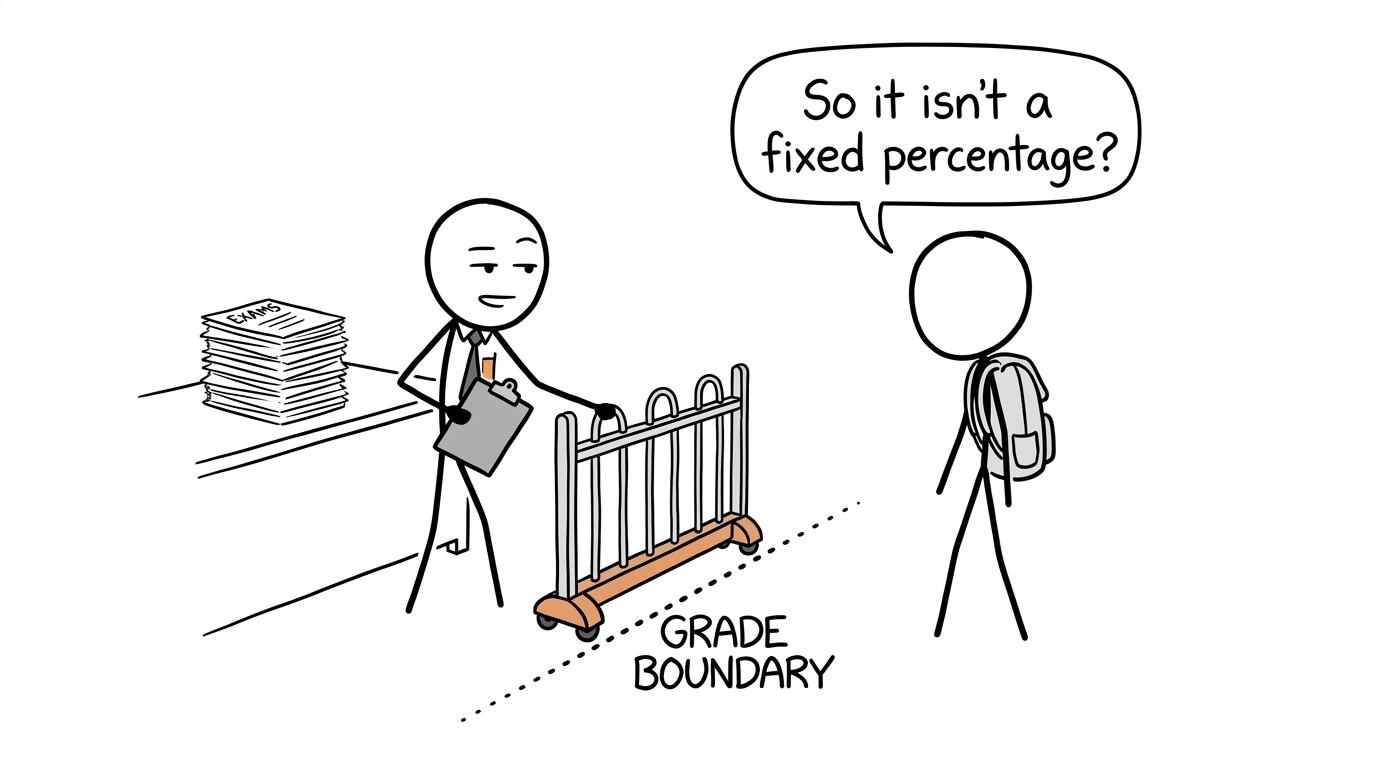 A grade-boundary fence explains why it has wheels
Does grade 5 matter for your next step?
A grade 5 is a credible result, but entry requirements belong to individual sixth forms, colleges, apprenticeships, employers and courses. Never assume that the phrase “strong pass” guarantees entry to every option. Check the published requirements for the institution and course you are considering.
English Language must also be distinguished from English Literature. They are separate qualifications, and a grade in Literature does not automatically become the same grade in Language. Requirements often name English Language specifically, while others may accept either qualification. The wording matters.
If you are considering A Level English Literature, providers commonly set their own subject-specific requirements. A grade 5 may be accepted in one place while another asks for a higher grade. Confirm the requirement directly rather than relying on a general conversion chart.
For students primarily focused on maths, the result still reveals useful transferable skills. Interpreting a question precisely, selecting evidence and building a logical argument all matter in multi-step mathematical reasoning. They are especially valuable when a question asks you to explain, justify, prove or compare.
Balancing English Literature with maths revision
A grade 5 target can become unhelpful if it turns every revision session into a hunt for a guessed boundary. A calmer approach is to measure actions you control.
For English Literature, that may mean planning an argument, retrieving quotations, analysing a short extract and checking the mark scheme. For maths, it means diagnosing a weak topic, reviewing the method, completing questions and correcting errors.
The subjects look different, but the revision cycle is similar:
- retrieve knowledge without notes;
- apply it to an exam-style task;
- compare the response with reliable guidance;
- identify the precise reason marks were lost;
- practise that weakness again.
MathsGenie's guide to finding your weakest GCSE topics helps you turn vague concern into a specific plan. You can then build those priorities into a realistic GCSE maths revision timetable.
 A student's brain recommends revising one subject at a time
Common mistakes when interpreting a grade 5
Treating it as an exact old grade
Calling grade 5 “the new B” or “the new C” is too definite. It sits within the broader territory covered by the old B and C grades, while only certain points on the two scales are formally aligned.
Assuming it always requires the same percentage
Grade boundaries change. A mark that achieved grade 5 in one series may not do so in another. Use previous boundaries for context, not as a guaranteed target.
Confusing English Literature with English Language
The subjects have different assessments and separate results. Read course requirements carefully, particularly where English Language is named.
Thinking one disappointing essay fixes the final grade
The qualification is based on the total marks across its assessed components. One response matters, but it does not independently determine the final result.
Comparing English Literature tiers with maths tiers
Current GCSE English Literature qualifications are untiered. GCSE maths has foundation and higher routes, with different available grade ranges. If you are unsure about your mathematical route, use the GCSE maths topics by exam board and tier guide and confirm your entry with your teacher.
Revising towards a boundary instead of towards better answers
A boundary is an outcome of the assessment process. It cannot tell you which quotation to choose, how to analyse structure or how to organise your time. Concentrate on improving the decisions that earn marks.
Turn the meaning into a useful next step
A grade 5 in GCSE English Literature means you achieved a strong pass and demonstrated a sound ability to understand, interpret and analyse literary texts. It is above the grade 4 standard-pass benchmark and lies broadly within the old B/C territory, without being an exact replacement for either letter.
Once that meaning is clear, the number can stop taking up so much space in your head. You can return to the work that changes results.
For maths, begin at the free GCSE Maths Revision hub. Use revision lessons and practice questions to repair individual topics, then move into mini tests, mark schemes and video solutions. When your knowledge is more secure, learn when to start GCSE past papers and use board-specific collections such as Edexcel GCSE Maths past papers.
Finish with predicted papers as focused preparation, not fortune-telling. A grade records what happened across a set of papers. Good revision decides what you do next.