GCSE English Language vs Literature: Sixth Form
GCSE English Language vs English Literature for sixth form: see which matters more, how entry rules vary and what maths applicants should check.
A sixth-form application can make two familiar GCSEs suddenly feel like rivals. One tests how you analyse and produce language; the other centres on texts, themes and writers' methods. Which one will an admissions team value more?
For students searching GCSE English Language vs English Literature sixth form, the direct answer is reassuring: sixth forms do not universally favour one over the other. Some accept a required grade in either qualification, some specifically name English Language, and courses such as A Level English Literature may require strong grades in both. For an aspiring maths student, the GCSE Maths grade and the published course requirements will usually matter more than whether Language or Literature is your higher English grade.
The important word is published. Entry rules differ between institutions and can change between application years.
The short answer for sixth-form applicants
Use this checklist before worrying about which subject “looks better”:
- Check the general sixth-form entry requirements.
- Check the separate requirements for every A Level or Level 333 course you want to take.
- Notice whether the wording says English Language, English Literature, or either.
- Look for an overall GCSE grade or best-subject score.
- Confirm the requirements for your intended year of entry.
- Ask the admissions team if the wording is unclear.
A grade in English is often one part of a larger academic threshold. A sixth form might require a particular number of GCSEs at grades 999 to 444, 999 to 555 or 999 to 666, alongside minimum grades in English and Maths. It may then set higher subject-specific thresholds for A Level Maths, Further Maths, sciences, economics or English.
That means there are really two questions:
- Does the English grade make you eligible for sixth form?
- Does it meet the requirement for your chosen courses?
The answer may be different for each.
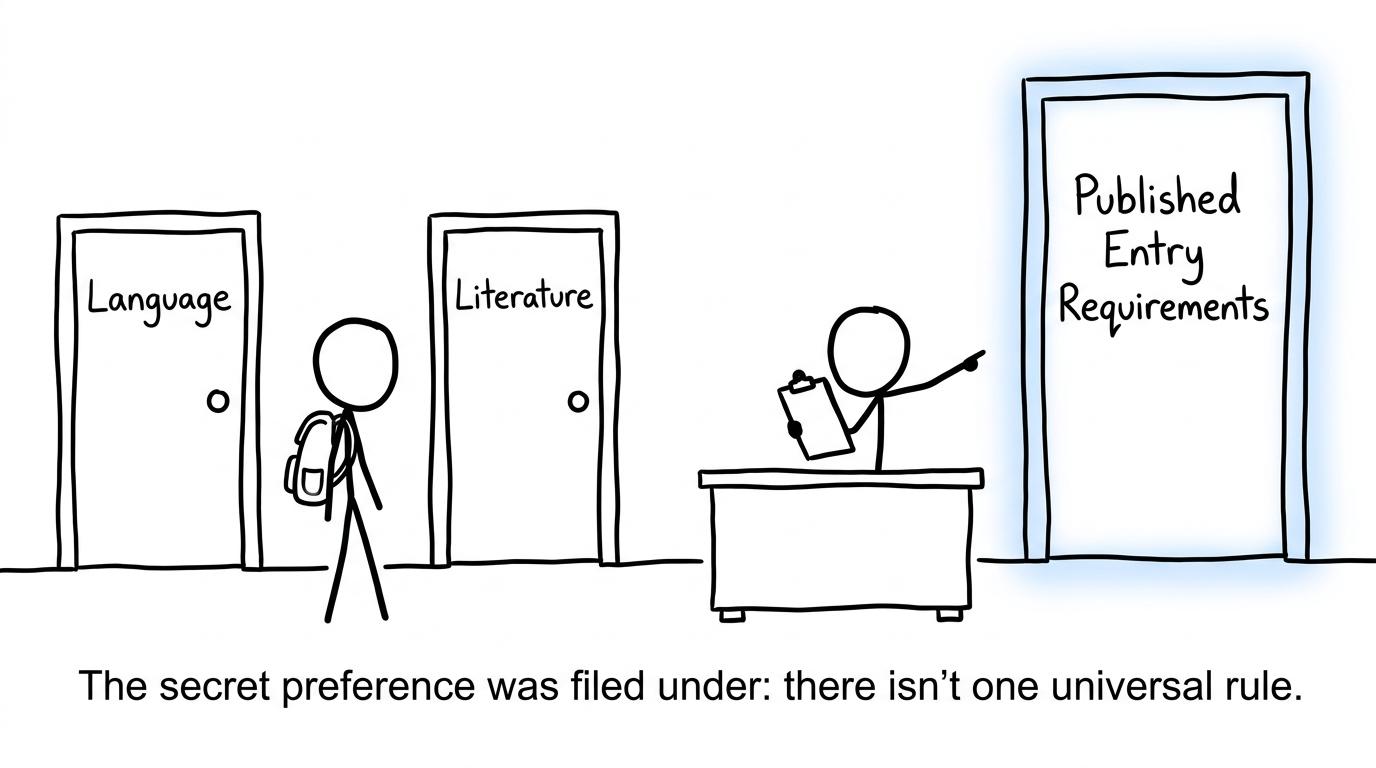 A student discovers that published entry requirements matter more than guessing which English GCSE is preferred
Do sixth forms favour English Language or Literature?
There is no national admissions rule saying English Language must be preferred to English Literature, or the other way around. Individual schools and colleges publish their own academic entry criteria.
Current published policies illustrate the variation. Some institutions require a minimum grade in English Language and Maths. Others write English Language or English Literature, allowing the stronger result to satisfy the English requirement. Some use the highest English grade when calculating an admissions score. These are different systems, not contradictory answers.
English Language can sometimes appear to be the safer qualification because it is explicitly named in many general entry requirements. It directly demonstrates reading, interpretation and written communication, which are useful across post-161616 courses. However, that does not mean Literature is regarded as inferior. A strong Literature result shows sustained analysis, evidence selection and the ability to construct an argument.
The sensible conclusion is this:
English Language may be specifically required by some sixth forms, but where a policy accepts either qualification, neither automatically looks better. The grade and the exact wording of the admissions policy matter more.
Why a grade 444 in either English can still matter
Admissions criteria and government funding rules are related, but they are not the same thing.
Under the published Department for Education condition-of-funding guidance for 161616 to 191919 programmes in England, a student who has achieved grade 444 or above in either GCSE English Language or GCSE English Literature at Key Stage 444 meets the English condition. A student without the required English or Maths attainment may need to continue studying an approved qualification after GCSE.
This does not guarantee admission to a particular sixth form. A school can require grade 555, 666 or higher for entry, even though grade 444 is a standard pass and can meet the national English funding condition. It can also set a specific English Language requirement.
Think of grade 444 as one national threshold, while sixth-form entry requirements are local gates. Passing the first does not automatically open every second one.
What matters for students applying for A Level Maths?
If you want to study A Level Maths, your GCSE Maths result is normally the decisive subject grade. Many sixth forms set a higher Maths threshold than their general entry requirement, often grade 666 or 777, while selective providers may ask for more. Further Maths commonly has an even higher requirement.
Your English result can still affect whether you meet the institution's overall entry criteria. However, an admissions team is unlikely to regard a higher Literature grade as a substitute for the required GCSE Maths grade.
For example, if a provider requires:
- a general pass in English;
- a minimum number of strong GCSE grades; and
- a particular grade in GCSE Maths for A Level Maths,
then all three conditions matter. The English qualification gets you through the general gate; the Maths result determines whether the course itself is open to you.
This is why protecting your Maths grade is so important. Begin with the GCSE Maths revision hub, where you can choose your exam board and find free lessons, topic questions and papers. If your revision feels unfocused, use the GCSE Maths topics by exam board and tier to check that your work matches Edexcel, AQA, OCR or Eduqas and your foundation or higher tier entry.
When English Literature matters more directly
Literature becomes especially relevant when you apply for A Level English Literature or a combined English course. Published sixth-form criteria often ask for a strong Literature grade, and some require specified grades in both Language and Literature.
It may also support applications for essay-heavy subjects such as history, politics, philosophy or law-related courses. Yet there is no universal formula. One provider may accept a grade in either English GCSE; another may name Language; another may consider an essay-based subject more broadly.
Do not turn a useful pattern into an invented rule. Read the course page.
If English is not part of your intended sixth-form programme, Literature can still contribute to your total number of qualifying GCSEs or an overall points calculation. A high grade is valuable because it is a high grade, not because every admissions tutor secretly ranks Literature above Language.
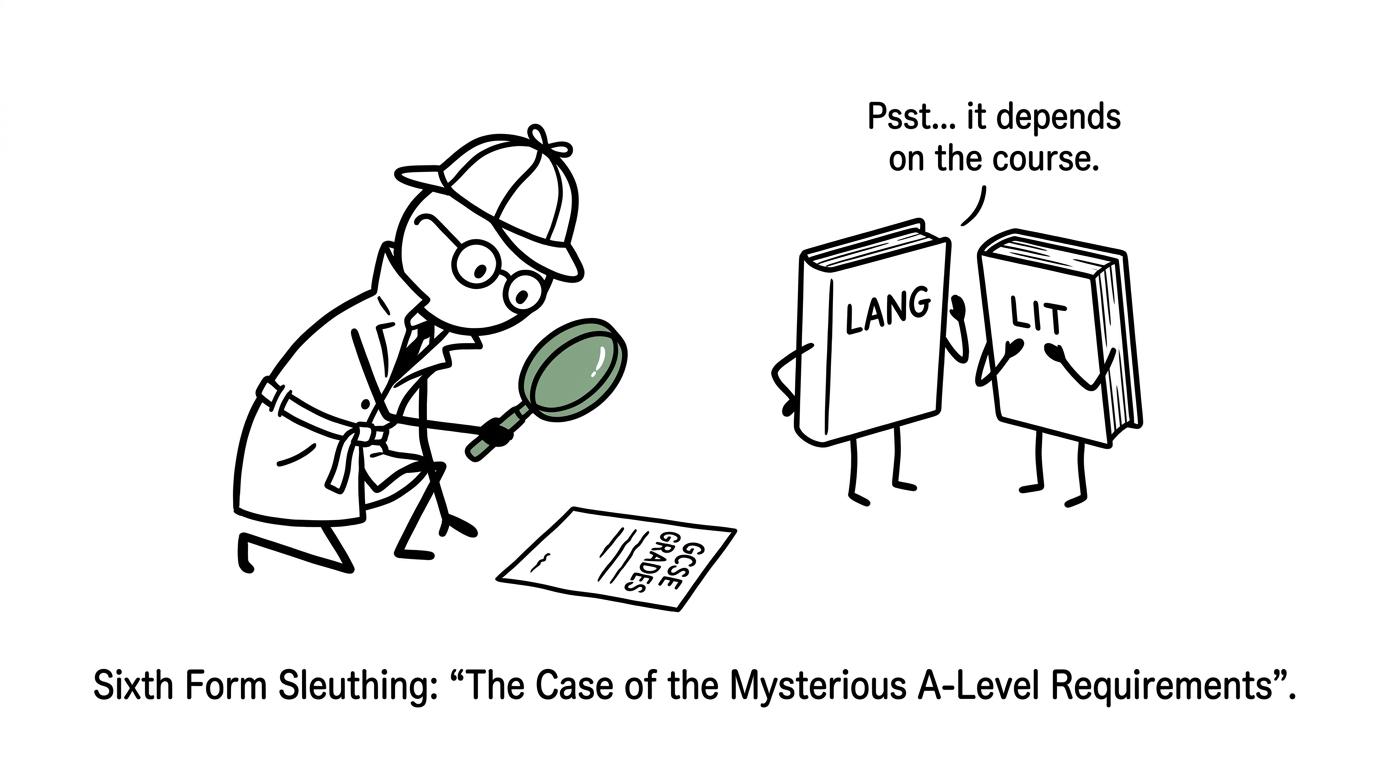 An application form investigates English grades while the books admit that the answer depends on the course
Should you prioritise Language or Literature revision?
Most students entered for both qualifications should not deliberately neglect either one. Your school will set the curriculum and exam entries, and both results can strengthen your GCSE profile.
If time is tight, prioritisation should be based on evidence:
- your target sixth form's exact requirements;
- your current predicted grades;
- the subjects you hope to take after GCSE;
- where focused revision is most likely to recover marks; and
- any risk of missing a compulsory threshold.
Suppose your intended sixth form specifically requires grade 555 in English Language and you are currently near grade 444. Language deserves immediate attention. If it accepts either English qualification and Literature is already secure, the pressure may be lower, although improving Language remains worthwhile.
Apply the same logic to Maths. Use a timed assessment to locate the marks you are losing rather than revising favourite topics repeatedly. MathsGenie's guide to finding your weakest GCSE topics gives you a practical diagnostic process. On busy days, the 20-minute maths revision routine keeps progress manageable.
Build an application-aware revision plan
The best revision timetable reflects both exam risk and future choices. Begin by writing down the actual grades required for your preferred sixth forms and courses. Include a realistic alternative provider because entry requirements and course availability can differ.
Then divide revision time according to need, not anxiety. A subject already comfortably above its threshold may need maintenance. A subject sitting one grade below a course requirement needs deliberate practice and feedback.
For Maths, a reliable cycle is:
- learn or revisit one method;
- answer targeted practice questions;
- mark the work carefully;
- record why marks were lost;
- retest the skill later; and
- move gradually into timed papers.
The one-month GCSE Maths revision plan can help organise this cycle. When you are ready for full exam practice, read when to start GCSE past papers and use Edexcel GCSE Maths predicted papers alongside official past papers rather than as a replacement for them.
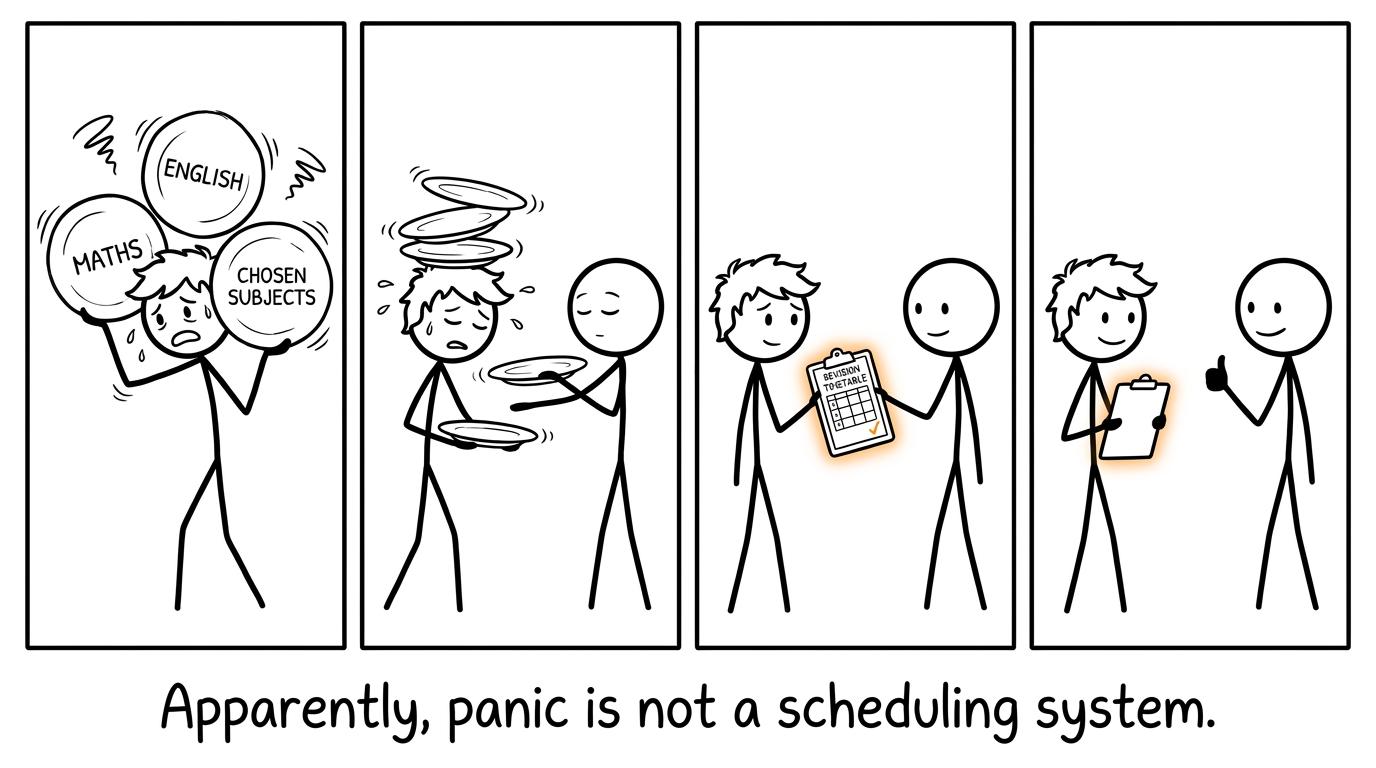 A student learns that balancing English, Maths and chosen subjects is easier with a revision timetable than with panic
Common mistakes when comparing the two GCSEs
Assuming every sixth form uses the same rule
One school's requirement tells you about that school. It does not establish a national preference. Check every provider separately.
Reading only the general entry criteria
Meeting the overall sixth-form threshold may not qualify you for every course. A Level Maths, Further Maths, sciences and English subjects often have additional requirements.
Treating a grade 444 as automatic admission
Grade 444 is an important national benchmark, but sixth forms can publish higher admissions thresholds. Always distinguish a standard pass from a provider's entry requirement.
Believing the subject title matters more than the grade
Where either English GCSE is accepted, a stronger grade may contribute more to eligibility or an overall score than the distinction between Language and Literature.
Sacrificing Maths revision because English feels uncertain
For a prospective A Level Maths student, missing the required GCSE Maths grade can close the course even if the wider application is strong. Use MathsGenie's GCSE revision timetable guide to keep your priorities visible.
Make the rule work for you
There is no universal winner in GCSE English Language versus English Literature for sixth-form applications. Some providers specifically require Language. Many accept either. English-based A Levels may demand strong results in both. For A Level Maths, GCSE Maths is usually the crucial subject-specific result, with English forming part of the general admissions threshold.
So replace guesswork with three actions: download the latest entry criteria, highlight every general and course-specific grade, and revise towards the gaps that could genuinely affect your choices.
Then let MathsGenie make the Maths side simpler. Use the free revision lessons to rebuild methods, practice questions and mini tests to expose weak areas, and past papers, predicted papers, mark schemes and video solutions to prepare for exam conditions. A sixth-form application is built from several grades, but progress still happens one corrected mistake at a time.