

GCSE English Language Revision Book Reviews
GCSE English language revision book reviews: check exam-board fit, question quality, answers and usability before confidently buying a new guide for revision.
Buying a revision guide can feel like buying certainty. The cover promises confidence, the online rating looks reassuring, and the pages appear organised. Yet none of that proves the book will help you prepare for your examination.
The useful answer behind most GCSE English language revision book reviews is simple: yes, you should review or preview a book before buying it. Look beyond star ratings and check its exam board, specification, question style, answer guidance and usability. A good guide should help you practise assessed skills, not merely explain them attractively.
This matters to maths students in particular. Your revision time is shared across several subjects. An unsuitable English guide does not just waste money; it occupies hours that could have gone into a maths mini test, a past paper or proper rest.
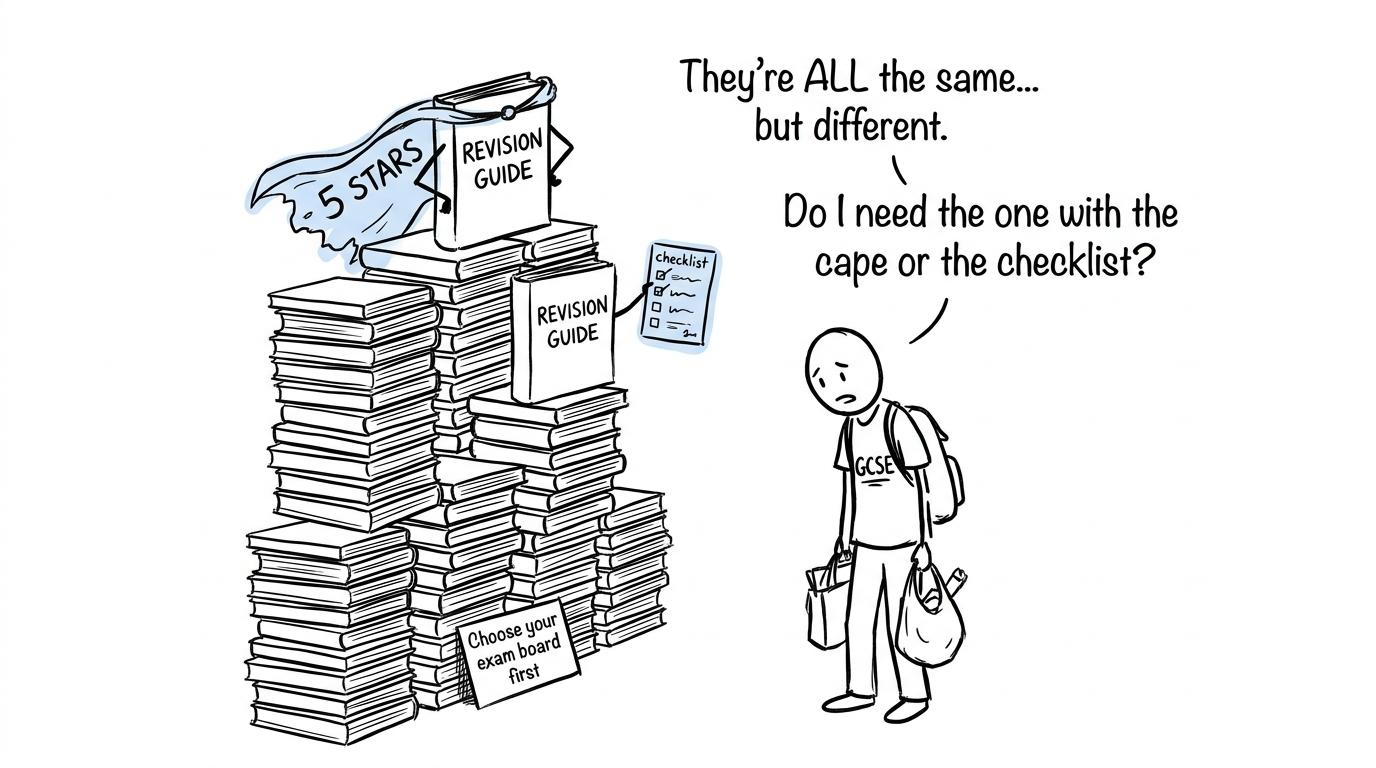 A student choosing between star ratings and a useful checklist
The quick checklist before you buy
Check these features in order:
- Exact exam board and specification: AQA, Pearson Edexcel, OCR or Eduqas, including the qualification code where possible.
- Current edition: it should match the specification you are being taught.
- Accurate paper structure: question order, marks, timings and writing tasks should reflect your course.
- Assessment objective coverage: reading, analysis, comparison, evaluation and writing accuracy must all receive appropriate attention.
- Exam-style practice: the guide should require you to produce answers, not just read advice.
- Useful answers: look for commentary, indicative content or guidance explaining why a response succeeds.
- Clear navigation: you should be able to find one weak skill quickly.
- Realistic workload: activities must fit the revision time you actually have.
- Accessible presentation: font, spacing, colour and digital features should help rather than distract you.
- Value: compare the useful practice you receive with free resources and books already available through school.
If a guide fails either of the first two checks, stop. A large discount cannot make the wrong specification useful.
Why star ratings tell only part of the story
A review score compresses many different judgements into one number. One buyer may reward fast delivery. Another may like colourful pages. A parent might value concise explanations, while a student needing demanding grade 8 or 9 practice may find the same material too shallow.
Ratings also cannot know your weaknesses. A book praised for creative-writing prompts may be a poor purchase if your difficulty is comparing viewpoints or analysing structure. Reviews are evidence, but they are not a diagnosis.
Read the detailed comments instead. Look for repeated observations about factual errors, unclear answers, specification mismatches and the quality of practice questions. Give more weight to reviews that identify the edition and exam board. Treat vague claims such as “this got me a grade 9” cautiously because a grade is influenced by teaching, prior knowledge and many hours of practice beyond one book.
The principle is familiar in maths revision. You would not choose your next algebra topic because it had the nicest cover. You would use evidence from a test. The MathsGenie guide to finding weak GCSE topics explains how mistakes can direct the next revision step. Apply the same thinking to English.
Check the exam board and specification first
GCSE English Language is not arranged identically by every exam board. AQA, Pearson Edexcel, OCR and Eduqas assess the nationally defined English Language skills, but their papers organise texts, questions, timings and marks differently. Even books covering similar assessment objectives are not automatically interchangeable.
Check the specification code on material supplied by your school. Examples include AQA 8700, Pearson Edexcel 1EN0 and OCR J351, but you should confirm your exact qualification with your teacher because boards can offer more than one qualification or update their materials.
Then compare the guide with a recent official paper. Ask:
- Do the paper names and lengths match?
- Are the reading texts drawn from the correct periods and genres?
- Does the guide teach the question types in the right order?
- Are mark totals and suggested timings accurate?
- Does it separate the Spoken Language endorsement from the written grade correctly?
Official subject requirements divide the written assessment equally between reading and writing. They also require spelling, punctuation, vocabulary and sentence structures to contribute 20%20\%20% of the qualification marks. Spoken Language is compulsory and reported separately, but it does not contribute to the final grades 9-1 result. A book that blurs these distinctions may lead you to distribute revision time badly.
This board-first habit matters in maths too. The GCSE Maths revision hub lets students select the appropriate exam board, while the GCSE Maths topics by board and tier guide explains why specification matching matters.
Inspect how completely it covers the assessed skills
A thick book can still have thin coverage. Use the contents page and index rather than judging by page count.
A suitable English Language guide should address the core assessment objectives. It should help you identify explicit and implicit information, analyse language and structure, compare ideas and perspectives, evaluate texts, organise writing for purpose and audience, and improve technical accuracy.
Coverage should also be balanced. Some guides spend many pages naming techniques because this is easy to summarise. The examination asks for more: you must explain effects, support interpretations with textual references and shape a coherent response. Spotting a metaphor is not the same as analysing why it matters.
For writing, check whether the guide covers both ideas and control. Imaginative vocabulary alone cannot replace organisation, register, punctuation and accurate sentences. The strongest resource makes the assessment criteria visible without turning every answer into a rigid formula.
Test the questions and answer guidance
Practice is the point at which a revision guide proves its value. Before buying, inspect a sample chapter in a shop, library or publisher preview where legitimately available.
Choose one task and ask three questions:
- Does it resemble the wording and demand of an official examination question?
- Is there enough space or guidance for genuine planning and response?
- Does the answer section explain what earns marks?
A bare model answer is less helpful than it first appears. You can admire it without learning how it was constructed. Better guidance identifies successful analysis, evidence selection, organisation and technical control. It should also recognise that English responses can take more than one valid approach.
Look for opportunities to practise with unseen material. GCSE English Language examines transferable reading and writing skills rather than your memory of one set text. A guide that repeatedly rehearses only its own short examples may create familiarity without flexibility.
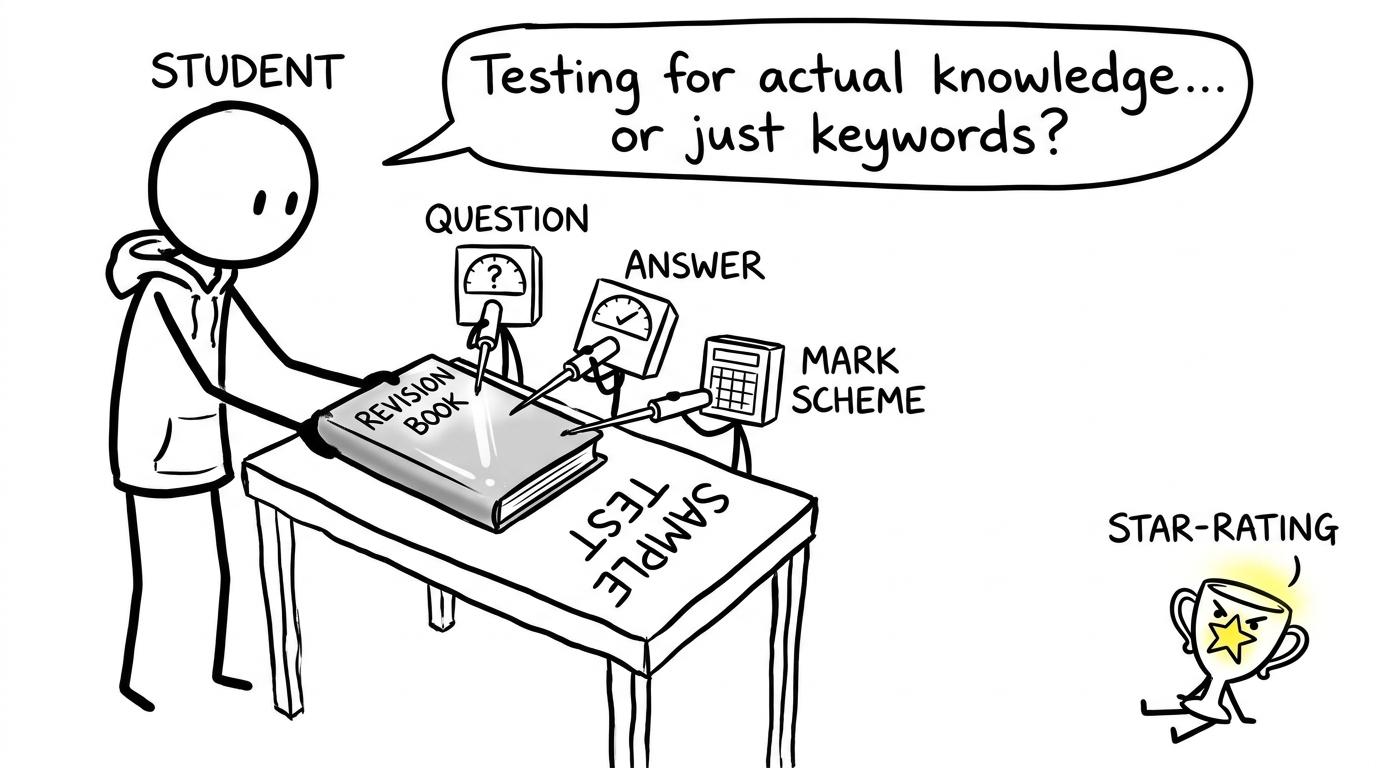 A revision guide being tested while its star rating waits nearby
This is the same distinction between reading a method and performing it. MathsGenie's guide to using GCSE past papers properly recommends a cycle of attempting, marking, correcting and retesting. For mathematics, Edexcel GCSE past papers and Edexcel GCSE mini tests make that cycle practical. Your English guide should support an equally active process.
Decide whether the format fits your revision habits
The best book is not necessarily the most comprehensive one. It is the one you can use consistently without losing sight of exam practice.
If you revise in short sessions, look for self-contained sections with a clear task and answer guidance. If long pages overwhelm you, choose uncluttered layouts and manageable blocks of text. If you use assistive technology, investigate the digital edition, zoom options, contrast and compatibility before paying.
Also test navigation. Imagine that a marked response shows weak comparison. Can you find the relevant guidance within a minute? A revision guide should behave like a tool, not a book you must read from beginning to end.
Avoid paying twice for the same material. Check what your school, local library or existing workbook already provides. A second summary guide has little value if what you actually lack is question practice and feedback.
Fit the book into a cross-subject revision plan
For a student preparing for maths exams, the hidden cost of any book is time. English Language and maths both improve through active attempts followed by careful correction, so neither subject should become endless passive reading.
A sensible English session might contain one focused explanation, one timed paragraph or plan, and a review against the assessment criteria. A maths session can follow the parallel rhythm of lesson, practice questions, mark scheme and retest. The guide to revising Edexcel GCSE Maths efficiently develops this approach in more detail.
Plan by need rather than giving every subject identical time. A compact English guide you use three times a week may be more valuable than an encyclopaedic book that stays closed. Likewise, short targeted mathematics practice can reveal more than rereading an entire chapter.
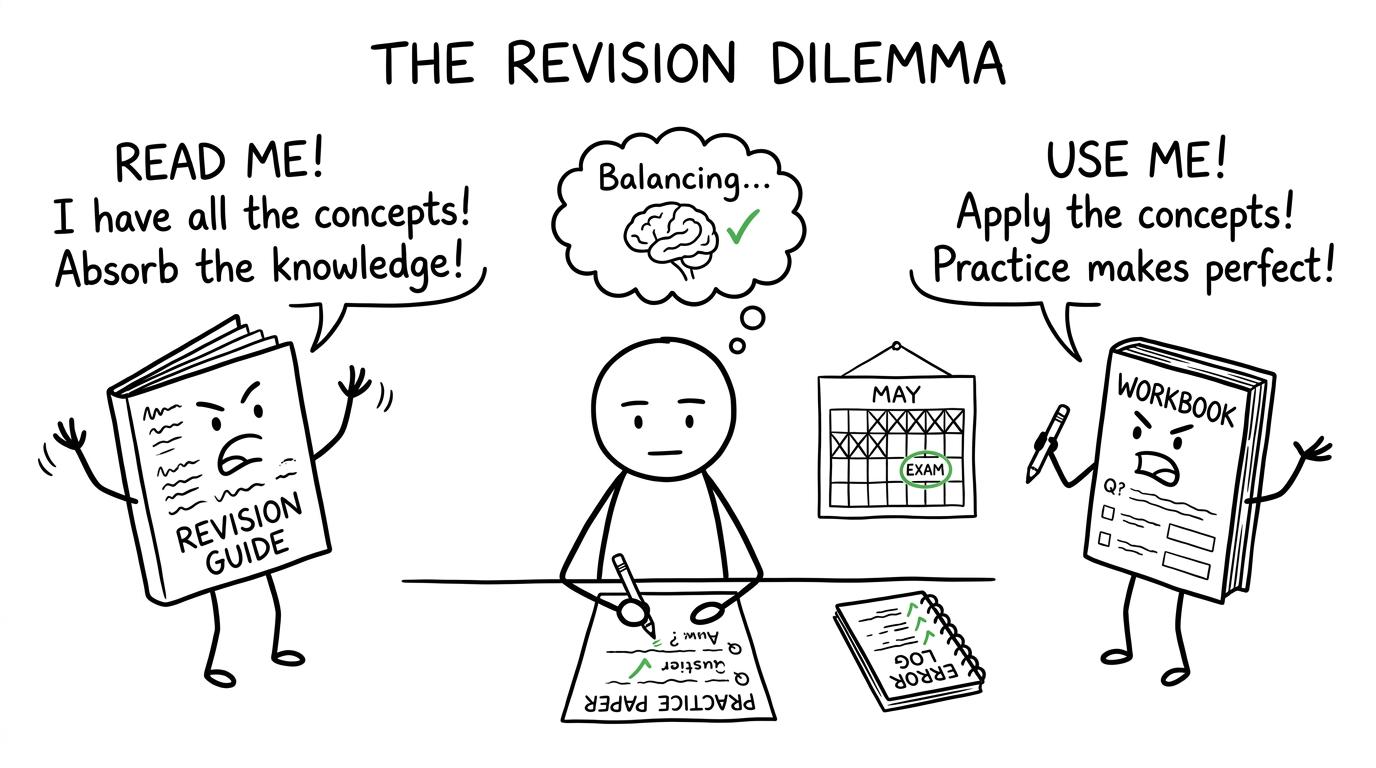 Two revision books debate while the student gets on with practice
Common mistakes when choosing a revision guide
Buying for the subject but not the qualification
“GCSE English” is not specific enough. English Language and English Literature are different qualifications, and each exam board has its own paper structure. Confirm the full title and code.
Assuming the newest-looking cover means current content
Design can be refreshed without resolving every content issue. Check the publication details and compare the paper information with your teacher's current specification.
Choosing only by average rating
A high score may reflect delivery, price or presentation. Read the reasons behind positive and negative reviews, then inspect the material yourself.
Confusing explanation with revision
Reading can create a comforting sense of recognition. Examinations require retrieval, analysis, decisions and writing under time pressure. Buy a guide only if it helps you do those things.
Expecting one resource to provide everything
A book cannot replace teacher feedback, official papers and repeated practice. Treat it as one part of a revision system.
Buying a guide that is too easy or too dense
A resource should stretch you without making every session unusable. Sample a page, attempt a question and inspect the answer guidance before deciding.
Make the purchase earn its place
The value of reviewing a GCSE English Language book before buying it is not merely avoiding a poor product. It is deciding what role the book will play.
Choose it when it matches your exact specification, covers your weak skills, provides credible exam practice and offers feedback you can act upon. Borrow, preview or leave it when those conditions are missing. The quiet truth of revision is that ownership changes very little; repeated, corrected practice changes much more.
Then protect the rest of your timetable. Use MathsGenie as your free maths revision base, beginning with the GCSE Maths revision area. Work through revision lessons and practice questions, check mark schemes and video solutions, then build exam confidence with mini tests, past papers and predicted papers. One carefully chosen English guide and one disciplined maths routine will serve you better than a shelf of resources you never truly use.











