GCSE English Language Part Time Job Balance
GCSE English Language part time job balance: build a realistic weekly plan, protect sleep and revise effectively around changing shifts and maths.
A part-time job rarely takes only the hours printed on the rota. There is the journey, the uniform, the tiredness afterwards and the awkward shift that appears just before a mock. That is why gcse english language part time job balance is not really about finding endless spare time. It is about protecting a few reliable revision periods before work claims the rest of your week.
The practical answer is simple: enter your shifts first, protect sleep and school commitments, then schedule short English Language sessions around your energy. Keep longer reading and writing tasks for non-work days. If you are also preparing for maths exams, give each subject a clear purpose rather than trying to revise everything every evening.
Your realistic balance checklist
Before building a detailed plan, make these decisions:
- Put confirmed shifts, travel and school commitments into one calendar.
- Reserve enough time for sleep before adding revision.
- Choose two or three English Language skills to improve this week.
- Use short sessions before shifts and longer sessions on days off.
- Give maths its own protected slots, especially for timed practice.
- Ask about rota changes early, particularly near mocks and final exams.
- Keep one flexible session available for disruptions.
- Review the plan weekly rather than treating it as permanent.
A timetable should describe the week you actually have. A beautiful plan based on imaginary free evenings will only make a busy student feel behind.
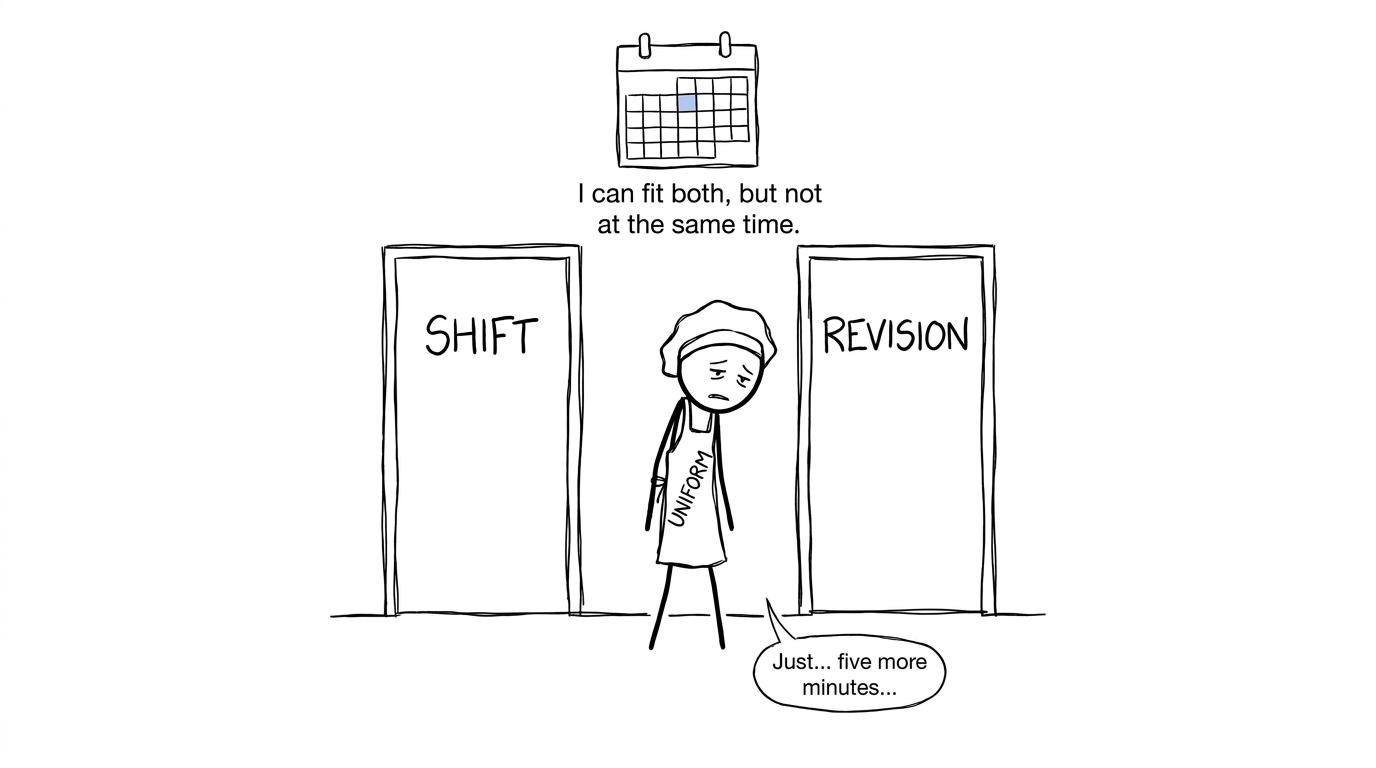 A student negotiating calmly with doors labelled Shift and Revision
Start with capacity, not ambition
Many revision plans begin with a list of subjects. A better plan begins with capacity.
Think of your available time as:
revision capacity=free time−travel−meals−rest−essential tasks\text{revision capacity}=\text{free time}-\text{travel}-\text{meals}-\text{rest}-\text{essential tasks}revision capacity=free time−travel−meals−rest−essential tasksDo not subtract sleep as though it were optional. NHS-linked guidance suggests that teenagers generally need around 888 to 101010 hours each night, although individual needs vary. A late shift followed by exhausted revision and an early start may create the appearance of effort without producing much useful learning.
Your job also includes hidden time. If a four-hour shift requires travel in both directions and time to change, block the entire period. Then ask what kind of revision your remaining energy can support.
A short pre-shift period may suit planning a writing response, recalling punctuation rules or annotating a paragraph. A full unseen reading section needs greater concentration. So does a maths mini test. Match the task to the energy available rather than forcing every session to look identical.
The same principle underpins a sensible GCSE maths revision timetable: short topic work during busy weekdays, with longer timed practice when there is space to mark and review it properly.
Build the week around fixed shifts
Treat confirmed work hours as fixed. Everything else should be placed around them in a deliberate order.
Protect the immovable commitments
Enter school, travel, meals, sleep and genuine family responsibilities first. Add your shifts, including the journey and recovery time. Next, mark deadlines and scheduled assessments.
Only then should you add revision.
This approach may reveal less available time than you hoped. That is useful information. It allows you to reduce the plan before the week begins instead of abandoning it halfway through.
Employment rules depend on your age, whether you are still below school-leaving age, where in the UK you live and sometimes local authority by-laws. In England, children below school-leaving age are generally limited to 121212 hours of work during a term-time week, with further restrictions on school days, Sundays and working times. Different protections apply to young workers above school-leaving age but under 181818, including limits and rest entitlements.
Check the rules that apply to you with a parent, carer, employer, school or local authority. If your hours appear unsafe, unlawful or harmful to your education, raise the issue with a trusted adult rather than trying to solve it through a harsher revision timetable.
Use revision anchors
An anchor is a session attached to something predictable. It might be the first 252525 minutes after breakfast on Saturday or a quiet library session immediately after school on Tuesday.
Choose a small number of anchors that survive most weeks:
- one English reading session;
- one English writing session;
- two focused maths topic sessions;
- one flexible review period.
When shifts change, move the flexible work first. Protect the anchors where possible. Consistency is easier when revision has a familiar place rather than depending on motivation at the end of every day.
Revise English Language by skill, not by vague intention
“Revise English” is too broad to begin. GCSE English Language assesses reading and writing skills, although the exact paper structure and timings differ between AQA, Edexcel, OCR and Eduqas. Your plan must match your specification and your teacher's guidance.
Useful session labels are specific:
- retrieve evidence from an unseen passage;
- analyse how language creates an effect;
- compare viewpoints across texts;
- plan a narrative or description;
- organise an argument for a stated audience;
- edit spelling, punctuation and sentence control;
- complete and mark one timed response.
This matters when time is scarce. A focused instruction reduces the effort needed to start.
Before a shift, choose a low-friction task: read one passage, select evidence or create a writing plan. On a non-work evening, complete an extended response. At the weekend, attempt a timed section and compare it with the relevant mark scheme or teacher feedback.
Do not assume that every English session must involve writing pages. Planning, marking and improving a paragraph can all be valuable when they target a known weakness.
Keep maths moving without competing with English
English Language and maths demand different kinds of practice, but they can share the same revision system: attempt, mark, diagnose and return.
Start with the GCSE maths revision hub, where resources are organised by exam board and include Edexcel, AQA, OCR and Eduqas. Choose work that matches your foundation or higher tier rather than opening a random worksheet.
On a work day, a short revision lesson followed by a few practice questions is usually more realistic than a full paper. MathsGenie's approach to revising efficiently without wasting time follows a useful cycle: learn a method, practise it, mark the work and retest the weak area.
Save longer tasks for days off. The MathsGenie past papers library provides papers with official mark schemes, while selected resources include worked or video solutions. Nearer the exams, Edexcel GCSE maths predicted papers can provide fresh exam-style practice, but they should support rather than replace official past papers.
The important distinction is between completion and correction. One carefully marked maths section and one improved English paragraph are more useful than two hurried tasks that receive no review.
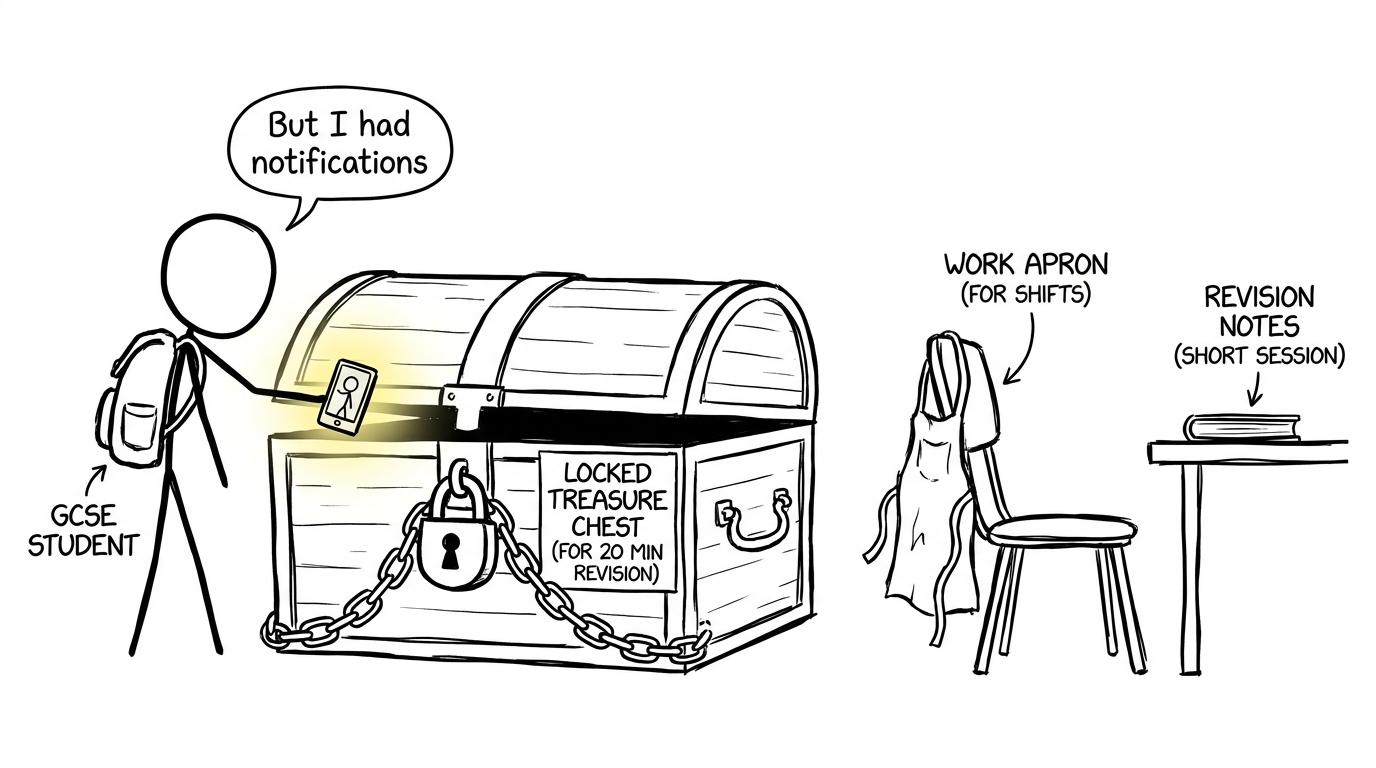 A student locking away a talkative phone before revision
Plan differently for work days and days off
A single daily target ignores how different your days can feel.
On a school and work day
Keep revision compact. Choose one task that can be finished and checked. You might plan an English response, revise one maths topic or correct previous work.
Avoid beginning a full paper shortly before leaving. An unfinished task creates mental clutter and is difficult to resume accurately after a shift.
On a school day without work
Use your best available concentration for an extended English response or a timed maths section. Leave time to mark it. If you routinely complete questions without reviewing them, your timetable is measuring activity rather than improvement.
On a day off
Use two separate blocks rather than one marathon session. One can focus on English Language; the other can cover maths or another priority subject. Include breaks, food and ordinary life.
If the exams are close and your week has become unusually crowded, adapt the ideas in the GCSE one-week maths revision plan. Diagnose first, select a small fix list and avoid trying to rebuild the entire course in seven days.
Talk to your employer before exam pressure peaks
A good manager cannot respond to information they do not have. As soon as your school confirms mocks or final exam dates, explain your availability clearly and politely.
You could ask whether:
- your regular hours can be reduced temporarily;
- a shift can be exchanged with a colleague;
- you can avoid late work before an exam;
- your availability can be recorded several weeks ahead;
- extra holiday shifts can replace some term-time hours.
Do not promise unlimited availability and hope revision will somehow fit around it. Set boundaries early. Keep requests specific and, where possible, offer workable alternatives.
Remember that the national exam window can include contingency arrangements. Follow the timetable and instructions issued by your school or college, and avoid committing yourself to work or travel when you are required to remain available.
What to do when the rota changes
A changing rota needs a flexible plan, not no plan.
At the start of each week, sort revision into three groups:
- Essential: preparation tied to an imminent assessment or a serious weakness.
- Important: useful practice that should happen if the week runs normally.
- Optional: extra tasks that can move without damaging your progress.
If you receive an extra shift, remove or relocate an optional task first. Do not automatically take time from sleep. If changes happen repeatedly, speak to your employer and tell a parent, carer or teacher that your workload is becoming difficult.
For maths, smaller resources can preserve momentum when a full paper no longer fits. The guidance on when to start GCSE past papers explains how mini tests, paper sections and targeted questions can lead gradually towards complete timed papers.
Common mistakes when balancing revision and work
Treating every free hour as usable revision time
Time after a demanding shift may not be high-quality time. Schedule lighter correction or recall tasks there and protect more demanding work for when you are alert.
Revising only the subject that feels urgent
English may dominate before a mock, then maths disappears for a week. Keep a small maintenance session for each core subject so that restarting never feels enormous.
Counting work completed but not marks learned
Finishing a paper is only the first half of revision. Use mark schemes, teacher feedback and video solutions to identify why marks were lost. The guide to using Edexcel maths past papers properly shows how to turn errors into targeted next steps.
Sacrificing sleep to rescue an overloaded plan
If the plan requires repeated late nights, the plan is too large. Reduce lower-priority tasks, discuss your shifts and ask teachers which areas deserve attention first.
Leaving employer conversations until the last minute
Last-minute requests are harder to accommodate. Share confirmed dates early and update your availability whenever the school timetable changes.
Make the balance sustainable
Balancing GCSE English Language with a part-time job does not require a flawless timetable. It requires honest limits, protected rest and revision tasks small enough to complete around real shifts.
Plan English by skill. Give extended reading and writing tasks your fresher periods. Keep maths active through short lessons, practice questions and mini tests, then use longer sessions for papers and careful marking. If the evening before an exam becomes crowded, follow a calm GCSE maths night-before plan rather than attempting a final marathon.
MathsGenie can reduce the number of decisions you have to make. Start with free revision lessons, move into targeted practice questions and mini tests, then build towards past papers and predicted papers. Use the mark schemes and video solutions to correct mistakes instead of merely collecting completed pages.
Your job can fit beside your GCSEs, but neither should be allowed to consume every available hour. Open the MathsGenie GCSE hub, choose one weak maths topic and schedule one manageable session around this week's rota. A realistic plan repeated calmly will take you further than an ambitious plan that lasts two days.