

GCSE English Language and Literature Christmas Revision
GCSE English language and literature Christmas holiday revision: build a balanced plan that improves exam skills while protecting rest and family time.
Christmas revision often begins with an impossible picture: every subject open at once, a colour-coded timetable covering every waking hour, and the quiet suspicion that everyone else is doing more.
A reasonable GCSE English language and literature Christmas holiday revision plan is much smaller. For most students, aim for around six focused English sessions across a two-week break, each lasting roughly forty-five to sixty minutes. Add more only if mocks are close or your teacher has identified urgent gaps. Keep several complete days free and protect your sleep.
The aim is not to finish English by January. It is to return to school remembering your texts, understanding your weakest exam skills and knowing what to practise next.
Your Christmas revision checklist
A balanced plan should include:
- around six focused English sessions across the holiday
- separate work for English Language and English Literature
- active tasks, such as planning, recalling, writing and marking
- at least one timed response or timed section
- several days with no revision at all
- a small, protected slot for maths and other subjects
- time for sleep, family, friends, exercise and ordinary holiday life
This is practical guidance rather than an official exam-board requirement. Your appropriate workload depends on your mock dates, school homework, current grades and personal circumstances.
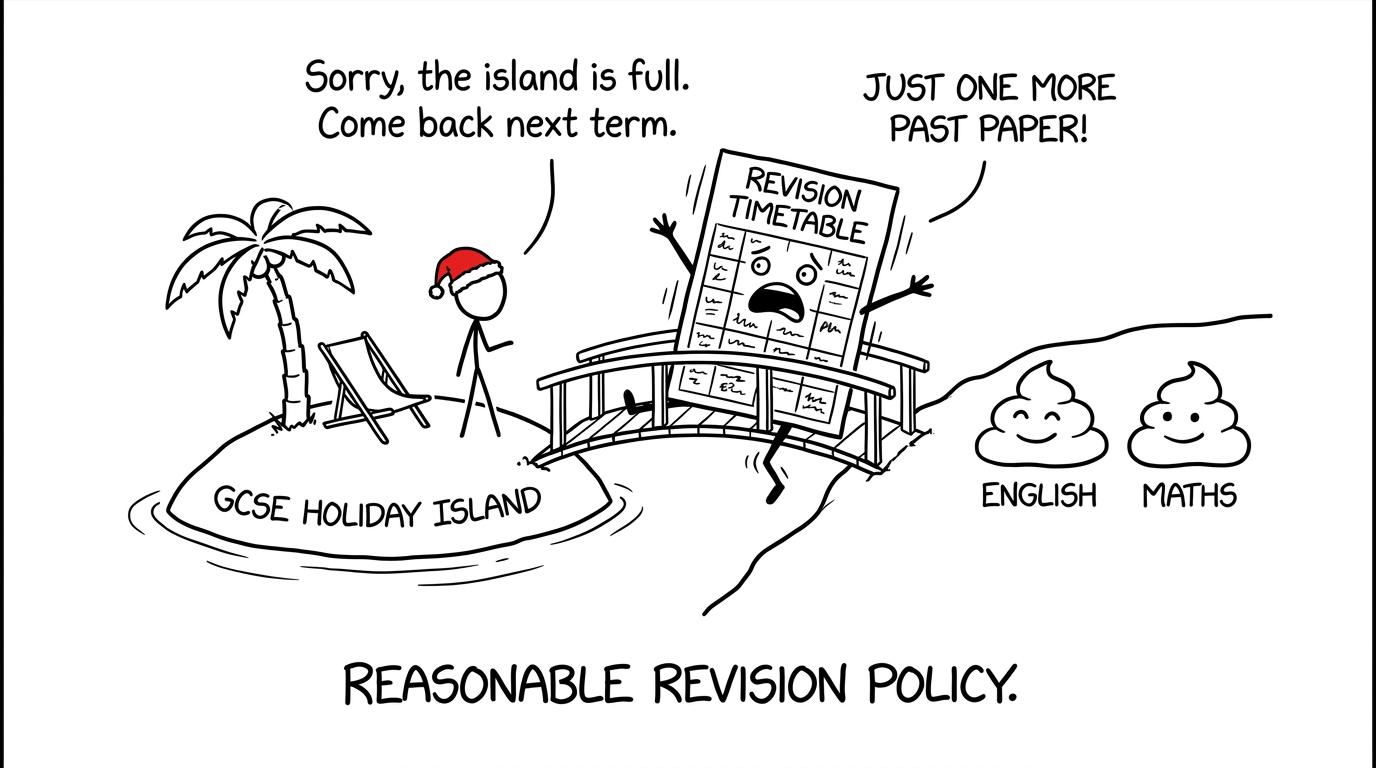 A student protects a peaceful Christmas island from an oversized revision timetable
How much Christmas revision is reasonable?
For many Year 11 students, between five and seven hours of English across the whole break is a sensible starting point. That is enough time to complete meaningful work without allowing one subject to consume the holiday.
If mocks begin immediately after Christmas, you might increase this slightly. If you are exhausted after a difficult term, have caring responsibilities or have already completed substantial school work, less may be appropriate. A timetable is useful only when it reflects the life you actually have.
Think in sessions rather than daily targets. Requiring yourself to revise every day creates unnecessary guilt when Christmas plans change. Six deliberate sessions are more valuable than fourteen evenings spent staring at notes while tired.
A simple pattern might be:
| Session | Main focus | Useful outcome |
|---|---|---|
| Language session | Unseen reading | Annotated extract and one developed response |
| Literature session | Character or theme | Quotation retrieval and an essay plan |
| Language session | Transactional or creative writing | Plan, opening and edited paragraph |
| Literature session | Poetry or a second set text | Comparison plan or theme map |
| Language session | Timed exam practice | Marked response with two improvements |
| Literature session | Mixed retrieval | Quotations, interpretations and context checked |
Leave space between sessions. Revision that can be repeated calmly is more useful than an ambitious plan abandoned after three days.
Divide the time between Language and Literature
Although the subjects are related, they demand different kinds of preparation.
English Language revision
English Language is primarily about transferable reading and writing skills. The exact paper structure varies across AQA, Edexcel, OCR and Eduqas, so use the specification, question wording and timings taught by your school.
Useful Christmas tasks include:
- reading an unseen fiction or non-fiction extract closely
- identifying explicit and implicit ideas
- analysing how language and structure shape meaning
- comparing viewpoints where your paper requires it
- planning descriptive, narrative or transactional writing
- editing for clarity, vocabulary, spelling and punctuation
Do not spend the entire holiday producing full papers. One timed task can expose useful weaknesses, but shorter focused responses are easier to mark and improve.
English Literature revision
Literature revision depends on the texts selected by your school. Exam boards have different text lists, combinations and paper arrangements, so revise only the correct specification and set texts.
Your sessions should strengthen three things:
- knowledge: plot, characters, themes and relevant context
- evidence: short, flexible quotations and precise references
- argument: a clear interpretation supported by analysis
A quotation is useful when you understand what it reveals and where it can fit. Memorising a large list without practising interpretation can create the feeling of progress while leaving essay writing unchanged.
Use active revision rather than comfortable revision
Rereading feels productive because everything looks familiar. Exams ask for something harder: recalling ideas independently and using them under pressure.
Close the book before testing yourself. Write down the quotations you remember for a theme. Plan a response without looking at class notes. Explain why a structural choice matters. Then check your work and fill the gaps.
A productive English session has four stages:
- choose one precise target
- retrieve what you already know
- complete one exam-related task
- check it and record the next improvement
For Language, that improvement might be developing analysis beyond naming a technique. For Literature, it might be selecting evidence that supports the argument more precisely.
Mark schemes are valuable, but they are not scripts to imitate word for word. Assessment objectives describe what examiners reward. In English Language, these include comprehension, analysis, comparison, evaluation and effective writing. In Literature, they include informed responses, textual references, analysis of methods and, where relevant, context. The weighting and application depend on the question and specification.
Keep maths alive without doubling your workload
If you are preparing for GCSE maths exams too, English revision should not quietly replace maths for two weeks. Nor should both subjects take over every day.
Alternate them. An English session might be followed the next day by a short maths session. On a busier day, the twenty-minute GCSE maths revision routine provides a manageable way to maintain fluency without beginning a marathon.
Use the GCSE maths revision hub to choose work matching your board and tier. Edexcel, AQA, OCR and Eduqas organise their papers differently, while foundation and higher tier students need appropriately targeted questions. The GCSE maths topics by exam board and tier guide can help you check that your practice is relevant.
The important word is maintenance. Christmas is a good time to repair one or two weak areas, not to revisit the whole specification.
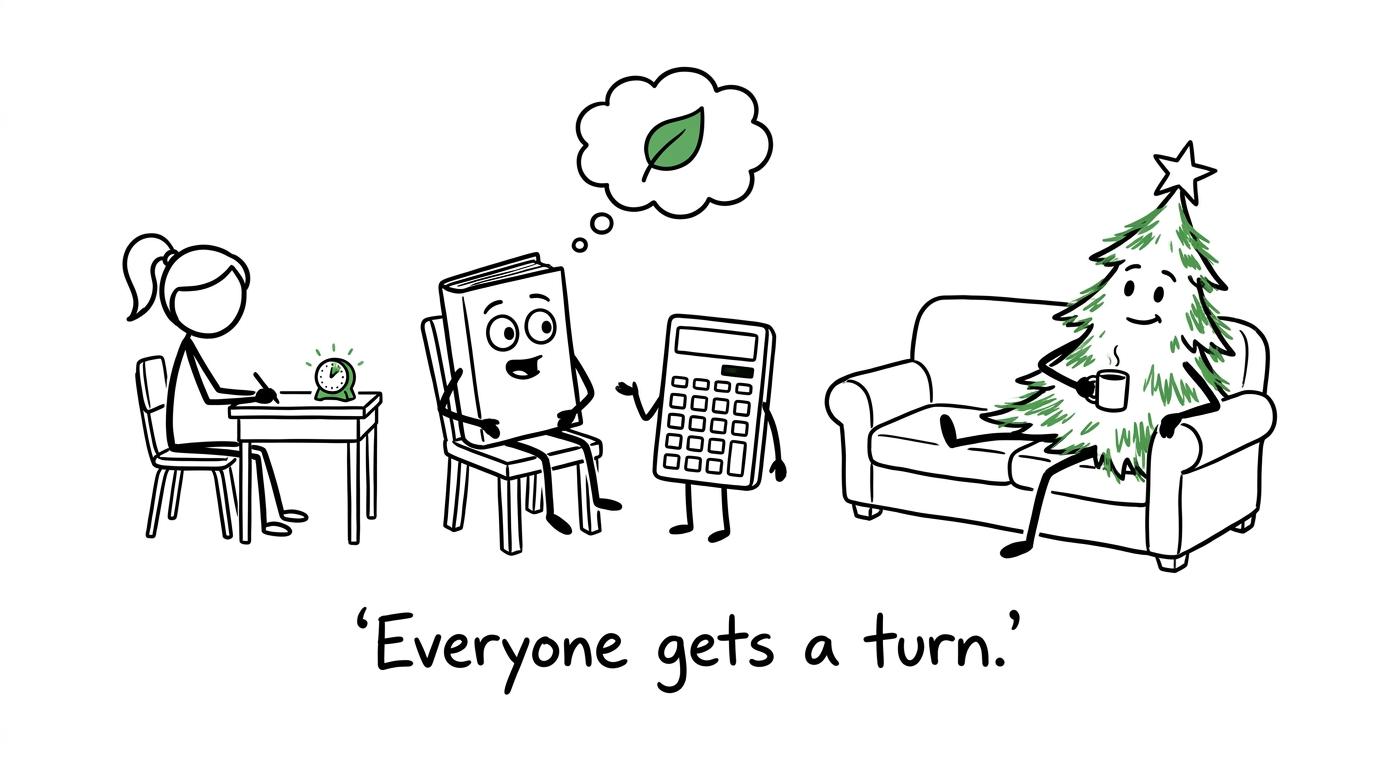 A novel and calculator politely take turns in the revision chair while the Christmas tree relaxes
Build a plan around priorities, not anxiety
Begin with evidence. Look at recent teacher feedback, mock responses and marked homework. List the English tasks that repeatedly cost you marks. Make each weakness specific.
“English Language” is too broad. “I identify methods but do not explain their effects” is useful. “Literature quotations” is vague. “I cannot recall evidence for responsibility in my set text” gives you a starting point.
The same principle works in maths. MathsGenie’s guide to finding your weakest GCSE topics explains how to turn lost marks into focused revision. Once the gaps are visible, the GCSE maths revision timetable guide can help you spread practice without overcrowding the week.
Choose a minimum plan before adding optional work. Your minimum might be six English sessions and three short maths sessions. If you complete those and feel rested, additional practice is a choice rather than a debt hanging over the holiday.
Make each English session produce evidence
A session should leave something you can inspect. That might be an essay plan, a paragraph, a quotation grid completed from memory or a marked timed answer.
Avoid turning note-making into an art project. Attractive resources can support recall, but decoration does not prove that you can answer a question. Ask yourself: What can I now do that I could not do before this session?
Keep a small improvement log with three headings:
- what I attempted
- what weakened the response
- what I will change next time
This prevents repeated practice from becoming repeated error. It also gives you a useful starting point when school resumes.
Protect rest as part of the plan
Rest is not the reward for completing every possible task. It is one of the conditions that allows focused work to happen.
NHS guidance says most teenagers need around eight to ten hours of sleep each night. An all-night revision session is therefore a poor trade: it exchanges tomorrow’s concentration for a few tired hours tonight.
Schedule stopping times. Keep Christmas Day or other important family days completely free if that suits your circumstances. Put phones away during short sessions, then finish properly rather than carrying background guilt through the rest of the day.
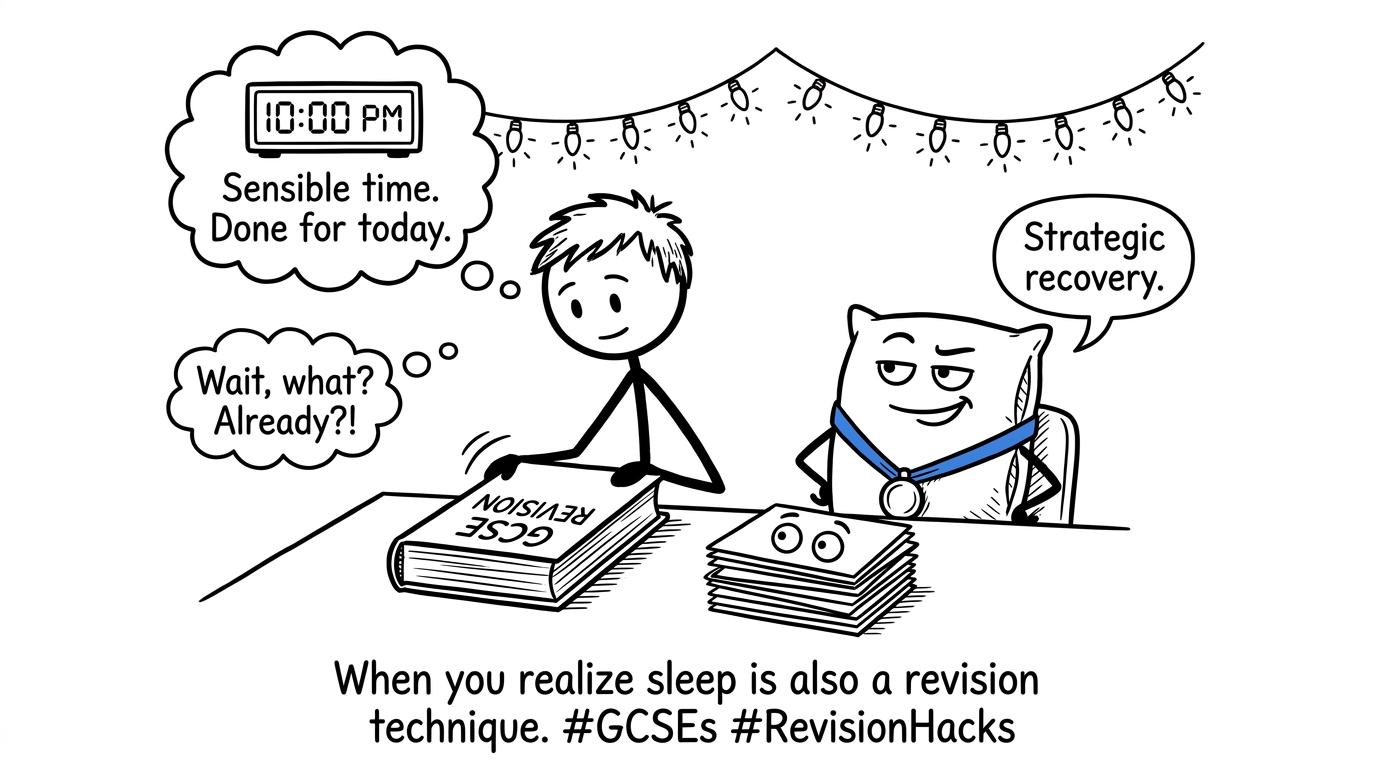 A pillow wins a medal for strategic recovery while the flashcards look surprised
Common Christmas revision mistakes
Trying to revise every text and skill
Breadth can become avoidance. Choose the few areas most likely to improve your next response, based on feedback rather than fear.
Memorising essays
A memorised essay may not answer the question set. Learn adaptable quotations, interpretations and argument structures instead.
Only rereading notes
Familiarity is not recall. Close the notes, retrieve first and check afterwards.
Completing work without reviewing it
Writing a response is only half the task. Use teacher feedback, assessment objectives or an appropriate mark scheme to identify a specific improvement.
Sacrificing every day of the holiday
A plan with no flexibility is likely to collapse. Include free days and one spare catch-up slot rather than treating every change as failure.
Neglecting maths until January
Small amounts preserve confidence. If you are ready for paper practice, read when to start GCSE past papers. Edexcel students can also use Edexcel GCSE Maths past papers and mark schemes, while students on other boards can choose the relevant area from the main GCSE hub.
A holiday should still feel like a holiday
Reasonable revision is not measured by how much of Christmas it occupies. It is measured by whether the work is focused, relevant and sustainable.
Plan around six purposeful English sessions. Balance Language skills with Literature knowledge. Test yourself instead of merely rereading. Keep a modest maths routine running, then stop at the time you planned to stop.
When you are ready for that maths slot, make MathsGenie your starting point. Use the free revision lessons to repair a weak method, practise with topic questions and mini tests, and build towards past papers and predicted papers. Mark your work with the available mark schemes and use video solutions to understand what needs to change.
Choose one English priority and one maths priority today. Put them into the calendar, protect the rest of the holiday, and let a small plan do its work.










