GCSE English Language Grade 5 Meaning Explained
GCSE English Language grade 5 meaning explained: learn what a strong pass shows, how it compares with old letter grades, and what to do next in revision.
A result can look simple on paper and still raise a complicated question. You see a grade 555 beside GCSE English Language. You know it is above a 444, but is it a good result? Is it equivalent to an old C or B? And what does it say about your actual ability?
The GCSE English Language grade 555 meaning is straightforward at its core: in England, a grade 555 is officially described as a strong pass. It represents achievement above the grade 444 standard-pass threshold and sits broadly within the range covered by the old B and C grades. It is commonly described as roughly comparable to a high C or low B, but the old and new scales do not match grade for grade.
That is the short answer. The more useful answer is what the grade represents, what it does not prove, and how it should influence the rest of your GCSE revision.
Grade 555 at a glance
Here is the essential checklist:
- Grade 555 is a strong pass under the grading system used in England.
- Grade 444 is the standard pass.
- Grade 555 sits broadly between the old B and C grades.
- It is not accurate to call it an exact replacement for either letter grade.
- It reflects your overall performance across the qualification, not one isolated skill.
- GCSE English Language is not divided into foundation and higher tiers.
- Grade boundaries vary between exam boards and examination series.
- Entry requirements are set by individual schools, colleges, employers and course providers, so they must be checked directly.
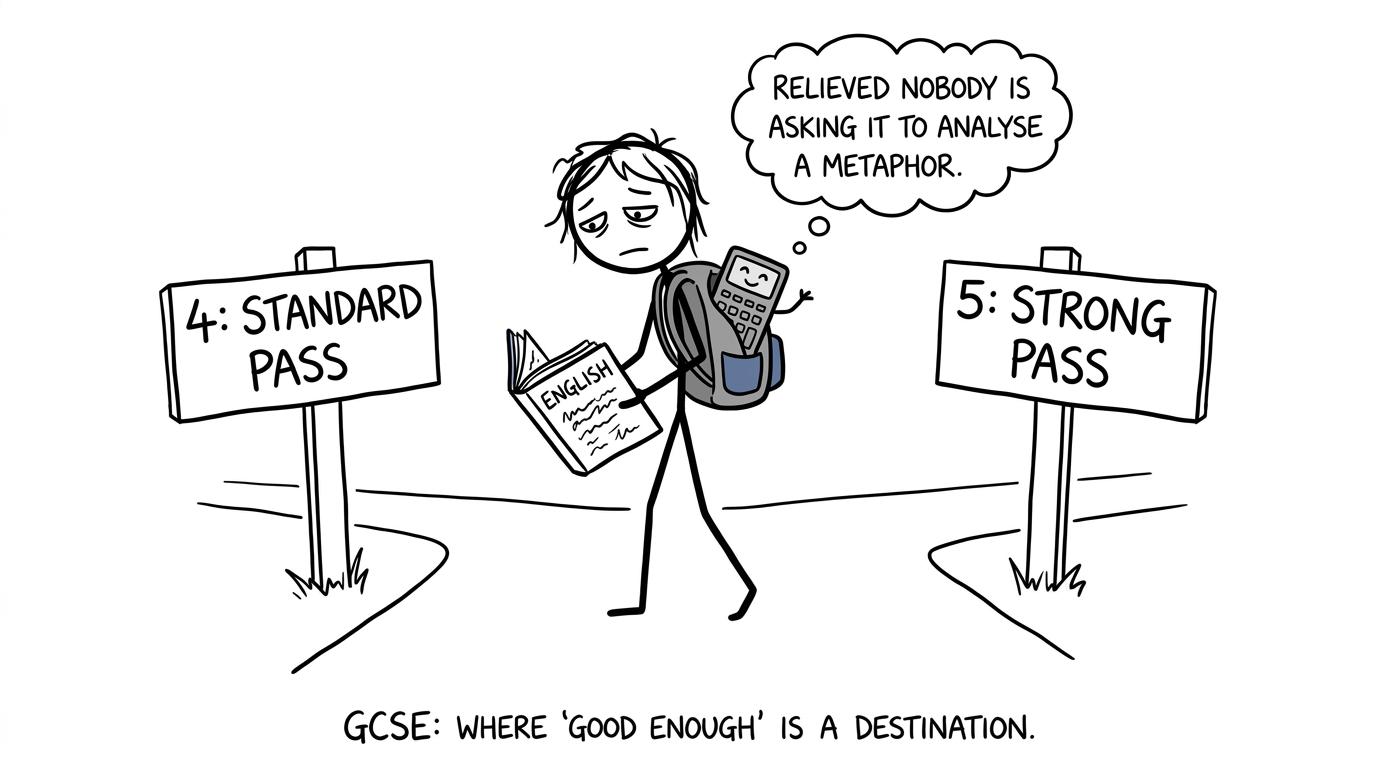 A student choosing between standard and strong pass signs while a calculator avoids metaphor analysis
What does a grade 555 represent in English ability?
A grade cannot describe every strength and weakness in a student's work. Two students may both earn a 555 through different combinations of marks. One might be stronger at analysing texts, while another gains more marks through controlled, purposeful writing.
Nevertheless, a grade 555 generally indicates that a student can engage competently with the central demands of GCSE English Language. These include:
- identifying explicit and implicit information in texts;
- selecting relevant textual evidence;
- explaining how writers use language and structure;
- comparing ideas and perspectives where required;
- evaluating a text and supporting judgements with references;
- writing clearly for a specified audience, purpose and form;
- organising ideas into a coherent response;
- using vocabulary, sentence structures, spelling and punctuation with reasonable control.
These broad abilities come from the assessment objectives shared across GCSE English Language specifications. The exact paper structure differs between AQA, Edexcel, OCR and Eduqas, so students should revise from the specification and materials for their own board.
A grade 555 does not mean every response demonstrated all these qualities consistently. It means the total mark across the assessed components reached the grade 555 boundary for that examination series.
That distinction matters. A GCSE grade is an overall judgement, not a certificate saying every paragraph was written at one fixed level.
How grade 555 compares with the old letter grades
The numbered scale replaced the A* to G scale in reformed GCSEs in England. Official comparisons provide three main anchor points:
| Current grade | Officially comparable point on the old scale |
|---|---|
| Bottom of grade 777 | Bottom of old grade A |
| Bottom of grade 444 | Bottom of old grade C |
| Bottom of grade 111 | Bottom of old grade G |
There is no official one-to-one conversion for every grade between those points. That is why statements such as “a 555 is exactly a B” or “a 555 is just a C” are misleading.
Grades 444, 555 and 666 collectively provide more differentiation across the ability range previously covered mainly by grades B and C. Grade 555 is therefore best understood as sitting around a high C to low B, rather than being treated as an exact copy of either one.
This also explains why a grade 444 should not be dismissed. It is aligned with the bottom of the old grade C and is officially recognised as a standard pass. Grade 555 is the next level up: the strong-pass benchmark.
Students comparing older maths resources should make the same distinction. MathsGenie still identifies its GCSE maths resources for the old A* to G specification separately from current grades 999 to 111, helping prevent two different grading systems from being mixed together.
Why grade 555 is called a strong pass
The terms “standard pass” and “strong pass” serve different purposes.
A grade 444 or above is officially recognised as a standard pass. In English and maths, students who have not secured the required grade are generally expected to continue studying the subject during post-161616 education, subject to the applicable funding and resit rules.
Grade 555 or above is called a strong pass in the Department for Education's headline school performance measures for English and maths. That makes it an important accountability benchmark, but it does not turn grade 444 into a failure.
The practical interpretation is:
- grade 444: you have reached the standard-pass benchmark;
- grade 555: you have reached the stronger benchmark used in school performance reporting;
- grade 666 and above: you have moved further into the upper part of the scale.
Your own next step depends on your plans. A particular sixth form, apprenticeship or course may request grade 444, 555, 666 or another combination of GCSE results. Never assume that “pass” automatically satisfies every entry condition. Read the provider's current requirements.
Grade boundaries are not fixed percentages
It is tempting to ask what percentage is always needed for a grade 555. There is no permanent answer.
Grade boundaries are set for each examination series after papers have been taken and marked. They account for differences in paper difficulty so that the standard represented by a grade remains broadly comparable. A boundary is simply the minimum overall mark needed for that grade in that series.
Different boards also use different papers, specifications, total marks and component arrangements. A boundary from AQA should not be applied to Edexcel, OCR or Eduqas. Nor should last year's boundary be treated as a prediction for this year's papers.
For a fuller explanation, read the MathsGenie guide to GCSE English Language grade boundaries. The safest revision target is not an unofficial predicted boundary. It is the strongest performance you can produce across the whole paper.
What a grade 555 does not mean
Grade 555 is a solid achievement, but it should not be made to carry meanings it cannot support.
It does not mean that you are “average at English” in every respect. A total grade can conceal variation between reading and writing, between papers, and between individual assessment objectives.
It does not guarantee entry to every course. Providers control their own requirements, and some may ask for a higher English Language grade.
It does not impose a ceiling on your ability. A result records performance in a particular assessment series. It is not a permanent judgement about how well you can communicate, reason or learn.
And it does not directly predict your maths grade. English and maths test different subject knowledge. However, reading accuracy matters in both. Interpreting command words, separating relevant from irrelevant information and communicating a logical argument can all help with multi-step maths questions.
The GCSE maths topics by exam board and tier guide can help you identify where those reading demands appear in your own maths specification.
Using the result to plan your wider GCSE revision
Students preparing for maths exams often face a quiet problem: one subject begins to consume all available revision time. A grade 555 in English Language can provide reassurance, but it should not lead to abandoning English completely or neglecting maths to chase a marginal improvement.
Instead, use evidence.
First, check any sixth-form, college or apprenticeship requirements. If grade 555 already meets the relevant condition, your English revision may focus on maintaining performance while you direct more time towards weaker subjects. If your intended course needs a 666, the result becomes a useful baseline rather than a finished target.
Second, balance subjects through short, repeatable sessions. The MathsGenie GCSE maths revision timetable explains how to combine topic work, retrieval and timed papers without allowing revision to become an unstructured list of good intentions.
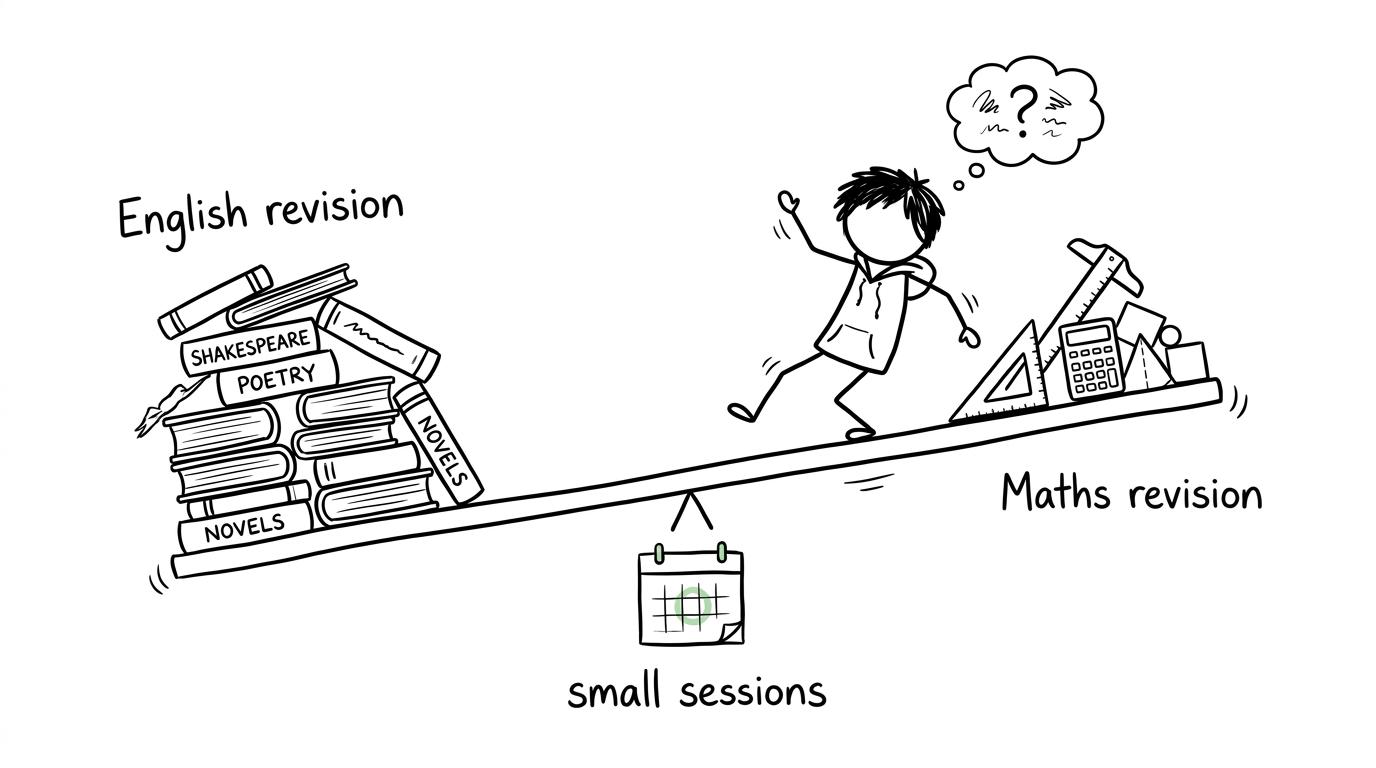 A student balancing English and maths revision with small sessions
Third, use feedback rather than the grade alone. In English, ask whether marks were lost through incomplete analysis, weak evidence, timing or technical accuracy. In maths, use the same principle: diagnose the specific topic or exam habit responsible for each lost mark.
MathsGenie's GCSE maths revision hub brings together free revision lessons, exam questions, worksheets, mini tests, flashcards and papers by exam board. If exams are close, a structured one-month GCSE maths revision plan can turn that diagnosis into a manageable weekly routine.
Common mistakes when interpreting grade 555
Calling it an exact old B or C
The grading scales have comparable anchor points, not a perfect conversion for every grade. “High C to low B” is a helpful approximation, provided it is clearly presented as approximate.
Assuming grade 444 is a fail
Grade 444 is officially a standard pass. Grade 555 is a strong pass. The language is different because the benchmarks serve different purposes, not because grade 444 has no value.
Treating one paper as the final grade
The qualification grade is based on the overall result after the relevant components and weightings have been combined. Notional component boundaries may help analyse performance, but they are not separate qualification grades.
Using last year's boundary as a target
Past boundaries provide context, not certainty. Paper difficulty changes, so boundaries can move. Prepare for the assessment objectives rather than betting your result on a predicted percentage.
Confusing English with tiered maths entry
GCSE English Language is untiered. GCSE maths commonly has foundation and higher tiers, with different available grade ranges. If you are planning both subjects, use the best order for learning GCSE maths topics and confirm your maths tier with your school.
A grade is a marker, not an identity
The most useful interpretation of grade 555 is neither inflated nor dismissive. It is a strong pass showing that your overall English Language performance went beyond the standard-pass threshold and demonstrated a sound command of reading and writing skills. Broadly, it lies around the upper-C to lower-B region of the old scale, but it has no exact single-letter equivalent.
Once you understand that, the grade becomes useful information rather than a label. Check what your next course requires. Study your feedback. Decide whether English needs maintenance or improvement, then protect enough time for maths.
Start with the free MathsGenie GCSE maths revision resources, choose your exam board and tier, and build a clear cycle: revision lesson, practice questions, mini test, mark scheme and correction. As exams approach, add past-paper practice at the right stage and predicted papers with video solutions. A result tells you where you stood. Good revision decides what happens next.