GCSE English Language Exam Season Results Explained
GCSE English language exam season results explained: learn whether summer or November changes grading, pass rates and your best choice of sitting.
A disappointing result can make the calendar look suspicious. Perhaps the summer paper felt unusually difficult. Perhaps someone says November resits are easier. Suddenly, GCSE English language exam season results seem to suggest that choosing the right month matters as much as preparing well.
The short answer is reassuring: GCSE English Language is not designed to be easier in summer or November. Ofqual maintains comparable standards between exam series in England, so the quality of work needed for a particular grade should remain consistent. Raw pass rates can differ, sometimes substantially, but that does not prove that one season gives individual students an advantage. The candidates, preparation time and reasons for entering are different.
For a student balancing English with GCSE maths, the useful question is not, “Which season is easier?” It is, “Which sitting gives me enough time to produce better work?”
The answer at a glance
- GCSE English Language is normally available in the summer and November series in England.
- The November series is restricted mainly to students aged at least 161616 on 313131 August of that year.
- Exam boards adjust grade boundaries after marking to account for differences in paper difficulty.
- A grade 444 should represent a comparable standard in summer and November.
- Different overall pass rates largely reflect different groups of candidates, not an easier examination.
- November may suit a prepared student who narrowly missed their target.
- Summer may be wiser when a student needs sustained teaching and more time to rebuild skills.
- Your school, college or examination centre controls entries, so confirm your options with them.
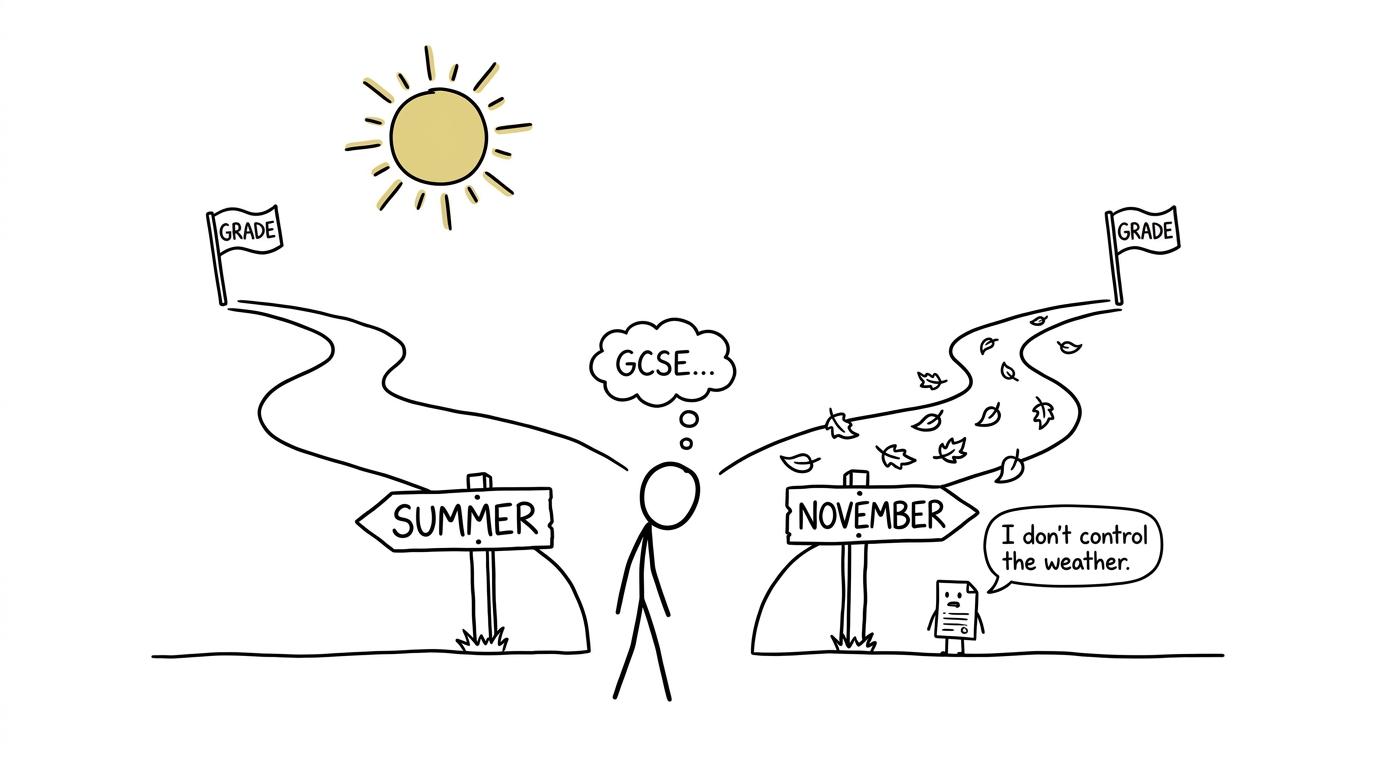 A student discovers that summer and November lead towards the same grade standard
Does the exam season directly affect your grade?
Not by design. Ofqual states that standards are maintained in each exam series. In practical terms, a grade 444 awarded in November is intended to mean the same as a grade 444 awarded in the preceding summer.
This does not mean that every paper has identical difficulty or identical grade boundaries. Papers contain different texts and questions, so one series may prove more demanding than another. Grade boundaries are set after the work has been marked, using evidence including examiner judgement and student performance. If a paper is harder, the marks required for a grade may be lower; if it is more accessible, they may be higher.
There is also no fixed quota requiring a particular proportion of candidates to pass or fail. Your grade is determined by the standard of your work against the boundaries for your specification and series.
A useful distinction is:
- Exam difficulty describes how demanding a particular paper proves to be.
- Grade standard describes the quality of performance required for a grade.
- Overall outcomes describe the proportion of an entire candidate group receiving each grade.
Those ideas are related, but they are not interchangeable.
Why summer and November results can look different
Official results tables may show different percentages achieving grade 444 or above in different seasons. It is tempting to treat those figures as a competition between papers. Ofqual explicitly warns against that conclusion because the summer and November cohorts are different.
Summer contains a broader mixture of candidates
The summer series includes most Year 111111 students taking GCSE English Language for the first time, alongside post-161616 candidates and other resit students. That creates a large and varied group with different prior attainment and circumstances.
November is mainly a resit series
In England, November entry for GCSE English Language and maths is normally limited to candidates who were aged at least 161616 by 313131 August of that year, apart from limited reasonable-adjustment circumstances. Most entrants are therefore resitting after receiving a summer result.
Even this resit group is selective. A student who narrowly missed grade 444 and remained exam-ready may enter in November. Another student may need a longer programme and wait until summer. Some November candidates have had only a short preparation period, while others benefit from concentrated support after results day.
The resulting percentage is influenced by who enters, not simply when the examination happens.
Even post-16 comparisons need caution
Comparing only post-161616 candidates does not remove every difference. Students sitting in November may differ from those waiting until summer in prior grades, attendance, confidence, readiness and the amount of teaching required. Students taking a summer resit may also include people who did not succeed in an earlier attempt.
This is a classic selection problem: two groups can produce different outcomes even when the assessment standard is comparable. The headline percentage cannot tell you what would have happened if the same students had all taken the other series.
What “winter sitting” actually means
Students often call it the winter resit, but the examination series is normally referred to as the November series. Results are released later, usually in January. Exact examination dates, entry deadlines and results dates change, so obtain the current timetable from your school, college, centre or exam board.
For specifications regulated in England, GCSE English Language and GCSE maths are routinely available in November as well as summer. AQA, Pearson Edexcel, OCR and Eduqas may all appear in national results reporting, but your available board and specification depend on the centre entering you.
Arrangements are not identical across every UK nation. Wales has different qualifications, grading arrangements and entry rules, so students should not automatically apply England’s grades 999, 111 or November age restriction to a Welsh course. Always check the specification you are actually taking.
Should you choose November or summer?
The best sitting is the earliest one for which you can be genuinely ready, not merely eligible.
November may make sense when
- you narrowly missed your target in summer;
- your teacher believes the underlying reading and writing skills are secure;
- your lost marks came from identifiable issues such as timing, incomplete answers or weak proofreading;
- you can follow a focused revision plan immediately after results day;
- your centre is willing to enter you.
A short gap can help because the course remains familiar. But familiarity alone is not improvement. Repeating the same preparation usually reproduces the same weaknesses.
Summer may make sense when
- substantial reading or writing development is needed;
- attendance or incomplete learning affected the previous attempt;
- you need regular teaching rather than a brief revision burst;
- English must be balanced with GCSE maths and a wider post-161616 programme;
- teachers judge that a November entry would be premature.
Waiting is not failure. Sometimes the valuable asset is time, provided that time contains purposeful teaching, practice and feedback.
In England, eligible students on funded 161616 to 191919 programmes who have not achieved the required level in English and/or maths are generally expected to continue studying the relevant subject under Department for Education funding conditions. This is a study requirement rather than a guarantee that every student will be entered for every available November examination. Your provider decides entry arrangements.
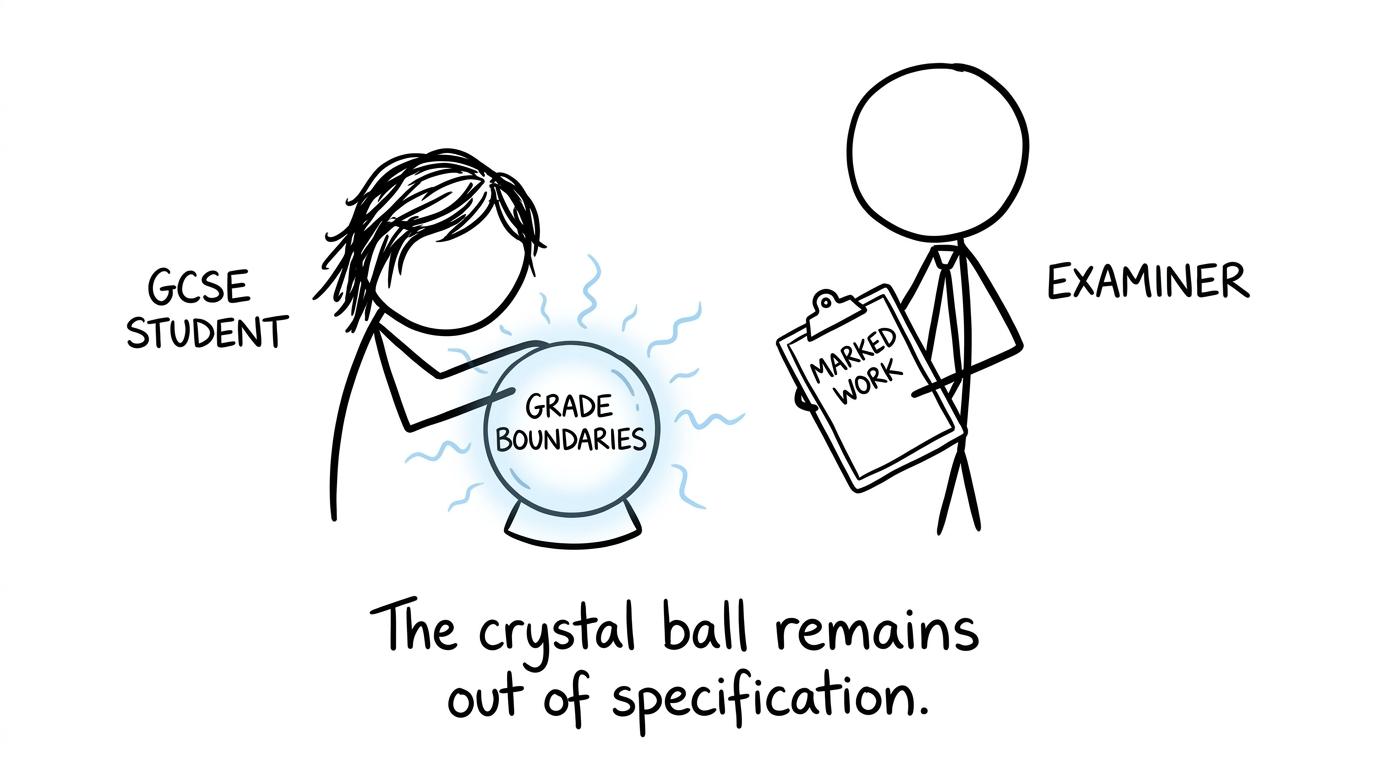 A crystal ball fails to predict grade boundaries while marked work provides the real evidence
Do not compare grade boundaries in isolation
Students often search old boundaries and decide that the series with the lower number must have been easier to pass. That reverses the logic.
A lower boundary may indicate that the paper proved harder. A higher boundary may indicate that candidates generally found it more accessible. Boundaries convert marks into comparable grades; they are not advance promises and cannot reliably predict the next series.
The safest target is therefore not last year’s boundary. Aim to collect every mark available and build a margin above the historical figures you have seen. This principle applies equally to English Language and GCSE maths.
For maths, use papers matching your board and tier. MathsGenie provides an all-board GCSE maths revision hub, as well as dedicated Edexcel GCSE maths past papers and AQA GCSE maths past papers. Mark schemes show how credit is awarded; they should guide preparation rather than become a source of boundary speculation.
How to balance an English resit with GCSE maths
English and maths compete for the same limited resource: focused attention. The answer is not to let the most worrying subject consume every evening. It is to give each subject a clear job.
Use this weekly structure:
- Diagnose: identify the precise skills losing marks in each subject.
- Repair: use a lesson, teacher feedback or targeted questions to address one weakness.
- Practise: complete independent work without notes.
- Mark: use a mark scheme and record why each mark was lost.
- Retest: return to the same skill after a short gap.
For maths, the efficient GCSE maths revision guide explains this feedback loop in more detail. If long papers are difficult to fit around English preparation, use GCSE maths mini tests before progressing to full timed papers.
A timetable should protect both subjects without pretending every week will be perfect. The GCSE maths revision timetable guide can help you organise repeatable sessions, while the GCSE maths resit results-day plan is useful if you are preparing for both qualifications again.
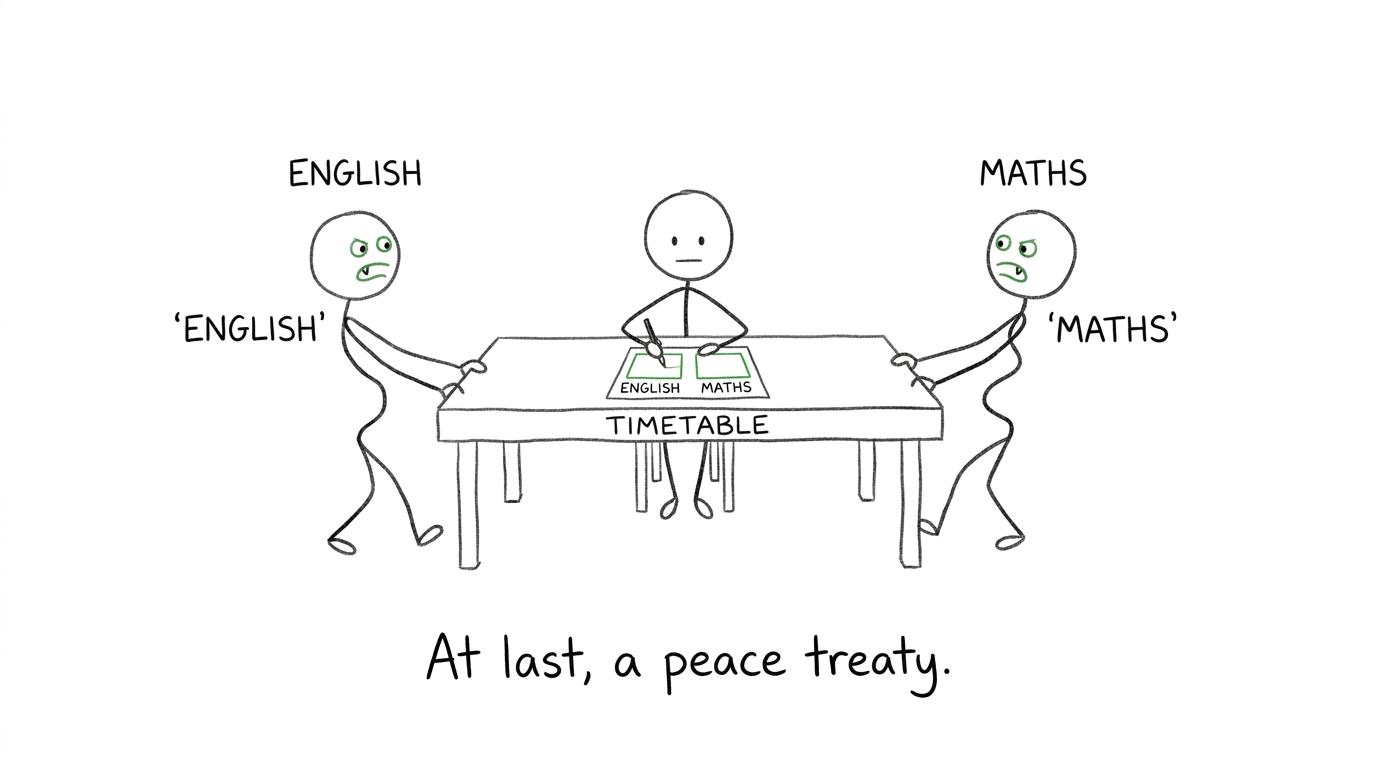 English and maths agree to share a student's revision timetable
Common mistakes when judging exam-season results
Assuming a higher pass rate means an easier paper
Pass rates describe a cohort. They do not isolate the effect of the paper, season, preparation or candidate background.
Treating November as an automatic second chance
Eligibility, centre policy, entry deadlines and readiness all matter. Confirm the arrangement rather than assuming you will be entered.
Predicting a future boundary from an old one
Boundaries can move because the demand of the papers changes. Revise for secure performance, not a guessed threshold.
Rushing into a resit without diagnosing the first result
Before choosing a series, identify whether marks were lost through knowledge, reading accuracy, writing quality, timing or incomplete responses. The same principle applies in maths: classify errors before doing more questions.
Allowing English preparation to displace maths completely
If you need both qualifications, neglecting one creates a second problem. Maintain short, regular maths sessions and increase full-paper practice when the examination approaches. MathsGenie’s guide to when to start GCSE past papers helps sequence this work, while GCSE predicted papers can provide additional practice nearer the sitting.
Choose readiness, not a supposedly lucky season
Summer and November can produce different-looking results, but the calendar is not a hidden grading strategy. Standards are intended to remain comparable, grade boundaries respond to paper difficulty, and candidate groups differ too much for raw outcomes to reveal which sitting is “easier”.
Choose November when your skills are close to the required standard and a focused repair period is enough. Choose summer when better teaching, more practice and greater maturity are likely to improve the work you produce. In either case, verify your entry with your school, college or examination centre.
Then make the season matter for the only reason it truly can: use the available time well. Keep English preparation focused, and make MathsGenie your free home for GCSE maths revision lessons, practice questions, mini tests, past papers, predicted papers, mark schemes and video solutions. Pick one weak maths topic today, practise it, mark it and turn the next sitting into evidence of progress.