

Can You Take GCSE English Language and Literature Together?
GCSE English Language and Literature together: learn whether you can take both, what overlaps, and how to balance English with GCSE maths revision.
Exam choices can become confusing before revision has even begun. A course name appears in one place, a slightly different name appears elsewhere, and suddenly it looks as though you may be taking the same subject twice. If you searched for gcse english language and literature and gcse english language together, the short answer is this: in England, English Language and English Literature are normally two separate GCSEs taken alongside each other. There is not usually a third combined GCSE to add to English Language.
Wales is different. Students beginning the new Made-for-Wales course from September 2025 can take an integrated GCSE English Language and Literature as a single or double award. Your location, specification and exact qualification title therefore matter.
The quick qualification checklist
Before changing your revision plan, check:
- which UK nation you are studying in
- the full qualification title on your school portal or statement of entry
- whether you receive one grade or two
- your exam board and specification code
- whether “English Language and Literature” is simply shorthand for two subjects
- how many English papers and assessments appear on your timetable
Your English teacher or exams officer can confirm your entry. That is more reliable than interpreting an abbreviated name in an online timetable.
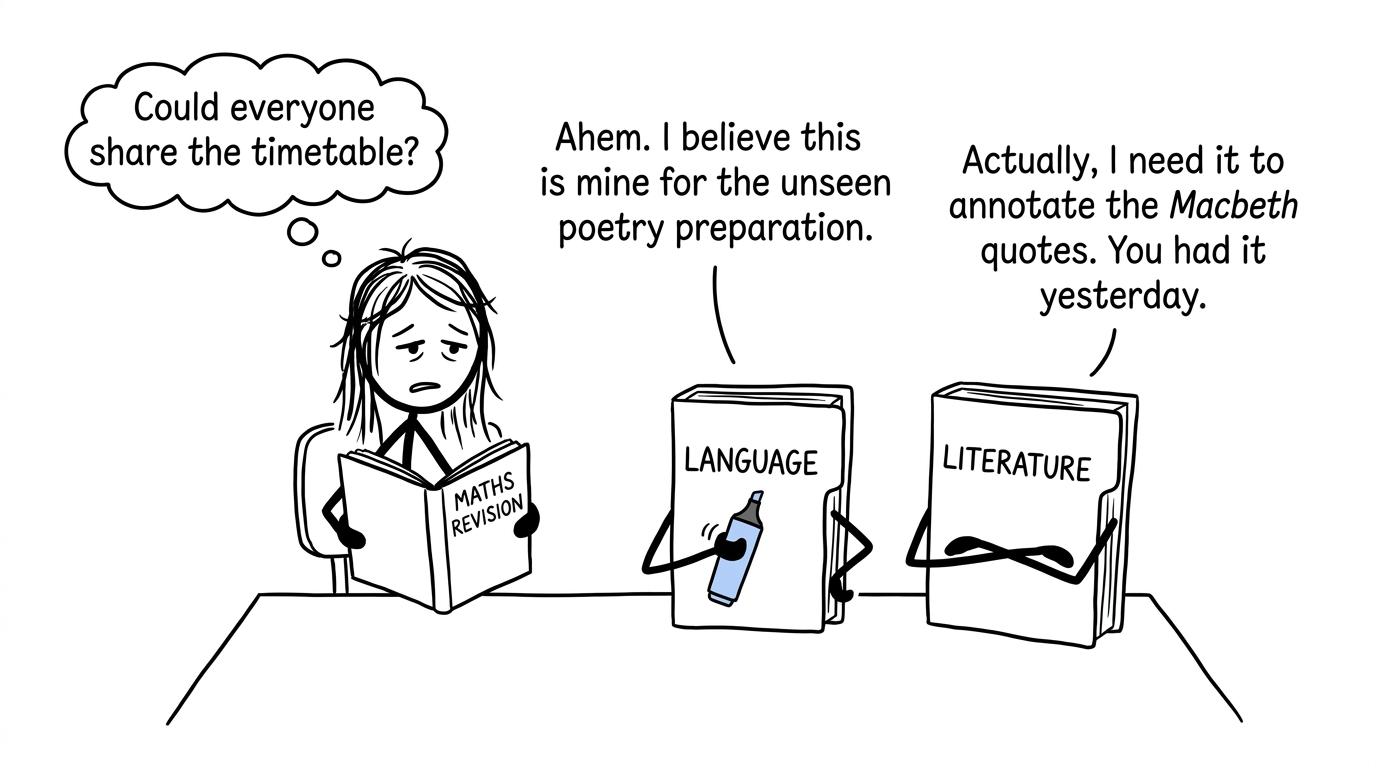 A student asks two English folders to share space with maths revision
Can you take GCSE English Language and Literature together?
Yes. In England, taking GCSE English Language and GCSE English Literature at the same time is normal and realistic. They are separate, untiered qualifications, generally taught across Years 10 and 11 and awarded separate grades from 9 to 1.
The potential misunderstanding lies in the wording. Schools may describe a timetable block as “English Language and Literature”, but that usually means you are being taught both separate GCSEs within the same English lessons. It does not normally identify an additional combined qualification.
Consequently, you would usually have:
- one entry for GCSE English Language
- one entry for GCSE English Literature
- two final GCSE grades
- separate sets of examinations, even if lessons combine preparation for both
You are not taking English Language twice. You are developing connected skills for two distinct qualifications.
What happens in England?
AQA, Pearson Edexcel, OCR and Eduqas offer separate GCSE English Language and English Literature qualifications for centres in England. The detailed paper structure varies between exam boards, but the broad distinction is consistent.
English Language assesses reading responses to unseen material and writing for particular purposes, audiences or forms. It also includes a compulsory spoken language assessment that is reported separately and does not contribute to the written GCSE grade.
English Literature assesses your response to studied literary works. Depending on the specification, these include areas such as Shakespeare, a nineteenth-century novel, modern prose or drama, anthology poetry and unseen poetry.
Official exam-board guidance describes the courses as suitable for co-teaching. That matters because the shared analytical skills are genuine, even though the qualifications and assessments remain separate.
Taking both also matters for the English element of the English Baccalaureate in England: students must enter both English Language and English Literature for that element to count. The EBacc is a school performance measure and collection of subjects, not a separate qualification awarded to you.
What happens in Wales?
The answer changes under the new Made-for-Wales qualifications. Students beginning the reformed course from September 2025 can study WJEC GCSE English Language and Literature as an integrated qualification.
It is available as:
- a single award worth one GCSE
- a double award equivalent to two GCSEs
The first complete awards are due in summer 2027. The qualification is unitised and untiered, combining language and literature rather than treating them as the two separate GCSEs commonly taken in England.
For most students on this pathway, taking the integrated award and an additional standalone English Language GCSE would create unnecessary duplication and may not form part of the centre’s approved programme. Legacy Welsh English qualifications are also being phased out as the new course is introduced. If you are in Wales, ask your school which cohort and specification apply rather than assuming the English arrangements used in England are identical.
How much overlap is there really?
There is useful overlap, but not enough to treat the two subjects as one exam. Think of them as two journeys using some of the same equipment.
| Area | English Language | English Literature | Degree of overlap |
|---|---|---|---|
| Close reading | Analyse unfamiliar fiction and non-fiction | Analyse studied texts and unseen poetry | Strong |
| Evidence | Select details or quotations from supplied extracts | Use quotations and references from set texts | Strong |
| Writer’s methods | Explore language and structure | Explore language, form and structure | Strong |
| Comparison | Compare ideas, viewpoints or texts where required | Compare poems or literary responses where required | Moderate to strong |
| Context | Usually driven by the material in the paper | Context can form part of literary interpretation | Limited |
| Writing | Creative, descriptive, narrative or transactional tasks | Mainly analytical essay responses | Limited |
| Set-text knowledge | No fixed literary set texts for the examination | Detailed knowledge of prescribed works | Very limited |
The strongest crossover is analytical thinking. You need to notice patterns, choose relevant evidence and explain how a writer creates meaning. Clear paragraphing, accurate vocabulary and controlled written expression help in both qualifications.
The difference is what you must bring into the examination. Language papers typically give you unseen sources and ask you to interpret or evaluate them before completing a writing task. Literature requires secure knowledge of complete set texts, characters, themes, relationships, structure and, where relevant, context.
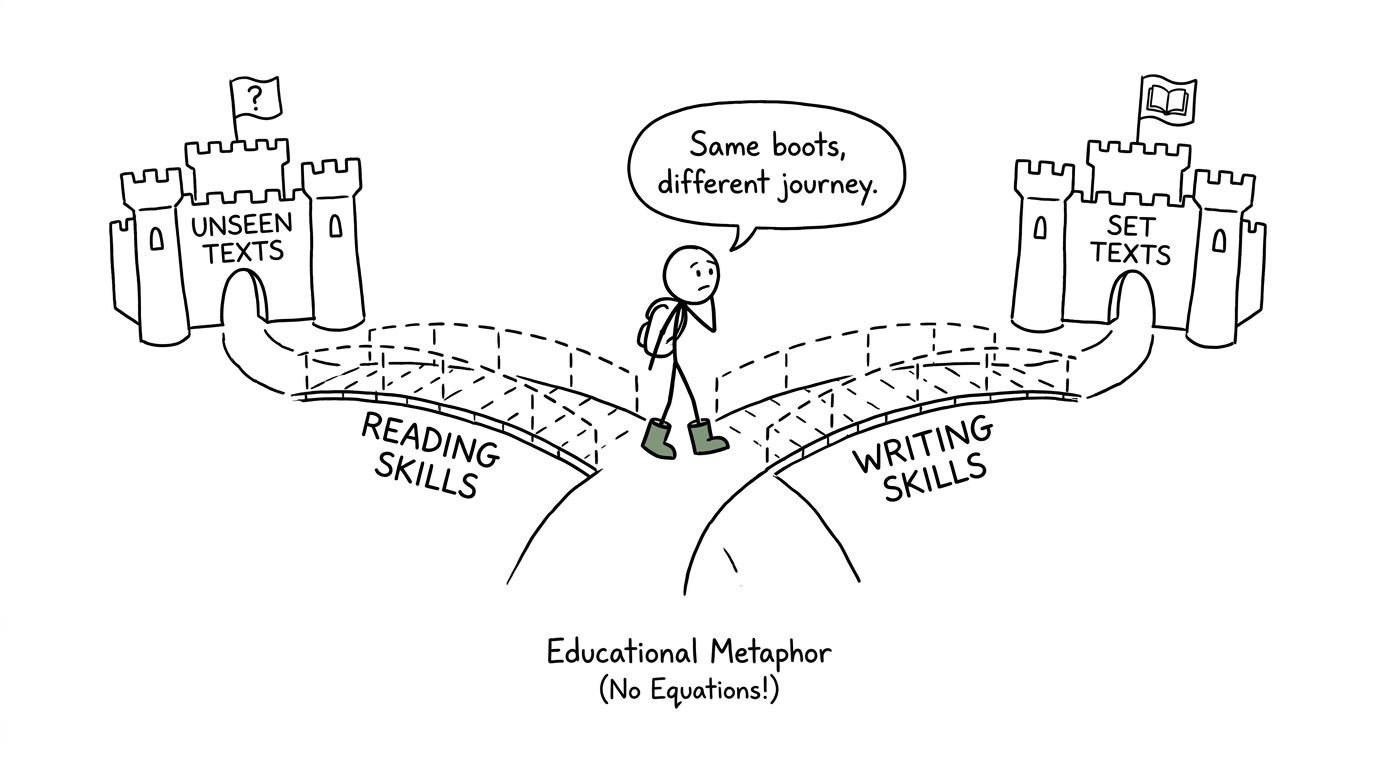 Two overlapping skill bridges lead towards unseen and set-text examinations
Is taking both English GCSEs realistic alongside maths?
For most students in England, yes. Schools design Key Stage 4 timetables on the expectation that students will often take English Language, English Literature, maths, science and several option subjects together.
That does not mean the workload feels light. Literature has a substantial memory demand, while Language improves through repeated reading and writing practice. Maths requires another kind of repetition: recalling a method is not enough unless you can apply it independently to unfamiliar questions.
The practical answer is not to give every subject identical revision time. Give each one the type of work it needs.
Separate revision by task, not just subject
Use three clear categories:
- English Literature: set-text recall, quotations, themes and essay planning
- English Language: unseen reading, timed responses and purposeful writing
- Maths: revision lessons, independent questions, marking and re-attempts
This prevents a common problem: spending an evening “doing English” without deciding which qualification or assessment skill you are actually improving.
For maths, begin with the GCSE Maths revision hub, where resources are organised by exam board, tier and topic. If the number of subjects is making your week feel crowded, use a practical GCSE maths revision timetable to create repeatable sessions rather than relying on long weekend marathons.
Protect active practice time
Reading notes feels tidy, but exams ask you to produce something. Each revision block should end with evidence of work: an essay plan, a timed paragraph, completed maths questions or a marked paper section.
In maths, use topic practice before moving to full papers. Edexcel students can then use Edexcel GCSE Maths past papers, while AQA students can work through the AQA GCSE Maths past-paper collection. Both routes let you compare your work with mark schemes and available solutions.
Do not wait until every topic feels perfect. The guide to when to start GCSE past papers explains how shorter paper sections can diagnose gaps before you are ready for repeated full papers.
Use overlap without pretending everything overlaps
A well-written Literature response can strengthen the clarity of your Language analysis. Careful Language reading can make you more precise when handling a Literature extract. These are genuine efficiencies.
But revising a Shakespeare character does not prepare you for transactional writing, and practising unseen non-fiction does not replace learning your poetry anthology. Shared skills reduce some of the burden; they do not erase subject-specific content.
The same principle works across English and maths. Planning, checking the command word, managing time and reviewing errors are transferable exam habits. The actual knowledge remains distinct.
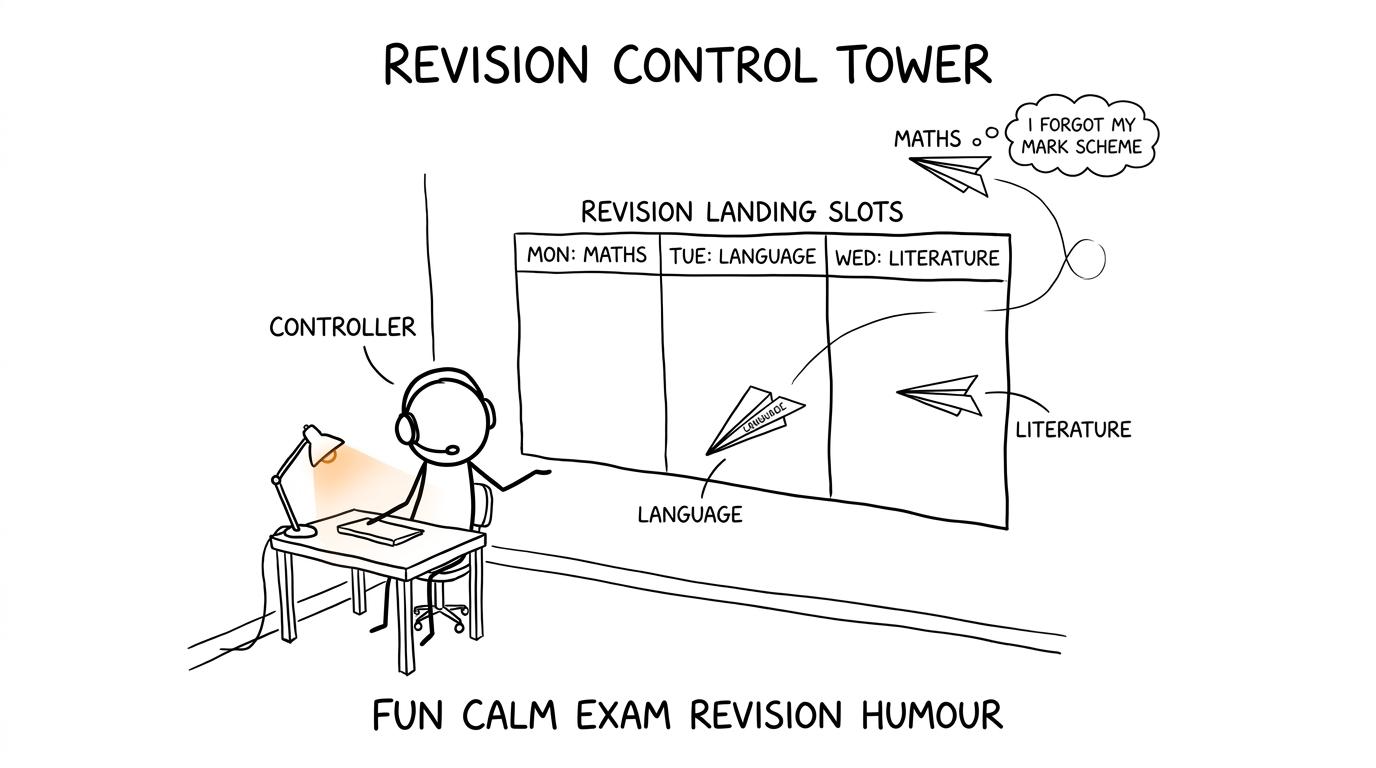 A revision timetable guides maths, language and literature into separate landing slots
A manageable revision approach
Start by listing every paper you will actually sit. Then attach a small weekly action to each one. A Literature action might focus on one text or theme. A Language action might be one timed reading response. A maths action might be a mini test followed by targeted corrections.
If exams are close, the one-month GCSE maths revision plan gives you a structure built around diagnosis, topic repair and paper practice. Nearer the final exams, Edexcel GCSE Maths predicted papers can add realistic timed practice, but they should support rather than replace revision of the full specification.
Keep a short error log for every subject. In English, record whether you misunderstood the task, chose weak evidence or ran out of time. In maths, separate missing knowledge from method errors and arithmetic slips. Revision becomes calmer when “I need to improve” turns into one precise next action.
Common mistakes when planning these GCSEs
Assuming a timetable label is a qualification title
“English Language and Literature” may be the name of a teaching block. Check your statement of entry before concluding that you are enrolled in a combined course and a separate Language GCSE.
Treating Language and Literature as identical
Analysis overlaps, but Language has unseen reading and substantial writing demands. Literature requires knowledge of prescribed texts. Prepare for the assessment in front of you.
Using the wrong national qualification structure
England and Wales now have different arrangements. Advice about separate English GCSEs in England may not describe the integrated Made-for-Wales single and double awards.
Revising only the subject that feels urgent
A looming Literature mock can consume the week, leaving maths practice untouched. Short, protected sessions preserve progress better than repeatedly abandoning one subject for another.
Completing papers without reviewing them
A paper shows what went wrong; review changes what happens next. Use mark schemes and video solutions, identify the lost skill, practise it and then return to a similar question.
Make the qualification names clear, then start revising
In England, GCSE English Language and GCSE English Literature are normally separate qualifications taken together. The phrase “English Language and Literature” often describes that pair, not a third GCSE that duplicates Language. In Wales, the new integrated qualification changes the answer, so your cohort and exact WJEC entry matter.
Once the title is clear, the workload becomes easier to organise. Give Literature time for set-text knowledge, Language time for unseen reading and writing, and maths time for active problem-solving.
MathsGenie can provide the maths side of that plan for free. Start with revision lessons and practice questions, check progress with mini tests, and then build exam confidence using past papers, predicted papers, mark schemes and video solutions. One clear task at a time is how a crowded GCSE timetable becomes a workable one.











