GCSE English Language 5 to 7: A Practical Guide
GCSE English Language 5 to 7: learn the reading, writing and revision changes that turn clear responses into developed, convincing exam answers.
Moving from a grade 555 to a grade 777 in English Language can feel strangely difficult. You may understand the extracts, finish most questions and write accurately, yet your marks remain in the same band. The answer is rarely “use more techniques”. The GCSE English Language 5 to 7 journey is about becoming more deliberate: selecting evidence carefully, analysing precise choices, developing interpretations and controlling your own writing.
The short version is this: grade 555 work is often clear and relevant, while grade 777 work is more consistently developed, analytical and convincing. You do not need to sound like a university lecturer. You need to make better decisions, more often, under timed conditions.
Your grade 555 to grade 777 checklist
Focus on these changes:
- answer the assessment objective, not just the general topic;
- choose short, useful quotations rather than copying whole lines;
- explain how and why a writer's choices create meaning;
- analyse structure as a sequence of deliberate decisions;
- compare perspectives directly rather than discussing texts separately;
- plan writing around purpose, audience and emotional direction;
- prioritise controlled vocabulary and punctuation over forced complexity;
- mark every practice response and rewrite its weakest part;
- practise using the timings and question format for your exam board.
Begin with the resources for your specification. For example, the AQA GCSE English Language revision hub brings together revision support, questions, past papers and mark schemes.
What separates a grade 555 from a grade 777?
There is no single paragraph that automatically “is” a grade 777. Your final grade comes from your total performance across the examined components, and grade boundaries change between examination series to account for differences in paper difficulty. English Language is also untiered, unlike GCSE maths, so every student can access the full grade range.
You can explore that distinction in MathsGenie's guide to GCSE English Language grade boundaries and its analysis of English Language grade boundary history. Past boundaries provide context, not a guaranteed target for a future paper.
Mark schemes differ in wording between AQA, Edexcel, OCR and Eduqas, but the underlying assessment objectives are shared. Across the qualification, reading accounts for half of the assessment and writing accounts for the other half. Technical accuracy under AO6 represents one fifth of the qualification.
The practical difference usually looks like this:
| A response around grade 555 often... | A response moving towards grade 777 often... |
|---|---|
| identifies a relevant method | selects the method that best explains the meaning |
| explains a quotation clearly | explores significant words and their implications |
| comments on a reader's reaction | connects the effect to purpose, tone or perspective |
| follows a memorised paragraph frame | adapts its structure to the exact question |
| makes separate points about two texts | compares ideas and methods throughout |
| includes ambitious vocabulary | chooses precise vocabulary that remains controlled |
| uses varied punctuation occasionally | uses punctuation deliberately and accurately |
These are tendencies, not official grade descriptors. The important shift is from spotting features to explaining decisions.
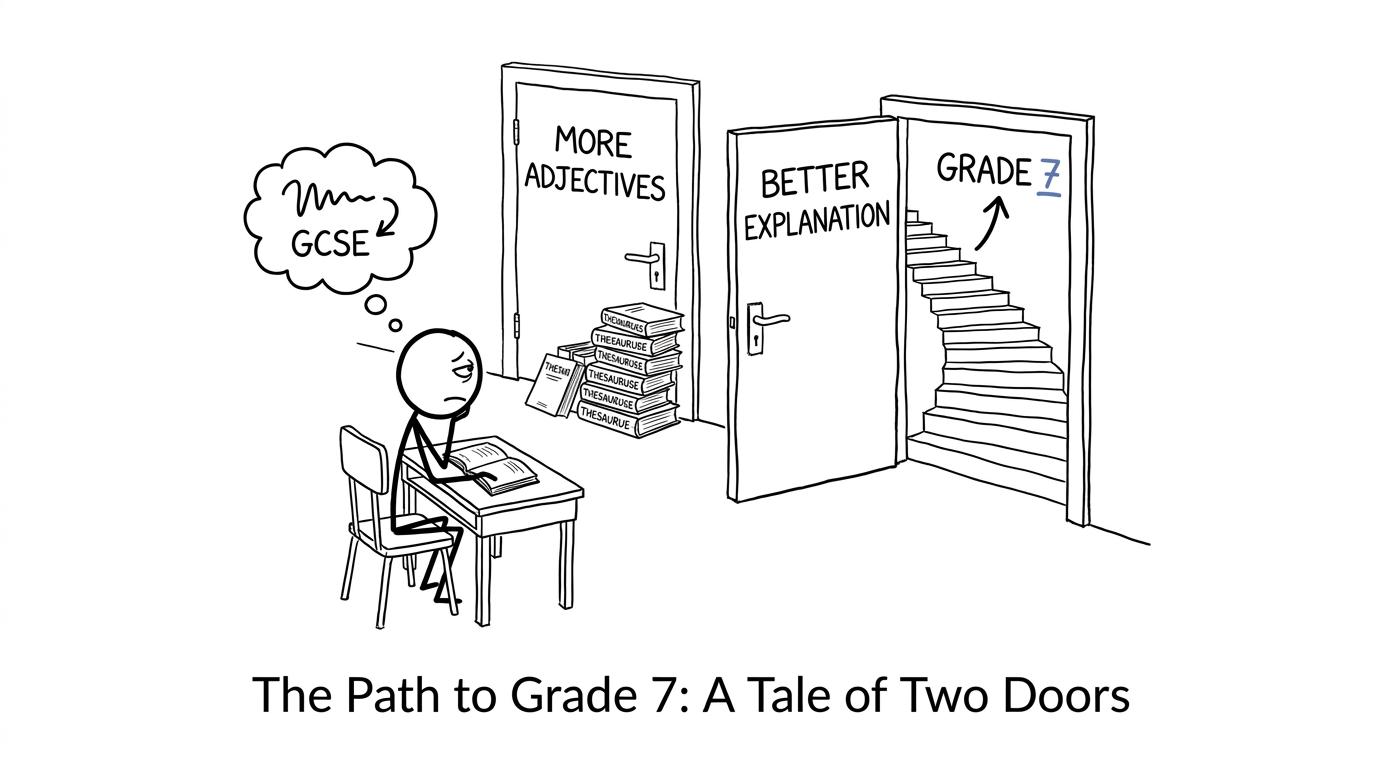 A student chooses better explanation over more adjectives
Make your reading analysis more precise
A grade 555 response may identify imagery and give a sensible effect. To move higher, ask a more useful question: why was this particular word, image or structural choice suitable here?
Select evidence with a purpose
Long quotations create more work. A short quotation lets you concentrate on the part that carries meaning. Before writing, decide what the evidence proves about the writer's attitude, the atmosphere, a character or the development of the text.
Your paragraph should normally contain:
- a direct answer to the question;
- concise textual evidence;
- analysis of a specific choice;
- an explanation of its meaning or effect;
- a link to the writer's wider purpose where relevant.
Subject terminology helps when it makes the explanation more exact. Simply naming a metaphor, adjective or short sentence does not demonstrate analysis. Examiners reward the explanation that follows.
Move from effect to interpretation
“The reader wants to read on” is possible, but usually too general. Explain what the reader is encouraged to anticipate, doubt, admire or fear. Then connect that response to the writer's presentation.
A strong interpretation remains rooted in the text. Alternative readings can add depth, but only when both readings are supported. Two undeveloped possibilities are not better than one convincing interpretation.
Treat structure as movement
Structural analysis is not a list of paragraph lengths. Track where attention begins, what changes and what the ending makes the reader reconsider. Look for shifts in time, setting, focus, pace, narrative perspective or tone.
Think of structure as a journey through the extract. The important question is not merely what changed? but why did the writer reveal the material in this order?
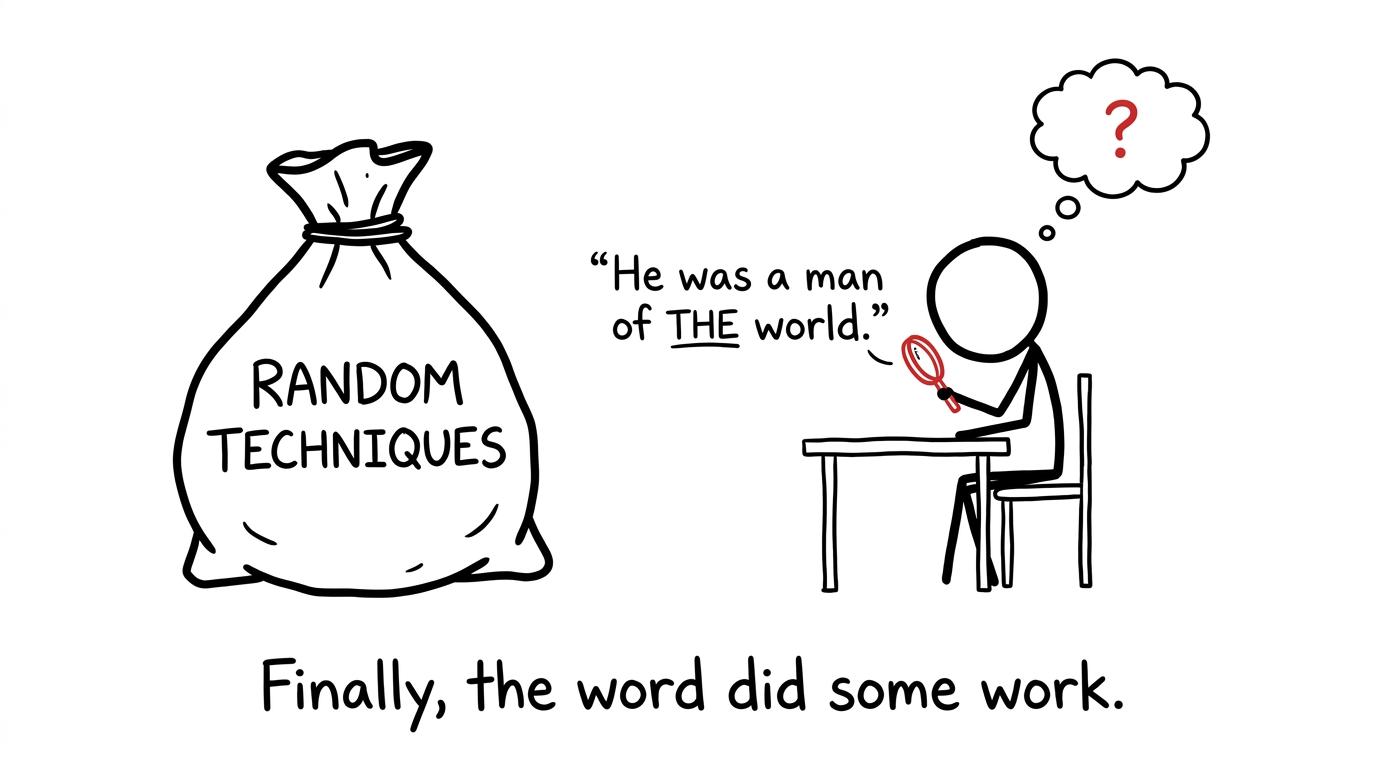 A student inspects one useful word instead of carrying random techniques
Compare ideas and perspectives directly
Comparison questions reward connections. Writing half an answer about one source and half about another can produce relevant material, but the comparison may remain implicit.
Choose a clear basis for each paragraph: attitude, experience, tone, purpose or method. Establish the connection immediately, then move between the texts. Comparison does not always mean difference. Writers may share an attitude but express it through contrasting tones or structural choices.
A useful planning grid has three headings:
- the central idea or perspective;
- evidence and method in the first text;
- the corresponding evidence and method in the second.
This prevents you from collecting unrelated quotations. For a broader time-efficient routine, use the GCSE English Language revision guide, which explains how to combine question practice, marking and targeted rewriting.
Turn competent writing into controlled writing
Students sometimes imagine that grade 777 writing must contain obscure words, constant semicolons and a dramatic plot. In reality, control matters more than decoration.
Decide the effect before choosing techniques
For creative writing, decide what emotional experience you want to create. Then choose a simple shape: an opening situation, a meaningful shift and an ending that feels connected to what came before.
For transactional writing, identify the form, audience and purpose before planning your content. A speech, article, letter, report or review requires a suitable relationship with its reader. Persuasive devices should support a clear argument rather than replace one.
Build coherence across the whole response
Individual sentences may be impressive while the complete response feels disjointed. Grade 777 writing tends to sustain its direction. Paragraphs should develop or turn the idea, not simply create visual breaks.
Use recurring images, contrasts or ideas sparingly. In transactional writing, arrange points so that the argument gathers force. In creative writing, vary pace according to what is happening rather than changing sentence length at random.
Make accuracy a source of marks
AO6 rewards vocabulary, sentence structures, spelling and punctuation. Accuracy is therefore not a finishing touch. It is a substantial part of the qualification.
Secure full stops, sentence boundaries, apostrophes and common spellings first. Add ambitious punctuation only when you understand its function. A correctly controlled sentence is more valuable than a complicated sentence that loses clarity.
Leave time to proofread. Search deliberately for recurring errors rather than rereading passively: sentence boundaries, missing words, repeated vocabulary and inconsistent tense are sensible places to begin.
Use the maths revision loop in English
The most useful habit from maths revision transfers neatly to English:
- attempt a question under timed conditions;
- mark it against the relevant assessment objective;
- identify where marks were lost;
- rewrite one section;
- test the same skill again.
Reading model answers can create familiarity, but familiarity is not performance. You improve when you produce an answer, receive feedback and change it.
Keep a small marks-leak log. Record patterns such as “evidence too long”, “comparison introduced late” or “ending rushed”. The principle is similar to the process in MathsGenie's guide to using past papers properly: a paper becomes valuable when its mistakes determine what you practise next.
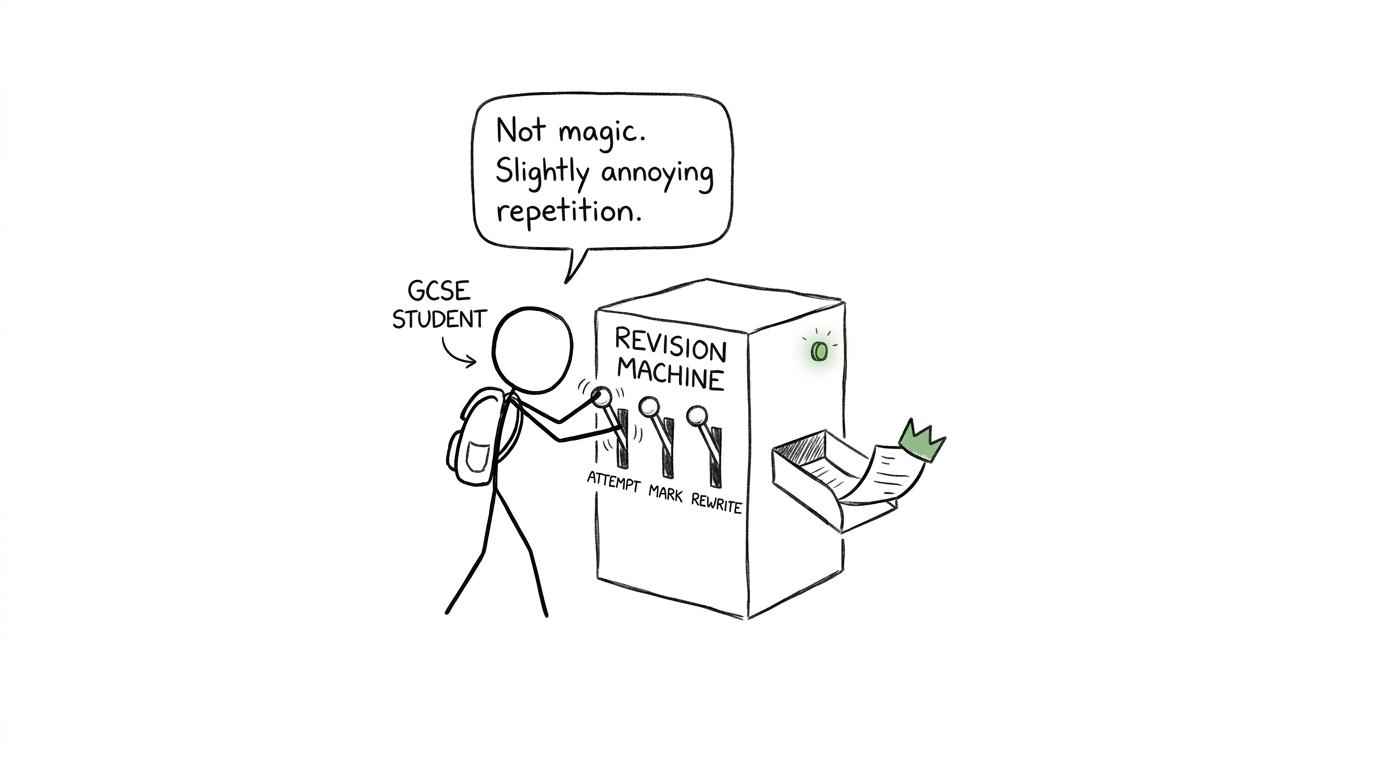 A revision machine turns attempts, marking and rewriting into improvement
A manageable revision routine alongside maths
English should not consume every evening, particularly when you are preparing for GCSE maths exams too. A sustainable weekly pattern could include:
- one focused reading question;
- one writing plan or timed writing section;
- one feedback session in which you mark and rewrite;
- regular maths topic practice in separate sessions.
Use your board's official paper duration and question structure when completing timed work. AQA, Edexcel, OCR and Eduqas assess the same core objectives, but their papers organise questions and timings differently.
If you are rebuilding after a mock or previous examination, the GCSE English Language resit revision plan offers a useful diagnosis-first approach. For maths, use GCSE predicted papers and revision resources after topic work and official past papers, rather than treating predictions as guarantees.
Common mistakes that keep students at grade 555
Writing everything you notice
A longer answer is not automatically a better one. Select the evidence and methods that let you answer the question most convincingly.
Naming techniques without analysing them
Terminology is a label, not an explanation. Always connect the choice to meaning, perspective, tone or purpose.
Forcing sophisticated vocabulary
An inaccurate “advanced” word weakens clarity. Choose the most precise word you can control.
Memorising entire answers
Prepared structures can reduce anxiety, but a pre-written response may not fit the task. Memorise flexible processes, not paragraphs.
Completing papers without repairing mistakes
Another paper may reproduce the same weaknesses. Mark carefully, identify a small number of priorities and rewrite before moving on.
Ignoring the exact exam board
Do not assume every English Language paper follows the same sequence. Check your specification, question wording and timings before practising.
Make the next response different
The move from grade 555 to grade 777 is not one dramatic leap. It is a collection of smaller changes: a shorter quotation, a sharper explanation, a direct comparison, a more coherent plan and a careful final check.
Choose one question today. Complete it under a realistic time limit, mark it and rewrite the weakest paragraph. Then use MathsGenie's free GCSE and A Level revision resources to keep the same disciplined loop running across your subjects. Revision lessons build understanding; practice questions and mini tests develop control; past papers and mark schemes expose weaknesses; predicted papers and video solutions help you sharpen your preparation.
The goal is not to write more. It is to make every choice earn its place.