GCSE Engineering Last Minute Revision Plan: 3 Days
GCSE engineering last minute revision plan: use three calm days to prioritise formulae, units, exam practice and the maths skills that cost marks.
The exam has not changed because you noticed it late. The clock has. That distinction matters.
A useful GCSE engineering last minute revision plan does not attempt to relearn an entire specification in three days. It identifies the knowledge most likely to unlock marks, tests it through questions, then repairs the mistakes that appear. For the mathematical side of GCSE Engineering, that means prioritising formulae, unit conversions, geometry, compound measures, graphs and clear working.
If you take AQA GCSE Engineering (8852), the current specification has a two-hour written paper worth 120120120 marks and 60%60\%60% of the qualification, alongside non-exam assessment worth 40%40\%40%. Other engineering and vocational qualifications may have different arrangements, so check the exact specification and exam details given by your school.
Your three-day revision checklist
Use this as the plan at a glance:
| Day | Main purpose | What you should produce |
|---|---|---|
| Day one | Diagnose gaps and rebuild essential knowledge | A one-page priority list and formula recall sheet |
| Day two | Practise calculations in engineering contexts | Marked questions and a short error log |
| Day three | Rehearse the exam and secure easy marks | A timed attempt and a final checklist |
Aim for two or three focused blocks each day rather than one exhausting session. A block of roughly 454545 to 505050 minutes, followed by a proper break, is long enough to make progress without turning revision into passive staring.
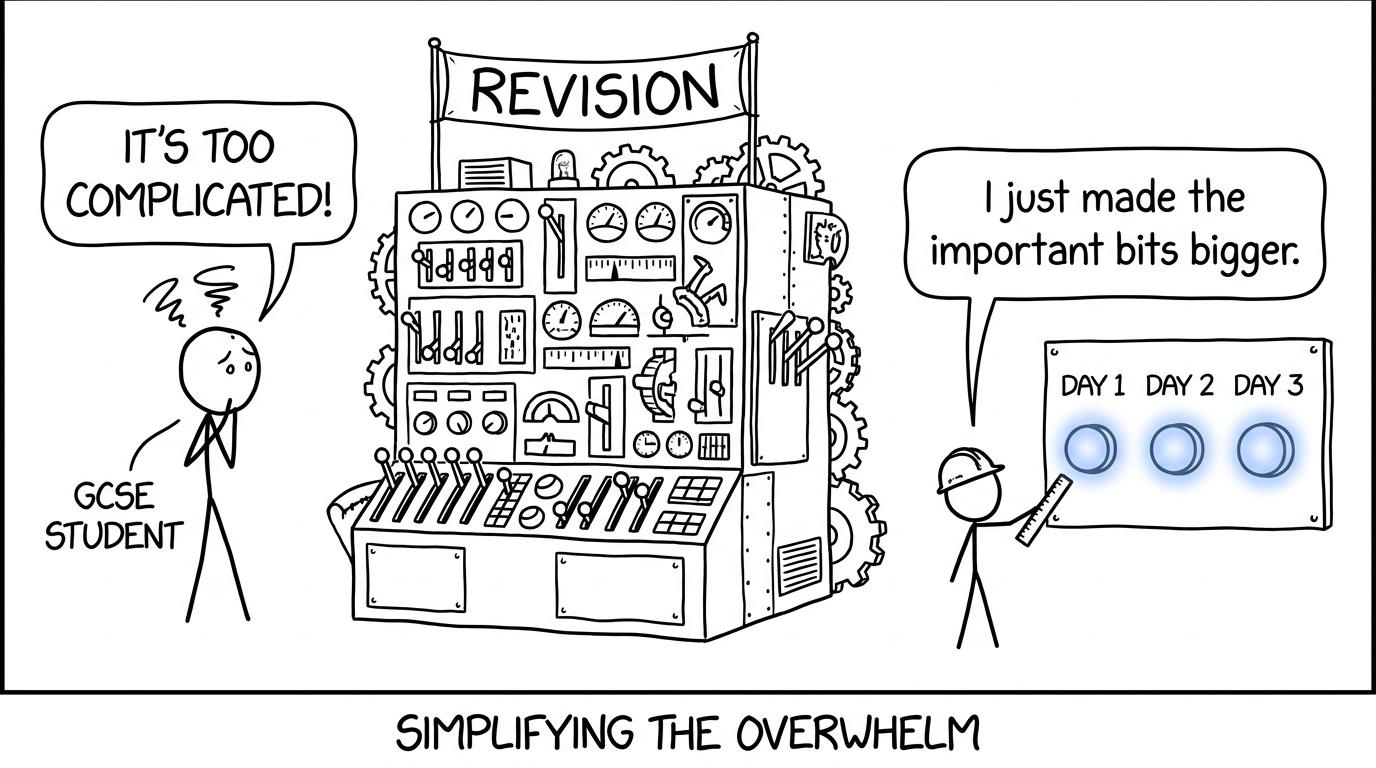 A calm engineer shows a worried student three simple revision buttons
Day one: find the marks hiding in your weak areas
Panic encourages indiscriminate revision. Everything feels equally urgent, so students often begin with the first page of their notes and move slowly forwards. A better first day is diagnostic.
Start with the correct specification
Write down the name and code of your qualification. GCSE Engineering is not interchangeable with GCSE Design and Technology, BTEC Engineering or other technical awards. Even when topics overlap, assessment structures and required formulae can differ.
For AQA GCSE Engineering, the official subject areas include engineering materials, manufacturing processes, systems, testing and investigation, modern technologies, and practical engineering skills. The written paper can place calculations inside any of these contexts. That is why memorising a formula without understanding the quantities and units is fragile preparation.
Spend 202020 minutes scanning your specification or your teacher's checklist. Label each topic:
- Green: you can explain it and answer a question without notes.
- Amber: you recognise it but make errors.
- Red: you cannot currently begin a question.
Do not revise every red topic. Choose the three or four that are both examinable and recoverable within the time available.
Audit the core mathematical skills
Engineering questions often depend on a relatively compact collection of GCSE maths skills:
- substituting values into formulae;
- rearranging formulae;
- converting units;
- using ratios and scale;
- calculating area and volume;
- working with density, pressure and stress;
- reading tables, charts and graphs;
- rounding sensibly and using significant figures.
Use the GCSE maths topics by exam board and tier to locate any underlying skill you have forgotten. If you are unsure where to begin, the best order for learning GCSE maths topics gives a sensible sequence rather than a random collection of pages.
Build a formula recall sheet
Do not make decorative notes. Fold a page in half. Put formula names on one side and the formulae, symbols and units on the other. Test yourself in both directions.
Depending on your specification, relevant engineering relationships may include:
A=L×W A = L \times W A=L×W V=L×W×H V = L \times W \times H V=L×W×H A=πr2 A = \pi r^2 A=πr2 V=πr2L V = \pi r^2L V=πr2L A=12bh A = \frac{1}{2}bh A=21bh ρ=mV \rho = \frac{m}{V} ρ=Vm σ=FA \sigma = \frac{F}{A} σ=AF ε=ΔLL \varepsilon = \frac{\Delta L}{L} ε=LΔL E=σε E = \frac{\sigma}{\varepsilon} E=εσ p=FA p = \frac{F}{A} p=AFThe symbol choices used in your paper may vary, so learn what each quantity means rather than relying only on the letter. Use your own specification as the final authority for what must be recalled.
Finish day one with a short closed-book test. Anything you cannot retrieve within a few seconds belongs on tomorrow's priority list.
Day two: turn knowledge into usable marks
Knowing that density involves mass and volume is not the same as handling a multi-stage question accurately. Day two is where knowledge becomes performance.
Practise by weakness, not by comfort
Choose one amber or red skill at a time. Review the method briefly, answer several questions without notes, mark them, then record the exact cause of each lost mark.
MathsGenie's conversions and units revision guide is particularly useful because engineering calculations regularly combine lengths, areas, volumes, masses and rates. Remember that a linear conversion factor changes when dimensions change. If
1 cm=10 mm, 1\text{ cm} = 10\text{ mm}, 1 cm=10 mm,then
1 cm2=100 mm2 1\text{ cm}^2 = 100\text{ mm}^2 1 cm2=100 mm2and
1 cm3=1000 mm3. 1\text{ cm}^3 = 1000\text{ mm}^3. 1 cm3=1000 mm3.These are relationships to recall, not optional details. Confusing them can damage an otherwise correct calculation.
OCR Maths students can also use the OCR conversions and units resources, while the broader OCR GCSE maths worksheets include scale drawings, circles, surface area, prisms and cylinders. The engineering qualification and maths exam board do not have to match for the underlying skill to be useful, but always follow your own engineering specification for subject content.
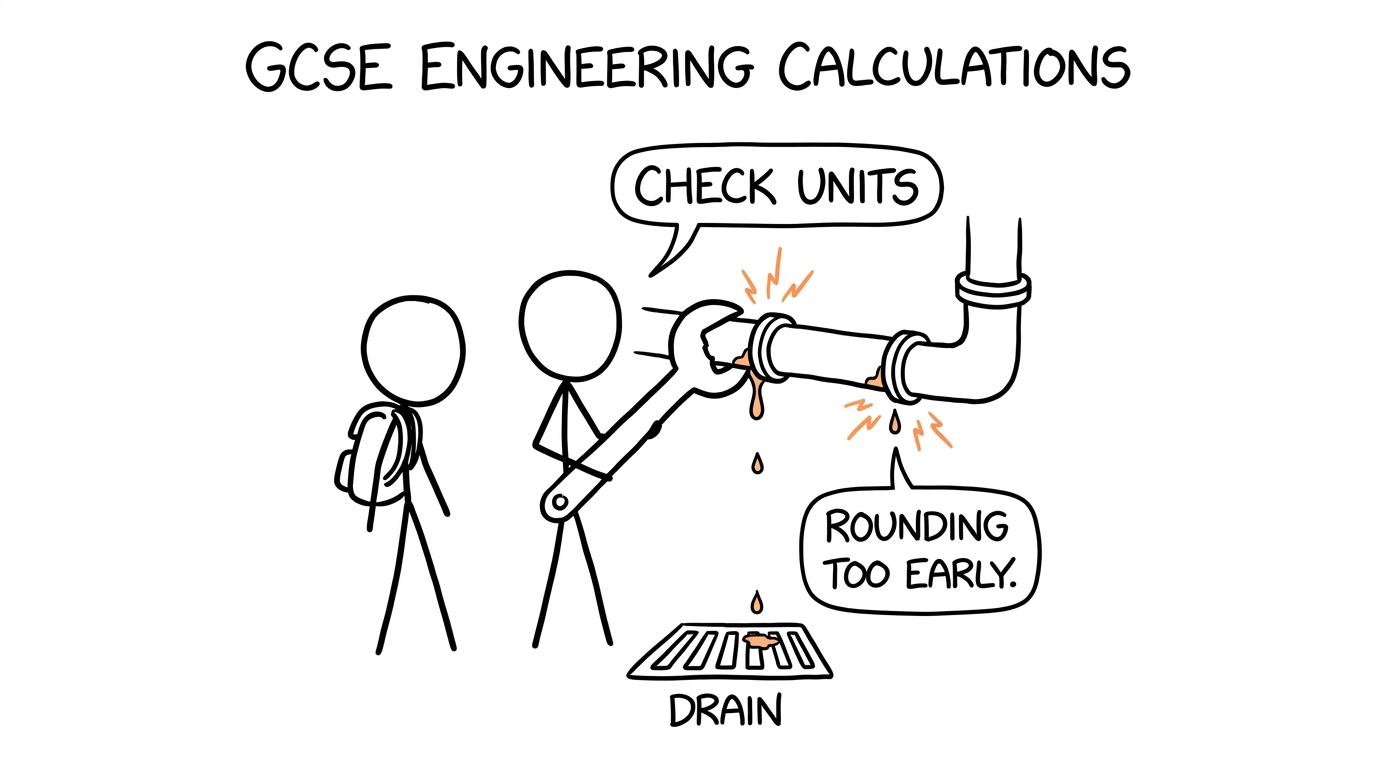 A student uses a check-units spanner to stop marks leaking away
Use an engineering calculation routine
For every calculation question, follow the same sequence:
- Identify the required quantity.
- Extract the relevant information.
- Convert incompatible units before calculating.
- Write the formula.
- Substitute values with units visible.
- Keep unrounded calculator values during intermediate stages.
- Round only the final answer unless instructed otherwise.
- Check whether the size and unit are plausible.
This routine is deliberately ordinary. Under pressure, ordinary systems outperform clever intentions.
Make the mark scheme teach you
An error log should contain three columns: what went wrong, why it happened and what you will do next time. “Silly mistake” is not a useful diagnosis. Better entries include:
- converted length but forgot that the area unit was squared;
- rearranged the formula incorrectly;
- used diameter where the formula required radius;
- rounded an intermediate value;
- omitted the final unit;
- described a material property without linking it to the product.
After marking, redo the failed questions without looking at the solution. If you only read the answer, recognition can create the illusion of understanding.
Day three: rehearse decisions, not just content
The final day should not become a frantic tour of untouched topics. Your aim is to make familiar knowledge easier to access under exam conditions.
Complete a timed paper or substantial section
Use an official paper provided by your teacher or exam board. Work in a quiet place, follow the permitted equipment rules and do not pause the clock whenever a question becomes uncomfortable.
If your mathematical foundations still need attention, a targeted MathsGenie mini test or paper section can be more useful than repeatedly failing a full paper. The revision process described in GCSE maths topics that come up regularly uses three passes: rebuild the method, complete topic practice, then test it through papers.
When you mark your attempt, separate errors into:
- knowledge gaps, where you did not know the fact or method;
- process errors, where units, substitution or arithmetic failed;
- exam errors, where you misread the command word or did not show enough reasoning.
Spend the final revision block fixing the repeated category. One repaired pattern is more valuable than ten pages reread.
Prepare a final recall circuit
Your last active session can be short:
- recall formulae from blank prompts;
- convert common length, area and volume units;
- identify material properties from definitions;
- compare manufacturing processes and suitable applications;
- interpret one graph or table;
- list checks for calculation questions;
- review the errors from your timed attempt.
Then stop. Pack the required equipment, check the official time and location, and protect your sleep. Late-night revision that makes tomorrow's thinking harder is a poor trade.
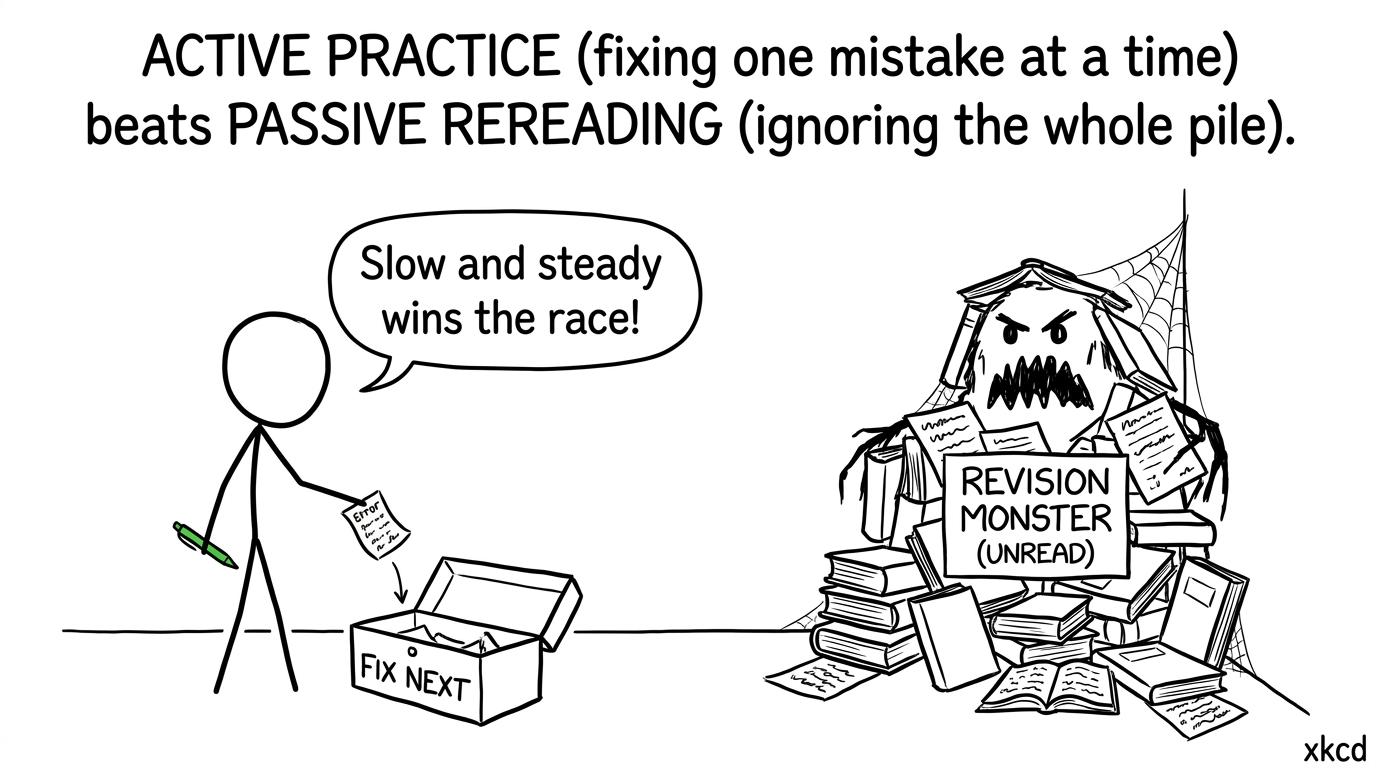 A calm student puts individual errors into a fix-next toolbox
Common last-minute revision mistakes
Trying to cover the whole course
Three days can improve recall and execution, but they cannot hold an unlimited syllabus. Prioritise high-value gaps and transferable mathematical methods.
Rereading instead of retrieving
Notes feel fluent because the answer is already visible. Close the page, write what you remember, answer a question and check it. The effort is the useful part.
Ignoring written engineering knowledge
The exam is not simply a maths paper with machines in the questions. You still need accurate knowledge of materials, manufacturing, systems, testing and the effects of technology. Balance calculations with concise subject recall.
Practising without marking
An unmarked paper measures endurance, not improvement. Mark schemes and video solutions reveal where a method earned credit and where an explanation remained too vague.
Treating units as decoration
Units help determine the operation, expose implausible answers and communicate what a number represents. Write them during your method, not as an afterthought.
Switching resources repeatedly
Resource hunting can become disguised avoidance. Choose one lesson, one question set and one mark scheme. Finish the cycle before opening another tab. The one-month GCSE maths revision plan contains a learn, practise, mark and retest loop that still works when compressed into three days.
Three calm days can still be useful
The goal is not to feel perfectly prepared. It is to become more prepared than you are now, in a way that survives contact with the exam paper.
Start by diagnosing. Then practise the mathematical and engineering knowledge that can still be repaired. Finally, rehearse under time pressure and learn from the mark scheme. That sequence turns panic into a list of actions.
Use MathsGenie as your free base for the underlying maths: revisit revision lessons, answer practice questions, check mark schemes and video solutions, then test yourself with mini tests, past papers and predicted papers. If you take Edexcel Maths, the guide to revising Edexcel GCSE Maths efficiently can help you avoid wasting the limited time you have left.
Open the first weak topic now. Not the easiest one. The one most likely to return a mark.