GCSE Engineering Exam Day Kit: What to Pack
GCSE engineering exam day kit checklist covering pens, drawing tools, calculators, banned items and the practical checks to complete the night before.
The night before an exam, small uncertainties become strangely loud. Is one pen enough? Does the calculator need its cover removed? Should you bring compasses? A well-prepared GCSE engineering exam day kit answers those questions before they can consume your attention.
For an AQA GCSE Engineering written paper, you should expect to need normal writing and drawing instruments plus a permitted calculator. However, your school’s instructions and the materials listed on the front of your specific paper are always definitive. Pack at least two black pens, pencils, an eraser, a sharpener, a ruler and your calculator in a clear pencil case. Add other drawing equipment only when your teacher or paper requires it.
This is not about carrying every tool you own. It is about having the right few things, checked and ready.
Your GCSE engineering exam day kit checklist
Prepare these items the night before:
- At least two working black ink or black ball-point pens
- Two sharpened pencils suitable for drawing
- An eraser
- A small pencil sharpener
- A ruler marked in millimetres and centimetres
- A permitted scientific calculator
- A protractor and pair of compasses if your teacher or paper requires them
- Any additional permitted drawing equipment specified by your centre
- A transparent pencil case
- A clear, label-free water bottle if your school allows one
- Your exam timetable or a written note of the start time and room, kept outside the exam room if required
- Any identification your school has specifically asked you to bring
Also confirm your exam board, specification and paper code. AQA’s current GCSE Engineering qualification is specification 885288528852, but engineering-related qualifications offered by different centres are not all identical. Do not assume that a friend at another school has the same paper or equipment rules.
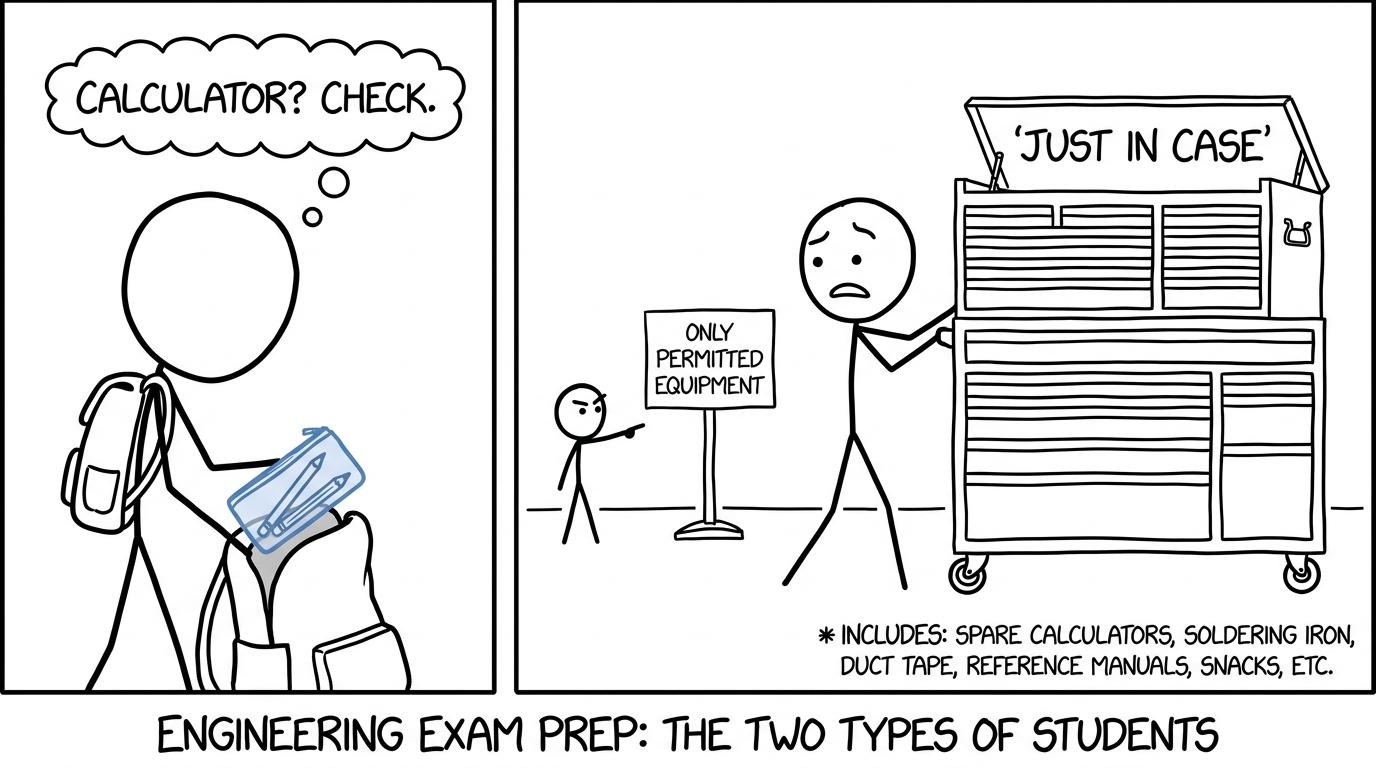 A student with a sensible clear pencil case watches a friend arrive with an enormous toolbox
The essential writing and drawing equipment
Black pens
JCQ instructions require candidates to write clearly in black ink unless the question paper says otherwise. Bring at least two black pens that you have already used successfully.
One pen is a tool. Two pens are a plan.
Avoid relying on gel pens, erasable pens, correcting fluid or correction tape. Current JCQ candidate guidance says these should not be used in answers. Highlighters should not be used to write answers either. If you make a mistake, cross it out neatly and continue.
Pencils, eraser and sharpener
Engineering papers can require sketches, diagrams and technical communication. AQA paper instructions distinguish between writing in black ink and using pencil for drawing, so bring pencils that hold a clear line without being so hard that the line becomes difficult to see.
Pack two sharpened pencils. An eraser is useful for correcting construction lines, while a small sharpener prevents a blunt pencil turning a precise sketch into an unnecessarily thick one.
Do not draw your written answers in pencil unless the paper permits it. Follow the instruction printed on the front cover.
Ruler and optional drawing instruments
A ruler marked in both millimetres and centimetres is the most useful drawing tool to pack. Check that its markings are legible and that the edge is not damaged.
A protractor and compasses may be useful where they are permitted or requested, but the exact equipment list can vary. The safest rule is simple: read your school’s exam notice and check the front of the paper when instructed to do so. If a required item appears to be missing, raise your hand and tell the invigilator before starting.
Engineering questions often draw on measurement, scale and technical diagrams. You can refresh these ideas with the MathsGenie scale drawings resources and the conversions and units revision guide.
Check your calculator before exam morning
AQA permits a calculator in its GCSE Engineering written examination, provided that it complies with JCQ regulations. Your paper’s instructions still take priority, so check them carefully.
The night before, make sure that your calculator:
- Switches on reliably
- Has sufficient battery power
- Is a model you already know how to operate
- Has had stored information cleared where necessary
- Cannot communicate with another device or the internet
- Does not provide prohibited symbolic algebra or symbolic calculus facilities during the exam
- Has no prepared programs, notes or accessible stored text
- Has its case, lid or cover removed if it contains formulae or instructions
Do not plan to use a phone calculator. Phones, tablets and other communicating devices are not permitted substitutes. You cannot borrow a calculator from another candidate during the examination, although an invigilator may be able to provide a replacement if yours fails.
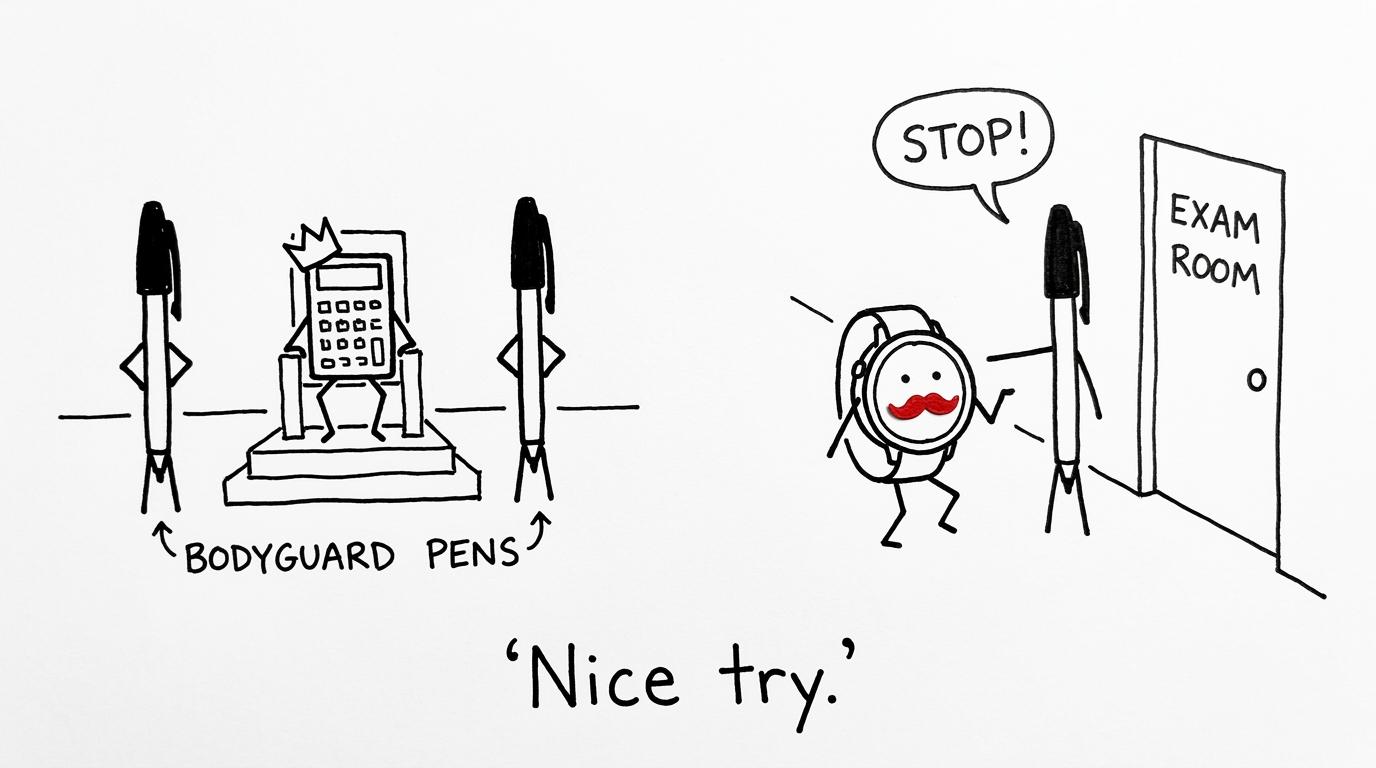 A calculator protected by two black pens while a disguised smartwatch is stopped at the exam-room door
A familiar calculator also reduces avoidable input errors. Engineering calculations may involve quantities such as area, volume and density, including relationships such as
density=massvolume.\text{density}=\frac{\text{mass}}{\text{volume}}.density=volumemass.Your kit cannot replace understanding, but it should never obstruct it. Use MathsGenie GCSE maths revision to practise calculator work, formula use and measurement skills before the final evening. If rearranging engineering formulae feels uncertain, review changing the subject of a formula.
What must stay outside the exam room
A good kit is partly defined by what it leaves behind.
Under current JCQ rules, unauthorised materials include notes, mobile phones, watches, earbuds, smart glasses and other smart devices. This applies even when a device is switched off. Ideally, leave these items somewhere secure outside the exam room, following your school’s procedure.
Do not take in:
- Revision cards or handwritten formula sheets
- Loose paper for rough work
- A calculator instruction booklet
- A calculator cover printed with instructions or formulae
- A watch of any kind, including an analogue watch
- Earphones or earbuds
- A phone, tablet or smart device
- An opaque pencil case
Rough work should be completed on the official exam paper or stationery provided, not on paper brought from home. Cross through rough work you do not want marked, but do not obscure potentially useful working.
If you accidentally bring an unauthorised item into the room, tell an invigilator immediately. Trying to hide a mistake can turn a manageable problem into a serious one.
A calm night-before routine
Packing takes only a few minutes when you use a fixed order.
Check the exam details
Confirm the date, start time, room, subject, paper and any school arrival instructions. Know whom to contact if illness, transport problems or another emergency might make you late.
Test each item
Write a short line with every pen. Sharpen the pencils. Read a measurement from the ruler. Switch on the calculator and check its settings. Then remove any prohibited calculator cover.
Put everything together
Place the permitted stationery in a clear pencil case. Put the kit beside your bag or wherever you will see it before leaving. Prepare permitted water separately.
Stop revising at a sensible point
The final evening is better used for calm recall than a frantic attempt to relearn an entire specification. If you want one short, structured session, review units, formula rearrangement and calculator inputs, then stop.
MathsGenie’s GCSE maths night-before plan can help you choose a manageable final session. Longer-term preparation is better organised through a GCSE maths revision timetable, rather than left until your pencil case is already packed.
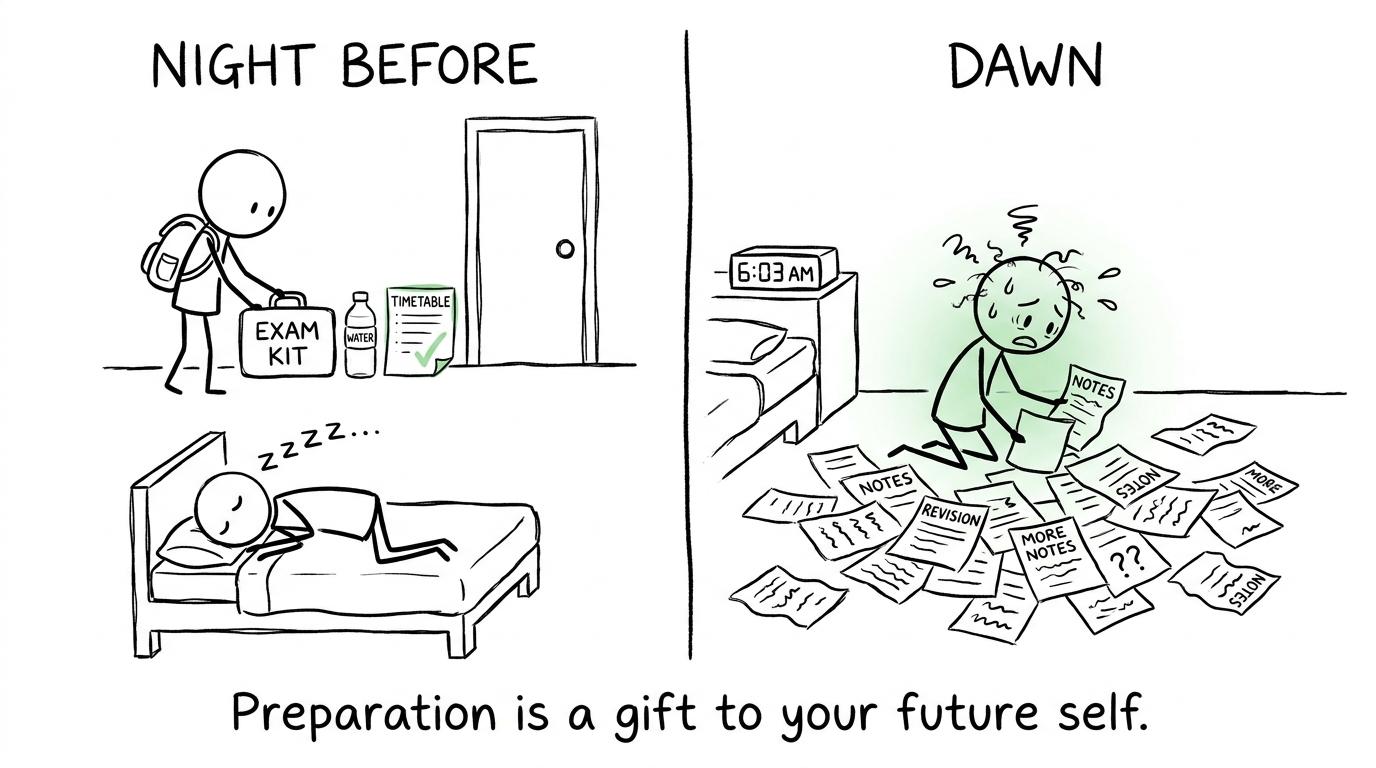 One student sleeps after preparing their kit while another searches through revision notes at dawn
Use your kit during realistic practice
Equipment becomes helpful when it becomes familiar. During timed practice, use the same calculator, ruler and pens that you intend to take into the exam. Keep your phone away and work only on permitted paper.
This reveals practical problems early: a calculator mode you do not understand, a ruler with faded markings or a pen that becomes uncomfortable during extended writing.
For the mathematical skills within engineering, use GCSE predicted papers alongside topic questions and mini tests. Predicted papers provide fresh practice, but they should supplement rather than replace official past papers. MathsGenie’s guide to starting GCSE past-paper practice explains how to move from short sections to full timed papers.
Remember that GCSE maths papers have their own board, tier and calculator rules. Edexcel, AQA, OCR and Eduqas papers may require equipment that differs from an engineering paper. Always reproduce the conditions of the exact assessment you are preparing for.
Common GCSE engineering kit mistakes
Packing only one pen
Pens fail at inconvenient moments. Bring at least two tested black pens rather than relying on an unfamiliar spare supplied at the last minute.
Assuming every calculator is permitted
A powerful calculator is not automatically an acceptable calculator. Check JCQ compliance, clear stored information and remove prohibited covers or instructions.
Bringing an ordinary pencil case
Any pencil case entering the exam room must be transparent. Pack a clear case in advance rather than carrying loose equipment after being stopped at the door.
Taking a watch into the room
Current JCQ rules prohibit all watches, not only smartwatches. Leave yours outside according to your school’s arrangements.
Copying a GCSE maths equipment list
Engineering and maths overlap, but they are separate assessments. A higher or foundation tier maths checklist does not automatically apply to GCSE Engineering. Use the instructions for your exact paper.
Treating packing as revision
Organising stationery feels productive because it is easy to complete. It does not replace learning. Finish the practical task, then use MathsGenie revision lessons, practice questions, mark schemes and video solutions to strengthen the methods that earn marks.
Pack once, then focus on the paper
The purpose of a GCSE engineering exam day kit is not to remove every uncertainty from the exam. It is to remove the avoidable ones.
Pack two black pens, drawing pencils, an eraser, sharpener, ruler and permitted calculator in a transparent pencil case. Add only the drawing equipment authorised for your paper. Test everything, check your timetable and leave watches, phones, notes and other prohibited items outside.
Then let the kit become boring. That is its job.
For the preparation that matters on the page, make MathsGenie your free revision base. Use focused revision lessons and practice questions to repair weak skills, mini tests to build recall, and past papers or predicted papers to practise under pressure. Mark your work with the mark schemes, use video solutions when a method is unclear, and arrive with both your equipment and your thinking ready.