

GCSE Economics Resit Entry: Late and Missed Exams
GCSE economics resit entry explained: learn when you can retake, how late fees work, what private candidates need and what to do after a missed exam.
Missing an exam creates a particular kind of panic. The revision may be done, the notes may be ready, yet one practical question suddenly matters more than everything else: when can you actually sit the paper?
The short answer is that a GCSE economics resit entry must be made through an approved exam centre. For the current OCR GCSE Economics qualification, the examination is normally available only in the May/June series, so missing the summer sitting usually means waiting until the following summer. A late entry may still be possible before the examination, but it depends on the awarding body's deadlines, the centre's capacity and payment of additional fees.
A late entry and a resit are not the same thing. Understanding that distinction is the first step towards making a calm plan.
GCSE economics resit entry checklist
If you need to retake Economics or think your original entry was missed, do these things first:
- Confirm whether you are taking GCSE Economics or International GCSE Economics.
- Check the awarding organisation and exact specification code.
- Contact your school's exams officer immediately if you are still enrolled.
- If necessary, find an approved centre that accepts private candidates.
- Ask whether the centre accepts your exact qualification and entry code.
- Request a complete price, including centre administration and late fees.
- Discuss access arrangements when you first contact the centre.
- Obtain written confirmation and check your statement of entry.
- Confirm the dates of every required paper.
- Build revision around the next available examination series.
The administrative work is not exciting, but it protects everything that follows. Revision only becomes useful once there is a confirmed place in an examination room.
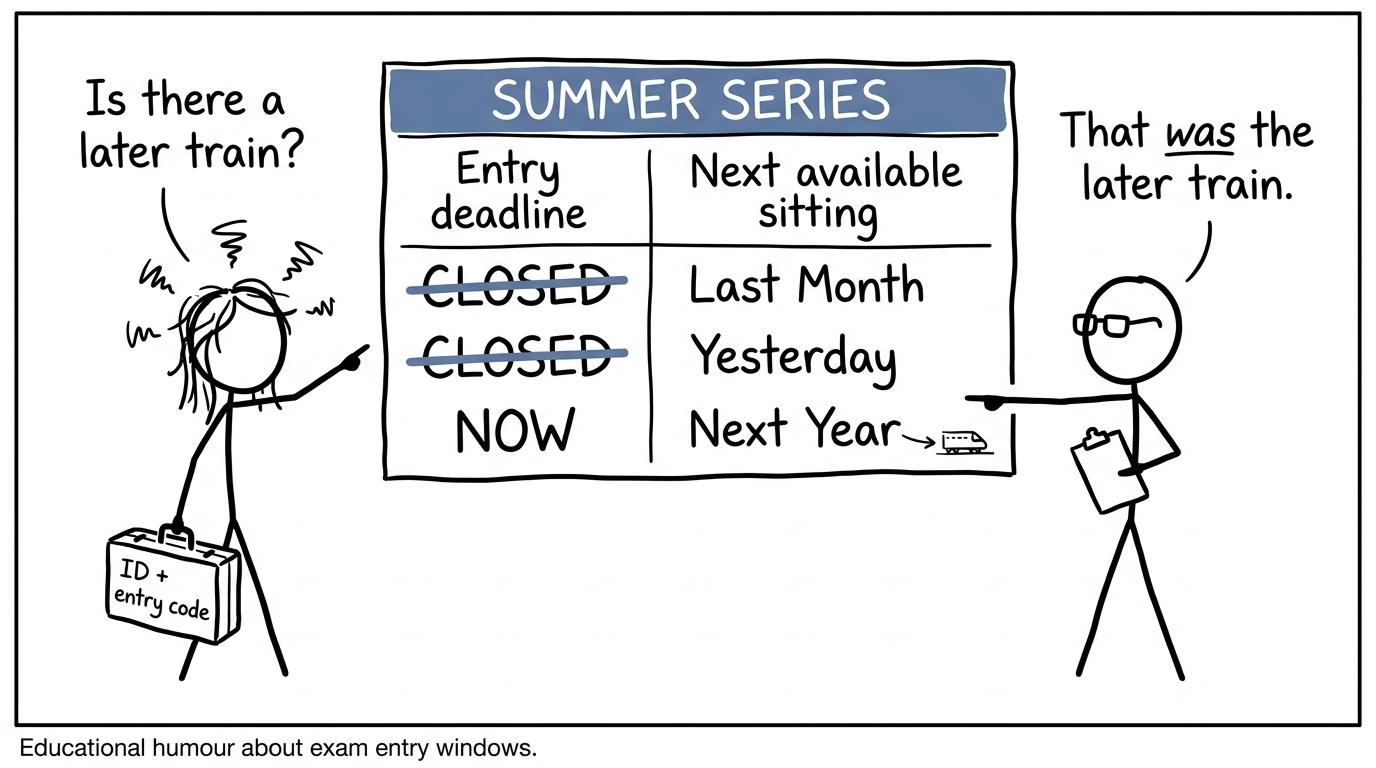 A student looking for the next exam-series train
What is the difference between a late entry and a resit?
A late entry is an entry submitted after the awarding organisation's standard deadline for a particular examination series. You are still trying to sit the approaching examination, but the centre may have to pay an additional charge and complete extra administration.
A resit, or retake, means taking the qualification again after a previous attempt or missed assessment opportunity. The new entry might be submitted on time or late. The word “resit” does not create a special examination window by itself.
This matters because students sometimes miss an entry deadline and assume they can simply take Economics in November. That is not normally how the current OCR GCSE Economics qualification works. OCR's specification states that it has one examination series each year, in May/June. It also states that candidates retaking the qualification must take all its components in the same series.
By contrast, Pearson Edexcel International GCSE Economics is a different qualification and has June and November availability. Do not book an International GCSE merely because its timetable is more convenient without first checking that it is the qualification you need and that your school, college or future provider will accept it.
What happens if you missed the usual GCSE Economics sitting?
Your next action depends on what “missed” means.
Your school forgot or failed to complete the entry
Contact the exams officer immediately and ask for written clarification. If the examination has not yet taken place, the school may be able to submit a late or very late entry, subject to the awarding body's rules and practical arrangements.
Late entry does not guarantee acceptance. The centre must still be able to obtain the correct papers, provide a suitable room, arrange invigilation and meet any access requirements. Its own deadline may therefore be earlier than the awarding organisation's published deadline.
You missed the exam because of illness or an emergency
Tell the exams officer as soon as possible. In some circumstances, the centre can apply for special consideration where a fully prepared candidate was absent for an acceptable reason beyond their control.
This is not automatic. Under current JCQ rules, special consideration for an acceptable absence normally requires the candidate to have completed at least one whole component worth at least the required minimum proportion of the qualification. The centre must support the application, and the awarding organisation makes the decision.
Misreading the timetable, arriving at the wrong place or choosing not to attend would not normally qualify. Never assume that a grade will be calculated for a missed paper. Ask the exams officer directly.
You missed the whole examination series
If no assessment was completed and the series has ended, a retrospective late entry is not possible. You will usually need to enter for the next available series.
For OCR GCSE Economics J205, that generally means the following May/June because there is no ordinary November Economics sitting. The qualification has two mandatory papers, and both must be taken in the same series.
You received a grade and want to improve it
You can enter again, but GCSE Economics is linear. For OCR J205, retaking means sitting both written components again rather than keeping the stronger paper and repeating only the weaker one.
That can feel frustrating, but it also gives you a clean attempt. You can use the previous result to identify whether the main weakness was knowledge, application, quantitative skills, evaluation or timing.
How late-entry windows actually work
Awarding organisations publish an entry deadline for each examination series. Entries received afterwards may attract a late fee, followed later by a higher or very late fee.
The important detail is that students do not usually submit entries directly to the awarding organisation. A school, college or private exam centre makes the entry. That centre may set an earlier internal deadline so it has time to verify identification, collect payment, check entry codes and organise access arrangements.
For the June 2026 GCSE series, major awarding organisations generally moved into late-fee charging after their February entry deadlines, with higher charges applying later in the spring. Future dates can change, so use this only to understand the pattern, not as a deadline for a new booking.
For your actual entry, ask the centre:
- What is your standard-entry deadline?
- When do your late and very late fees begin?
- What is the final date on which you will accept this qualification?
- Is the quoted amount refundable if I withdraw?
- Does the price include every required paper and centre charge?
A published awarding-body deadline is not a promise that every centre will accept candidates until that day. Capacity, staffing and paper-ordering arrangements can produce earlier local cut-offs.
How to enter as a private candidate
A private candidate sits an examination at an approved centre without being enrolled there as a full-time student. The JCQ private-candidate service can help students locate possible centres, but each centre chooses which qualifications and candidates it will accept.
When you contact a centre, be precise. Give them:
- your full name and date of birth;
- the qualification title;
- the awarding organisation;
- the specification and entry code;
- details of any previous attempt;
- your Unique Candidate Identifier, if you have one;
- your access-arrangement requirements;
- confirmation that you need every required component.
For OCR GCSE Economics, the specification code is J205, with Introduction to Economics and National and International Economics as its two mandatory components. Check the current specification and entry documentation rather than relying on an old certificate or an online forum.
Once the booking is processed, request a statement of entry. Check the spelling of your legal name, date of birth, subject, specification code and paper details. Administrative mistakes are usually easier to correct early.
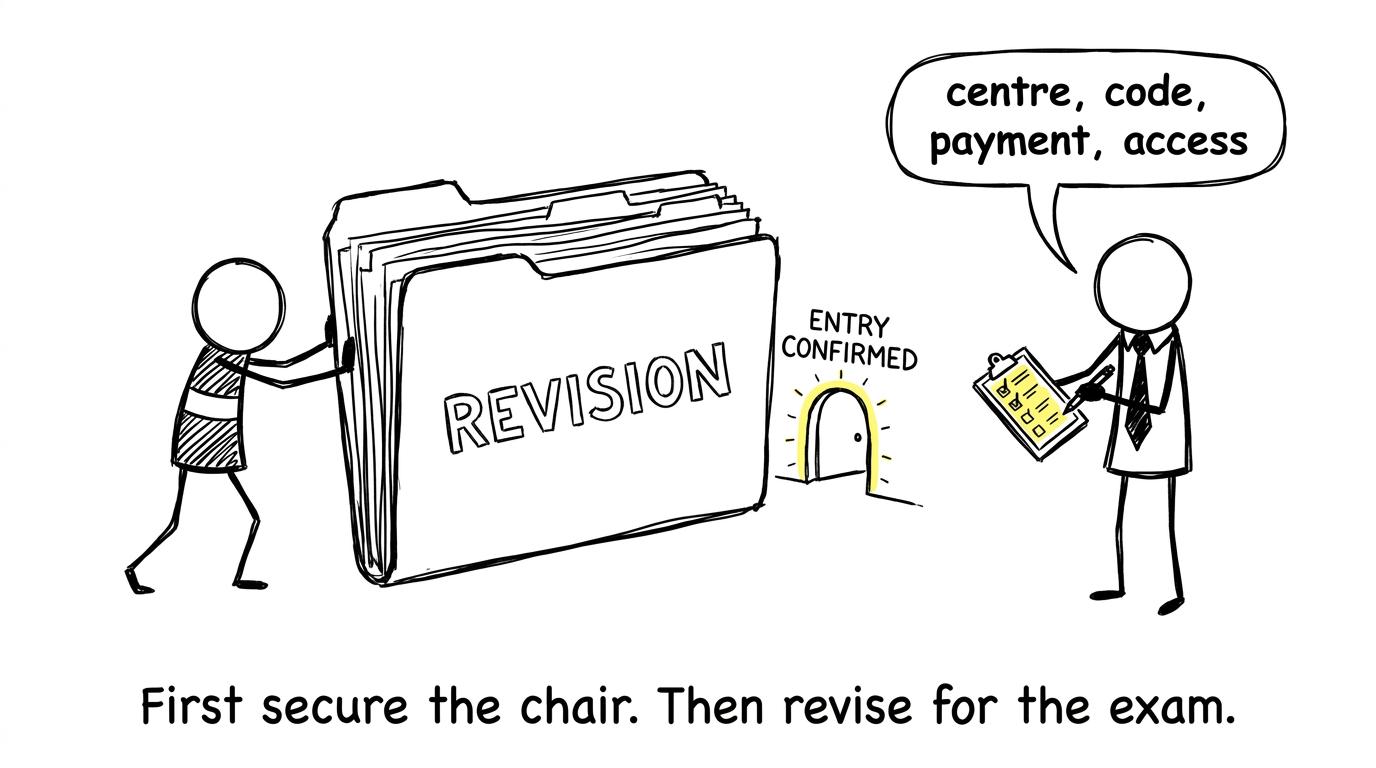 A student learning that entry confirmation comes before revision
Fees, access arrangements and practical details
There is no single national price for a private GCSE Economics entry. Your total may include the awarding organisation's entry fee, centre administration, invigilation, room hire and late-entry charges. A centre can therefore charge more than the awarding body's basic fee.
Ask for the total in writing before paying. Also check the withdrawal and refund policy because late fees are commonly non-refundable.
If you need extra time, a reader, a word processor, modified papers or another reasonable adjustment, mention it during your first enquiry. The centre normally needs evidence and must complete the appropriate process before the published deadline. A very late entry can become impractical if there is insufficient time to approve or arrange the support you need.
Do not assume that arrangements from a previous school transfer automatically. Ask what evidence the new centre requires and whether its SENCo or exams team must conduct an assessment.
Plan revision while the entry is being resolved
Administration and revision should run alongside each other. Waiting for an email reply does not have to mean losing a week.
GCSE Economics includes quantitative skills, so regular maths practice remains valuable. Percentages, ratios, averages, interpreting graphs and using data accurately all support economic analysis. Start with the free GCSE Maths Revision hub and choose the exam board and tier relevant to your maths qualification.
If OCR is your maths board, the OCR GCSE Maths revision resources provide lessons, questions, worksheets and past papers. This is separate from OCR Economics, but the numerical fluency transfers well.
A sensible resit routine is simple:
- revisit one weak area;
- answer relevant practice questions;
- mark the work carefully;
- record the exact reason for each lost mark;
- return to the same skill later in the week.
The GCSE catch-up revision guide explains how to turn missed content into a manageable priority list. If the next sitting is several months away, use the structure in the GCSE one-month revision plan as a repeatable cycle rather than trying to revise everything at once.
As the examination approaches, increase timed practice. The guide to when to start GCSE past papers shows how to move from short diagnostic tasks to complete papers. For maths, MathsGenie's GCSE predicted papers and video solutions can help you practise unfamiliar questions without treating predictions as guarantees.
Common mistakes with GCSE Economics resit entries
Assuming every GCSE has a November resit
November availability is limited. OCR GCSE Economics is normally assessed in May/June, unlike GCSE English Language and Maths, which have established November opportunities for eligible candidates.
Confusing GCSE with International GCSE
Pearson Edexcel International GCSE Economics has different availability and a different specification. Confirm the exact qualification before paying.
Contacting centres without an entry code
“Economics GCSE” may not be enough. Give the centre the awarding organisation and specification code so it can check availability accurately.
Waiting for the official deadline
Centres often close entries earlier than awarding organisations. Contact them as soon as you know you need a place.
Forgetting that all papers must be retaken
OCR GCSE Economics is linear. A resit requires both mandatory components in the same examination series.
Leaving access arrangements until later
Late disclosure can leave too little time for evidence, approval or modified-paper orders. Discuss your needs at the first contact.
Revising before confirming the booking
Revision is essential, but confirmation is the foundation. Obtain a statement of entry and verify every detail.
Turn the delay into a better attempt
A missed sitting can feel like time has stopped. It has not. The calendar has changed, and your plan must change with it.
Confirm the qualification, contact an approved centre, ask for the full cost and secure written proof of entry. Then use the extra preparation time deliberately. Build quantitative confidence through MathsGenie's free revision lessons and practice questions, test yourself with mini tests, and develop exam stamina using past papers, predicted papers, mark schemes and video solutions.
Start at the MathsGenie GCSE Maths revision hub, add each confirmed exam date to your revision planner and make every week produce something measurable. An entry deadline is administrative. Your preparation afterwards is where the marks are made.











