GCSE Economics Key Terminology Mistakes That Cost Marks
GCSE economics key terminology mistakes explained clearly. Learn precise definitions, command words and calculation language to protect valuable exam marks.
A student can understand an economic idea and still lose the mark for describing it with the wrong word. That is what makes GCSE economics key terminology mistakes so frustrating: the problem is often not a lack of knowledge, but a lack of precision.
The quickest solution is to revise terminology in contrasting pairs. Learn why revenue is not profit, why inflation is not simply a high price, and why an increase in demand is different from an increase in quantity demanded. Then practise using each term inside a complete economic chain.
This matters because terminology is part of the reasoning. If the opening concept is inaccurate, everything built upon it can become harder for an examiner to reward.
A quick terminology checklist
Before finishing an economics answer, ask:
- Have I used the precise economic term rather than an everyday substitute?
- Have I distinguished a change in a curve from a movement along it?
- Have I separated revenue, costs and profit?
- Have I described inflation as a change in the general price level?
- Have I kept fiscal policy separate from monetary policy?
- Have I answered the command word: define, explain, analyse or evaluate?
- Have I included units and shown my method in calculations?
- Does every cause-and-effect link make economic sense?
For GCSE Economics, always follow the terminology in your own specification and mark schemes. AQA and OCR offer GCSE Economics, while Pearson Edexcel offers International GCSE Economics. Their wording and question structures are not identical, so avoid assuming that a classroom definition automatically fits every board.
Demand is not quantity demanded
This is one of the most important distinctions in microeconomics.
Demand describes the quantity consumers are willing and able to buy at different prices during a given period. An increase in demand means that the whole demand curve shifts to the right.
Quantity demanded is the amount consumers are willing and able to buy at one particular price. A change in the good's own price usually causes a movement along the existing demand curve, assuming other factors remain unchanged.
Therefore:
- a change in income, tastes, population or the price of a related good may shift demand;
- a change in the product's own price creates a movement along the demand curve.
Writing “demand increases because price falls” can cost marks because it labels a movement along the curve as a shift. The same distinction applies to supply and quantity supplied.
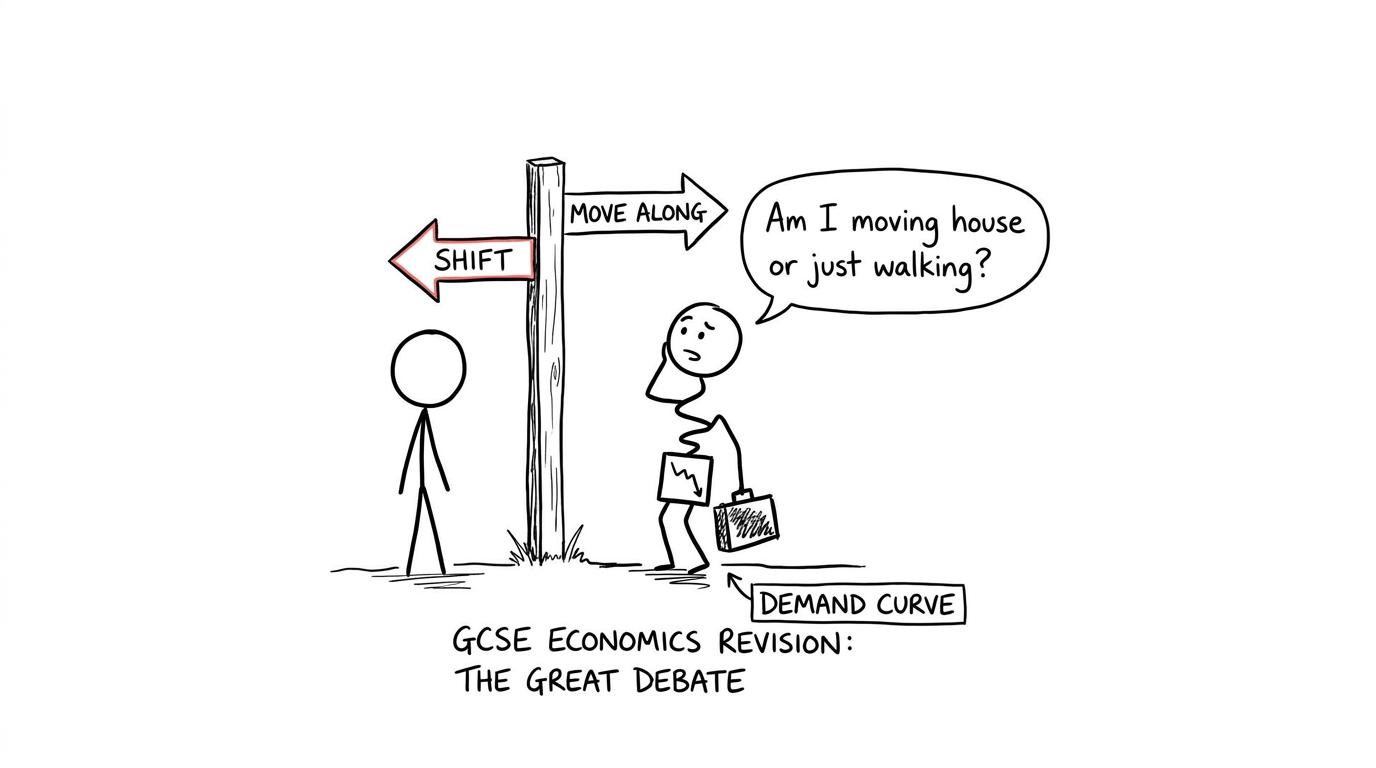 A demand curve wonders whether it is shifting or moving along
Elastic and inelastic demand
Price elasticity of demand measures how responsive quantity demanded is to a change in price:
PED=% change in quantity demanded% change in price\text{PED}=\frac{\%\text{ change in quantity demanded}}{\%\text{ change in price}}PED=% change in price% change in quantity demandedDemand is not “elastic” merely because consumers react. The term describes the size of that response relative to the percentage change in price. Similarly, price inelastic demand does not mean demand never changes; it means quantity demanded changes proportionally less than price.
OCR's Summer 2024 examiner report highlighted confusion between price elastic and price inelastic demand. That is a useful warning: a familiar word still needs its technical meaning.
You can strengthen the calculation behind elasticity using MathsGenie's free percentage change revision and interactive percentage change lesson.
Scarcity is not a temporary shortage
Scarcity is the fundamental economic problem created because resources are limited while wants are unlimited. It exists even in a wealthy economy.
A shortage is more specific: quantity demanded exceeds quantity supplied at the current price. It can be temporary and may apply to one market.
Calling scarcity “when shops run out of something” narrows a broad economic concept into a market shortage. That can prevent an answer from demonstrating secure knowledge.
Scarcity also creates choice, and choice creates opportunity cost. Opportunity cost is the next best alternative forgone when a decision is made. It is not simply the money spent, nor is it every possible alternative. The phrase “next best” is essential.
Revenue, profit and costs must remain separate
OCR's 2024 report explicitly noted confusion between revenue and profit. These terms describe different parts of a firm's finances:
Total revenue=price×quantity sold\text{Total revenue}=\text{price}\times\text{quantity sold}Total revenue=price×quantity sold Profit=total revenue−total costs\text{Profit}=\text{total revenue}-\text{total costs}Profit=total revenue−total costsA firm can earn more revenue without earning more profit. If its costs rise by a greater amount, profit can fall. Consequently, writing that higher sales revenue “means the firm is more profitable” skips an important step.
Fixed costs do not change directly with output in the relevant period. Variable costs change as output changes. Total costs combine both:
Total costs=fixed costs+variable costs\text{Total costs}=\text{fixed costs}+\text{variable costs}Total costs=fixed costs+variable costsStudents should also distinguish average cost from total cost:
Average cost=total costoutput\text{Average cost}=\frac{\text{total cost}}{\text{output}}Average cost=outputtotal costEconomies of scale reduce average cost as the scale of production increases. They do not mean that every cost falls or that becoming larger automatically guarantees greater profit.
 A student discovers that revenue and profit are different tools
Production and productivity
Production is the creation of goods and services. Productivity measures output relative to an input:
Productivity=outputinput\text{Productivity}=\frac{\text{output}}{\text{input}}Productivity=inputoutputLabour productivity might be measured as output per worker or per hour worked. Production can rise because a firm employs more workers even if productivity stays unchanged. Conversely, productivity can rise without total production rising if the firm uses fewer inputs.
That distinction protects the logic of answers about wages, competitiveness, costs and economic growth.
Inflation is not the price of one product rising
Inflation is a sustained increase in the general price level over time. It does not mean that every price rises by the same percentage, and it is not established by one product becoming more expensive.
A country can also experience falling inflation while prices continue to rise. This means the general price level is increasing more slowly. A fall in the general price level is deflation, which is different from a fall in the inflation rate.
Students sometimes use inflation, cost of living and living standards as though they mean the same thing:
- inflation concerns the rate of change in the general price level;
- the cost of living concerns the cost of maintaining a particular standard of consumption;
- standard of living concerns material wellbeing and access to goods and services.
Precise language matters because each term leads to a different analysis.
Economic growth is not automatically development
Economic growth is an increase in real gross domestic product. Real GDP adjusts for changes in the price level, making it more useful for comparing output over time than nominal GDP.
GDP concerns production within an economy over a period. It is not the same as personal wealth, government revenue or the money held by a country.
Growth may improve living standards, but the two terms are not interchangeable. The effect depends on factors such as population growth, income distribution, working conditions and environmental costs. Economic development is broader still, incorporating changes in wellbeing and quality of life as well as income.
These distinctions become particularly important in analyse and evaluate questions. An unsupported statement that “GDP rises, so everyone becomes better off” overlooks distribution and does not establish a justified conclusion.
Fiscal policy is not monetary policy
Both can influence demand in an economy, but they use different instruments.
Fiscal policy involves government taxation and spending. Monetary policy involves measures such as interest rates and, depending on the specification, other tools affecting monetary conditions.
Mixing these terms can break an entire chain of reasoning. A statement beginning with “the government uses fiscal policy by changing interest rates” assigns the wrong instrument to the policy.
Students should also separate a budget deficit from government debt. A budget deficit occurs when government spending exceeds government revenue over a period. Government debt is the accumulated amount owed. The deficit is a flow; debt is a stock.
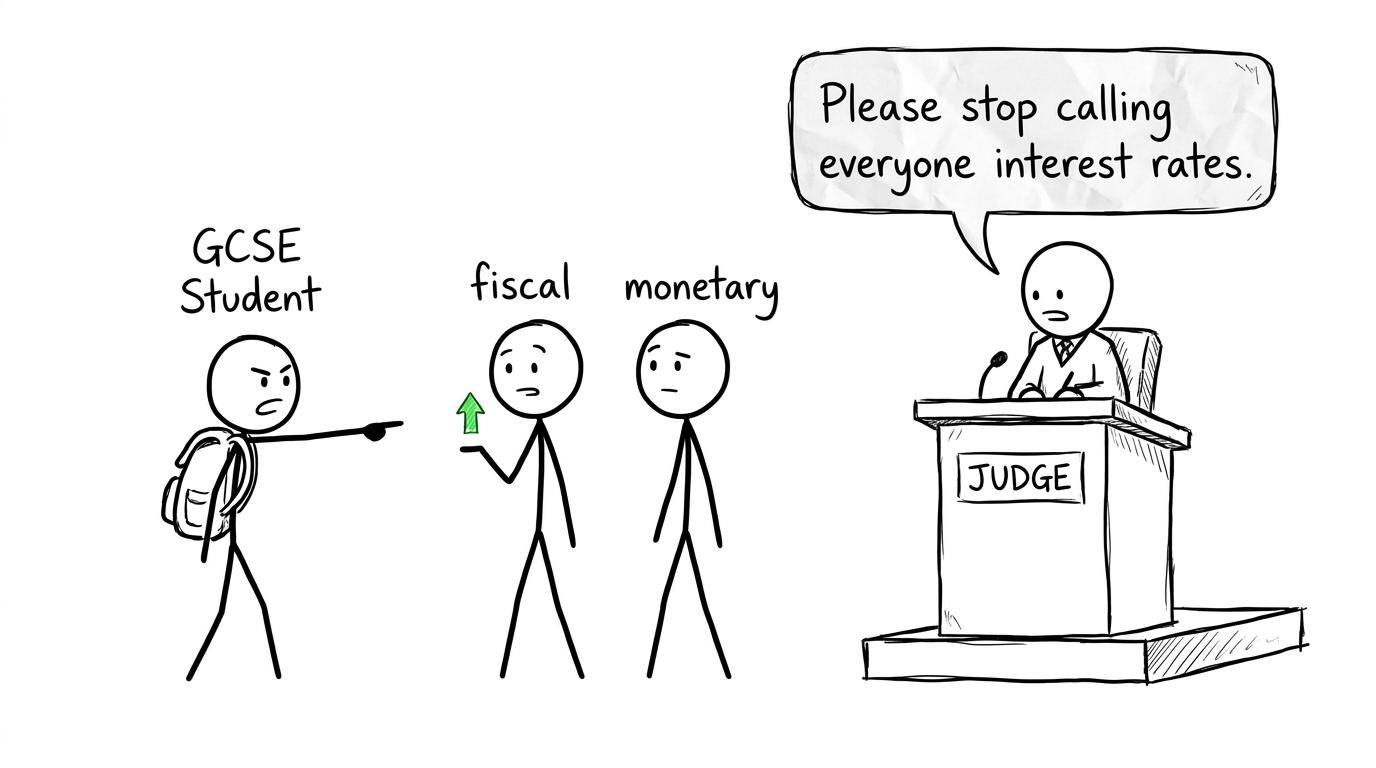 Fiscal and monetary policy appear as very different witnesses
Command words are economic terminology too
Official AQA guidance explains that command words tell students what kind of response is required. OCR similarly distinguishes explanation, analysis and evaluation in its specification.
| Command word | What your answer needs | Terminology mistake to avoid |
|---|---|---|
| Define | A precise meaning | Repeating the word without explaining it |
| Describe | Relevant characteristics or what is happening | Explaining causes instead of describing the feature |
| Explain | A reason or process showing how or why | Giving an unsupported statement |
| Analyse | A developed, logical chain of reasoning | Listing separate effects without connecting them |
| Evaluate | Analysis, consideration of alternatives and a supported judgement | Writing two sides but reaching no conclusion |
| Calculate | A mathematical result with appropriate working | Giving an unexplained number or omitting units |
“Analyse” does not simply mean “write more”. It requires connected reasoning. “Evaluate” does not mean adding a memorised disadvantage at the end. It requires a judgement grounded in the evidence or context supplied.
Mathematical language that protects economics marks
Economics papers can include percentages, averages, ratios, index numbers, graphs and changes over time. The terminology surrounding the calculation matters as much as pressing the right calculator buttons.
Percentage change should be calculated from the original value:
Percentage change=new value−original valueoriginal value×100%\text{Percentage change}=\frac{\text{new value}-\text{original value}}{\text{original value}}\times 100\%Percentage change=original valuenew value−original value×100%A percentage-point change is different from a percentage change. Units also need attention: pounds, percentages, years, workers and quantities are not interchangeable.
MathsGenie's GCSE Statistics revision resources can help with averages, charts and interpreting data. For repeated changes over time, use the repeated percentage change revision guide.
Common GCSE economics terminology mistakes
The highest-risk mistakes tend to have a common feature: the words sound similar in ordinary conversation but perform different jobs in economics.
Watch particularly for:
- saying entrepreneur when you mean enterprise;
- treating capital as money in every context rather than recognising capital goods as a factor of production;
- calling every large business a monopoly;
- confusing a substitute with a complement;
- describing a tariff as a quantity limit rather than a tax on imports;
- confusing an import quota, which restricts quantity, with a tariff;
- using external cost to mean any private cost faced by a firm;
- claiming that equilibrium means a market is fair or socially desirable;
- confusing the exchange rate with the rate of inflation;
- using “increase” without stating what increased and over which period.
A useful correction routine is to create three columns: the term used, the precise definition, and the term it was confused with. This turns vague revision into a visible error log.
The same principle works in maths. MathsGenie's guide to finding your weakest GCSE topics explains how to turn individual errors into topic labels and then re-test them.
Revise terminology as an active skill
Reading a glossary can create recognition without recall. Instead, cover the definition, say it aloud, and then write one sentence using the term accurately. Contrast it immediately with the term most likely to be confused with it.
Next, inspect mark schemes and examiner reports from your own exam board. Look for the language credited and note where inaccurate terminology interrupts a chain of analysis. A timed paper can then reveal whether the definitions remain accessible under pressure.
This is the same learn, practise, mark and repair cycle that makes maths revision effective. Use MathsGenie's past-paper revision tools for your maths preparation, alongside revision lessons, practice questions, mark schemes, video solutions, mini tests and predicted papers. The best order for learning GCSE maths topics can help you organise the quantitative skills that support economics data questions.
Make every word earn its place
Economic terminology is not decoration added to an answer after the thinking is finished. It is the structure of the thinking itself. Demand, quantity demanded, revenue, profit, inflation and economic growth each point to a precise idea. Use the wrong term and the examiner may see a different argument from the one you intended.
Start with the pairs you confuse most. Define them, contrast them, then practise retrieving them under timed conditions. For the mathematical side of your GCSE preparation, make MathsGenie your next step: rebuild methods with free revision lessons, practise with topic questions, check mark schemes and video solutions, and test your progress through mini tests, past papers and predicted papers.